Atlassian Cloud Pricing: A Practical Planning Guide for 2026
How can you forecast Atlassian Cloud pricing? Plan users, products, billing, add-ons, and growth with confidence. Click to build your 2026 budget.
Planning Atlassian Cloud can feel simple until you add users, multiple products, annual billing, support, security controls, and growth. A plan that looks affordable for 20 people may become expensive when 200 teammates need access.
The difficulty grows when Jira, Confluence, Jira Service Management, Marketplace apps, and premium controls appear on the same invoice. Small assumptions can create a large budget gap by renewal time.
But here's the truth: you can estimate Atlassian Cloud pricing reliably by separating product licenses, user tiers, billing terms, add-ons, and future growth. This guide shows you how to build that estimate for 2026 without relying on a single headline price.
How to Plan Atlassian Cloud Pricing for 2026
Atlassian Cloud pricing is the recurring cost of using Atlassian’s hosted products, usually calculated by product, plan level, user or agent count, billing term, and optional services.
For planning purposes, treat your expected bill as five separate layers:
- Core product subscriptions, such as Jira, Confluence, or Jira Service Management.
- The plan tier, commonly Free, Standard, Premium, or Enterprise.
- The number of billable users, agents, or service participants.
- Optional security, administration, Marketplace, and support costs.
- Growth, currency, tax, and pricing-change allowances.
Here's why: a product’s advertised entry price rarely represents the cost of a complete company rollout. You need a usage model that reflects who needs access and what each team actually does.
Step 1: List the Atlassian products you need
Start with a product map rather than a single subscription figure. A software team may need Jira for planning, Confluence for team knowledge, and Jira Service Management for internal support.
A simple planning list might look like this:
| Product area |
Typical audience |
Important billing question |
| Jira |
Engineering, product, design, and operations teams |
How many people need to create, edit, and manage work? |
| Confluence |
Employees, contractors, and approved collaborators |
Who needs regular access to pages and team knowledge? |
| Jira Service Management |
Service agents, administrators, and request participants |
How many people actively resolve requests as agents? |
| Atlassian Guard |
Organizations needing stronger identity and administration |
Which accounts require advanced security controls? |
| Marketplace apps |
Teams requiring specialized functions |
Is the app priced by users, sites, or another tier? |
Do not count every employee automatically. For example, 120 employees may include 35 Jira users, 90 Confluence users, and 8 Jira Service Management agents.
Step 2: Count each license type correctly
Jira and Confluence generally depend on the number of users assigned access. Jira Service Management uses a different planning concept because agents handle requests, while many other people may submit them.
That distinction matters. A company with 10 support agents and 2,000 employees could have a very different service-management bill from a company with 100 agents.
Separate these groups before estimating:
- Full users who create, edit, or manage work regularly.
- Occasional users who need access for reviews or approvals.
- Customers or request participants who interact with service portals.
- Administrators who require configuration access.
- External collaborators who may need controlled access.
Here's a practical example: if 50 engineers use Jira, 75 employees read Confluence, and 6 people resolve service tickets, model those populations separately.
Step 3: Compare plan tiers by business need
Atlassian’s main cloud plans typically progress from Free to Standard, Premium, and Enterprise. The right tier depends on scale, administration, uptime expectations, automation needs, and governance.
| Plan level |
Usually suits |
Planning questions |
| Free |
Small teams testing basic workflows |
Will the seat limit, feature limits, and support level remain practical? |
| Standard |
Growing teams with regular production use |
Do you need broader collaboration, permissions, and administrative controls? |
| Premium |
Organizations needing advanced scale and resilience |
Will automation, capacity, and continuity features reduce operational risk? |
| Enterprise |
Large or complex organizations |
Do you need centralized governance, advanced security, and commercial terms? |
The cheapest plan may work for a pilot but fail during expansion. Conversely, a premium tier can be wasteful if your team only needs basic issue tracking and knowledge sharing.
Step 4: Calculate monthly and annual scenarios
Build at least three scenarios: current use, expected growth, and maximum likely adoption. This gives you a budget range instead of a fragile single estimate.
Use this structure:
- Product subscription cost.
- Plus Marketplace apps and security services.
- Plus implementation, migration, training, and administration.
- Plus a contingency allowance for growth and price changes.
For example, a team may begin with 40 Jira users and 60 Confluence users. If hiring plans add 25 people over the next year, calculate both the starting tier and the next likely pricing band.
Monthly billing can offer flexibility during a pilot. Annual billing may simplify budgeting, but it can reduce flexibility if your user count changes significantly.
Step 5: Add the costs that rarely appear in the headline figure
A realistic estimate includes more than product licenses. Review every cost that could affect the total ownership budget.
- Marketplace applications for time tracking, testing, reporting, or advanced planning.
- Identity, security, audit, and user-provisioning services.
- Migration support and configuration work.
- Training for administrators, managers, and everyday users.
- Internal administration and workflow maintenance.
- Integration work with chat, source control, customer support, or finance systems.
- Tax, currency conversion, and regional purchasing differences.
The best part? You can often reduce surprises by creating an app register before committing to a plan. Record each app, its billing method, owner, renewal date, and business purpose.
Step 6: Validate the estimate before approval
Check your assumptions against Atlassian’s current pricing pages, official calculators, contract terms, and account-specific quotes before purchase.
Pricing can change with product packaging, user bands, regional currency, promotions, and commercial agreements. A planning model should therefore include a review date.
Ask these questions before approval:
- Does each product have the correct user or agent count?
- Are inactive accounts consuming paid seats?
- Does the selected tier include the controls your security team requires?
- Are annual terms appropriate for expected growth?
- Have Marketplace apps been included?
- What happens when the organization crosses the next user band?
- Who owns renewal and license optimization?
What Changes the Final Cloud Bill?
The largest pricing factor is usually the number of billable people, but it is not the only one. Product mix and plan level can change the total more dramatically than a small difference in seat count.
For instance, adding 20 occasional Confluence readers may have a smaller impact than moving a core Jira environment from Standard to Premium. Adding a service-management app can also affect costs differently from adding another project-management user.
Think of your subscription like a layered utility bill. The base service matters, yet usage patterns, optional services, and capacity thresholds determine the final amount.
User bands and growth thresholds
Cloud products commonly use user bands rather than a simple per-person calculation at every level. Crossing a threshold can change the effective cost for the whole tier.
Suppose your team grows from 95 to 105 Jira users. The extra 10 people may place you in a different pricing band. That is why hiring forecasts should appear in your licensing plan.
Review your expected headcount quarterly. Remove inactive accounts, identify contractors who no longer need access, and compare assigned seats with actual activity.
Billing term and commercial flexibility
Monthly billing works well for pilots, temporary teams, and uncertain headcount. Annual billing can make financial planning easier when your user population is stable.
However, an annual commitment may leave unused capacity after a restructuring or project closure. Compare the value of predictable budgeting with the risk of paying for seats you cannot reassign.
You might be wondering: should you always choose annual billing? No single answer works for every organization. Match the term to hiring confidence, procurement rules, and expected product adoption.
How to Compare Jira, Confluence, and Service Management Costs
Comparing products by sticker price can produce poor decisions because each product serves a different role. Compare the cost against the work each product replaces or improves.
| Need |
Likely product focus |
Useful evaluation measure |
| Track engineering and product work |
Jira |
Active contributors, workflows, reporting, and automation |
| Organize team knowledge |
Confluence |
Regular contributors, readers, permissions, and content governance |
| Manage internal or external requests |
Jira Service Management |
Agents, request volume, service channels, and response targets |
A company may need all three, but not every employee needs the same level of access. Build separate adoption assumptions for engineering, product, HR, IT, finance, and leadership.
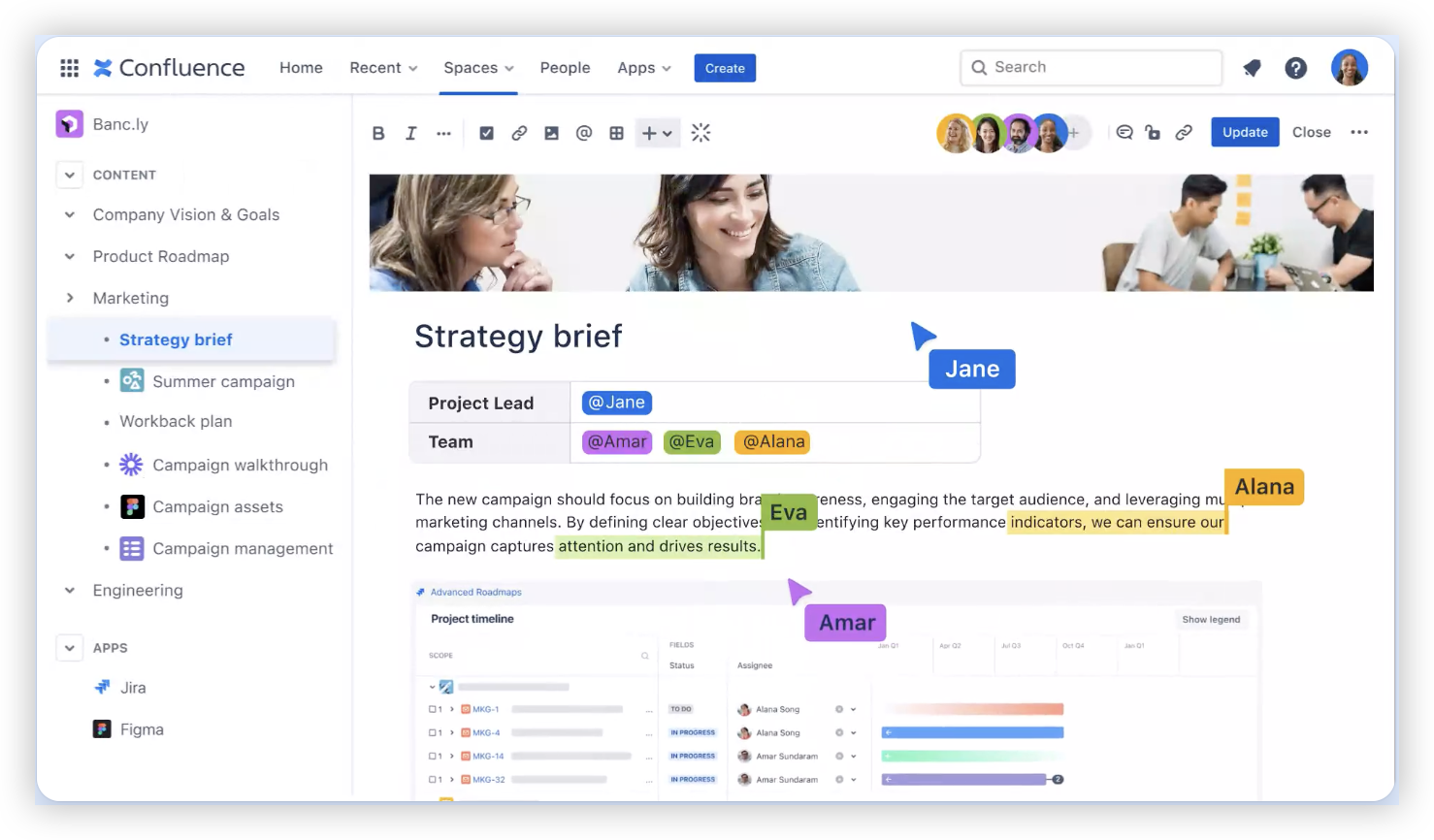
A practical comparison example
Imagine a 150-person company. Forty people actively manage Jira work, 110 regularly read or contribute to Confluence, and 7 IT staff handle service requests.
The cost model should not treat the company as 150 identical seats. It should reflect separate populations, product tiers, and the value created by each service.
Then compare alternatives such as fewer apps, consolidated workflows, or a unified platform. The goal is to measure total operating cost, not simply the cheapest first-year subscription.
Hidden Costs That Can Distort Your Budget
Subscription fees are visible. Operational costs often appear later, especially when teams customize heavily or install many Marketplace apps.
Here's why: every additional integration can create configuration work, maintenance responsibility, permission reviews, and renewal decisions.
Marketplace application overlap
Teams often purchase several apps that solve similar problems. A reporting app, planning app, and automation app may each be useful, yet their combined features can overlap.
Create a capability map before purchasing. If two apps both provide capacity planning, compare adoption, administration, security, and total cost.
Administration and workflow maintenance
Jira workflows can become difficult to manage when every department requests unique statuses, fields, permissions, and automation rules.
Estimate internal administration time. A platform that costs less in licensing can still cost more if it requires constant manual maintenance.
Migration and training
Moving from self-hosted tools or separate collaboration systems requires planning, cleanup, permissions design, and training.
For example, a team may need several weeks to redesign workflows, test integrations, train project leads, and support the first rollout. Include that effort in the first-year budget.
A 2026 Pricing Forecast Framework
Because commercial pricing may change, use a range model rather than treating one quote as permanent. A simple forecast has three cases.
| Scenario |
Assumption |
Budget purpose |
| Lean |
Current users, limited apps, existing administrators |
Minimum practical operating cost |
| Expected |
Planned hiring, likely apps, normal adoption |
Primary annual budget |
| Expansion |
Higher adoption, additional departments, stronger controls |
Renewal and growth planning |
Apply a contingency percentage to the expected case. The allowance should cover growth, currency movement, pricing revisions, and unplanned app requirements.
Keep the model easy to update. Change user counts, plan tiers, or app costs in one place, then review the effect on monthly and annual totals.
Metrics worth reviewing each quarter
- Assigned seats compared with active usage.
- Cost per active contributor.
- Cost per service agent.
- Marketplace app adoption.
- Unused or duplicate capabilities.
- Average time spent administering the environment.
- Projected users at the next renewal.
These measures turn pricing management into an operating habit. You can identify waste before renewal instead of discovering it after the invoice arrives.
Atlassian Cloud Alternative for Unified Project and Knowledge Management: ONES.com
Value Proposition
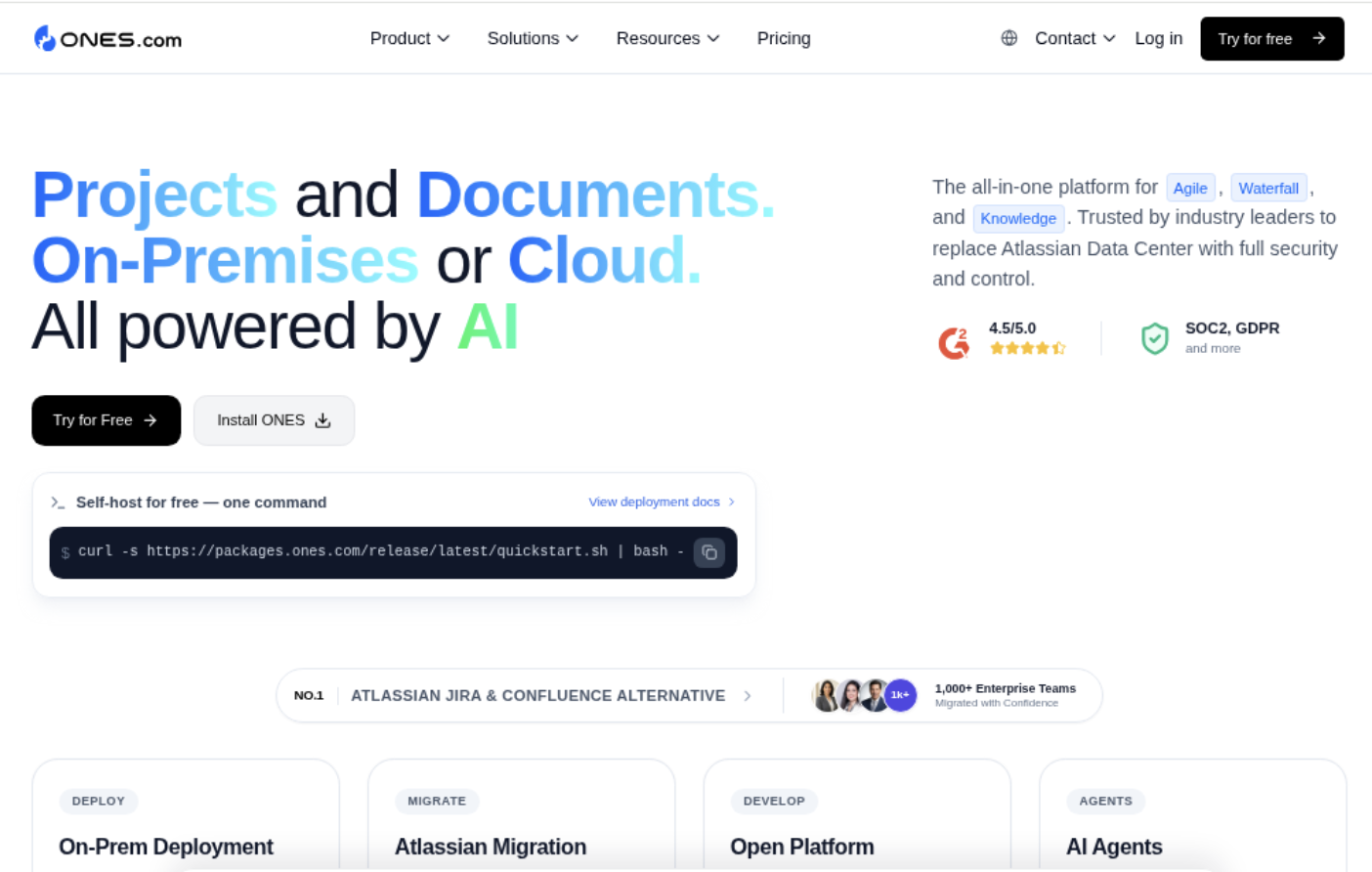
ONES.com combines project management and knowledge management in one platform powered by ONES Assistant. ONES Project is a Jira alternative, while ONES Wiki is a Confluence alternative, and each product can be sold separately.
This approach can help teams compare subscription structure, administration, deployment requirements, and workflow coverage alongside Atlassian Cloud pricing.
Core Capabilities
- Fragmented project and knowledge workflows: ONES.com connects project work with team knowledge in one environment, helping people find context without maintaining separate systems.
- Migration concerns for Jira teams: ONES Project supports Jira-compatible workflows, making it easier to map familiar planning and issue-management practices.
- Limited reporting visibility: Built-in reporting provides project views and progress insights without requiring a large collection of reporting plugins.
- Rigid workflow structures: Custom workflows and custom fields let teams adapt the platform to different departments and delivery methods.
- Manual sprint coordination: Sprint management supports planning, execution, and review across iterative delivery teams.
- Repetitive project administration: Automation reduces routine actions, such as assigning work, updating statuses, or triggering follow-up tasks.
- Plugin sprawl: Native capabilities can reduce the number of separate extensions needed for common project-management requirements.
- Restricted deployment requirements: ONES.com supports Cloud, On-Premise, Private Cloud, and Air-gapped deployments.
- Concerns about self-hosted functionality: The self-hosted version has full feature parity with the cloud version, so deployment choice does not require giving up core capabilities.
- Small-team budget pressure: The free plan supports up to 30 seats, giving smaller teams room to evaluate the platform before a broader rollout.
Application Scenarios
Growing software company: A development team can use ONES Project for backlogs, sprints, custom workflows, and reporting, while product and support teams share relevant knowledge through ONES Wiki.
Regulated organization: A company with strict network controls can evaluate an On-Premise, Private Cloud, or Air-gapped deployment while retaining the same core feature set available in the cloud version.
Project approval environment: A PMO can create custom approval workflows and fields, automate routine handoffs, and use native reporting without assembling several separate plugins.
Common Challenges When Estimating Atlassian Subscriptions
Challenge: Treating every employee as the same license type
Solution: Separate contributors, readers, agents, request participants, contractors, and administrators. Each group may affect product costs differently.
Challenge: Choosing a plan from the first-year price alone
Solution: Compare three-year ownership. Include growth, administration, apps, training, migration, and expected plan changes.
Challenge: Forgetting Marketplace applications
Solution: Maintain an application register with price, owner, renewal date, user band, and replacement options.
Challenge: Missing the impact of user growth
Solution: Add hiring forecasts and department rollouts to the estimate. Review the next pricing band before approving annual terms.
Challenge: Over-customizing workflows
Solution: Establish workflow standards. Require a clear business reason for new fields, statuses, automations, and permissions.
Frequently Asked Questions
Does Atlassian Cloud pricing depend only on the number of users?
No. User count is important, but the total also depends on the product, plan tier, billing term, service-management agent count, Marketplace apps, security services, currency, tax, and commercial terms. Build a separate estimate for each product instead of multiplying one seat price across the entire organization.
Which Atlassian Cloud plan should a growing team choose?
Standard is often a practical starting point for a growing production team, while Premium may suit organizations needing greater scale, continuity, or advanced capabilities. Enterprise is designed for more complex governance and large-scale administration. Test the features you actually need before selecting a higher tier.
Are Jira Service Management customers counted like Jira users?
Planning usually differs because Jira Service Management distinguishes agents from people who submit requests. Count active service agents separately, then review how employees, customers, and external participants interact with the service portal. The correct model depends on your service configuration and current commercial terms.
Should I choose monthly or annual billing?
Monthly billing gives you more flexibility when headcount and adoption are uncertain. Annual billing can make budgets easier to manage when user numbers are stable. Compare the expected savings or predictability with the risk of unused seats after hiring changes, reorganizations, or project closures.
How can I control Atlassian Cloud costs after purchase?
Review active usage quarterly, remove inactive access, consolidate overlapping apps, standardize workflows, and forecast the next user band. Assign an owner for renewals and require each Marketplace app to have a clear business purpose. Cost control works best as a recurring review rather than a one-time cleanup.
Is a unified project and knowledge platform worth comparing?
It can be, especially when teams pay for separate project-management and knowledge-management products, maintain many plugins, or need self-hosted deployment. Compare workflow coverage, migration effort, administration, security requirements, deployment options, and three-year ownership rather than comparing subscription prices alone.
Conclusion
Planning Atlassian Cloud for 2026 requires more than checking a per-user price. Separate products, count each license type, compare plan tiers, include apps and administration, and model realistic growth.
But here's the truth: the biggest budget mistakes usually come from incomplete assumptions. A clear forecast with lean, expected, and expansion scenarios gives you a stronger basis for procurement and renewal decisions.
If your teams want project management and knowledge management with fewer moving parts, compare Atlassian Cloud with alternatives such as ONES.com. The right choice should fit your workflows, deployment needs, governance model, and long-term operating budget.