Atlassian Intelligence Pricing Tiers for Jira Cloud: A Guide
Confused by atlassian intelligence pricing tiers jira cloud? Compare plans, AI features, limits, and costs to budget confidently. Read now.
Jira Cloud pricing can feel confusing when you add Atlassian Intelligence to the mix. You may see Free, Standard, Premium, and Enterprise tiers, then wonder whether AI creates another charge. That uncertainty makes budgeting harder, especially when your team wants summaries, automation, search, and planning help without unexpected bills.
The confusion grows because AI availability can vary by feature, plan, region, rollout stage, and user permissions. A plan that looks affordable may also have limits that affect your team’s everyday work. But here's the truth: Atlassian Intelligence pricing usually follows your Jira Cloud subscription rather than appearing as a simple, standalone AI tier.
This guide explains how the tiers work, what to check before upgrading, and how ONES.com compares for teams evaluating AI-supported project management.
How Atlassian Intelligence Pricing Tiers Work in Jira Cloud
Atlassian Intelligence pricing tiers for Jira Cloud generally depend on your Jira Cloud plan, eligible AI features, user count, and any separate Atlassian products you activate. AI is commonly bundled into eligible paid subscriptions rather than purchased as one universal add-on.
Atlassian’s packaging can change as features move through development and become generally available. You should therefore confirm the current plan page and administration billing screen before approving a purchase.
1. Identify your Jira Cloud plan
Start with the Jira Cloud tier your team already uses. The main tiers are Free, Standard, Premium, and Enterprise, although availability and naming can differ across Atlassian products.
- Free: Suitable for small teams testing Jira and selected capabilities, with tighter limits on users, storage, administration, and advanced controls.
- Standard: Designed for established teams that need broader collaboration, permissions, support, and day-to-day project management.
- Premium: Adds higher scale, advanced planning, stronger administration, and capabilities intended for complex or growing organizations.
- Enterprise: Built for organizations managing multiple teams, sites, governance requirements, and larger operational environments.
The key question is not simply, “Which tier includes AI?” Ask instead, “Which AI features can my team use on this tier, and what limits apply?”
2. Check whether the feature is Atlassian Intelligence or another AI service
Atlassian uses several AI-related capabilities across its product family. Atlassian Intelligence may support tasks such as summarizing work, improving text, generating ideas, and answering questions about project activity.
Other capabilities may connect with Rovo, automation, search, or marketplace applications. Those services can have different eligibility rules or consumption limits.
For example, a team might use an AI summary inside Jira, while a separate search or agent capability belongs to another Atlassian offering. Treating every AI feature as one product can lead to inaccurate budget estimates.
3. Review the user and site requirements
Pricing usually depends on more than the plan label. Your estimate can change with user count, billing frequency, site structure, product combinations, and the number of people who need access.
A 10-person team and a 300-person organization may use the same Jira Cloud tier, yet pay very different subscription amounts. Enterprise arrangements may also use negotiated pricing instead of a simple public rate.
Check whether AI access applies to every licensed person, selected roles, or only people working in specific products. Administration settings can also affect who can use AI features.
4. Confirm feature availability before making a decision
Atlassian may release AI capabilities gradually. A feature can be available for one product, region, or account configuration while remaining unavailable elsewhere.
Open your Jira administration area and review the current feature controls. Look for eligibility, access settings, usage notices, privacy controls, and any displayed limits.
Keep a short record of the features your team actually needs. For example:
- Summarize long issue discussions.
- Turn natural-language requests into Jira queries.
- Create or improve issue descriptions.
- Suggest automation rules.
- Find related work across projects.
- Help teams plan sprints and identify risks.
This list gives you a better comparison than the broad label “AI included.”
5. Calculate the full subscription cost
Estimate the Jira subscription first, then add any connected Atlassian products, marketplace applications, premium support, or separate AI-related services.
For example, a 25-person team may need Jira Premium for advanced planning, while a 100-person organization may need Enterprise governance. The AI capability is only one part of that decision.
Use this simple calculation:
Total monthly estimate = Jira plan cost + additional Atlassian products + marketplace apps + support or contract charges
Then compare the estimate with the value you expect. If AI saves each project manager 30 minutes daily, calculate the monthly time recovered and compare it with the incremental plan cost.
What Each Jira Cloud Tier Usually Means for AI Adoption
Atlassian Intelligence is easier to evaluate when you connect it to the operating needs of each tier. The table below provides a practical framework, not a permanent price list.
| Jira Cloud tier |
Typical role in AI evaluation |
| Free |
Useful for early testing, small teams, and basic workflow experiments. Confirm which AI capabilities are available and whether usage or administration limits affect practical use. |
| Standard |
A common starting point for teams that want regular Jira collaboration with selected AI assistance. Review permissions, feature eligibility, and team-wide access. |
| Premium |
Often a stronger fit for teams needing advanced planning, scale, administration, and broader automation alongside AI-supported work. |
| Enterprise |
Best evaluated through governance, identity management, multi-site administration, compliance needs, and negotiated commercial terms. |
Here's why: an AI feature rarely creates value on its own. It becomes useful when your team has clean workflows, consistent issue details, clear permissions, and enough activity for the feature to assist effectively.
A small team may gain more from Standard with disciplined workflows than from Premium with no process ownership. A large organization may need Enterprise controls even if individual AI features look similar across plans.
Free tier considerations
The Free tier can help you explore whether AI assistance fits your team. You might ask Jira to summarize a short issue discussion or improve a basic task description.
However, a small user limit or restricted administration can make the tier unsuitable for a growing department. If several teams need shared workflows, reporting, or governance, the plan’s operational limits may matter more than AI availability.
Standard tier considerations
Standard is often the practical comparison point for small and mid-sized teams. It can support regular collaboration without immediately committing to the highest subscription tier.
Before upgrading, test representative work. Ask a project manager to summarize a sprint discussion, help refine acceptance criteria, and locate related issues. Measure whether the results save time without creating review work.
Premium tier considerations
Premium becomes relevant when your team needs advanced planning, more scale, and stronger controls around complex delivery. AI can complement these capabilities by helping people interpret project activity faster.
The extra cost should connect to a clear operational outcome. For example, a product organization may justify Premium when portfolio planning and cross-team visibility reduce missed dependencies.
Enterprise tier considerations
Enterprise pricing is usually less transparent because large organizations may negotiate terms around multiple products, sites, security, and support.
Ask for a clear explanation of AI eligibility, administrative controls, privacy handling, rollout options, and any usage conditions. Procurement should evaluate the complete agreement rather than focusing on one AI feature.
What Can Change the Real Cost of AI in Jira Cloud?
The advertised plan price is only the starting point. Your real cost can change when you add users, activate other Atlassian services, or need a higher tier for governance.
User count and access patterns
Consider who genuinely needs AI assistance. A development team may need it daily, while occasional viewers may not require the same level of access.
For example, a 60-person company might have 15 people creating work, 25 people reviewing it, and 20 people viewing progress. The most cost-effective plan depends on how Atlassian licenses those roles.
Additional Atlassian products
Jira is often used alongside Confluence, Jira Product Discovery, or other Atlassian services. Each product can have its own plan and AI-related capabilities.
A team that budgets only for Jira may underestimate the total subscription. Map each product to a specific business need before adding it.
Marketplace applications
Many Jira teams rely on applications for advanced reporting, time tracking, test management, or workflow extensions. These apps can introduce separate recurring charges.
AI may reduce the need for some manual work, but it does not automatically replace specialized functionality. Compare the cost and maintenance burden of every application you plan to keep.
Usage controls and governance
AI adoption can create review, security, and training costs. Someone must define acceptable use, check generated results, and explain how sensitive project information should be handled.
A simple policy might require human approval before an AI-generated description becomes a committed requirement. That small control can prevent unclear or inaccurate work from entering a sprint.
How to Evaluate Value Before Upgrading Jira Cloud
The best way to judge an AI tier is through a controlled pilot. Choose two or three workflows that happen every week and measure the time, quality, and review effort.
Pick measurable tasks
Good pilot tasks have a clear beginning and end. Examples include summarizing issue activity, drafting acceptance criteria, finding related work, and preparing sprint updates.
Record the current effort for one week. Then compare it with the effort after introducing AI assistance. Include editing time because a fast first draft has limited value if it requires heavy correction.
Use a simple scoring model
| Measure |
Question to ask |
| Time saved |
How many minutes does the team recover per task? |
| Quality |
Are summaries and suggested text accurate enough for normal review? |
| Adoption |
Do people use the feature without constant coaching? |
| Governance |
Can administrators control access and explain the process clearly? |
| Total cost |
Does the plan remain worthwhile after products, apps, and support are included? |
The best part? You do not need a perfect productivity model. A practical estimate from real team behavior is more useful than a broad promise about AI transformation.
Compare outcomes, not feature counts
Suppose Plan A offers an AI feature your team rarely uses, while Plan B improves planning and reduces manual reporting every week. Plan B may create more value even if its AI list looks shorter.
Ask each team to name one repetitive task that slows delivery. Then connect the plan decision to that bottleneck. For example, if managers spend hours preparing status updates, prioritize summarization, reporting, and cross-project visibility.
Questions to Ask Before Buying an AI-Enabled Jira Plan
Pricing pages rarely answer every practical question. Use these questions during evaluation and procurement.
- Which AI features are available on the exact Jira Cloud tier?
- Are the features available to every licensed person or only selected roles?
- Do any AI capabilities have usage limits or separate commercial terms?
- Are features available in our region and account configuration?
- What controls exist for administrators?
- How are generated results reviewed and corrected?
- Will our marketplace apps continue to work with the chosen tier?
- What happens if we downgrade later?
- Can we export our workflows and operational content if our strategy changes?
- Which support level is included?
You might be wondering: should you choose a higher tier simply to get AI? Usually, that depends on whether the tier’s other capabilities solve a real business problem.
If your team only wants occasional drafting help, a lower eligible tier may be enough. If you need advanced planning, governance, and scale, AI may be one additional reason to select Premium or Enterprise.
Jira Cloud AI Alternative: ONES.com
Value Proposition
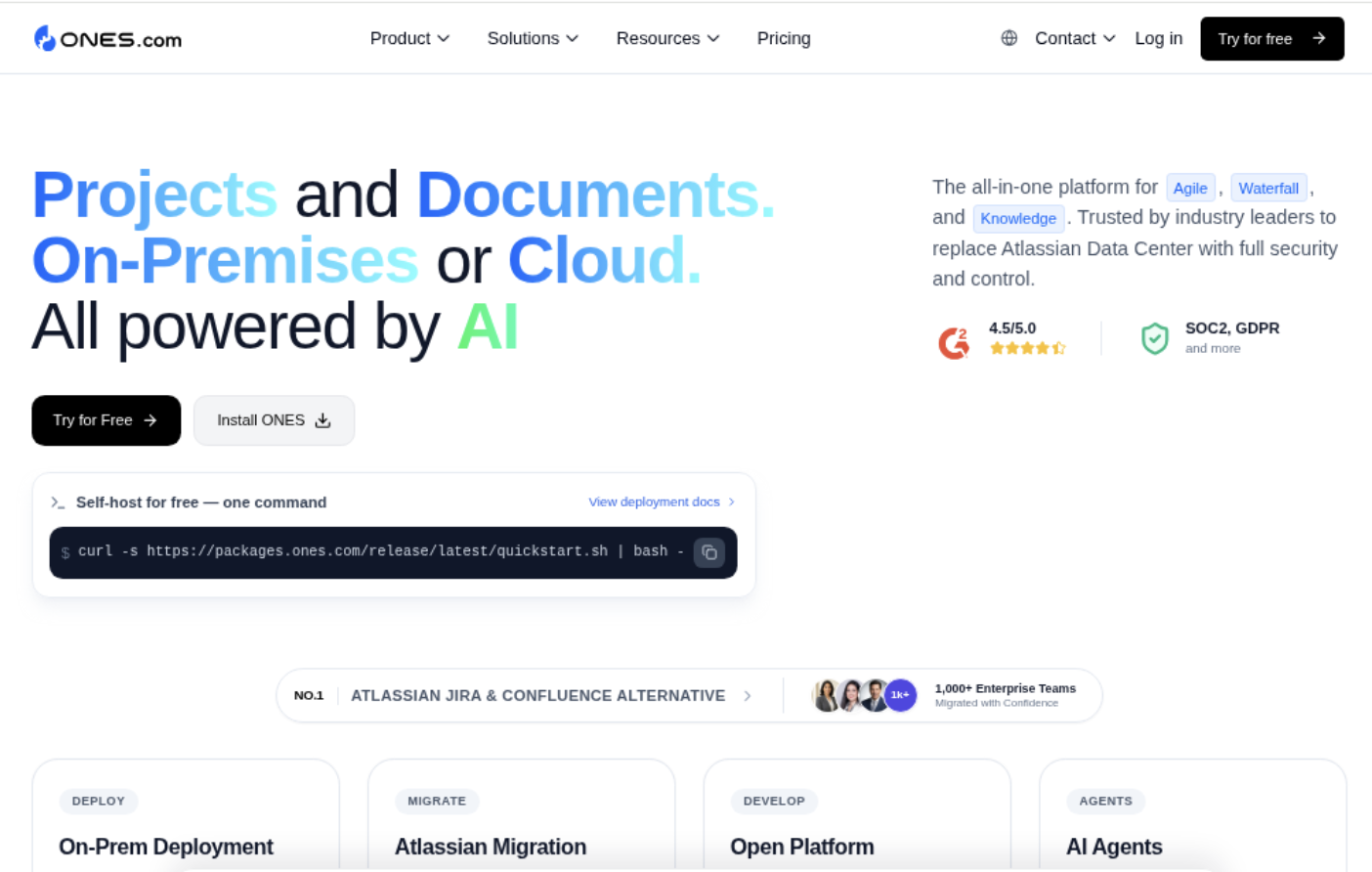
ONES.com combines project management and knowledge management in one platform, with AI assistance through ONES Assistant. ONES Project is the project management product and can serve as a Jira alternative, while ONES Wiki is the knowledge management product and can serve as a Confluence alternative; they are sold separately.
For teams comparing recurring AI costs, deployment flexibility, workflow compatibility, and plugin dependence, ONES.com offers another evaluation path alongside Jira Cloud.
Core Capabilities
- Fragmented project and knowledge work → Unified platform → Keep project activity and team knowledge connected through ONES.com instead of moving between disconnected systems.
- Migration concerns → Jira-compatible workflows → Preserve familiar project practices while evaluating ONES Project as a Jira alternative.
- Heavy plugin dependence → Built-in reporting and workflow tools → Reduce the number of extensions needed for reporting, custom workflows, custom fields, sprint management, and automation.
- Deployment restrictions → Four deployment options → Choose Cloud, On-Premise, Private Cloud, or Air-gapped deployment according to your security and infrastructure requirements.
- Different cloud and self-hosted capabilities → Full feature parity → Access the same core feature set across cloud and self-hosted versions.
- Unclear AI cost progression → Three-layer AI usage model → Start with a basic allowance, use personal Assistant Credit for regular work, and add team-shared Extra Credit when demand grows.
- Limited AI continuity for active teams → Shared overflow capacity → Use Extra Credit when personal allowances are insufficient, helping team-scale AI work continue without describing the capacity as unlimited.
- Small-team adoption risk → Free plan for up to 30 seats → Test the platform with a team of up to 30 seats before making a broader commitment.
Application Scenarios
Scenario one: a regulated engineering team. A team working in a restricted network may need an air-gapped deployment. ONES.com supports that deployment model while retaining feature parity with its cloud and other self-hosted options.
Scenario two: a Jira migration evaluation. A project office can compare ONES Project with Jira by mapping sprint management, custom fields, workflows, reporting, and automation. The team can focus on operational fit rather than evaluating AI in isolation.
Scenario three: gradual AI adoption. A department can begin with the basic allowance for low-volume experimentation. Individual contributors can then use Assistant Credit for steady work, while a team-shared Extra Credit pool supports heavier demand.
How ONES.com Handles AI Usage Credits
ONES.com uses a three-layer AI usage model. The basic allowance provides a low-barrier way to try core AI features and handle limited requests.
Assistant Credit adds 3,000 credits per user per month beyond the basic allowance. This layer supports stable individual use, such as summarizing work, improving descriptions, or asking for help during routine project tasks.
Extra Credit is a team-shared pool used when personal credits are insufficient. It costs USD 10 per 1,000 credits, with a minimum order of 5,000 credits.
In practical terms, the model supports a progression from individual experimentation to scalable team adoption. The basic allowance lowers the barrier to trial, Assistant Credit supports predictable personal usage, and Extra Credit helps high-frequency team usage continue when individual allowances run short.
Common Challenges When Comparing AI Pricing
Challenge: Treating every AI feature as included
Problem: A team sees an AI label and assumes every related capability belongs to the same subscription.
Solution: List each feature separately and confirm its product, tier, user eligibility, and commercial terms. This prevents a broad marketing label from becoming a budget assumption.
Challenge: Ignoring non-AI plan differences
Problem: Teams upgrade for AI, then discover they also pay for planning, administration, storage, or support capabilities they did not evaluate.
Solution: Compare the complete plan. Decide whether the tier solves a major operational need beyond AI assistance.
Challenge: Measuring speed without measuring accuracy
Problem: An AI-generated summary may appear fast but still require substantial correction.
Solution: Measure final usable time. Include review, editing, and approval before claiming productivity gains.
Challenge: Underestimating governance work
Problem: People use AI inconsistently, sensitive details appear in prompts, or generated recommendations enter delivery work without review.
Solution: Set clear access rules, require human review for important outputs, and provide short examples of acceptable use.
Challenge: Comparing cloud products with different deployment needs
Problem: A cloud-only tool may not satisfy teams working under strict infrastructure or network requirements.
Solution: Include deployment options in the comparison. ONES.com offers Cloud, On-Premise, Private Cloud, and Air-gapped deployment, which may matter as much as the feature list.
FAQs
Is Atlassian Intelligence a separate Jira Cloud subscription?
Usually, Atlassian Intelligence is connected to the Jira Cloud plan and eligible product features rather than sold as one universal standalone tier. However, availability and commercial terms can vary by feature, product, region, and account setup. Check the current Jira plan details and administration billing area before budgeting. Also distinguish Atlassian Intelligence from Rovo, marketplace applications, and other services that may have separate conditions.
Does the Free Jira Cloud plan include Atlassian Intelligence?
Do not assume that every AI capability is available on Free. Atlassian can apply different eligibility rules to individual features, and limits on users or administration may affect practical use even when a feature is visible. Test the exact workflow you need, then confirm its availability for your account. A small team may use Free for exploration, while regular team adoption may require a paid tier.
Which Jira Cloud tier is best for AI?
There is no universal best tier. Standard may suit a small or mid-sized team that needs regular collaboration and selected AI assistance. Premium may make more sense when advanced planning, scale, and administration matter. Enterprise is relevant to organizations with multi-site governance and negotiated commercial requirements. Choose the tier that solves your broader operating needs, then evaluate AI as one part of the decision.
Can Atlassian Intelligence usage create extra charges?
Some AI-related capabilities may be included in an eligible product plan, while other services, apps, or future packaging changes can introduce separate costs. Your total bill may also increase because of additional users, connected Atlassian products, marketplace applications, or higher support requirements. Review the exact commercial terms shown for your account. Do not estimate the entire budget from the AI label alone.
How does ONES.com handle AI credits?
ONES.com uses three layers: a basic allowance for trying core AI features and handling limited requests, 3,000 Assistant Credits per user per month for regular individual use, and team-shared Extra Credit for heavier demand. Extra Credit costs USD 10 per 1,000 credits, with a minimum order of 5,000 credits. This structure supports gradual adoption without describing Extra Credit as unlimited.
Conclusion
Atlassian Intelligence pricing in Jira Cloud is best understood through the complete subscription picture. Start with your Jira tier, confirm each AI feature’s eligibility, check user and product requirements, and review any separate services or applications.
But here's the truth: the most expensive mistake is choosing a tier because it mentions AI without proving that it improves your team’s work. Run a small pilot, measure final usable time, and include governance in the estimate.
If Jira Cloud fits your workflows, its bundled AI approach may be convenient. If you need an alternative with Jira-compatible workflows, multiple deployment choices, built-in project capabilities, and a defined credit model, evaluate ONES.com alongside it.