Atlassian Jira Data Center Pricing: The 2026 Cost Guide
Wondering about atlassian jira data center pricing? This 2026 guide covers licenses, infrastructure, apps, and support. Click to plan your budget.
Atlassian Jira Data Center pricing can feel difficult to estimate because the public number is only one part of the investment. You may see a tier price and still wonder about infrastructure, administration, support, apps, and migration.
That uncertainty creates a common budgeting problem. A 500-person team can pay very different amounts depending on its deployment design, marketplace apps, uptime requirements, and renewal choices. A low license estimate can become an expensive implementation.
Here’s the practical answer: treat Jira Data Center as a total-cost project, not a simple subscription. This guide explains the pricing model, major cost drivers, budgeting formula, renewal risks, and alternatives you can evaluate for 2026 planning.
How Atlassian Jira Data Center Pricing Works
Atlassian Jira Data Center pricing is the cost of a self-managed Jira deployment licensed for a specific user tier, plus infrastructure, administration, support, apps, migration, and ongoing maintenance. The final annual budget depends on your tier, contract terms, operating model, and technical requirements.
Jira Data Center is designed for organizations that need self-managed deployment, greater control over hosting, and enterprise-scale availability. You run the environment on approved infrastructure or a supported private-cloud architecture.
Atlassian generally presents Data Center pricing through user tiers and commercial quotes rather than one universal price for every customer. Therefore, you should confirm the current quote, eligible discounts, support terms, and renewal conditions directly with Atlassian or an authorized partner before approval.
The main cost layers
Your planning model should separate direct licensing from operating expenses. This makes the estimate easier to review and helps you see where unexpected costs may appear.
| Cost layer | What it may include |
|---|
| Jira Data Center license | The annual license for your selected user tier and deployment entitlement. |
| Infrastructure | Compute, storage, networking, backups, monitoring, disaster recovery, and security controls. |
| Administration | Platform engineering, upgrades, permission management, performance tuning, and incident response. |
| Marketplace apps | Third-party workflow, reporting, testing, time tracking, service management, and integration apps. |
| Implementation | Architecture, migration, configuration, testing, training, and launch support. |
| Support and continuity | Premium support arrangements, recovery exercises, operational coverage, and compliance work. |
Why the license tier matters
The licensed tier is usually tied to the maximum number of Jira users covered by your agreement. That means your estimate should reflect planned growth, not only today’s active accounts.
For example, a 900-person engineering organization might need a tier that accommodates future hiring and occasional contributors. Choosing a tier with no room to grow can force a commercial review sooner than expected.
What Determines Your 2026 Budget?
Several variables shape the total amount you should reserve. The most important are user count, deployment architecture, resilience expectations, application footprint, and internal operating capacity.
1. Licensed users and growth
Start with the people who need Jira access. Separate full-time contributors, occasional collaborators, contractors, service accounts, and inactive accounts.
Then create three scenarios:
- Current state: the active population today.
- Expected state: the likely population after hiring and organizational changes.
- Maximum state: the tier required if your adoption plan succeeds.
This approach prevents a common mistake: comparing the smallest possible tier with the largest operational environment.
2. High availability and disaster recovery
Data Center planning often includes multiple application nodes, load balancing, shared storage, health checks, backups, and a recovery environment. Each requirement adds engineering effort and infrastructure expense.
Consider two examples. A small internal engineering group may run a simpler production arrangement. A financial services company may require geographically separate recovery, scheduled failover tests, detailed audit controls, and continuous monitoring.
The license may be similar in both cases, while the total operating budget is very different.
3. Hosting decisions
You can host the environment in your own facility, a private cloud, or another approved enterprise infrastructure arrangement. Your choice affects capital spending, staff responsibilities, networking, security reviews, and recovery design.
A private cloud may reduce hardware management while adding platform charges. An internal facility may use existing capacity while requiring more specialized administration. Compare the complete operating model rather than comparing hosting labels alone.
4. Apps and integrations
Many teams depend on marketplace apps for advanced reporting, portfolio planning, time tracking, test management, approvals, or external integrations. Those subscriptions can become a major part of annual spend.
App pricing may follow its own user tier. An app licensed for the same population as Jira can materially increase your renewal total, especially when several departments install separate tools for similar work.
Review every app before renewal. Remove abandoned integrations, consolidate duplicate capabilities, and confirm that each app supports your target deployment.
5. People and operational coverage
Running a self-managed platform requires ownership. You may need administrators, infrastructure engineers, security specialists, release coordinators, and service desk coverage.
For example, a team with two experienced administrators may need limited external help. A company without internal platform expertise may require a partner for architecture, upgrades, performance reviews, and incident recovery.
Include these labor costs even when the work is shared with other platforms. Otherwise, the business case understates the real cost of ownership.
A Practical Formula for Estimating Total Cost
Use a simple annual model before requesting a commercial quote:
Total annual cost = Jira license + app subscriptions + infrastructure + administration + support + security and compliance + renewal contingency.
For a first-pass estimate, build each category separately. Avoid placing one unexplained number beside the product name.
Example planning model
Imagine a software company with 1,200 planned Jira accounts. Its planning worksheet might include:
- The appropriate Data Center license tier.
- Two or more production nodes with load balancing.
- Separate recovery capacity.
- Backup retention and monitoring.
- Five essential marketplace apps.
- One platform administrator and shared infrastructure support.
- Migration and testing work during the first year.
The first-year budget will usually be higher than the renewal-year budget because migration, architecture, and training are front-loaded. Renewal years may still rise when the organization grows or adds more apps.
Separate one-time and recurring costs
| One-time planning item | Recurring planning item |
|---|
| Migration assessment | Annual Jira license |
| Architecture design | Marketplace app renewals |
| Configuration and testing | Infrastructure consumption |
| Training and launch support | Administration and monitoring |
| Initial integration work | Backup, security, and recovery operations |
This separation gives finance teams a clearer view of the first-year investment. It also makes a later comparison with cloud or another self-managed platform more credible.
Data Center, Cloud, and Other Deployment Choices
The right deployment depends on control, compliance, operating capability, and cost predictability. Price alone rarely provides enough information for a responsible decision.
When Data Center may fit
Data Center may suit you when your organization needs self-managed deployment, strict network controls, specialized compliance requirements, or an established platform operations team.
It can also fit companies that need greater control over upgrade timing and infrastructure architecture. However, that control comes with responsibility for availability, security, recovery, and performance.
When cloud may fit better
Cloud can reduce the infrastructure work you manage directly. You may avoid server capacity planning, cluster operations, and several maintenance tasks.
Cloud pricing is typically easier to model as a recurring subscription. Still, you should assess user tiers, premium features, marketplace apps, data residency, integration constraints, and migration effort.
When an alternative deserves attention
An alternative may be worth evaluating when your current environment has too many plugins, complex administration, slow reporting, or rising renewal costs.
For example, if ten apps provide overlapping workflow and reporting features, a platform with more native capabilities could simplify the operating model. The result may be easier maintenance even when license savings are not the only objective.
How to Prepare for a Pricing Quote
A precise quote becomes easier when you prepare commercial and technical details in advance. Here’s why: unclear requirements often produce an estimate that must be revised later.
Build a clear requirements brief
Include your expected user population, current population, growth forecast, deployment location, recovery objectives, integration needs, and compliance constraints.
Also list your critical workflows. A software team may need sprint planning, release tracking, code integration, and defect management. A business operations team may need approvals, intake queues, and audit history.
Review your current environment
Inventory every app, integration, custom workflow, permission scheme, automation rule, and reporting dependency. Identify what is essential, optional, obsolete, or duplicated.
A realistic review may reveal that 20% of installed apps support no active process. Removing them can simplify migration and reduce renewal exposure.
Ask commercial questions
- Which user tier matches your expected population?
- How are additional users handled during the term?
- What renewal assumptions should you include?
- Which support services are included?
- Are partner services priced separately?
- What happens if your deployment changes?
- Which apps require separate commercial agreements?
Keep the answers with your internal approval materials. Pricing decisions become difficult when assumptions are scattered across emails and meetings.
Value Proposition
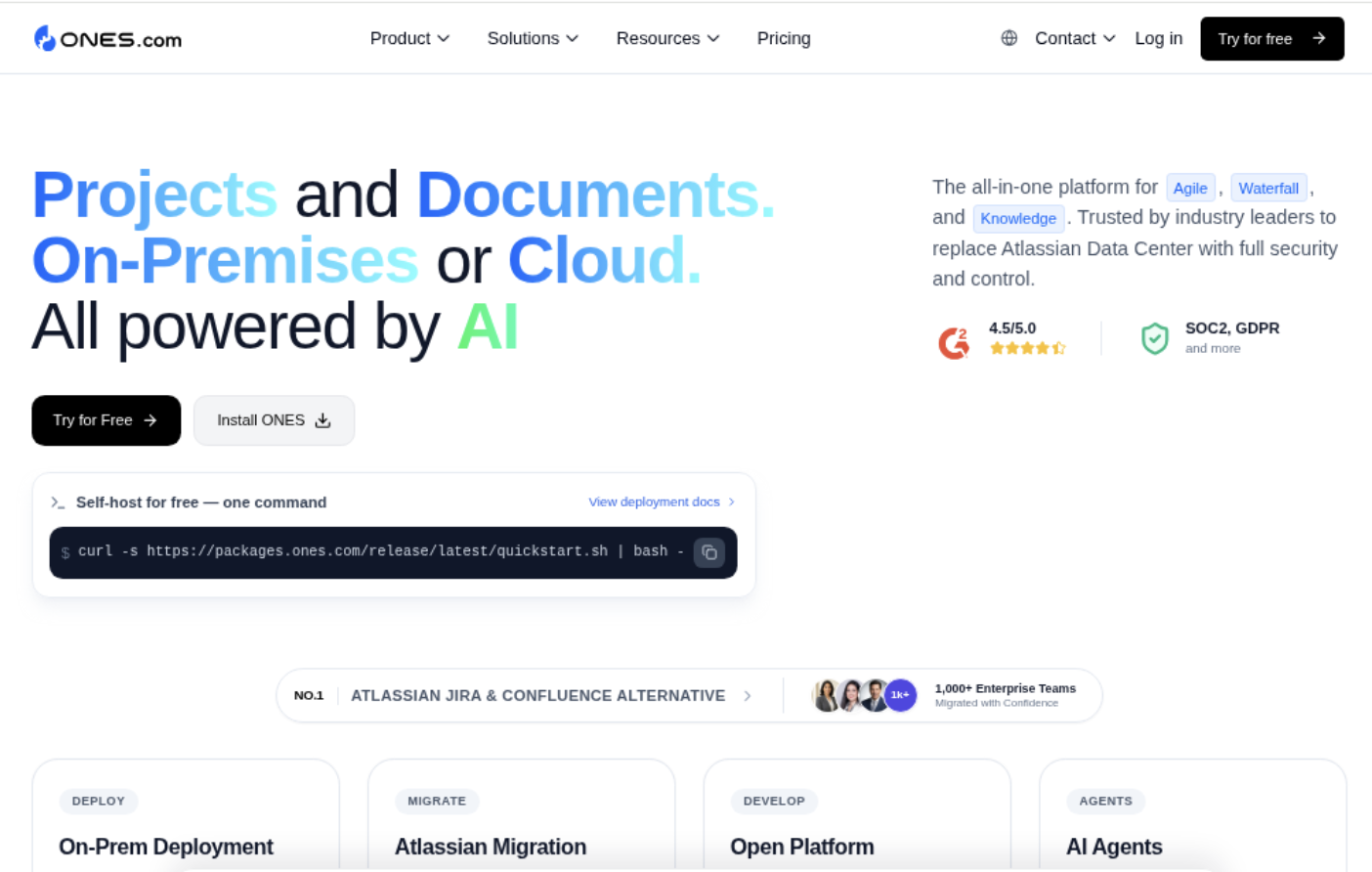
ONES.com is a unified platform for project management and knowledge management, powered by AI through ONES Assistant. ONES Project is the project management product and can serve as a Jira alternative, while ONES Wiki is the knowledge base product and can serve as a Confluence alternative. They are sold separately.
For teams comparing self-managed project platforms, ONES.com offers Cloud, On-Premise, Private Cloud, and Air-gapped deployments. The self-hosted versions provide full feature parity with the cloud version.
Core Capabilities
- Plugin complexity: Teams often assemble many separate tools for planning, reporting, and workflow control. ONES capability: ONES Project includes built-in reporting, custom workflows, custom fields, sprint management, and automation. Result: You can reduce dependency on extra plugins and simplify administration.
- Jira migration concerns: A team may worry that familiar delivery processes will disappear during a platform change. ONES capability: ONES Project supports Jira-compatible workflows. Result: Your team can preserve recognizable planning and delivery patterns while evaluating a Jira alternative.
- Restricted-network requirements: Some organizations cannot place project information in a public cloud. ONES capability: ONES.com supports On-Premise, Private Cloud, and Air-gapped deployment options. Result: You can align the platform with network isolation and internal governance requirements.
- Uneven feature expectations: Self-hosted products sometimes lag behind their cloud editions. ONES capability: ONES.com provides full feature parity between cloud and self-hosted versions. Result: Your deployment decision does not require accepting a reduced feature set.
- Scattered project knowledge: Delivery decisions can become separated from technical guidance and team knowledge. ONES capability: ONES Wiki provides a dedicated knowledge management product within the broader ONES.com platform. Result: You can connect project coordination with a structured knowledge practice.
- Manual status reporting: Project leads may spend hours collecting updates from different views. ONES capability: Built-in reporting and configurable workflows support consistent status collection. Result: Managers can spend less time assembling updates and more time resolving delivery risks.
- Growing teams: Early-stage teams need a low-risk way to evaluate a platform. ONES capability: The free plan supports up to 30 seats. Result: You can test core project workflows before planning a broader rollout.
- Operational transition risk: Teams may need to compare cloud and self-hosted operations without maintaining separate feature assumptions. ONES capability: Four deployment options and feature parity support a staged evaluation. Result: You can assess governance, security, and operating effort before selecting a long-term model.
Application Scenarios
Scenario one: regulated engineering team. A healthcare software team needs restricted network access and controlled deployment. It can evaluate ONES Project in an air-gapped environment while reviewing custom workflows, sprint planning, and reporting.
Scenario two: growing product organization. A 25-person product team wants to replace scattered planning tools. It can begin with the free 30-seat plan, test Jira-compatible workflows, and decide whether ONES Project fits its release process.
Scenario three: enterprise platform review. A large organization is reassessing its Jira Data Center renewal. It can compare existing app dependencies with ONES Project’s native capabilities, then evaluate On-Premise or Private Cloud deployment against its governance requirements.
Common Challenges and Practical Solutions
Challenge: confusing license price with total cost
Solution: Create separate lines for licensing, infrastructure, apps, staffing, migration, and recovery. Ask each owner to validate its estimate.
Challenge: underestimating marketplace apps
Solution: Review app activity and business value before renewal. Replace overlapping functions where practical, and confirm compatibility with your target deployment.
Challenge: choosing a tier without growth planning
Solution: Model current, expected, and maximum populations. Include acquisitions, contractors, regional expansion, and new departments.
Challenge: overlooking internal operating effort
Solution: Estimate administration hours for upgrades, permissions, backups, monitoring, security reviews, and incident response.
Challenge: comparing products on license price alone
Solution: Compare a three-year total cost alongside feature coverage, deployment control, migration effort, app requirements, and staffing needs.
FAQs About Jira Data Center Costs
Is there one public price for Jira Data Center in 2026?
There may not be one universal amount that applies to every organization. Your quote can depend on the user tier, contract structure, support arrangement, and commercial terms. Treat public pricing information as an initial planning reference, then confirm the current amount directly with Atlassian or an authorized partner.
What should I include besides the Jira license?
Include infrastructure, high availability, recovery capacity, monitoring, backups, administration, security controls, marketplace apps, implementation, training, and support. If you already have infrastructure or staff, assign an internal cost to that capacity. Otherwise, your comparison may make self-managed deployment appear cheaper than it really is.
Is Jira Data Center cheaper than cloud?
There is no universal answer. Data Center may align better with strict control or self-managed requirements, while cloud may reduce infrastructure responsibilities. Compare at least three years of licensing, apps, staffing, hosting, migration, security, recovery, and support costs before deciding.
How far ahead should I plan a renewal?
Begin several months before the renewal deadline. That gives you time to review active accounts, app subscriptions, infrastructure needs, growth assumptions, and alternative platforms. Early planning also creates room for technical testing and commercial negotiation instead of forcing a rushed decision.
Can ONES Project replace Jira Data Center?
ONES Project is a Jira alternative with Jira-compatible workflows, custom workflows and fields, sprint management, automation, and built-in reporting. It supports Cloud, On-Premise, Private Cloud, and Air-gapped deployment through ONES.com. You should test your priority workflows, integrations, permissions, reporting, and migration requirements before making a final choice.
Conclusion
Atlassian Jira Data Center pricing should be evaluated as a complete operating investment. The license tier matters, but infrastructure, apps, administration, recovery, migration, and growth can change the final budget substantially.
Start with your expected user population. Then separate one-time work from recurring costs, review every app, compare deployment models, and request a quote using clear technical assumptions.
But here’s the truth: a platform decision is easier when you measure operational complexity as carefully as license cost. If your current setup depends on many plugins or requires strict self-hosted control, evaluate ONES Project alongside your renewal plan. The right choice is the one that supports your workflows without creating an operating burden your team cannot sustain.