Atlassian Jira Official Pricing: A 2026 Plans and Cost Guide
Confused by atlassian jira official pricing? Compare 2026 plans, user tiers, billing, and add-ons to budget wisely. Read now to choose the right plan.
Jira pricing can look simple until you compare plans, user bands, billing terms, and add-ons. A small team may pay nothing, while a growing organization can face a much larger monthly commitment. Confusion grows when annual pricing, Premium features, Enterprise contracts, and marketplace apps appear together.
That makes budgeting difficult. You may choose a plan that lacks key controls, or pay for capacity your team never uses. A few cents per user can also become thousands of dollars across a large organization.
Here’s the practical solution: separate the plan fee, user count, billing cycle, and optional services. Then compare each tier against your actual workflow. This guide explains Atlassian Jira official pricing for 2026 planning, how Jira calculates costs, and which alternatives may fit your team better.
Jira Pricing at a Glance for 2026
Jira pricing follows a tiered subscription model based mainly on plan level, user count, billing cycle, and deployment type. The Free plan supports small teams, while Standard and Premium add administration, scale, automation, and advanced delivery features. Enterprise pricing is negotiated directly with Atlassian.
| Plan |
Best fit |
Typical pricing approach |
Main consideration |
| Free |
Small teams evaluating Jira |
$0 within the plan’s user and feature limits |
Limited administration, storage, automation, and support |
| Standard |
Growing teams managing regular projects |
Per-user subscription, with rates affected by user band and billing term |
Balances core project management with broader controls |
| Premium |
Organizations needing scale and advanced delivery controls |
Higher per-user subscription, with volume and billing effects |
Costs more, but adds advanced capabilities and stronger service commitments |
| Enterprise |
Large organizations with complex governance |
Custom quotation |
Requires a sales-led evaluation and agreement |
Atlassian can adjust prices, user bands, regional currency, taxes, and packaging. Use the official Jira pricing calculator for the live amount before approving a purchase.
For a reliable estimate, calculate the subscription in four parts:
- Choose the plan: Free, Standard, Premium, or Enterprise.
- Count billable users: Include every person who needs access, even if some people use Jira occasionally.
- Select billing frequency: Monthly billing offers flexibility, while annual billing can provide a different effective rate and commitment.
- Add related services: Include Marketplace apps, extra products, migration support, and applicable taxes.
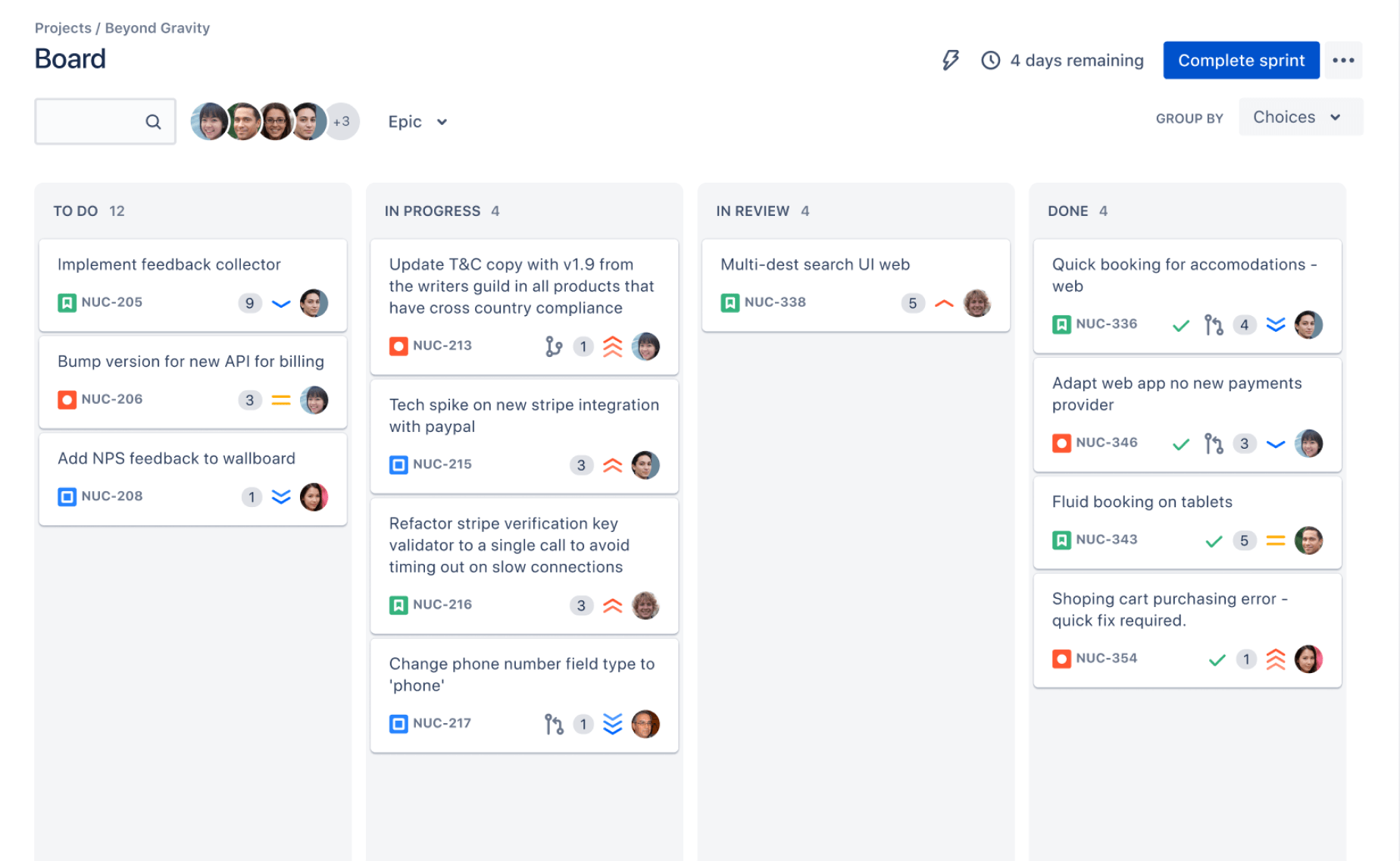
What Each Jira Plan Includes
Free plan
The Free plan is designed for small teams testing Jira or managing a limited number of active contributors. It gives you access to core issue tracking, project boards, backlogs, workflows, and reporting within defined limits.
For example, a five-person product team can use Free to track feature requests, bugs, sprint work, and release progress. The plan becomes less suitable when you need extensive permissions, advanced administration, or greater automation capacity.
Check the current user limit, storage allowance, automation limits, and support terms before relying on Free for ongoing operations.
Standard plan
Standard is usually the starting point for teams that have outgrown the Free tier. It supports a broader user base and provides stronger administration, collaboration, and operational controls.
A software team may choose Standard when several departments need access, project permissions become more complex, or Jira becomes part of the organization’s regular delivery process.
The price depends on the number of users and the billing arrangement. Jira generally uses progressive user bands, so the cost per person may change as your team grows.
Premium plan
Premium targets organizations that need more scale, advanced delivery features, and stronger service commitments. It can be useful for teams coordinating multiple projects, products, or business units.
Premium may include capabilities such as advanced planning, higher automation capacity, expanded administration, and improved service-level commitments. The exact feature set can change, so confirm the current package before purchasing.
Premium becomes easier to justify when downtime, manual coordination, or cross-team dependencies create measurable business costs.
Enterprise plan
Enterprise is intended for large organizations with complex governance, security, procurement, and support requirements. Atlassian typically prices it through a tailored agreement rather than a simple public rate.
An Enterprise discussion may consider user volume, product scope, deployment requirements, support expectations, compliance needs, and commercial terms.
Ask for a complete commercial breakdown. The subscription is only one part of the total budget.
How Jira Calculates Your Actual Cost
The advertised rate rarely equals the final amount on an invoice. Your total usually depends on several variables that deserve separate attention.
User count and pricing bands
Jira subscription pricing commonly uses user tiers. A team with 11 people may fall into a different band than a team with 10, even when the eleventh person adds little daily activity.
That means you should model growth in steps. Compare your present headcount with likely hiring points, such as 25, 50, 100, and 200 users.
Monthly versus annual billing
Monthly billing helps when your team size changes quickly. Annual billing can simplify procurement and may offer different commercial terms.
Use annual billing only after estimating headcount changes. Paying for unused seats across a full year can erase the benefit of a lower effective rate.
Taxes and regional pricing
Currency, local taxes, and regional commercial rules can affect the amount you pay. A displayed US dollar price may not match the final amount for your organization.
Ask your finance team to review tax treatment before comparing vendors. Otherwise, two apparently similar quotes may have different final costs.
Marketplace apps and connected services
Jira’s base subscription may cover your main workflow while separate apps handle time tracking, test management, advanced reporting, or portfolio planning.
For example, a team might pay for Jira Standard and then add three Marketplace apps. Those add-ons can change the annual budget more than upgrading to Premium.
Deployment and administration requirements
Cloud and self-managed products involve different cost patterns. Cloud subscriptions reduce infrastructure responsibilities, while self-managed deployments may require hosting, maintenance, backups, upgrades, and internal support.
Compare the complete operating cost rather than the license amount alone.
Jira Cloud, Data Center, and Enterprise Cost Differences
Jira Cloud is generally priced as a recurring subscription. Atlassian manages much of the underlying service, which can reduce internal maintenance work.
Jira Data Center follows a different commercial model and may suit organizations with specific hosting, resilience, or control requirements. Its licensing and infrastructure expenses need separate evaluation.
Enterprise arrangements can combine products, support, security requirements, and commercial commitments. A large organization should request a proposal that separates each cost category.
| Cost area |
Cloud subscription |
Self-managed or Enterprise environment |
| Software access |
Recurring subscription |
License or negotiated commercial agreement |
| Infrastructure |
Primarily included in the service |
May require hosting, storage, networking, and resilience planning |
| Maintenance |
Lower internal maintenance burden |
Internal teams may manage upgrades and operations |
| Customization |
Uses available cloud configuration and apps |
May offer different control options, depending on the product |
| Support |
Plan-dependent support options |
May include negotiated support and service commitments |
The right choice depends on your security model, administration capacity, integration needs, and long-term operating budget.
How to Build a Jira Budget Before You Buy
Start with a simple three-year model. A one-month trial can hide costs that appear after hiring, expansion, or process changes.
- List active roles: Separate developers, product managers, testers, executives, service teams, and occasional collaborators.
- Estimate user growth: Add expected hiring, contractors, acquisitions, and temporary project participants.
- Compare plan limits: Review automation, permissions, reporting, storage, support, and planning features.
- List necessary apps: Include testing, time tracking, documentation, reporting, and integration tools.
- Estimate administration: Include setup, workflow maintenance, permissions, training, and internal support.
- Model renewal risk: Allow for price changes, higher user bands, taxes, and additional services.
Here’s a concrete example. A 40-person team may begin with Standard, two reporting apps, and monthly billing. After adding a testing app and expanding to 75 people, its annual budget may change significantly.
That increase does not necessarily mean Jira became poor value. It means the team’s operating model became more complex. Your budget should reflect that reality before the commitment begins.
Jira Pricing Value: When Is a Higher Tier Worth It?
A higher Jira tier makes sense when it removes a costly limitation. The question is whether the additional capability saves more time, risk, or administration than it costs.
| Business situation |
Potential reason to upgrade |
Question to ask |
| Many teams share one environment |
More advanced administration and governance |
How much time does permission management consume? |
| Automation runs frequently |
Higher automation capacity |
Do manual handoffs delay releases? |
| Executives need portfolio visibility |
Advanced planning and reporting |
Are leaders relying on separate status updates? |
| Service reliability is critical |
Stronger service commitments |
What would an outage cost the business? |
| Multiple apps are required |
Potentially broader native functionality |
Would a higher plan reduce paid extensions? |
For instance, upgrading may be sensible if a team spends 30 hours each month manually combining project reports. If the higher tier removes that work, the financial case becomes easier to defend.
However, a premium plan will not automatically fix unclear ownership or poorly designed workflows. Process quality still matters.
Value Proposition
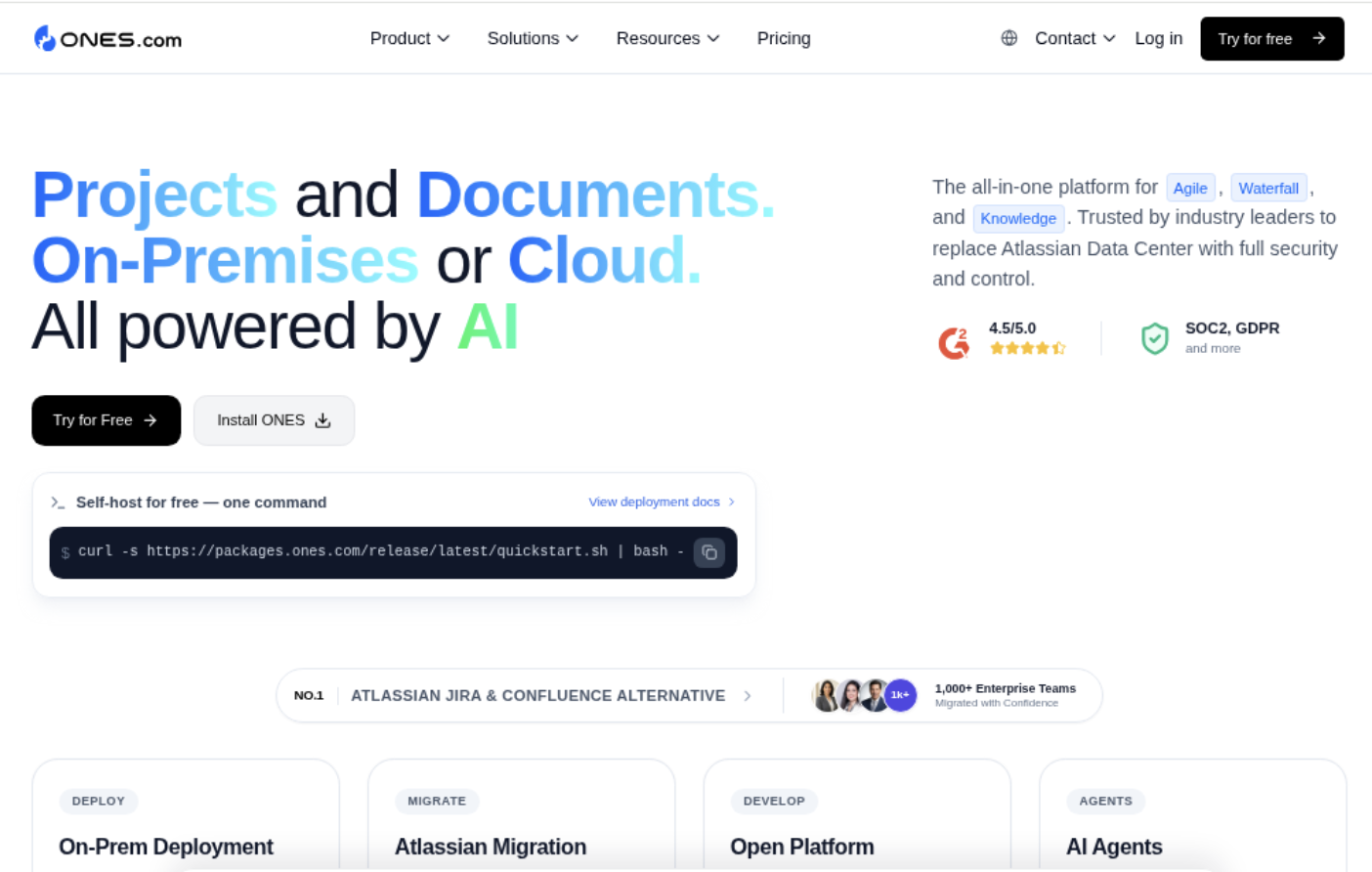
ONES.com combines project management and knowledge management in one platform. ONES Project is a Jira alternative for teams that want structured delivery workflows, while ONES Wiki supports shared team knowledge.
The products are sold separately, so you can choose the capability you need. ONES.com offers cloud, on-premise, private cloud, and air-gapped deployments, with feature parity between cloud and self-hosted versions.
Core Capabilities
1. Multiple deployment choices
Pain: Some organizations cannot place project information in a public cloud environment.
ONES capability: ONES.com supports Cloud, On-Premise, Private Cloud, and Air-gapped deployment options.
Result: You can align the platform with internal security, network, and hosting requirements.
2. Jira-compatible workflows
Pain: Switching project systems can disrupt familiar issue states, permissions, and delivery routines.
ONES capability: ONES Project supports Jira-compatible workflows and configurable project processes.
Result: Teams can preserve familiar working patterns while evaluating a different platform.
3. Custom workflows and fields
Pain: Generic workflows often force teams to track important details elsewhere.
ONES capability: You can configure custom workflows and fields for different work types.
Result: Product, engineering, operations, and business teams can manage relevant information in one workspace.
4. Built-in reporting
Pain: Separate reporting tools add cost and create inconsistent project views.
ONES capability: ONES Project includes built-in reporting for delivery and project visibility.
Result: Managers can review progress without assembling updates across several services.
5. Sprint management
Pain: Agile teams need clear sprint planning, prioritization, and progress tracking.
ONES capability: Sprint management supports planning work, monitoring progress, and reviewing outcomes.
Result: Delivery teams get a structured cycle for planning and continuous improvement.
6. Automation
Pain: Repetitive transitions and notifications consume time and create avoidable mistakes.
ONES capability: Automation can handle defined workflow actions and routine project updates.
Result: Teams reduce manual coordination and keep work moving consistently.
7. Unified project and knowledge management
Pain: Teams often separate delivery work from decisions, procedures, and technical knowledge.
ONES capability: ONES.com brings ONES Project and ONES Wiki into one broader platform, while allowing separate purchase.
Result: Project context and team knowledge can stay connected across daily work.
8. Free access for small teams
Pain: Early-stage teams may need to test a platform before approving a larger budget.
ONES capability: ONES.com offers a free plan for up to 30 seats.
Result: A small team can evaluate core workflows before making a wider commitment.
Application Scenarios
Restricted-network engineering: A regulated engineering group can evaluate an air-gapped deployment when public cloud access is unsuitable. Its project workflows remain available inside the approved environment.
Growing product organization: A product company can use ONES Project for backlog management, sprint planning, automation, and reporting. It can add ONES Wiki separately when teams need a structured knowledge base.
Jira migration evaluation: A team can recreate representative workflows, fields, reports, and sprint routines before deciding whether another platform reduces administrative complexity.
Common Challenges When Estimating Jira Costs
Challenge: Counting only full-time employees
Problem: Contractors, consultants, executives, and occasional contributors may also need access.
Solution: Map every role that needs viewing, commenting, editing, approval, or reporting access. Then model the highest likely headcount during the contract period.
Challenge: Ignoring add-on costs
Problem: A low base subscription can look attractive until essential testing, reporting, or time-tracking apps are added.
Solution: Create a complete capability list before selecting the plan. Price the base tier and each required extension together.
Challenge: Comparing different billing terms
Problem: Monthly and annual offers can make direct comparisons misleading.
Solution: Convert every option into a 12-month and three-year total. Include expected user growth and renewal assumptions.
Challenge: Treating administration as free
Problem: Workflow design, permissions, training, cleanup, and support require internal time.
Solution: Assign an estimated monthly administration cost. A platform with a lower subscription can still have a higher total operating cost.
Challenge: Choosing features without a business case
Problem: Teams sometimes upgrade because a feature sounds useful, without measuring its effect.
Solution: Connect each upgrade to a measurable outcome, such as fewer manual reports, faster approvals, or lower outage exposure.
FAQs About Jira Pricing
Is Jira free for small teams?
Jira offers a Free plan for small teams, subject to current user, storage, automation, support, and feature limits. It can work well for a small product or engineering group with straightforward workflows. Before committing, check the live eligibility rules and limits. If your team needs advanced administration, extensive automation, or broader reporting, you may need Standard or Premium.
How much does Jira cost per user?
There is no single rate for every Jira customer. The amount depends on the plan, number of users, billing frequency, region, currency, taxes, and current Atlassian pricing. Standard and Premium use tiered subscription pricing, while Enterprise usually requires a custom quote. Use the official pricing calculator with your expected user count instead of applying one rate to every scenario.
Is annual Jira billing cheaper than monthly billing?
Annual billing may provide different commercial terms, but the result depends on the plan, user band, region, and current offer. It also creates a longer commitment. Compare the full annual amount with 12 months of monthly billing, then account for hiring and contract changes. Annual billing can suit stable teams, while monthly billing may offer more flexibility during rapid growth.
Do Jira Marketplace apps cost extra?
Many Marketplace apps have separate commercial terms. Their pricing may depend on the app, user tier, billing cycle, and deployment type. Include every required app in your estimate. For example, testing, time tracking, reporting, and planning extensions can materially increase the total budget. Review app pricing alongside Jira rather than treating it as an afterthought.
Which Jira plan is best for a growing team?
Standard often suits a growing team that needs more users and administration than Free provides. Premium may be a better fit when the team needs advanced planning, higher automation capacity, stronger governance, or improved service commitments. The right choice depends on measurable needs. Compare the cost of the upgrade with the time and risk created by staying on the lower tier.
Should I compare Jira with alternatives?
Yes, especially when deployment control, built-in reporting, workflow flexibility, or total operating cost matter. Compare each platform using the same criteria: subscription, add-ons, administration, migration effort, support, security, and scalability. ONES.com may deserve consideration when you need a Jira alternative with cloud, self-hosted, private cloud, or air-gapped deployment options.
Conclusion
Jira pricing for 2026 depends on more than the headline plan rate. User bands, billing frequency, taxes, add-ons, deployment, administration, and growth assumptions all affect the final budget.
Start with the Free plan when you are testing a small team workflow. Consider Standard for broader everyday use, Premium for advanced scale and delivery requirements, and Enterprise for complex organization-wide needs.
But here’s the truth: the cheapest subscription is not always the lowest-cost choice. A plan that reduces manual reporting, app sprawl, and administration may deliver better value over time.
Build a three-year estimate, verify current official pricing before purchase, and compare alternatives such as ONES.com when workflow control or deployment flexibility matters. That approach gives you a clearer financial decision and fewer surprises after adoption.