Atlassian Jira Pricing Plans: A 2026 Buyer’s Guide for Teams
Comparing Atlassian Jira pricing plans for 2026? Find the right tier, features, and costs for your team—read the buyer’s guide now.
Choosing a Jira plan can feel harder than building the workflow itself. The pricing page uses seats, billing terms, feature limits, storage allowances, automation rules, and support levels. A plan that looks affordable for five people may cost much more after your team grows, adds contractors, or needs advanced controls.
That uncertainty creates two risks. You may overpay for capabilities your team never uses, or choose a cheaper tier that forces workarounds later. Switching plans can also affect permissions, reporting, approvals, and administration.
But here's the truth: you can make a confident choice by comparing each tier against your team size, delivery process, security needs, and growth plans. This guide explains Atlassian Jira pricing plans, the cost factors behind them, and practical alternatives to consider before you commit.
Jira Pricing Plans: A Quick Buyer’s Overview
Jira generally offers Free, Standard, Premium, and Enterprise options. The right choice depends on team size, collaboration needs, automation volume, administration requirements, and whether you need advanced scale or governance.
| Plan |
Best suited to |
Typical strengths |
Watch carefully |
| Free |
Small teams testing Jira |
Core issue tracking, basic project management, and limited collaboration |
Team size, storage, permissions, automation, and support limits |
| Standard |
Growing teams running regular projects |
More capacity, broader administration, and stronger collaboration controls |
Per-seat cost rises as the team expands |
| Premium |
Teams managing multiple projects or complex delivery |
Advanced planning, higher limits, stronger service features, and expanded controls |
Extra capabilities may exceed a small team’s needs |
| Enterprise |
Large organizations with governance requirements |
Centralized administration, scale, security, and enterprise support |
Usually requires a sales-led agreement and careful contract review |
Atlassian commonly calculates cloud costs by user count, billing cycle, and plan level. Annual billing may use a different seat calculation than monthly billing, so compare the total commitment rather than only the displayed monthly figure.
You should also separate Jira Software from other Atlassian products. Jira Product Discovery, Jira Service Management, Confluence, and other services can have separate pricing. A low Jira quote may become a larger Atlassian bill after you add collaboration, service, or knowledge features.
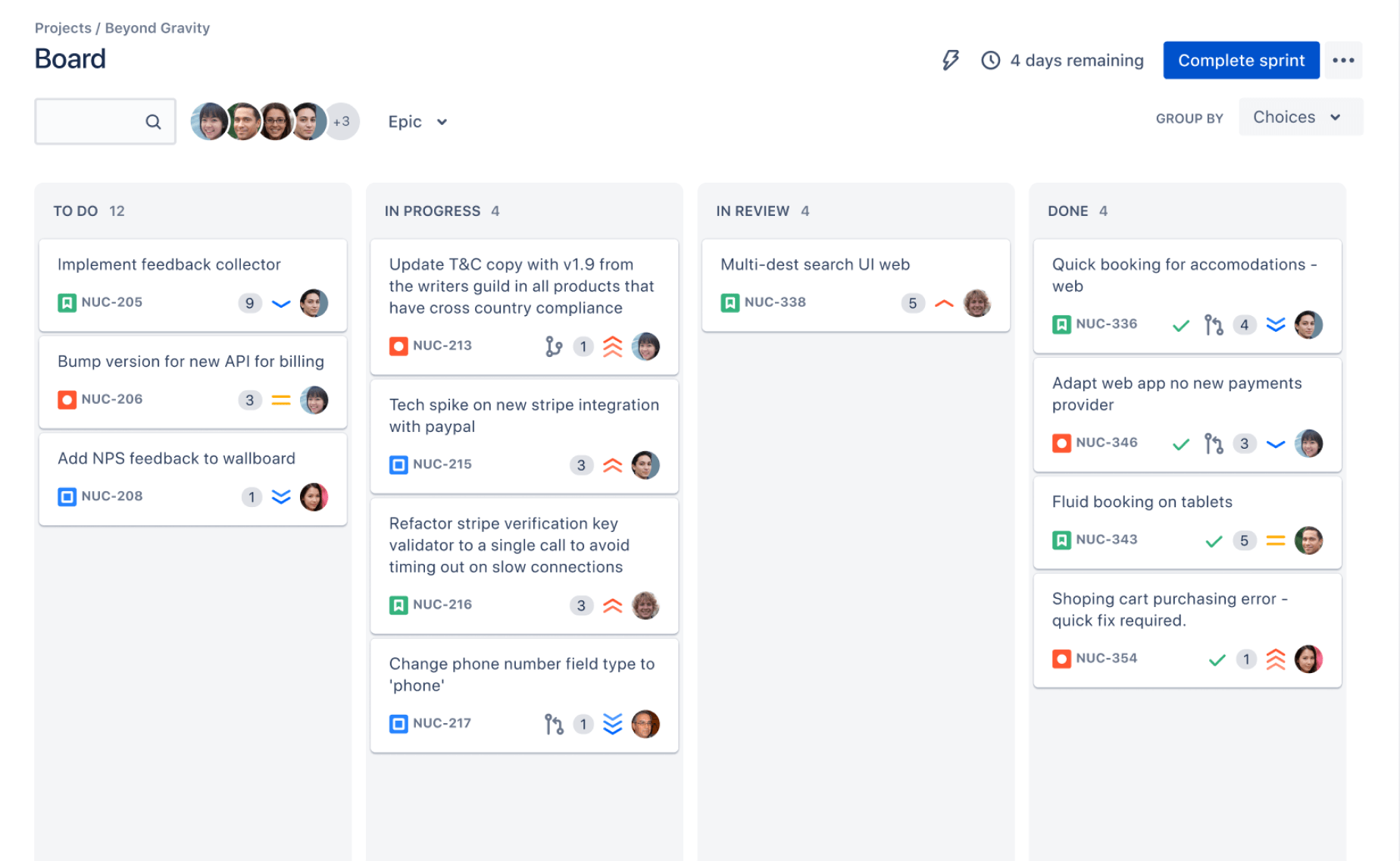
What the Free tier usually means
The Free tier is useful when you are validating a workflow with a small team. You can create projects, manage issues, assign work, and test basic boards without an immediate subscription commitment.
Its limits matter when your team depends on detailed permissions, larger storage, extensive automation, advanced reporting, or formal administration. A five-person product team may be comfortable on Free, while a growing engineering department may outgrow it quickly.
Use Free as a practical trial environment. Before relying on it for daily operations, list the controls you need for access, reporting, integrations, and team expansion.
When Standard becomes the practical baseline
Standard often fits teams that have moved beyond simple task tracking. You may need more room for projects, more reliable administration, and collaboration features that support a larger working group.
Consider a software team with 18 people, two contractors, and three active products. The team may not need enterprise governance, yet Free could create friction through capacity or permission limits. Standard may offer a more balanced operating point.
Here's why: the cheapest plan is not always the lowest-cost option. Time spent maintaining workarounds, cleaning up permissions, or manually producing reports also carries a business cost.
When Premium earns consideration
Premium is designed for teams with more demanding planning and delivery requirements. It can make sense when you coordinate several projects, need advanced planning, or depend on higher service capacity.
Imagine a product organization coordinating platform engineering, mobile development, compliance work, and customer-facing releases. A stronger planning layer can reduce scheduling conflicts and give leaders a clearer view of dependencies.
Premium deserves a closer look when your team already has a mature process. If you only need a board, a backlog, and basic reporting, the additional cost may deliver limited value.
Who should evaluate Enterprise
Enterprise is usually aimed at large organizations with complex governance, many teams, and strict administrative requirements. The commercial structure may differ from self-service cloud tiers.
Enterprise buyers should evaluate more than the subscription amount. Review identity management, permission administration, audit requirements, support expectations, regional controls, procurement terms, and renewal conditions.
You might be wondering: does a large headcount automatically justify Enterprise? No. The better question is whether centralized governance and organizational scale create requirements that lower tiers cannot handle efficiently.
What Really Determines Your Jira Bill
Plan labels provide a starting point. Your actual cost depends on several variables that can change the total significantly.
Seat count and growth
Most cloud subscriptions scale with the number of people who need access. That count may include engineers, product managers, designers, quality specialists, managers, contractors, and occasional collaborators.
Build a 12-month estimate rather than counting today’s team only. For example, a 20-seat team that expects to hire ten people may cross a pricing threshold sooner than expected.
Also identify inactive accounts. Keeping former contractors assigned to a paid seat can quietly increase recurring costs.
Monthly versus annual billing
Monthly billing offers flexibility when your team changes often. Annual billing may provide a lower effective rate or simpler procurement, though it can create a longer commitment.
Compare both options using three scenarios: your current headcount, expected headcount, and maximum likely headcount. This exposes the cost of growth instead of hiding it behind a single estimate.
Product combinations
Jira may be only one part of your working environment. You might also need Confluence for knowledge management, Jira Service Management for support operations, or other Atlassian services.
Make a complete product map before approving a plan. A team that needs work tracking, internal knowledge, service requests, and reporting should compare the combined experience and price.
Marketplace apps and integrations
Additional apps can improve specialized workflows, yet each one adds cost and administrative effort. Common examples include advanced roadmaps, time tracking, test management, portfolio reporting, and specialized approvals.
List every paid integration you expect to keep for at least a year. Then ask whether the selected Jira tier already includes a similar capability or whether another platform provides it natively.
How to Choose the Right Tier for Your Team
Start with requirements rather than plan names. A short evaluation prevents you from buying features because they sound impressive.
- Count active contributors. Include everyone who creates, edits, assigns, reviews, or reports on work.
- Map your workflow. Write down intake, prioritization, development, review, testing, release, and follow-up stages.
- Mark essential controls. Identify permissions, approval rules, audit needs, reporting requirements, and administrative roles.
- Estimate growth. Model likely hiring, contractors, acquisitions, and temporary project teams.
- List connected products. Include knowledge management, service management, identity, analytics, and testing requirements.
- Calculate operational effort. Estimate time spent maintaining workarounds, producing reports, and managing access.
- Run a realistic trial. Test a real project with real roles, dependencies, reports, and approval steps.
- Review the exit path. Understand how you would export work, reduce seats, change tiers, or migrate later.
The best part? You do not need to test every possible feature. Choose one representative workflow and measure whether the plan supports it without manual repair.
Use a simple scoring model
Score each plan against five categories: required features, expected capacity, administration, total cost, and future flexibility. Give each category a weight according to its importance.
| Category |
Question to ask |
Suggested weight |
| Workflow fit |
Can the plan support your real delivery process? |
30% |
| Capacity |
Will limits support your projects and growth? |
20% |
| Administration |
Can you manage access and governance efficiently? |
20% |
| Total cost |
What will subscriptions, apps, and administration cost? |
20% |
| Flexibility |
Can the plan adapt as your organization changes? |
10% |
This approach stops price from dominating the decision. A plan with a lower subscription may score poorly after you account for manual effort and add-ons.
Cloud, Self-Hosted, and Deployment Considerations
Deployment choice affects more than infrastructure. It changes administration, responsibility, upgrade planning, security review, and procurement.
Cloud deployment
Cloud hosting reduces infrastructure maintenance and usually provides a faster starting point. Atlassian manages much of the platform operation, while your administrators focus on configuration, permissions, and workflow design.
Cloud can suit distributed teams that want quick access and fewer internal hosting responsibilities. It may require closer review when your organization has strict residency, network, or regulatory requirements.
Self-hosted deployment
Self-hosted arrangements can offer more control over environment management and network placement. They also shift more responsibility to your internal team.
You may need specialists for upgrades, availability, backups, security hardening, performance monitoring, and recovery testing. Those labor costs belong in the purchase decision.
Questions for regulated teams
Ask where information is stored, who can administer the environment, how identity is managed, and how activity is audited. Confirm how integrations behave across your security boundary.
A regulated organization may accept a higher subscription when it reduces review effort. Another organization may prefer a simpler cloud setup because internal hosting would cost more than expected.
Common Mistakes When Comparing Jira Plans
Many buying mistakes come from comparing advertised tiers without matching them to daily work.
Choosing by current headcount only
A small team can become a larger team within one planning cycle. If you choose a tier with narrow limits, growth may force an urgent upgrade.
Use a three-point forecast: current seats, expected seats, and a high-growth scenario. Then check how each plan behaves at those points.
Ignoring non-subscription costs
Apps, consulting, training, administration, and reporting work can exceed the subscription difference between two tiers.
For example, saving $200 monthly may look attractive until a manual reporting process takes 30 hours each month. Include staff time in your evaluation.
Buying advanced features without a process
Premium controls cannot repair unclear ownership or inconsistent prioritization. A team may purchase advanced planning and continue working from chat messages and private notes.
Define the process first. Then select the tier that supports it cleanly.
Failing to test permissions
Access problems often appear after rollout. A project may need separate visibility for customers, contractors, partners, and internal teams.
Test representative roles before signing. Include a project administrator, contributor, reviewer, manager, external collaborator, and read-only stakeholder.
Atlassian Jira Pricing Plans Alternative: ONES.com
ONES.com combines project management and knowledge management in one platform, with ONES Project for project work and ONES Wiki for knowledge sharing. ONES Project is positioned as a Jira alternative, while ONES Wiki is a Confluence alternative; the products are sold separately.
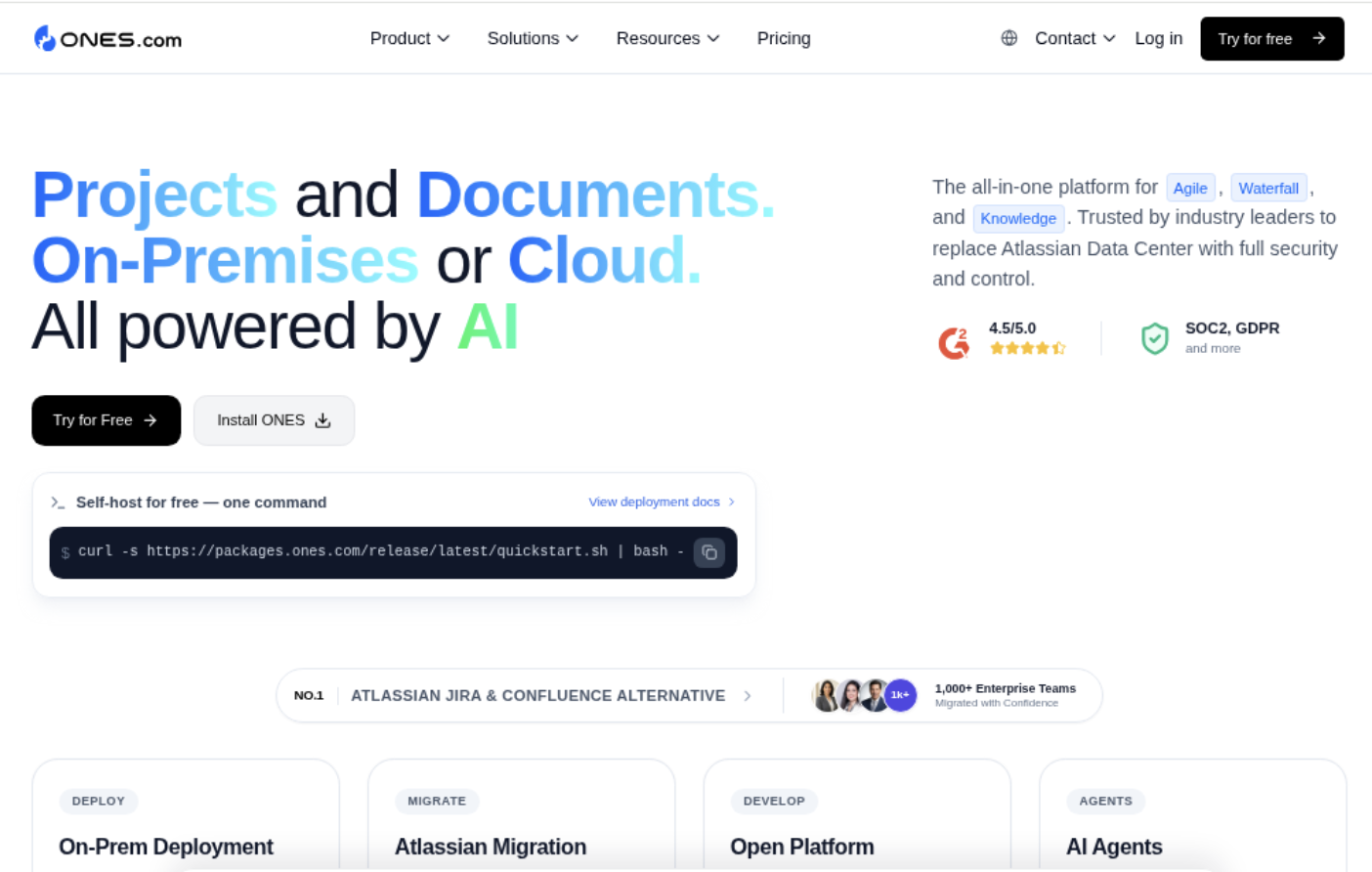
The platform can suit teams comparing recurring seat costs, plugin dependency, deployment control, and workflow flexibility. A free plan supports up to 30 seats, and deployment options include Cloud, On-Premise, Private Cloud, and Air-gapped environments.
Core Capabilities
- Scattered project tracking → ONES Project combines planning, issue tracking, and delivery workflows → Your team gets one consistent place to coordinate work.
- Rigid processes → Custom workflows and fields let you model intake, review, testing, release, and approval stages → Teams can reflect their operating process without excessive workarounds.
- Separate sprint tools → Built-in sprint management supports backlog planning and iteration tracking → Product and engineering teams can manage cycles with fewer add-ons.
- Manual recurring actions → Automation handles routine transitions and notifications → People spend less time repeating administrative steps.
- Limited reporting visibility → Built-in reporting turns project activity into planning and delivery views → Managers can identify delays, workload concerns, and progress patterns earlier.
- Plugin-heavy workflows → Native capabilities reduce dependence on multiple extensions → Administrators can manage fewer moving parts and review fewer compatibility risks.
- Deployment restrictions → Cloud, On-Premise, Private Cloud, and Air-gapped options support different security environments → Teams can select an operating model that matches internal requirements.
- Uneven cloud and self-hosted capabilities → ONES maintains feature parity between cloud and self-hosted versions → A deployment decision does not automatically mean giving up core functionality.
Application Scenarios
Growing product team: A 25-person team can use custom fields for product area, customer impact, release target, and risk. Sprint management and reporting then connect daily work with release planning.
Restricted-network engineering group: An organization with an air-gapped environment can evaluate the self-hosted deployment path. The team can keep project workflows inside its approved network boundary.
Multi-team delivery organization: Several departments can use shared workflow standards while keeping project-specific fields and reporting views. This supports consistency without forcing every team into identical procedures.
Common Challenges When Buying a Jira Plan
Challenge: Your team size changes frequently
Solution: Track active seats monthly and forecast contractors separately. Compare flexible billing with annual commitment before choosing a term.
Challenge: The plan meets basic needs, but reporting takes too long
Solution: Measure reporting effort for one full planning cycle. Compare built-in reporting, available integrations, and the cost of manual preparation.
Challenge: Different teams need different permissions
Solution: Create role scenarios before purchase. Test visibility, project administration, external access, and approval authority with realistic examples.
Challenge: Add-ons make the total cost unclear
Solution: Create a 12-month product and integration budget. Include subscription fees, app charges, training, migration, administration, and renewal changes.
Challenge: Procurement wants a single lowest-price answer
Solution: Present three options: minimum viable, recommended, and growth-ready. Explain the operational trade-offs behind each choice.
FAQs About Jira Plan Costs
Is Jira Free enough for a small team?
It can be enough for a small team with straightforward issue tracking and limited administration needs. Test your real workflow before relying on it long term. Check permissions, reporting, automation, storage, integrations, and team growth. A small team may still need a paid tier if it handles sensitive projects, requires advanced controls, or depends on extensive collaboration.
What is the main difference between Standard and Premium?
Standard generally suits growing teams that need more capacity and administration than the Free tier provides. Premium is aimed at more complex delivery environments that need stronger planning, higher limits, or advanced service capabilities. The right choice depends on your process. A small team with simple workflows may receive little value from Premium features.
Does Jira pricing change as more people join?
Cloud pricing typically changes with the number of seats included in your subscription. Add contributors, managers, contractors, or reviewers, and your recurring cost may rise. Keep a seat forecast for the next year rather than reviewing headcount only at renewal. Also check whether annual and monthly billing calculate seats differently.
Should I choose monthly or annual billing?
Monthly billing can suit teams with uncertain headcount, temporary projects, or frequent organizational changes. Annual billing may provide a simpler purchasing process and a different effective rate, though it creates a longer commitment. Compare both options against current seats, expected growth, and your likely maximum headcount.
Are Jira add-ons included in the plan price?
Many specialized apps and integrations carry separate charges. Examples include advanced planning, time tracking, testing, portfolio reporting, and service features. Review your complete tool list before making a decision. A lower Jira tier with several paid add-ons may cost more and require more administration than a higher tier with broader native capabilities.
Conclusion
Choosing among Atlassian Jira pricing plans starts with your workflow, team size, growth forecast, deployment needs, and complete operating cost. Free can support a small trial, Standard often fits growing teams, Premium suits more complex delivery, and Enterprise deserves evaluation when governance and scale become central requirements.
But here's the truth: the cheapest subscription can become expensive when it creates manual reporting, extra apps, permission workarounds, or difficult administration. Compare realistic scenarios instead of plan labels alone.
Review the full Atlassian combination you may need, test representative workflows, and include non-subscription effort in your calculation. If deployment flexibility, native capabilities, and a Jira alternative matter, ONES.com gives you another platform to evaluate alongside Jira.