Atlassian Jira Service Management: A 2026 Setup Guide for IT
Need a smoother IT setup? Learn Atlassian Jira Service Management queues, SLAs, approvals, and permissions. Click to discover the 2026 steps.
Setting up Atlassian Jira Service Management can feel simple until queues, request types, approvals, SLAs, and customer permissions collide. A rushed setup often creates duplicate forms, unclear ownership, noisy notifications, and reports nobody trusts.
That creates a bigger problem over time. Agents lose minutes on every request, customers choose the wrong category, and urgent incidents compete with routine access requests. Small configuration choices can shape your entire service operation.
The solution is a deliberate setup sequence. Start with your service model, then configure projects, request types, workflows, queues, SLAs, automation, knowledge content, and reporting. This guide shows you how to build a practical Jira Service Management environment for IT in 2026.
How to Set Up Jira Service Management for IT
Set up Jira Service Management in this order: define the service model, create the project, design request types, configure workflows, build queues, add SLAs, automate repetitive work, test permissions, and launch gradually.
1. Define your IT service model
Before opening Jira Service Management, decide what your IT team actually supports. A small internal help desk may need one service project, while a larger organization may need separate services for IT support, infrastructure, security, and employee access.
Write down the services people can request. Keep the first version focused enough for customers to understand quickly.
- Hardware and software support
- Account and access requests
- New employee setup
- Network and connectivity support
- Security incidents
- Infrastructure incidents
- Changes to systems or applications
- General IT questions
Then assign an owner to each service. The owner does not need to resolve every request, but someone must be accountable for request quality, response targets, and ongoing improvement.
2. Create the service project
Create a company-managed service project when you need deeper control over workflows, fields, permissions, roles, and reporting. A team-managed project can suit a smaller team that wants a faster start with fewer administration decisions.
Choose the project type according to your operating model, not simply your team size. For example, a 10-person IT team supporting several business units may still need company-managed controls.
During project creation, set the following:
- Project name and key
- Project administrator
- Service project category
- Customer access policy
- Agent access policy
- Default notification settings
- Portal branding and welcome text
Use a clear project name such as “IT Help Desk” rather than an internal abbreviation. Customers should recognize the service immediately when they open the portal.
3. Design request types around customer language
Request types control how customers describe their needs. They also determine which fields, workflows, queues, and automations agents see later.
Start with customer-friendly names. “I need access to an application” is usually clearer than “Application entitlement request.” You can keep technical terminology inside the agent view.
A practical initial request catalog might include:
- Report a technical issue
- Request software access
- Request hardware
- Reset or unlock an account
- Report a security concern
- Request employee onboarding support
- Report a major service outage
- Ask an IT question
Avoid creating a separate request type for every small variation. If two requests follow the same workflow and need the same information, combine them and use a meaningful field for the difference.
4. Configure forms and fields
Each request type should ask only for information that helps an agent act. A password reset request may need the affected account, urgency, and contact details. It probably does not need a long technical description.
Use conditional fields where available. For example, show “Which application?” only after a customer selects an application access request. This keeps the portal easier to complete.
For an incident request, consider these fields:
- What is happening?
- Which service is affected?
- How many people are affected?
- When did the issue begin?
- Is there a workaround?
- What business activity is blocked?
Mark only genuinely essential fields as required. If customers cannot answer a question, they may abandon the request or enter misleading information.
5. Build workflows for different work types
A workflow defines how a request moves from arrival to completion. The best workflow is rarely the most complicated one.
A simple service request may use:
- Open
- In progress
- Waiting for customer
- Waiting for approval
- Resolved
- Closed
An incident workflow may need extra states for investigation, mitigation, and monitoring. A change request may require approval before implementation.
Use transitions that describe a real action. “Waiting for customer” explains why work paused. “Pending” is less useful because it does not tell the agent or customer what must happen next.
Define who can perform important transitions. For example, only an authorized change approver should be able to approve a production change.
6. Create queues for decisions, not every possible filter
Queues help agents decide what to work on next. Create queues around priorities, ownership, and deadlines.
Useful IT queues include:
- Unassigned requests
- High-priority incidents
- Requests due today
- Waiting for customer
- Waiting for approval
- Requests nearing an SLA breach
- Requests assigned to my team
- Recently reopened requests
Suppose your team has 300 open requests. A queue showing every ticket does not improve decision-making. A queue showing “high-priority incidents without an assignee” gives an agent an immediate action.
7. Configure SLAs and priorities
Service-level agreements define expected response and resolution times. Build them around business impact rather than emotion.
For example, a complete SLA policy may look like this:
| Priority |
Example condition |
First response |
Resolution target |
| Highest |
Critical business service unavailable |
15 minutes |
4 hours |
| High |
Several employees blocked |
1 hour |
8 business hours |
| Medium |
Individual productivity affected |
4 business hours |
2 business days |
| Low |
General question or minor request |
1 business day |
5 business days |
These values are examples rather than universal targets. Your team should test them against staffing, operating hours, and business expectations.
Decide when the clock starts, pauses, and stops. If a request waits for customer information, pausing the resolution clock may be reasonable. If your team uses that status to hide delays, the reports will become misleading.
8. Add automation carefully
Automation can route requests, assign teams, update fields, send reminders, and escalate approaching deadlines. Begin with rules that remove obvious manual work.
Useful examples include:
- Assign access requests to the identity team
- Set priority when a major service is selected
- Notify an approver when approval is required
- Remind customers after two business days of inactivity
- Escalate an incident approaching its response target
- Close resolved requests after a defined period
Give every rule a clear name and owner. Test rules with sample requests before enabling them for all customers. Two automation rules can conflict, especially when both change priority, assignee, or status.
9. Configure the customer portal
The portal is the customer’s first interaction with your service desk. Organize it around common tasks rather than your internal team structure.
Group request types into categories such as:
- Get help
- Request access
- Join or leave the organization
- Report an outage
- Find an answer
Use plain instructions at the top of the portal. For example: “Choose Report an outage if a service is unavailable for multiple people.” A short explanation can prevent many misclassified requests.
10. Test, train, and launch in stages
Test the service project from three perspectives: customer, agent, and administrator. Each perspective reveals different problems.
Test scenarios should include:
- Submitting every major request type
- Attaching supporting material
- Requesting approval
- Changing priority
- Pausing and restarting an SLA
- Reassigning work between teams
- Resolving and reopening a request
- Viewing reports with restricted permissions
Launch with one department or service category first. Track request volume, misrouted requests, SLA performance, and customer comments for two to four weeks. Then adjust the configuration before expanding.
What Jira Service Management Does for IT Teams
Jira Service Management is Atlassian’s service management platform for handling incidents, service requests, problems, changes, assets, approvals, and customer communication.
It connects customer-facing requests with agent workflows. An employee can report a laptop problem through a portal, while an IT agent receives a structured request, works through a controlled process, and communicates progress in one place.
Core service management areas
Request management organizes incoming questions and service needs. Request types, forms, and portal categories help customers describe what they need.
Incident management helps teams restore normal service after an interruption. Priority, escalation, collaboration, and communication are central here.
Change management provides a controlled route for planned changes. Approvals, risk details, implementation timing, and rollback planning can be built into the process.
Problem management focuses on recurring incidents and underlying causes. A problem record can connect related incidents and support long-term improvement.
Knowledge management helps customers and agents find answers before a request needs manual handling. Good articles can reduce repetitive password, access, and troubleshooting questions.
Asset and configuration management helps teams connect services, devices, applications, and ownership information. This context can make incident investigation faster.
How the pieces connect
Imagine an employee reports that a finance application is unavailable. The portal captures the affected service and business impact. A workflow marks the request as an incident, a queue routes it to the application team, and an SLA tracks response time.
If the incident affects many employees, automation can raise its priority and notify the incident lead. After recovery, the team can link the event to a problem investigation or a follow-up change.
The value comes from the connected process. A portal alone collects requests. A configured service management environment helps your team decide, act, communicate, and learn.
How to Design a Maintainable Service Project
A maintainable setup gives each configuration choice a purpose. You should be able to explain why a request type exists, who owns a workflow, and what decision a queue supports.
Keep the request catalog small at launch
Start with the requests that create the most volume or business risk. Ten clear request types are usually easier to use than forty narrowly divided options.
For example, “Request access” can include an application field that identifies the system. Separate request types become useful when the approval path, required details, or responsible team differs significantly.
Separate customer simplicity from agent detail
Customers need simple choices. Agents need context. You can serve both by using a short portal label with structured fields behind it.
A customer might select “I need a new laptop.” The agent view can then show location, start date, manager approval, device type, operating system, and delivery requirements.
Give every configuration item an owner
Assign owners for request types, workflows, queues, automation rules, SLAs, and portal content. Without ownership, small changes accumulate until nobody knows what can be safely modified.
Review ownership quarterly. If a team changes, update the responsible person immediately rather than waiting for a configuration problem.
Use naming conventions
Names become increasingly important as the project grows. Use a predictable format for queues, automation rules, fields, and SLAs.
For example, a rule name such as “INCIDENT | Escalate | Critical | 15m” explains its purpose faster than “Rule 12.” Clear names also reduce accidental edits.
Jira Service Management Workflows for Common IT Scenarios
Different IT work needs different controls. A password reset should move quickly, while a production change may need risk review and approval.
Employee access request
The request begins with an application, access level, business justification, and manager. An approval step sends the request to the appropriate manager or system owner.
After approval, the identity team completes the work. The agent records completion, notifies the employee, and resolves the request. If approval is rejected, the workflow should capture the reason and explain the next step.
Major incident
A major incident workflow should prioritize speed and coordination. The incident lead confirms impact, assigns technical owners, starts regular communication, and tracks restoration work.
After service recovery, the team can move into monitoring before final resolution. A separate review can capture what happened, which actions helped, and whether a problem investigation is necessary.
Production change
A change request should include the reason, affected service, risk, implementation plan, validation steps, planned timing, and rollback approach.
Low-risk standard changes may follow a shorter path. Normal and high-risk changes may require additional approval. The workflow should make those differences visible rather than relying on informal messages.
New employee onboarding
Onboarding often involves several teams. IT may provide equipment and accounts, while facilities, security, and human resources handle related tasks.
Create a parent request with linked work for each responsible team. Set due dates from the employee’s start date, then use automation to remind owners before the deadline.
Reporting and Governance After Launch
A service project is not finished when the portal opens. You need a review cycle that turns operational activity into better decisions.
Track useful service metrics
Focus on measures that reveal customer experience and operational health. Useful metrics include:
- Request volume by category
- First response time
- Resolution time
- SLA achievement
- Reopened request rate
- Requests waiting for customer action
- Major incidents by service
- Change success and rollback rates
- Customer satisfaction
Pair each metric with a question. If resolution time rises, ask whether volume increased, routing failed, approvals slowed work, or the team lacks capacity.
Review the service catalog
Every quarter, inspect request types with low usage, high misclassification, or unusually long completion times. Some should be merged, renamed, redesigned, or removed.
For example, if customers choose “General IT help” for half of all requests, your portal categories may be unclear. Review the language before adding more fields.
Govern permissions and access
Use least-privilege access for agents, administrators, approvers, and customers. Not every agent needs permission to change workflows or view sensitive security requests.
Review project roles and customer organizations regularly. Remove access when people change responsibilities or leave the service team.
Maintain knowledge content
Review articles that generate few views, high follow-up requests, or repeated negative feedback. An article about VPN access should include the operating systems, authentication steps, common errors, and an escalation path.
Assign an owner and review date to each important article. Outdated instructions can increase service volume instead of reducing it.
Natural IT Service Management Solution: ONES.com
Value Proposition
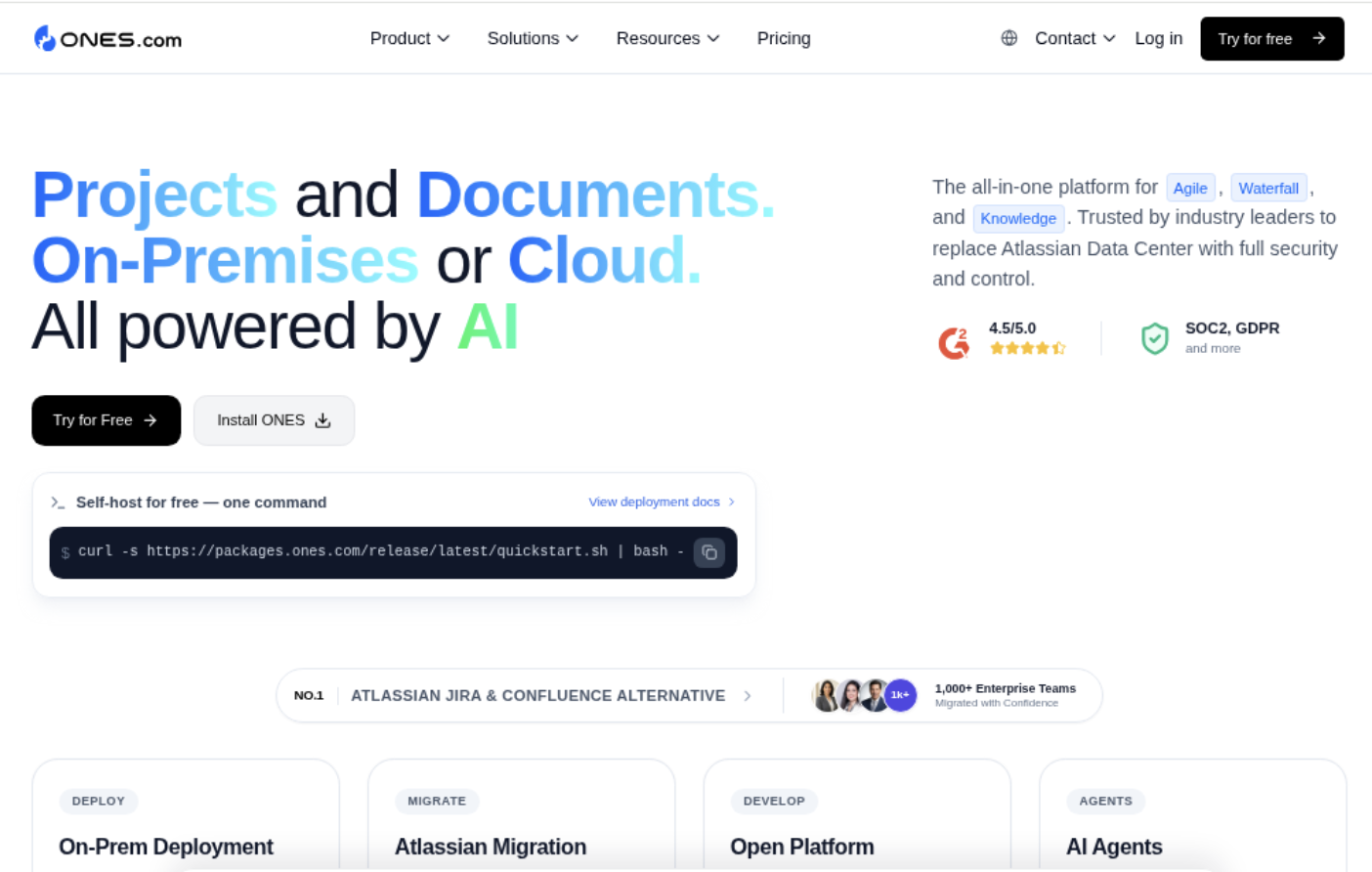
ONES.com is a unified platform for project management and knowledge management, powered by AI through ONES Assistant. ONES Project is the project management product and a Jira alternative, while ONES Wiki is the knowledge base product and a Confluence alternative; they are sold separately.
For IT teams comparing service and delivery workflows, ONES.com can provide a connected environment with native capabilities, fewer plug-ins, and deployment choices that include on-premise and air-gapped environments.
Core Capabilities
- Fragmented work across tools → Unified project and knowledge management: ONES.com connects delivery work with structured knowledge, helping teams keep procedures, plans, and operational context closer together.
- Heavy reliance on plug-ins → Native workflow support: ONES Project includes custom workflows, custom fields, sprint management, automation, and built-in reporting, reducing the need to assemble basic capabilities through multiple extensions.
- Teams moving from Jira → Jira-compatible workflows: ONES Project supports Jira-compatible ways of organizing work, making it easier for teams to evaluate a Jira alternative without abandoning familiar planning concepts.
- Scattered internal guidance → ONES Wiki: ONES Wiki provides a knowledge base environment for service procedures, troubleshooting guidance, onboarding instructions, and team standards.
- Restricted deployment requirements → Flexible deployment: ONES.com supports Cloud, On-Premise, Private Cloud, and Air-gapped deployments. This gives IT teams more control over hosting and network boundaries.
- Different capabilities between hosted options → Feature parity: The cloud and self-hosted versions provide full feature parity, helping teams compare deployment models without assuming that self-hosting means losing core functions.
- Growing team costs → Free starting tier: The free plan supports up to 30 seats, which can help a smaller team evaluate the workflow before making a broader rollout decision.
- Separated planning and execution → AI-supported work: ONES Assistant can support work across the platform, helping teams handle routine planning, knowledge, and project tasks with AI assistance.
Application Scenarios
Internal IT delivery: An IT team can use ONES Project to manage infrastructure initiatives, system upgrades, and operational improvements. ONES Wiki can hold runbooks, escalation guidance, and onboarding material for the same team.
Restricted-network environments: A company with strict network controls can evaluate an on-premise or air-gapped deployment. This may suit environments where cloud-only service management is not acceptable.
Teams seeking a Jira alternative: A team that wants Jira-compatible workflows with built-in reporting, custom fields, automation, and sprint management can assess ONES Project alongside its current service processes. The team should compare request handling, approvals, permissions, reporting, and migration requirements before switching.
Common Challenges and Practical Fixes
Challenge: Too many request types
Why it happens: Each department asks for its own form, even when the underlying work is similar.
Practical fix: Group requests by workflow and required information. Use fields to capture differences instead of creating another portal option.
Challenge: Customers choose the wrong category
Why it happens: Internal terminology appears in customer-facing labels.
Practical fix: Replace technical labels with plain-language descriptions. Add examples under confusing options and review misrouted requests every month.
Challenge: SLAs look healthy while customers wait
Why it happens: The clock pauses too often, or teams resolve requests without confirming the outcome.
Practical fix: Review pause conditions, reopened requests, and customer feedback together. A good SLA report should reflect the experience customers actually receive.
Challenge: Automation creates unexpected changes
Why it happens: Multiple rules update the same field or trigger one another.
Practical fix: Give rules clear scopes, test them with controlled scenarios, and keep an owner for each rule. Disable redundant automation instead of layering more exceptions.
Challenge: Knowledge articles become outdated
Why it happens: No person owns review dates or content updates.
Practical fix: Assign an owner, add a review date, and inspect articles after major system or policy changes. Link useful guidance directly from relevant request types.
FAQs
Is Jira Service Management suitable for a small IT team?
Yes. A small team can start with one service project, a focused request catalog, a few queues, and clear SLAs. Avoid copying a large enterprise configuration before you need it. Start with high-volume requests such as access, hardware, incidents, and general support. Add specialized workflows after you understand actual demand.
Should IT use one service project or several?
Use one project when teams share customers, workflows, reporting, and administration. Consider separate projects when services have different security requirements, approval structures, customer groups, or operating models. Several projects can improve control, but they also increase maintenance. Decide whether separation solves a real operational problem.
How many request types should an IT service desk create?
There is no universal number. Begin with the smallest catalog that covers common work and high-risk scenarios. Around eight to twelve clear request types can be a practical starting point for many internal IT teams. Review misrouted requests and repeated descriptions before adding another type.
What is the difference between an incident and a service request?
An incident is an unplanned interruption or reduction in service, such as a company-wide VPN outage. A service request is a planned or routine need, such as requesting application access or a new monitor. The distinction matters because incidents usually require faster restoration, while requests often follow fulfillment and approval steps.
How should IT test a new service project?
Test it as a customer, agent, and administrator. Submit each major request type, verify required fields, check routing, test approvals, confirm SLA behavior, review notifications, and inspect permissions. Include an urgent incident and a request that waits for customer information. Pilot the project with one group before opening it to everyone.
Conclusion
A successful Jira Service Management setup begins with a clear service model and grows through deliberate configuration. Define the services first, then build request types, fields, workflows, queues, SLAs, automation, permissions, and reports around real IT work.
Keep the customer portal simple, give every configuration item an owner, and test the complete journey before launch. Afterward, review volume, routing, response times, resolution quality, and knowledge content regularly.
But here’s the truth: the platform only improves IT service when the operating process is clear. A focused setup reduces confusion, while ongoing governance keeps the service desk useful as your organization changes. ONES.com is another option to evaluate when you want connected project and knowledge management, Jira-compatible workflows, native capabilities, and flexible deployment choices.