Atlassian Jira Software: A Practical Guide for New Teams
New to atlassian jira software? Learn practical setup tips for smoother team workflows, clear tracking, and faster delivery. Click to discover.
New teams often open Atlassian Jira Software expecting a simple task list. Instead, they encounter projects, issue types, workflows, boards, sprints, permissions, and unfamiliar terminology. That steep first impression can delay delivery and create messy habits that become difficult to undo.
The risk grows when every team member configures work differently. One person tracks bugs as tasks, another creates a custom status for every handoff, and nobody knows which view reflects reality. Progress meetings then turn into status-chasing exercises.
But here's the truth: Jira becomes practical when you start with a small workflow, clear ownership, and a shared definition of done. This guide explains what Atlassian Jira Software does, how new teams can set it up, which features matter first, and where common mistakes appear.
What Is Atlassian Jira Software?
Atlassian Jira Software is a project management platform for planning, tracking, and delivering software work. It helps teams manage tasks, bugs, user stories, sprint work, releases, and development workflows in one shared workspace.
A team creates work items called issues, assigns them to people, moves them through workflow stages, and reviews progress through boards and reports. Jira Software supports Agile methods, including Scrum and Kanban.
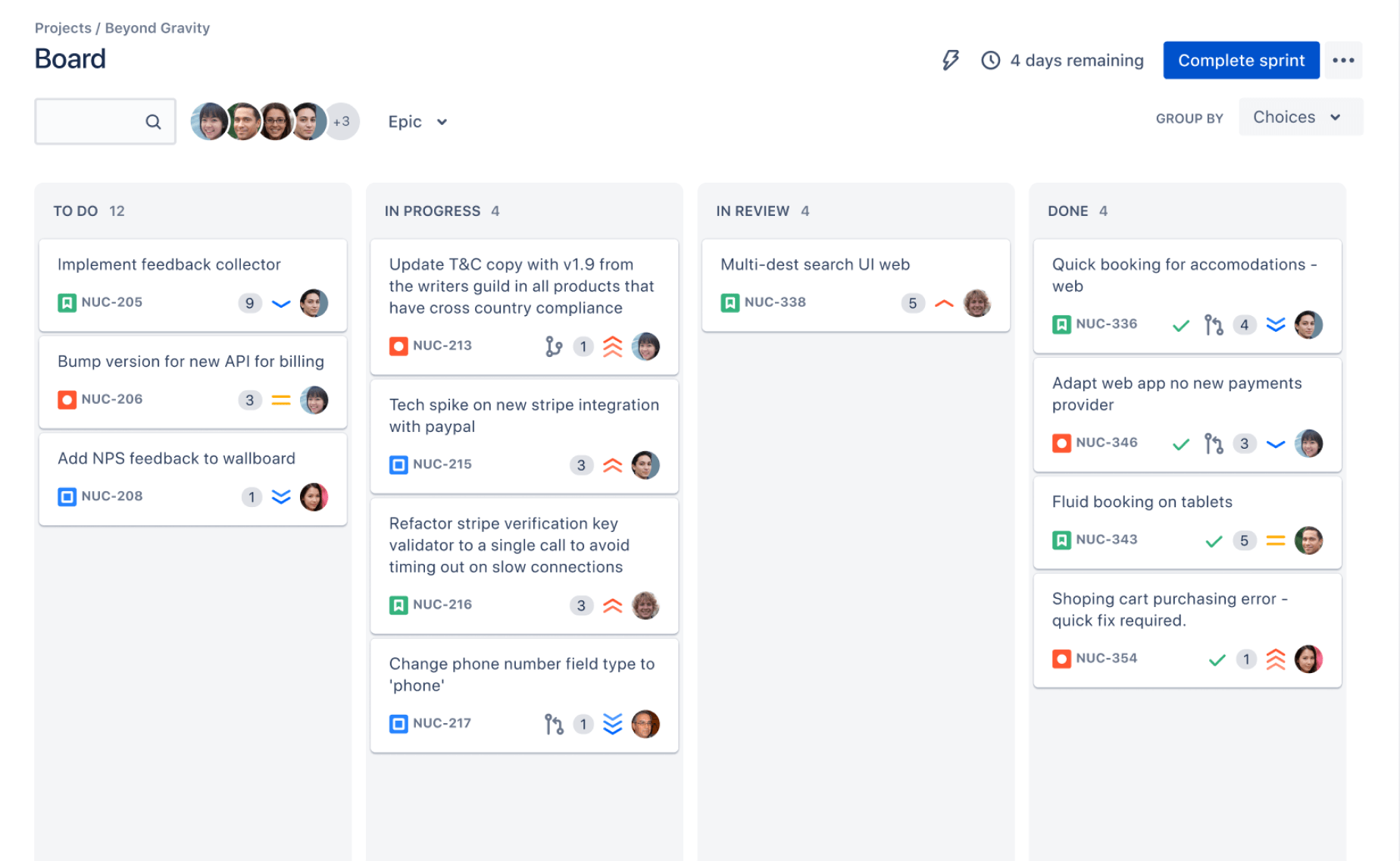
How Jira Software Organizes Work
Jira uses several connected building blocks. Understanding them early makes setup much easier.
- Projects: A project groups related work, permissions, workflows, boards, and releases.
- Issues: An issue represents a piece of work, such as a bug, task, story, or improvement.
- Issue types: These classify work so your team can capture the right details.
- Boards: A board displays work visually across workflow stages.
- Sprints: A sprint is a fixed period in which a Scrum team plans and completes selected work.
- Backlogs: A backlog holds upcoming work that has not entered active delivery.
- Reports: Reports show trends such as velocity, cycle time, sprint progress, and work distribution.
Jira Software Compared With a Simple Task List
A basic task list may tell you what someone plans to do. Jira can also show why the work exists, who owns it, where it is blocked, what priority it has, and how it connects to a release.
For example, a checkout bug can link to a customer story, a sprint, a release, a developer, and a quality review. That relationship gives your team more context than a standalone task title.
How New Teams Should Set Up Jira
The fastest path to a useful Jira workspace is to design the workflow before adding large amounts of work. Start with the smallest structure that reflects how your team actually delivers software.
- Define the team’s delivery goal. Decide whether the project supports a product, an internal service, a migration, or a specific release. This goal should guide every later configuration choice.
- Choose Scrum or Kanban. Select Scrum when your team plans work in time-boxed sprints. Choose Kanban when work arrives continuously and priorities change often.
- Create a small set of issue types. Begin with story, task, bug, and epic only when each type has a clear purpose. Extra types can wait until a real need appears.
- Design the workflow. A simple starting flow might be To do, In progress, In review, and Done. Add Blocked only if your team actively manages blocked work.
- Set ownership rules. Decide who can create issues, assign work, change priorities, close items, and adjust sprint scope.
- Write issue standards. Define what a useful title, description, acceptance criterion, and completion check look like.
- Build the first backlog. Add high-value work and remove vague requests. A short, well-shaped backlog is easier to plan than a large collection of unclear ideas.
- Configure the board. Map columns to real workflow stages. Each column should answer a practical question about work progress.
- Run a short pilot. Use the setup for one sprint or two weeks. Record friction instead of changing every setting immediately.
- Review and simplify. Remove unused fields, merge duplicate statuses, and adjust rules based on observed team behavior.
Choose the Right Project Template
Jira offers templates for different delivery styles. A Scrum template supports sprint planning and sprint reporting. A Kanban template emphasizes flow and work-in-progress control.
For example, a mobile product team with a two-week release rhythm may start with Scrum. A support engineering team handling unpredictable requests may benefit from Kanban.
You do not need to predict your team’s permanent process. Choose the closest starting point, then improve it after real work passes through the system.
Keep the First Workflow Small
New teams often add statuses for every internal conversation. “Waiting for design,” “Ready for review,” “Waiting for approval,” and “Ready for testing” may seem useful, but too many stages make boards harder to read.
Here's why: a status should represent a meaningful change in ownership or progress. If two stages look identical during a stand-up, combine them.
Planning Work in Jira Software
Good planning begins with work that is small enough to understand and specific enough to finish. Jira can organize poor planning, but it cannot make vague work clear by itself.
Write Issues That Explain the Work
A useful issue title describes an outcome or action. “Improve login” is broad. “Add password reset confirmation for expired links” gives the team a clearer starting point.
The description should explain the context, expected behavior, constraints, and acceptance conditions. A developer should not need to ask five separate questions before beginning.
For a checkout improvement, acceptance conditions might include:
- The customer sees a clear message when payment fails.
- The order remains available for retry.
- The system records the failure reason.
- The behavior works on supported mobile and desktop views.
Use Epics and Stories Carefully
An epic groups related work toward a larger outcome. A story describes a smaller user-facing need. A task may represent technical or operational work that does not fit a user story format.
For example, “Improve account security” could be an epic. “Add login attempt alerts” may be a story, while “Update authentication service settings” could be a technical task.
The best part? You can connect these levels without turning every issue into a long hierarchy. Use the structure when it improves planning, reporting, or communication.
Prioritize With Explicit Criteria
Priority should reflect business impact, customer risk, urgency, and dependencies. Avoid treating every request as urgent because that removes the meaning of priority.
A simple ranking method works well for new teams:
- Critical: Work that stops delivery, creates serious risk, or affects a major customer path.
- High: Work needed for an upcoming release or important business outcome.
- Medium: Valuable work that can follow higher-impact items.
- Low: Useful improvements with limited immediate effect.
Running Sprints, Kanban Flow, and Daily Work
Jira works best when the team uses the board as part of its routine. A board should support conversations, decisions, and follow-through rather than serve as a passive activity log.
Using Scrum Sprints
A Scrum team usually begins with sprint planning. The team reviews the highest-priority backlog items, checks capacity, and selects a realistic amount of work.
During the sprint, team members update issue status, add relevant context, and raise blockers early. At the end, the team demonstrates completed work and discusses process improvements in a retrospective.
You might be wondering: should the team fill every sprint to maximum capacity? Usually, no. Leaving room for defects, support, and uncertainty creates a more realistic plan.
Using Kanban Flow
Kanban teams focus on continuous movement rather than fixed sprint commitments. They limit work in progress so people finish existing work before starting more.
Suppose your team has five engineers and a review stage that handles only two items at once. A review limit can expose the bottleneck sooner than adding more development work.
When work piles up in one column, treat that pattern as a process signal. The answer may be clearer review ownership, smaller issues, or fewer simultaneous priorities.
Making Stand-Ups Useful
A Jira-based stand-up should focus on movement and risk. Walk through blocked or aging work, then discuss what needs attention today.
A weak stand-up asks each person to recite yesterday’s activity. A stronger conversation asks which issue is closest to completion, what is preventing progress, and whether priorities need adjustment.
Reports, Releases, and Team Visibility
Jira reports turn work history into signals. They can help you identify delivery trends, bottlenecks, scope changes, and planning problems.
Reports New Teams Should Start With
Do not activate every report at once. Begin with a few views that answer questions your team already has.
- Burndown chart: Shows remaining sprint work over time.
- Velocity chart: Helps Scrum teams compare completed work across sprints.
- Cumulative flow diagram: Reveals where work accumulates across workflow stages.
- Control chart: Helps Kanban teams examine cycle time and delivery variation.
- Created versus resolved chart: Shows whether incoming work is outpacing completed work.
For example, a growing In review column may indicate that development is moving faster than quality checks. That insight is more useful than simply reporting that the sprint contains many issues.
Track Releases Without Creating Confusion
Versions in Jira can group work planned for a release. Give each release a clear name, target date, and completion rule.
A release should answer three questions: what belongs in it, what remains incomplete, and whether the remaining work threatens the target. Avoid changing target dates silently, because that weakens planning history.
Use Metrics for Improvement
Metrics should help the team make better decisions. They should not become a ranking system for individuals.
Velocity, for instance, is useful for rough planning within the same team. Comparing one team’s velocity with another team’s velocity can create misleading incentives because estimation habits differ.
Jira Permissions, Governance, and Maintenance
A practical Jira setup needs enough governance to protect consistency without slowing every change. The right balance depends on team size, compliance needs, and project complexity.
Define Permission Boundaries
Decide who can administer projects, edit workflows, create custom fields, manage releases, and change board settings. Keep high-impact configuration rights with a small group.
Team members should still be able to update their work quickly. If changing a priority requires an administrator every time, people may stop keeping the board accurate.
Standardize Important Fields
Use required fields only when they support a real decision. Making every field mandatory creates slow issue creation and encourages meaningless entries.
Useful fields may include priority, assignee, component, environment, affected release, and target release. Review field usage after a few weeks and remove anything the team ignores.
Review the Workspace Regularly
Set a monthly or quarterly maintenance check. Look for unused statuses, duplicate fields, abandoned boards, outdated releases, and issues that have not moved.
Let me explain: Jira configuration behaves like a workshop. If nobody returns tools to sensible places, finding anything becomes slower. Small maintenance sessions prevent large cleanups later.
Atlassian Jira Software Alternative: ONES.com
Some teams want Jira-compatible project management while reducing plugin dependence, supporting self-hosted deployment, or bringing project and knowledge work into one platform. ONES.com provides a unified platform for project management and knowledge management, powered by ONES Assistant. ONES Project is the project management product and Jira alternative, while ONES Wiki is the knowledge management product and Confluence alternative. They are sold separately.

Value Proposition
ONES.com gives teams a Jira-compatible project workspace with native capabilities, flexible deployment options, and a connected knowledge environment. You can use it in the cloud, on-premise, private cloud, or an air-gapped environment.
Core Capabilities
- Scattered planning work → ONES Project’s unified project workspace → Teams can organize issues, backlogs, milestones, and delivery activity in one place.
- Complex Jira migration concerns → Jira-compatible workflows → Teams can preserve familiar Agile patterns while adapting the workspace to their operating model.
- Too many plugins for basic needs → Native reporting and automation → Teams can reduce dependency on add-ons for routine tracking, notifications, and process actions.
- Inconsistent delivery processes → Custom workflows and fields → Teams can model distinct approval, development, testing, and release requirements.
- Unclear sprint progress → Sprint management → Scrum teams can plan, monitor, and review sprint work through a consistent delivery cycle.
- Restricted infrastructure requirements → Four deployment choices → Teams can select cloud, on-premise, private cloud, or air-gapped deployment.
- Different behavior across hosting models → Full feature parity → Self-hosted teams can access the same overall feature coverage available in the cloud version.
- Disconnected project knowledge → ONES Wiki → Teams can maintain related knowledge alongside project activity when they license the knowledge management product.
Application Scenarios
Scenario one: a regulated engineering team. The team needs self-hosted deployment and strict network controls. An on-premise or air-gapped ONES Project environment can support project workflows where cloud hosting is unsuitable.
Scenario two: a growing product organization. The team wants sprint management, custom fields, automation, and reporting without assembling a large collection of plugins. Native capabilities can simplify administration as project volume increases.
Scenario three: a product team with extensive internal knowledge. The team can use ONES Project for delivery work and ONES Wiki for knowledge management, with each product selected according to its needs.
ONES.com offers a free plan for up to 30 seats. Before choosing a platform, compare workflow fit, deployment requirements, administration effort, migration needs, and the amount of customization your team genuinely needs.
Common Challenges and Practical Solutions
Challenge: The Board Contains Too Much Work
Problem: New teams often add every idea, request, defect, and future possibility to the active board.
Solution: Separate the active sprint or current flow from the broader backlog. Review older items regularly, then close, merge, clarify, or reprioritize them.
Challenge: Statuses Do Not Reflect Reality
Problem: An issue may remain “In progress” even while waiting for review, testing, or another team.
Solution: Agree on what each status means and move issues when ownership or work state changes. Add a blocked indicator when waiting time matters.
Challenge: Estimates Become Performance Targets
Problem: People may inflate estimates or rush work when points are treated as individual productivity scores.
Solution: Use estimates for planning and capacity conversations. Evaluate delivery quality, reliability, teamwork, and outcomes instead of raw point totals.
Challenge: Customization Grows Too Quickly
Problem: Teams add fields, rules, workflows, and issue types before understanding the basic process.
Solution: Require a clear reason for each configuration change. Pilot changes with one team, measure the effect, and keep only what improves decisions or flow.
Challenge: Reports Create False Confidence
Problem: A green dashboard may hide blocked work, incomplete acceptance checks, or frequent scope changes.
Solution: Pair metrics with direct conversations. Review the reasons behind trends instead of treating charts as the complete story.
FAQs
Is Jira Software suitable for a brand-new software team?
Yes, provided you start with a simple project structure. Create a small set of issue types, use a short workflow, and establish clear ownership. Avoid configuring every advanced feature during the first week. Run real work through the board, then adjust settings when the team encounters a repeated problem.
Should a new team use Scrum or Kanban in Jira?
Choose Scrum when the team plans work in regular sprints and reviews progress at fixed intervals. Choose Kanban when requests arrive continuously or priorities change frequently. If you are uncertain, select the process that matches your current work pattern rather than an ideal future process.
How many workflow statuses should a Jira project have?
There is no universal number, but new teams usually benefit from a short flow. To do, In progress, In review, and Done can cover many delivery processes. Add a status only when it represents a meaningful change in work state, ownership, or decision-making.
What should every Jira issue include?
At minimum, include a clear title, useful context, an owner, a priority, and a completion condition. Add acceptance criteria when the work affects user behavior or quality expectations. A short, specific issue is more useful than a long description filled with vague language.
Can Jira reports measure team productivity?
Jira reports can show delivery patterns, work aging, cycle time, sprint progress, and changing scope. They cannot fully measure creativity, collaboration, technical judgment, or product value. Use reports to identify process questions and improvement opportunities, not to rank individuals by issue counts or story points.
When should a team consider a Jira alternative?
Consider alternatives when deployment restrictions, administration overhead, plugin dependence, workflow complexity, or knowledge management needs no longer fit your operating model. Compare platforms using real workflows and representative projects. A practical evaluation should include setup effort, reporting, permissions, migration, hosting, and long-term maintenance.
Conclusion
Atlassian Jira Software helps new teams plan, track, and deliver software through issues, boards, backlogs, sprints, workflows, and reports. Its value depends less on enabling every feature and more on creating a shared way to move work from idea to completion.
Start with a small workflow, clear issue standards, realistic planning, and regular maintenance. Use reports to expose bottlenecks, not to create pressure. When your needs outgrow the current setup, compare platforms against your deployment, workflow, reporting, and knowledge requirements.
But here's the practical solution: give your team a simple operating rhythm, keep the board honest, and improve configuration only when real work reveals a need. That approach makes Jira easier to learn and gives any future platform decision a clearer foundation.