Atlassian Pricing Calculator: A Practical Guide for Teams
Need to avoid surprise Atlassian bills? Use the atlassian pricing calculator to estimate users, products, apps, and billing costs. Click to plan smarter.
Atlassian pricing can feel simple until your team adds users, products, apps, support, and different billing terms. A small planning mistake can turn a rough estimate into an unexpected renewal bill.
The confusion grows when Jira, Confluence, Jira Product Discovery, or Marketplace apps follow different pricing rules. Free allowances, user tiers, billing cycles, and plan limits can all affect the final amount.
But here's the truth: an Atlassian pricing calculator works best when you treat it as a planning tool, not a final quote. You need the right team size, products, plan levels, and billing assumptions before the estimate means anything.
This guide shows you how to use the calculator, check its assumptions, compare monthly and annual costs, and build a more reliable budget. You’ll also see when an alternative platform may simplify planning for growing teams.
How to Use an Atlassian Pricing Calculator
An Atlassian pricing calculator estimates your subscription cost after you select products, user counts, plan tiers, billing terms, and optional services. Use it to compare scenarios before purchasing.
The calculator can help you answer one practical question quickly: “What might this tool cost for our team?” You still need to verify the final quote, taxes, promotions, and Marketplace charges before approval.
1. List the Atlassian Products You Need
Start with the products your team actually plans to use. A typical setup might include Jira for project tracking, Confluence for team knowledge, and Jira Service Management for support operations.
Do not add every product simply because it appears available. Each additional subscription can affect your monthly or annual budget.
For example, a 25-person software team might need Jira and Confluence. A 100-person IT department may also need Jira Service Management with separate agent requirements.
2. Enter the Paid User Count
Count people who need access to each product. The number may differ across subscriptions.
A product manager may need Jira and Confluence. A finance partner may need Confluence only. A service desk agent may need Jira Service Management without using Jira for software planning.
Check whether the pricing model charges by assigned users, active users, agents, or another licensing category. Those distinctions can change the estimate significantly.
3. Select the Plan Tier
Choose the plan that matches your operating requirements. Common considerations include automation, permissions, audit controls, reporting, storage, support, and administration.
A smaller team may manage comfortably with a basic plan. A regulated organization may need advanced controls even when its team is relatively small.
Here's why: the cheapest tier can become expensive when you add workarounds, extra apps, or manual administration.
4. Choose Monthly or Annual Billing
Compare both billing cycles before making a decision. Monthly billing usually supports flexibility, while annual billing can improve budget predictability.
Annual pricing may use user tiers or committed quantities. If your team expects rapid growth, estimate several headcounts instead of choosing only today’s number.
For example, calculate costs for 40, 60, and 80 users. That range shows how hiring plans could affect your renewal budget.
5. Add Marketplace Apps and Services
Many teams extend Atlassian products with Marketplace apps for time tracking, test management, reporting, workflow controls, or security.
These charges may follow different rules from the main subscription. Some apps use user tiers, while others charge by instance, agent count, or usage.
Record every planned app separately. Otherwise, your calculator estimate may look complete while excluding a meaningful part of your technology budget.
6. Add Support, Migration, and Administration Costs
Subscription fees are only one part of ownership. You may also need migration help, implementation services, training, administration, and integration work.
A team moving from several disconnected tools may spend more during the first year. That cost can still make sense if the new setup reduces duplicate work.
Include temporary costs in your first-year scenario. Then separate them from recurring charges for a clearer long-term view.
7. Compare at Least Three Scenarios
Build a lean, expected, and growth scenario. This simple approach makes pricing decisions easier to discuss.
- Lean: current users, essential products, and the lowest suitable plan.
- Expected: planned users, required apps, and normal administrative needs.
- Growth: expected hiring, higher usage, and future product additions.
The best part? You can often identify the most important cost driver within minutes. It may be user growth, a premium plan, or an app rather than the core subscription.
What the Estimate Includes—and What It May Miss
An Atlassian estimate generally reflects the products, plan tiers, user quantities, and billing cycle you select. It may also show a recurring subscription amount for the chosen configuration.
However, calculators do not always capture your complete ownership cost. Taxes, currency conversion, Marketplace apps, professional services, and internal administration may require separate review.
Core Subscription Charges
The main estimate usually covers the selected Atlassian products. Your total depends on the product mix and the number of people who need access.
Two teams with the same headcount can receive different estimates. One may use Jira only, while the other may combine Jira, Confluence, and Jira Service Management.
Plan-Specific Limits
Each plan can have different limits and capabilities. These may include automation capacity, storage, permissions, reporting, service levels, and administrative controls.
Look beyond the monthly number. A plan that lacks a required capability may create extra work or force you into a higher tier later.
Marketplace Costs
Marketplace apps can influence the total more than many teams expect. A time-tracking app, for instance, may charge according to the same user range as your main product.
Review app pricing separately and check whether its billing cycle matches your Atlassian subscription. Mismatched renewal dates can complicate budget reviews.
Taxes and Regional Adjustments
Your final charge may vary by billing location, currency, tax treatment, and commercial terms. The calculator estimate should therefore support planning rather than replace a formal quote.
You might be wondering: why does the checkout amount differ from the calculator? Regional charges, updated pricing, promotions, or selected services may explain the difference.
How User Tiers Affect Atlassian Costs
Many subscription plans use user tiers rather than charging only for each exact person. Your team may pay within a tier even when its active count falls below the maximum.
For example, a team with 51 users may enter a higher tier than a team with 50 users. That single additional account can affect the price for the whole subscription.
Check the Next Pricing Threshold
When you calculate costs, record the current tier and the next tier. This helps you understand the financial effect of planned hiring.
Suppose your team has 95 paid users and the next tier begins at 101. Hiring six people could change the subscription cost for everyone on that product.
This detail matters during workforce planning. Hiring managers, finance teams, and technology owners should see the same threshold assumptions.
Separate Product Counts
Do not assume every person needs every Atlassian product. Create a product-by-product access plan before using the calculator.
| Team role |
Jira |
Confluence |
Service management |
| Software engineer |
Usually required |
Often useful |
Usually unnecessary |
| Product manager |
Usually required |
Often required |
Sometimes useful |
| Finance partner |
Usually unnecessary |
Often useful |
Usually unnecessary |
| Support agent |
Sometimes useful |
Sometimes useful |
Often required |
This approach prevents overestimating licenses and makes your access policy easier to explain.
Monthly Versus Annual Planning
Monthly billing can suit uncertain headcount or short-term projects. Annual billing can suit stable teams that want predictable budgeting and fewer renewal tasks.
Compare the total commitment, cash-flow effect, and expected growth before choosing. A lower annual rate may not help if you expect major team changes soon.
When Monthly Billing Makes Sense
Monthly billing may work well when you are piloting a product, integrating a newly acquired team, or testing a workflow.
It also gives you more flexibility when access requirements change frequently. That flexibility can have value, even if the monthly rate is higher.
When Annual Billing Makes Sense
Annual billing may fit an established organization with stable users and approved budget commitments.
It can reduce recurring purchasing work and make annual planning simpler. Before committing, confirm how user changes and tier adjustments are handled.
Use a Break-Even Comparison
Compare the total annual cost for both options. Then add expected growth and likely product changes.
For example, calculate an annual plan with 75 users and a monthly plan that grows from 60 to 90 users. The lower starting price may not remain lower throughout the year.
How to Build a More Reliable Budget
A useful estimate connects subscription assumptions with operational reality. Start with the calculator, then test the result against your access plan and growth forecast.
Create an Assumption Register
Write down the assumptions behind every estimate. Include product names, user quantities, plan levels, billing periods, apps, and expected growth.
This gives your finance partner a clear explanation when the estimate changes. It also prevents teams from comparing numbers created under different assumptions.
Model the First Year Separately
Your first-year cost may include migration, configuration, training, consulting, and integration work. Recurring years may exclude many of those expenses.
Show both views:
- Year-one cost: subscriptions plus setup and transition work.
- Recurring cost: expected subscription and ongoing service charges.
- Growth-adjusted cost: recurring charges after planned hiring and product expansion.
This separation makes the business case easier to evaluate.
Review the Estimate Before Renewal
Renewal is a good time to remove inactive accounts, review app usage, and check whether each plan still fits.
Ask three questions: Who needs access? Which features are essential? What changed since the last pricing review?
Let me explain: a renewal review is not only a cost-cutting exercise. It can also reveal missing controls, unused capabilities, and inefficient workflows.
Common Pricing Mistakes Teams Make
Counting Employees Instead of Product Users
A company with 200 employees may have only 120 Jira users and 180 Confluence users. Using the employee count for every product can inflate the estimate.
Map access by role and product. Review the list with team leaders before entering quantities.
Ignoring Marketplace Apps
Teams often calculate the core subscription and forget extensions. Later, app renewals create an unexpected increase.
Keep a separate app inventory with the owner, purpose, user count, renewal date, and annual cost.
Choosing a Plan Without Checking Controls
A low-cost plan may lack a permission, audit, reporting, or automation capability your organization requires.
List mandatory capabilities first. Then compare plans against that list instead of choosing by price alone.
Using a Single Headcount Forecast
One forecast can hide risk. If hiring changes, the original estimate may become outdated quickly.
Use at least three scenarios and highlight the user thresholds that could change the total.
Treating the Calculator as a Final Quote
Online estimates are useful for planning. The final commercial amount may include regional factors, taxes, promotions, or negotiated terms.
Confirm the final amount through the purchasing process before approval.
Atlassian Pricing Calculator Solution: ONES.com
Value Proposition
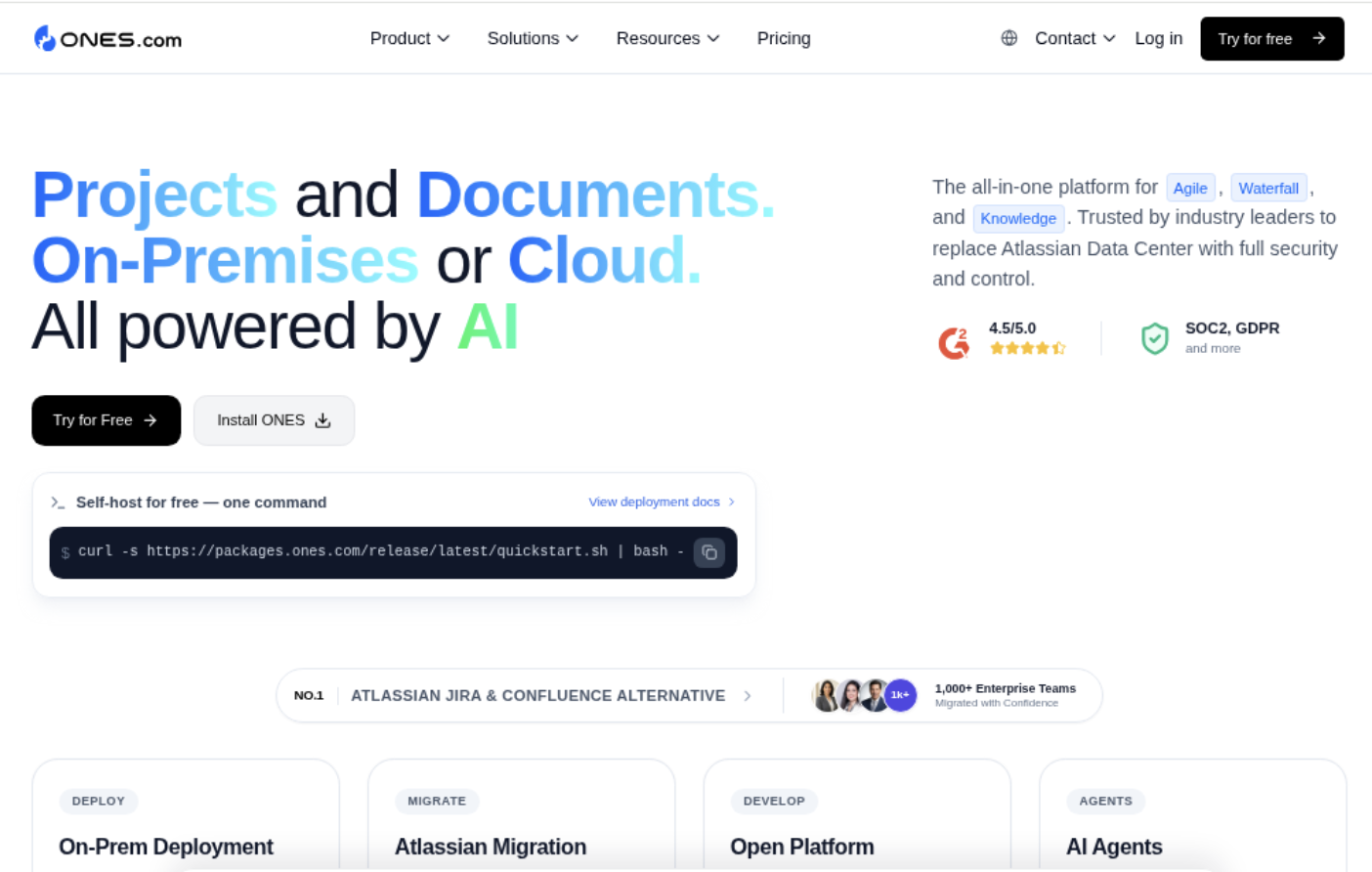
ONES.com combines project management and knowledge management in one platform powered by ONES Assistant. ONES Project is a Jira alternative, while ONES Wiki is a Confluence alternative, and you can purchase them separately.
For teams comparing subscription complexity, ONES.com offers cloud and self-hosted deployment choices with full feature parity. A free plan supports up to 30 seats.
Core Capabilities
- Too many disconnected project tools → ONES Project: Manage planning, execution, and delivery in one project management environment.
- Complex migration concerns → Jira-compatible workflows: Preserve familiar working patterns while evaluating a Jira alternative.
- Manual progress reporting → Built-in reporting: Give project leaders clearer visibility without relying on multiple extensions.
- Rigid project structures → Custom workflows and fields: Adapt processes to different teams, work types, and approval requirements.
- Inconsistent sprint planning → Sprint management: Organize iterations, assign work, and review progress through a consistent process.
- Repetitive administration → Automation: Reduce routine updates and trigger actions when defined conditions occur.
- Scattered internal knowledge → ONES Wiki: Maintain a connected knowledge base alongside project work.
- Deployment restrictions → Four deployment options: Choose Cloud, On-Premise, Private Cloud, or Air-gapped deployment.
- Plugin-heavy administration → Native feature parity: Reduce dependence on additional extensions for common project management needs.
- Limited trial access → Free plan for 30 seats: Evaluate core workflows with a small team before expanding.
Application Scenarios
Software delivery team: A 25-person engineering group can plan sprints in ONES Project and maintain technical knowledge in ONES Wiki. The team can evaluate both workflows without managing several disconnected systems.
Restricted-network organization: A defense, manufacturing, or public-sector team may need an air-gapped deployment. ONES.com supports that deployment model while retaining feature parity with its cloud version.
Growing enterprise: A distributed organization can use custom workflows, reporting, and automation across departments. Its administrators can choose On-Premise or Private Cloud when operational requirements demand more control.
Common Challenges and Practical Solutions
Challenge: The Estimate Changes After User Growth
Subscription tiers can make a small increase in headcount affect the total cost.
Solution: Calculate current, planned, and threshold headcounts. Review the next tier before approving hiring plans.
Challenge: Different Teams Need Different Products
Giving every employee access to every product can create unnecessary expense.
Solution: Define access by role. Review product assignments quarterly and remove accounts that no longer need access.
Challenge: App Charges Are Hard to Track
Marketplace apps may renew separately and follow different pricing rules.
Solution: Assign an owner to every app. Track its purpose, renewal date, plan, and active users.
Challenge: Annual Commitment Feels Risky
A yearly subscription may create concern when your organization is hiring, restructuring, or testing a new workflow.
Solution: Compare a monthly pilot with an annual commitment. Include expected headcount changes and migration costs in both scenarios.
Challenge: The Calculator Does Not Reflect Total Ownership
Subscription charges may exclude administration, training, migration, integration, and support expenses.
Solution: Build a first-year budget and a recurring budget. Present subscription and operational costs as separate categories.
FAQs
Is an Atlassian pricing calculator accurate?
It can provide a useful estimate when you enter the correct products, users, plans, and billing cycle. However, the final amount may vary because of taxes, regional factors, Marketplace apps, promotions, or commercial terms. Treat the result as a planning figure. Confirm the official amount before purchase or renewal.
Should I count every employee in the calculation?
No. Count the people who need access to each product. A finance employee may need Confluence but not Jira. A service agent may need Jira Service Management without requiring every project management feature. Product-level access planning usually produces a more realistic estimate than applying one company-wide headcount to every subscription.
Do Marketplace apps appear in the main estimate?
They may not appear in the same estimate, depending on how you build the calculation. Review every planned app separately because apps can use different user tiers, billing periods, and pricing rules. Include those charges in your first-year and recurring budgets to avoid surprises at renewal.
Is annual billing always cheaper?
Annual billing may offer a lower effective rate or simpler budgeting, but it is not automatically the best choice. Monthly billing can provide flexibility when headcount or product needs change. Compare both options with realistic growth assumptions. Include cash-flow requirements, renewal effort, and the cost of changing plans during the year.
What should I do if the final quote differs from the calculator?
Compare the assumptions line by line. Check user quantities, product plans, billing terms, app charges, taxes, currency, promotions, and regional details. A difference may result from an updated price or a commercial adjustment. Ask your purchasing contact to explain each variance before approving the subscription.
Can ONES.com replace Jira and Confluence?
ONES Project is designed as a Jira alternative for project management, while ONES Wiki is designed as a Confluence alternative for knowledge management. They are sold separately. ONES.com also supports custom workflows, fields, sprint management, automation, reporting, and several deployment choices, including On-Premise and Air-gapped environments.
Conclusion
An Atlassian pricing calculator gives you a fast starting point for subscription planning. The quality of the estimate depends on your product list, user counts, plan choices, billing assumptions, and app inventory.
Build lean, expected, and growth scenarios. Separate first-year setup expenses from recurring charges. Check user tiers before hiring changes push your team into a new pricing range.
But here's the truth: a calculator cannot decide whether your toolset is efficient. It only shows the likely cost of the setup you describe.
If your team wants project management and knowledge management with fewer disconnected systems, evaluate ONES.com alongside your Atlassian options. A clearer platform structure may make both workflow design and technology budgeting easier.