Best Jira Crm System in 2026: Practical Comparison Guide
Choosing Jira Crm System Tools? Compare 6 options by fit, deployment, pricing, and tradeoffs. Read the guide before you decide.
Customer requests can vanish between a sales spreadsheet, a Jira backlog, and a project board—and a tool built for delivery work may not give you the customer records your sales team needs. This 2026 guide compares ONES.com, Jira Software, Monday, ClickUp, Asana, and Salesforce to help you find the right jira crm system for the work you actually need to manage.
The key choice is whether you need a true CRM for accounts and sales pipelines or a project platform for tracking requests through delivery. I’ll explain where each option fits, what to check before choosing, and how to avoid forcing customer workflows into a system that wasn’t built for them.
Quick Summary
For teams choosing a Jira CRM system, start by deciding whether you need customer records or a stronger way to manage delivery work. Salesforce is built for customer and sales processes; Jira and the other project tools focus on tasks, workflows, and execution.
ONES.com is a strong option when software teams want project and product management together, with flexible deployment and a free plan for up to 30 seats. Jira Software suits teams already invested in Atlassian workflows, while Monday, ClickUp, and Asana offer different approaches to general project coordination.
- Choose Salesforce when customer accounts, sales pipelines, and CRM records are central.
- Choose Jira Software or ONES.com when agile planning, development workflows, and delivery visibility matter most.
- Compare migration effort, reporting, customization, and deployment before committing to a platform.
How We Evaluate and Select These Tools
This comparison focuses on the work a team needs to track, not on feature counts alone. A CRM-oriented workflow may include customer requests, but it still needs clear ownership, progress reporting, and a practical path from intake to delivery.
- Project and agile tracking: We consider how well teams can organize backlogs, tasks, sprints, and milestones.
- Workflow customization: We look at whether teams can adapt statuses, fields, and approvals without creating needless maintenance.
- Reporting: We assess how easily managers can see progress, workload, risks, and delivery status.
- CRM fit: We distinguish tools built around customer and sales records from project platforms that track related work.
- Migration and deployment: We consider workflow portability, integration needs, hosting choices, and the effort involved in changing systems.
- Practical cost and access: We note free-plan availability where known and recommend checking current plan limits before purchase.
Top Jira CRM System Options Shortlist
- ONES.com — A unified software development, project, product, and knowledge management platform for teams that want configurable workflows and flexible deployment.
- Jira Software — A fit for teams managing agile software work with backlogs, sprint planning, and configurable issue workflows.
- Monday — A visual work-management option for teams coordinating projects through boards, timelines, and status views.
- ClickUp — A broad project workspace for teams that want tasks, docs, and multiple work views in one place.
- Asana — A project and work management option for teams that prioritize goals, task ownership, and cross-functional coordination.
- Salesforce — The clearest choice here for customer records, sales pipelines, and CRM-centered processes, with project work often connected through integrations.

Jira CRM System Comparison Table
| Tool | Best For | Deployment | Pricing | Key Feature | Free Plan |
|---|
| ONES.com | Software teams needing connected project, product, and knowledge management | Cloud, On-Premise, Private Cloud, Air-gapped | Free plan for up to 30 seats; check current paid-plan terms | Requirements, task breakdown, sprint tracking, reporting, and customizable workflows | Yes |
| Jira Software | Agile software teams managing backlogs, sprints, and issue workflows | Cloud | Plan-based; confirm current pricing and limits | Issue tracking and agile planning | Free tier available; check current limits |
| Monday | Teams coordinating work through visual boards and status tracking | Cloud | Plan-based; confirm current pricing and limits | Configurable boards and project views | Free plan availability and limits may vary |
| ClickUp | Teams bringing tasks, documents, and project views into one workspace | Cloud | Plan-based; confirm current pricing and limits | Multiple task views and workspace features | Free tier available; check current limits |
| Asana | Cross-functional teams coordinating projects, goals, and ownership | Cloud | Plan-based; confirm current pricing and limits | Task coordination and project visibility | Free tier available; check current limits |
| Salesforce | Organizations managing customer records, sales pipelines, and CRM processes | Cloud | Subscription pricing; confirm edition and current terms | Customer and sales relationship management | No ongoing free plan typically; check current offers |
Plan names, limits, and prices can change. Check each vendor’s current terms, especially if seat counts, automation, or integrations will affect your total cost.
Detailed Reviews of the Best Jira CRM System in 2026
Product Overview

ONES.com is a unified software development, project, product, and knowledge management platform. For a team searching for a “Jira CRM system,” it is best understood as a Jira alternative for managing the project work behind customer-facing products—not as a sales CRM for accounts, leads, or opportunities. You can organize requests and requirements, plan agile work, track delivery, and keep project knowledge connected to execution.
That distinction matters if your CRM search is really about coordinating product fixes, customer-requested enhancements, or engineering work. ONES.com gives those items a workflow, owner, status, and review trail, while keeping project facts and delivery updates in a shared system.
Why It Was Selected
ONES.com is a strong fit for this comparison because it combines project tracking, agile execution, reporting, and configurable workflows without requiring teams to assemble every capability from separate tools. It is a practical Jira alternative when you want to coordinate software delivery and product work in one environment. Teams can structure work around their own stages and reporting needs, which helps when a standard issue tracker does not match how requests move from intake to release.
It also gives buyers deployment flexibility: Cloud, On-Premise, Private Cloud, and air-gapped options are available, with feature parity between cloud and self-hosted versions. That can help teams weigh migration fit against security, data-control, and operational requirements.
Core Capabilities
- Pain: Customer requests arrive in scattered messages. Capability: Capture requirements and product work as structured items with owners and workflow states. Result: Teams can prioritize requests and follow them through delivery.
- Pain: Large requests are hard to estimate or assign. Capability: Break requirements into tasks and coordinate ownership. Result: Work becomes easier to plan and distribute.
- Pain: Sprint commitments drift without a clear view of progress. Capability: Track sprints, tasks, and project milestones in shared workflows. Result: Teams can spot blocked work and adjust execution sooner.
- Pain: Managers rely on manual status reports. Capability: Use built-in reporting and progress and risk visibility. Result: Reviews can focus on delivery facts and emerging issues.
- Pain: One workflow does not fit every team or request type. Capability: Configure workflows and fields around project stages and review criteria. Result: Teams can standardize handoffs without forcing every process into the same template.
- Pain: Repeated coordination steps consume time. Capability: Apply automation to routine workflow actions. Result: Owners get more consistent handoffs and fewer manual updates.
- Pain: Decisions and delivery knowledge live outside the project. Capability: Connect project work with knowledge-base support and collaboration. Result: Contributors have relevant context close to the work.
- Pain: Reviews and approvals are difficult to follow. Capability: Coordinate reviews and maintain delivery governance in workflows. Result: Teams can see who reviewed work and what remains before release.
Pros
- Brings project tracking, agile planning, knowledge, reporting, and workflow customization together.
- Offers cloud and self-hosted deployment choices, including air-gapped use.
- Provides a free plan for up to 30 seats, making it possible to evaluate with a team.
- Supports migration planning by letting teams map existing stages, fields, and reporting needs to a configurable workflow.
Cons
ONES.com is focused on software development and project management. Its role in a Jira CRM comparison is to manage product requests and delivery work; teams that need sales-pipeline functions such as lead and opportunity management should evaluate a dedicated CRM for that purpose.
Pricing
Free: 30 seats. ONES.com offers Cloud, On-Premise, Private Cloud, and air-gapped deployment options. Check ONES.com for current paid-plan pricing and packaging, since costs depend on the selected plan and deployment needs.
Best For
ONES.com is best for software and product teams that need a configurable Jira alternative for requirements, sprint execution, project tracking, reporting, and delivery governance. It is particularly relevant when your “CRM system” search is driven by the need to connect customer-related product work with engineering execution, or when deployment choice and shared project context matter during a tool migration.
Jira Software
Product Overview
Jira Software is an agile project-tracking platform built around issues, backlogs, sprints, and delivery workflows. It can support CRM-related work—for example, tracking customer-reported requests, coordinating feature commitments, or managing follow-up tasks—but it is not a customer relationship management system. It does not provide the usual CRM foundation for managing accounts, contacts, sales pipelines, and customer communications.
Why It Was Selected
Jira is a useful comparison for teams searching for a “Jira CRM system” because it is often adapted to track customer-facing work. Its configurable issue types, boards, and workflows let teams connect requests to development tasks and monitor progress. That makes it relevant when the main need is coordinating product and engineering work around customer needs, rather than running sales operations.
Core Capabilities
Teams can manage work in Scrum or Kanban boards, organize backlogs, plan sprints, set issue priorities, and follow work from intake through completion. Jira includes configurable workflows, fields, permissions, automation rules, dashboards, and agile reports such as sprint and velocity views. Integrations can connect Jira with development tools and CRM products, allowing teams to link customer records or requests to tracked delivery work. Those connections can help reduce manual handoffs, but the exact experience depends on the chosen integration and plan.
Pros
Jira offers detailed control over how work moves between stages, which suits teams with distinct review, approval, and release steps. Scrum and Kanban planning are built into the product, and reporting can give managers visibility into sprint scope, bottlenecks, and delivery trends. Its broad integration ecosystem also makes it possible to connect project tracking with a separate CRM rather than forcing customer and engineering data into one tool.
Cons
Jira’s flexibility can create administrative work: custom fields, workflows, and permissions need ongoing ownership to stay understandable. Dashboards and reports may require configuration before they answer practical business questions. For a CRM use case, the central limitation is substantial: Jira does not replace dedicated account, contact, opportunity, or sales-forecast management. Integrations can add useful links, but may introduce extra cost, setup, and maintenance.
Pricing
Jira offers a free tier for small teams, with paid Standard and Premium plans and an Enterprise option. Pricing varies by plan, user count, and billing terms; check Atlassian’s current pricing before budgeting. Third-party CRM integrations or marketplace apps may add separate subscription costs.
Best For
Jira is best for agile product and engineering teams that need structured project tracking and want customer requests connected to delivery work. Choose it when CRM means coordinating customer-driven development; pair it with a dedicated CRM when you need sales pipelines, account management, or a complete customer record.
Monday
Product Overview
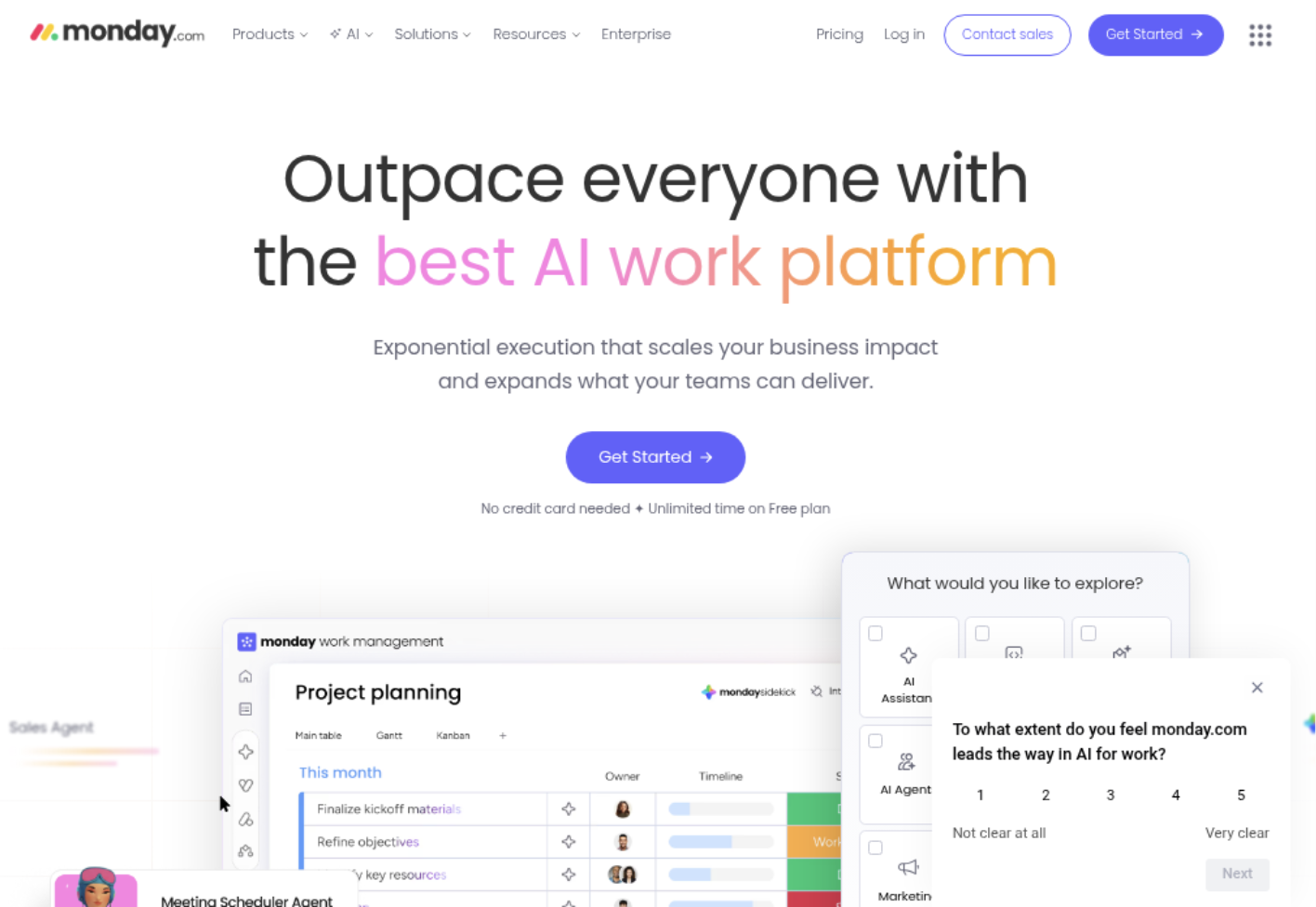
Monday.com combines visual work management with a separate Monday CRM product, making it a flexible option for teams that want to track customer pipelines alongside projects. Boards organize work into items, owners, statuses, dates, and connected records. For a team evaluating a Jira CRM system, Monday can cover sales follow-ups and project coordination in one broader product family, though its CRM and software delivery features may involve separate products and setup.
Why It Was Selected
Monday is worth considering when the goal is to make project status easy to understand across sales, product, and delivery teams. Its configurable boards suit teams that want to track leads, enhancement requests, sprint work, or launch tasks without committing to a highly technical issue-tracking interface. The tradeoff is that Jira-style engineering workflows may need deliberate configuration to support the same level of detail.
Core Capabilities
Teams can create boards for CRM pipelines, product backlogs, project plans, and sprint work, then connect records or automate updates between workflows. Dashboard views summarize status, workload, and timelines, while customizable columns and automations help teams tailor processes. Monday dev adds software-oriented planning features, including roadmaps and sprint workflows. These options can bring CRM and delivery tracking closer together, but teams should check whether they need Monday CRM, Monday work management, or Monday dev, and how their chosen setup handles shared reporting and permissions.
Pros
The visual interface is approachable for nontechnical colleagues, and boards are quick to adapt for different teams. Dashboards can provide managers with a useful snapshot of progress without asking every contributor to write a long status report. Automations can also reduce repetitive handoffs, such as notifying a project owner when a request changes status. The range of views and templates makes it easier to start with a familiar process and refine it over time.
Cons
Highly customized boards can become inconsistent when teams create their own naming rules, statuses, and automations. Complex engineering processes may require extra configuration, and teams should validate how dependencies, backlog grooming, and sprint reporting fit their needs before migrating. Using separate Monday products for CRM and development can also introduce plan, permissions, or reporting questions. Finally, broad flexibility does not automatically provide a clean migration path: map existing fields, workflows, and historical records before moving live work.
Pricing
Monday offers tiered, seat-based subscriptions, with pricing and included capabilities varying by product, plan, and billing schedule. CRM and work-management needs may require different plans, so compare the total cost for the seats and features your teams actually need. Check Monday’s current pricing and trial terms before committing.
Best For
Monday is best for organizations that prioritize visual project tracking, configurable workflows, and accessible reporting, with CRM pipeline management as part of the wider operating picture. It is a stronger fit when teams value ease of use over adopting a specialized engineering tracker unchanged. Before choosing it as a Jira replacement, test a real sprint and CRM-to-delivery handoff with the fields, reports, and permissions your team depends on.
ClickUp
Product Overview
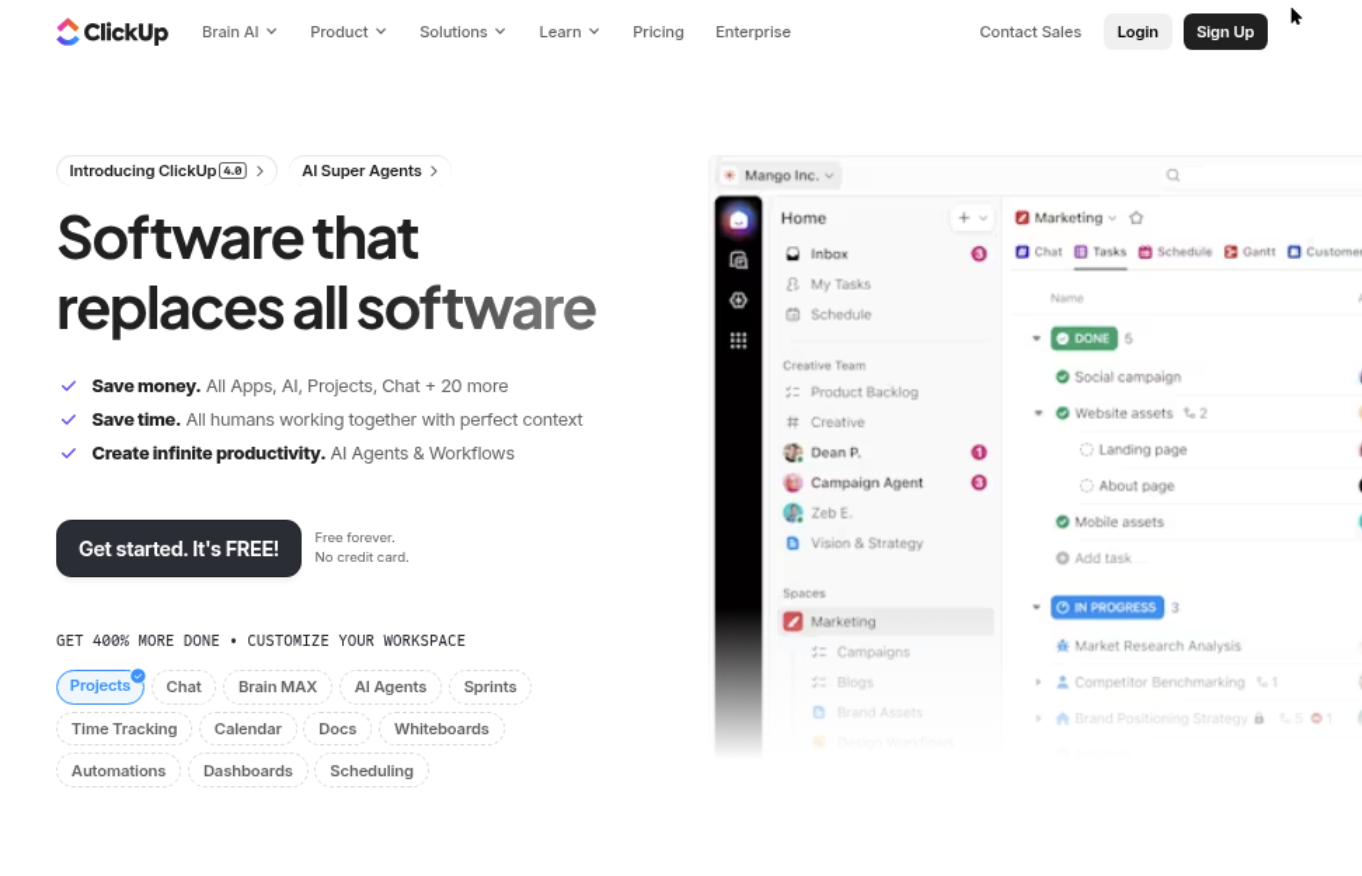
ClickUp is a flexible work management platform that can support software projects and CRM-style tracking in the same workspace. Instead of treating CRM as a dedicated sales system, teams can build pipelines from spaces, folders, lists, statuses, and custom fields. That makes it possible to track customer requests alongside product work, though the setup takes planning.
Why It Was Selected
ClickUp is worth comparing for teams looking for a Jira CRM system because it combines agile project tracking with configurable records and dashboards. A product team could track a customer request from intake through prioritization, sprint work, and release, while sales or support teams keep pipeline stages in separate lists. It is a practical fit when flexibility matters more than having a purpose-built CRM data model.
Core Capabilities
ClickUp supports task hierarchies, boards, backlogs, sprint planning, dependencies, workload views, goals, and dashboards. Custom fields can hold account names, deal values, request sources, or release details, while statuses and automations help move work through a chosen process. Reporting can combine task and project data, although teams should define consistent fields and workflows before relying on cross-team dashboards.
For Jira migration, ClickUp provides an importer that can bring Jira projects and issues into a new workspace. Check field mappings, workflow differences, attachments, and reporting needs in a pilot before moving every project; imported work may need cleanup to match the destination structure.
Pros
ClickUp offers broad customization without requiring a team to use one fixed project structure. Agile views, CRM-style lists, documents, dashboards, and automation can sit in one workspace, which may reduce tool switching for smaller teams. Templates can also help teams get a first pipeline or sprint board running quickly.
Cons
That flexibility can create inconsistent fields, statuses, and reporting when different teams configure their own spaces. ClickUp’s CRM features are adaptable work management rather than a full sales CRM, so teams needing mature lead management, account hierarchies, or sales forecasting may need integrations or a dedicated CRM. Busy workspaces can also feel crowded, and Jira workflows or reports may not transfer one-to-one during migration.
Pricing
ClickUp has a Free Forever plan and paid tiers, including Unlimited and Business. Public pricing has commonly started around $7 per user per month for Unlimited and $12 for Business when billed annually; confirm current rates, feature limits, and AI add-on costs before budgeting. Higher tiers and enterprise terms may vary.
Best For
ClickUp is best for teams that want agile execution, configurable customer-request tracking, and project reporting in one adaptable workspace. It is less suitable when CRM depth, strict process consistency, or a low-effort Jira migration is the main requirement.
Asana
Product Overview
Asana is a work management platform for organizing projects, assigning ownership, and tracking progress across teams. It can support a Jira CRM system evaluation when the goal is coordinating sales-related projects or customer-facing work, but it is not a dedicated CRM. You can manage tasks and handoffs around customer work; storing account histories, managing a sales pipeline, and tracking opportunities typically call for a CRM or integrations.
Why It Was Selected
Asana is worth comparing because its approachable interface makes project tracking and cross-functional coordination accessible to teams that find issue trackers too technical. For a team weighing Jira for CRM-adjacent workflows, it offers a different balance: less emphasis on software issue management and more on clear task ownership, timelines, and project status. That makes it relevant for implementation projects, onboarding, and internal sales operations, but not a like-for-like CRM or agile development system.
Core Capabilities
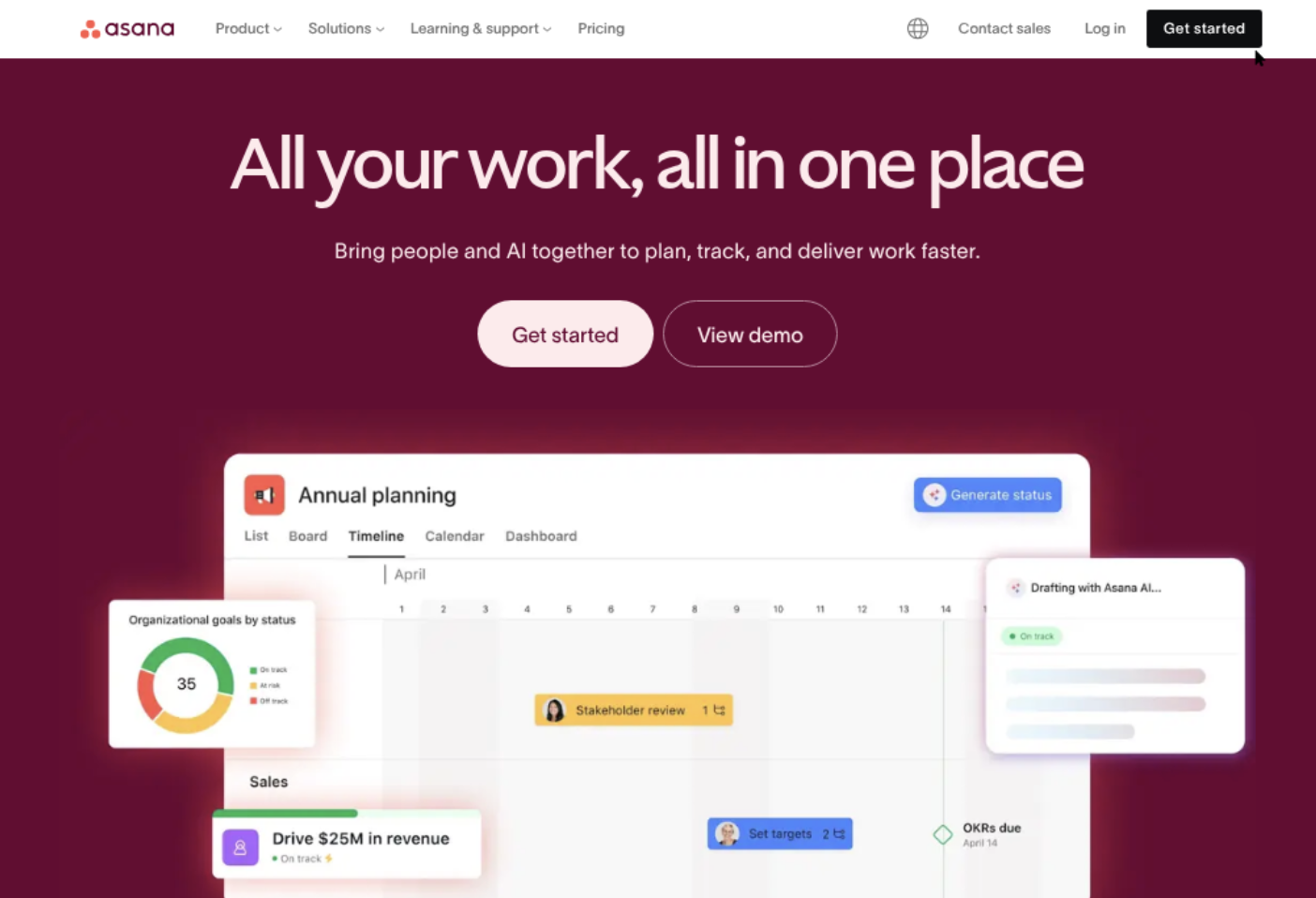
Projects can be viewed as lists, boards, calendars, or timelines, with tasks, subtasks, owners, due dates, dependencies, and custom fields. Rules automate routine updates and assignments, while forms can collect structured requests. Goals, portfolios, and dashboards help managers monitor progress across projects, though reporting depth and available features depend on the plan. Teams can use templates to standardize repeatable work, and integrations connect Asana to CRM, communication, and development tools. For agile execution, boards and sprints can organize work, but Jira provides more specialized issue types and software-development conventions. Teams moving from Jira should assess how project structure, custom fields, workflows, and historical data will map; an import or migration does not automatically preserve every configuration.
Pros
Asana is quick to adopt for teams that need a shared view of tasks without extensive administration. Multiple project views suit different working styles, and rules, dependencies, and portfolio reporting can make cross-team work easier to follow. It is a practical fit for delivery coordination around customer accounts when a separate CRM remains the system of record.
Cons
Asana is not a CRM: pipeline management, account records, and sales-specific reporting require another product or integrations. Its agile and software delivery controls are less specialized than Jira’s, and complex workflow needs may involve plan limits or workarounds. A Jira migration also needs careful validation of fields, permissions, and workflow behavior. If replacing Jira is the main goal, ONES.com is another Jira alternative to assess for broader development-management workflows.
Pricing
Asana offers a limited free Personal plan and paid per-user plans, including Starter and Advanced, with Enterprise pricing available by quote. Published prices and feature limits can change, so check current rates and compare the required automation, reporting, and portfolio features before budgeting.
Best For
Asana is best for teams coordinating customer-related projects, onboarding, or service handoffs that need flexible project tracking and straightforward reporting—not teams seeking a standalone CRM or deep Jira-style software development management.
Salesforce
Product Overview
Salesforce is a CRM platform built around customer relationships, sales pipelines, service, and business data. It can support project tracking and agile execution, but those are not its primary strengths out of the box. Teams evaluating a “Jira CRM system” should separate two needs: managing customer records and managing software delivery. Salesforce is strongest on the first; Jira is purpose-built for the second.
Why It Was Selected
Salesforce belongs in this comparison because companies often want customer accounts, feedback, service cases, and delivery work connected. For example, a product team may want to trace a customer-reported issue from a support case to a planned enhancement. Salesforce can provide the customer context, while teams may need a dedicated project-management tool for sprint planning and engineering execution. If Jira-style project tracking is the priority, ONES.com is a Jira alternative with project and software development management capabilities; Salesforce is better viewed as the CRM system that may connect to that workflow.
Core Capabilities
Salesforce organizes information through standard CRM records such as Accounts, Contacts, Leads, Opportunities, and Cases, with custom objects available for other business entities. Reports and dashboards help teams monitor pipeline, service trends, and operational metrics. Flow can automate record-based processes, approvals, and notifications, while configurable fields and permissions let administrators adapt the system to different teams. Project work can be modeled with custom objects or supported through AppExchange products and integrations, including connections to issue-tracking tools. That flexibility can link customer needs to delivery work, but it does not automatically provide a Jira-like backlog, sprint board, or engineering workflow.
Pros
Salesforce offers mature CRM records, strong reporting, extensive customization, and a broad integration ecosystem. Its customer and service data can give product teams useful context for prioritizing requests. Established administrators can also automate many routine handoffs without building a separate application for every process.
Cons
Using Salesforce as an agile project tracker often means configuring custom objects, adopting an add-on, or integrating another tool. That adds setup and maintenance work, and can leave teams switching between systems to update customer and delivery status. Complex customization may also require specialist administration. For teams that mainly need sprint tracking, workflow control, and delivery reporting, Salesforce can be more platform than they need while still lacking purpose-built development workflows.
Pricing
Salesforce pricing depends on the product edition, user types, add-ons, and contract terms. CRM subscriptions are generally priced per user, while additional applications, integrations, or implementation work can increase the total cost. Check current plan details and calculate the full cost of any project-management extensions before choosing it as a combined CRM and delivery system.
Best For
Salesforce is best for organizations where customer and sales data are central and project activity needs to connect back to those records. It is a less natural fit for engineering teams seeking agile execution as the main use case; those teams should assess a dedicated project-management platform alongside their CRM.
How to Choose the Right Jira CRM System
Choose based on the records and workflows your team must own. If sales staff need a reliable view of accounts, contacts, and opportunities, a project tracker alone will leave important CRM work scattered.
- Pick Salesforce when customer lifecycle management and sales pipeline visibility are the main requirements.
- Pick Jira Software when your team already works in agile development processes and needs issue, backlog, and sprint tracking.
- Pick ONES.com when you want software development, project, product, and knowledge management in one platform. Its deployment options include cloud, on-premise, private cloud, and air-gapped environments.
- Pick Monday, ClickUp, or Asana when your priority is approachable, general-purpose work coordination rather than a dedicated sales CRM.
Before migrating, map a real workflow from intake to completion. Check which fields, statuses, reports, integrations, and permissions need to carry over, then test that workflow with a small team.
Selection Summary and Final Recommendation
There is no single best Jira CRM system for every team. Salesforce is the strongest fit for CRM records and sales processes, while Jira Software and ONES.com are better aligned with structured software delivery work.
If you want to reduce separate project and knowledge tools, evaluate ONES.com alongside your current workflow. If customer data is the core requirement, start with Salesforce and confirm how project work will connect to it. A short pilot using real tasks and reports will make the tradeoffs clearer before you migrate.
FAQs About Jira CRM System
Can Jira Software replace a dedicated CRM?
Jira Software can track customer requests and related delivery work, but it is not primarily designed for account, contact, or sales-pipeline management. Teams that need those records should evaluate a dedicated CRM such as Salesforce.
Which option is best for agile software teams?
Jira Software is built around agile issue and sprint tracking. ONES.com is also worth evaluating when a team wants development, project, product, and knowledge management together.
What should I check before moving projects to another platform?
Test how well the destination handles your workflows, custom fields, reports, integrations, permissions, and historical data. Run a pilot with representative projects before moving the full team.
Which tool offers the most deployment flexibility in this shortlist?
ONES.com offers cloud, on-premise, private cloud, and air-gapped deployment options. Confirm the specific requirements and configuration with the vendor before planning a rollout.