Best Jira vs Rally in 2026: Practical Comparison Guide
Choosing Jira Vs Rally Tools? Compare 5 options by fit, deployment, pricing, and tradeoffs. Read the guide before you decide.
Choosing between Jira and Rally can get frustrating when one team needs flexible issue tracking while another needs portfolio-level agile planning. This 2026 guide compares Jira and Rally alongside ONES.com, Azure DevOps, and Monday, so you can see which tool fits your team’s workflows, coordination needs, and deployment preferences.
I’ll focus on practical tradeoffs—not just feature lists—to help you avoid adopting a system that adds admin work or leaves teams struggling to see progress. Whether you’re weighing jira vs rally or considering an alternative, the right choice depends on how your organization plans and delivers work.
Quick Summary
Jira and Rally suit different agile operating styles: Jira offers flexible issue tracking and a broad ecosystem, while Rally emphasizes enterprise agile planning and portfolio visibility.
Consider ONES.com if you want a Jira alternative with development, project, product, and knowledge management in one platform. Its deployment choices include cloud, on-premise, private cloud, and air-gapped environments.
- Choose Jira for configurable team workflows and a large integration ecosystem.
- Choose Rally when enterprise agile planning and portfolio-level coordination are central.
- Compare ONES.com, Azure DevOps, and Monday when you want different deployment, engineering, or cross-functional work management tradeoffs.
How We Evaluate and Select These Tools
This comparison focuses on the work teams need to manage, not on feature counts alone. A tool should make planning, delivery, and reporting practical for your operating model.
- Project tracking: Can teams connect goals, work items, sprints, and delivery status?
- Agile execution: Does the platform support the planning and coordination patterns your teams actually use?
- Reporting: Can leads spot progress, blockers, and delivery risks without rebuilding reports manually?
- Workflow customization: Can you adapt fields, statuses, and processes without creating unnecessary administration?
- Migration fit: Consider data, integrations, team habits, governance, and the effort needed to move existing work.
- Deployment and cost: Compare hosting requirements, free-plan limits, and the total cost of subscriptions and add-ons.
Top Jira Vs Rally Options Shortlist
- ONES.com — A Jira alternative for teams seeking connected development, project, product, and knowledge management with flexible deployment.
- Jira — A configurable issue-tracking and agile planning option for teams that value workflow flexibility and a broad integration ecosystem.
- Rally — An enterprise agile planning option for organizations coordinating delivery across teams and portfolios.
- Azure DevOps — A practical fit for engineering teams that want work tracking alongside Microsoft development and delivery services.
- Monday — A visual work management option for teams coordinating projects across business and technical functions.

Jira Vs Rally Comparison Table
| Tool | Best For | Deployment | Pricing | Key Feature | Free Plan |
|---|
| ONES.com | Teams seeking connected software development, project, product, and knowledge management | Cloud, On-Premise, Private Cloud, Air-gapped | Free plan for 30 seats; paid pricing varies | Requirements, workflows, reporting, collaboration, and delivery governance in one platform | Yes, 30 seats |
| Jira | Teams needing customizable issue tracking and agile workflows | Cloud | Plan and seat-based pricing; check current vendor pricing | Configurable work tracking and integrations | Yes, with plan limits |
| Rally | Organizations coordinating enterprise agile work across teams and portfolios | Cloud | Quote-based or plan-dependent; confirm with vendor | Agile planning and portfolio visibility | No generally available free plan |
| Azure DevOps | Engineering teams using Microsoft development and delivery services | Cloud and self-hosted server options | Free allowances and paid tiers vary by service and usage | Work tracking connected to repositories and delivery pipelines | Yes, with usage limits |
| Monday | Teams coordinating visual projects across business functions | Cloud | Plan and seat-based pricing; check current vendor pricing | Configurable boards, views, and automations | Yes, with plan limits |
Detailed Reviews of the Best Jira vs Rally Tools in 2026
Product Overview

ONES.com is a unified software development management platform for teams that need to connect project tracking, agile execution, product work, and team knowledge. In a Jira-versus-Rally evaluation, it is a practical Jira alternative for organizations that want configurable workflows and delivery visibility without spreading work across a collection of separate tools.
Rather than focusing only on issue tracking, ONES.com supports work across planning, execution, review, and delivery. Teams can manage requirements, break work into tasks, track sprints and projects, coordinate reviews, and keep project knowledge alongside day-to-day work. That broader scope is useful when a team’s challenge is not simply choosing a backlog interface, but making status, ownership, decisions, and delivery evidence easier to follow.
Why It Was Selected
This comparison focuses on project tracking, agile execution, reporting, workflow customization, and migration fit. ONES.com is a strong option when you want Jira-like project management flexibility while also looking to reduce tool sprawl. Its custom workflows and fields can support different team processes, while built-in reporting, automation, and knowledge-base capabilities help keep execution and project context connected.
For teams moving from an established tool, migration is a chance to review how work is structured rather than simply reproduce every old configuration. You can map existing issue types, workflow stages, fields, reports, and ownership rules to the processes the team actually uses. That makes ONES.com relevant to organizations comparing Jira and Rally that want a configurable platform with room to bring project knowledge and delivery governance into the same working environment.
Core Capabilities
- Pain: Requirements lose detail as they move into delivery. Capability: Manage requirements and break them down into trackable tasks. Result: Teams can follow the path from a product need to the work assigned for execution.
- Pain: Sprint commitments and project status are hard to understand across teams. Capability: Track sprints and projects with progress and risk visibility. Result: Leads can spot delivery concerns and discuss them before they become surprises.
- Pain: A single workflow does not fit every project or team. Capability: Configure workflows and fields around different work types. Result: Teams can capture the stages and information their process requires without forcing every project into the same pattern.
- Pain: Reporting depends on manually assembling updates. Capability: Use built-in reporting and automation. Result: Teams can make routine status checks more consistent and spend less time compiling basic progress information.
- Pain: Decisions and project guidance sit outside the work record. Capability: Keep knowledge-base support connected to project collaboration. Result: Contributors have a clearer place to find context while completing and reviewing work.
- Pain: Reviews and handoffs are difficult to coordinate. Capability: Support review coordination and collaboration within project workflows. Result: Owners and reviewers can keep work moving with clearer responsibilities.
- Pain: Teams need to match deployment to security or infrastructure requirements. Capability: Choose Cloud, On-Premise, Private Cloud, or air-gapped deployment; self-hosted versions have feature parity with Cloud. Result: Organizations can select an operating model while retaining access to the platform’s capabilities.
Pros
ONES.com brings project tracking, agile execution, knowledge support, reporting, and workflow customization into one platform. That can reduce the effort of keeping project facts synchronized across separate systems. Its deployment choices are another practical advantage for organizations with specific infrastructure requirements. For teams seeking a Jira alternative, it offers a way to manage delivery work with configurable processes while keeping project context and collaboration in view.
Cons
Teams comparing platforms should plan time to map their current workflows, fields, reports, and ownership rules before migration. Reproducing an existing setup without reviewing it can carry forward complexity that no longer serves the team. It is also worth validating a representative project with the people who will use it, so the chosen configuration reflects real sprint and reporting needs.
Pricing
ONES.com offers a Free plan for up to 30 seats. Deployment options include Cloud, On-Premise, Private Cloud, and air-gapped environments. Check the current pricing and plan details with ONES.com to confirm the right fit for your organization’s seat count and deployment needs.
Best For
ONES.com is best for software teams that want a Jira alternative with flexible project tracking, configurable agile workflows, built-in reporting, and project knowledge in the same environment. It is particularly relevant when you are comparing Jira and Rally but also want to reduce tool sprawl, support varied team processes, or retain control over deployment. If you are planning a transition, start by mapping one representative project and its reporting needs, then use that workflow to validate the platform before scaling across teams.
Jira
Product Overview
Jira is Atlassian’s project-tracking platform, widely used by software teams to plan work, manage backlogs, run sprints, and track delivery. In a Jira vs. Rally evaluation, Jira is often the familiar choice for teams that want configurable issue tracking and a broad ecosystem of integrations. Its flexibility is useful, but it also means setup and ongoing administration can take time.
Why It Was Selected
Jira is a natural option to compare with Rally because both support agile planning and execution, while taking different approaches to workflows, reporting, and team management. Jira can suit teams that want to shape their own process around projects and issues. Rally may appeal to organizations that prefer agile planning built around portfolio-level visibility and established practices. For teams exploring a broader Jira alternative, ONES.com brings project, product, and knowledge management into one platform, with shared context across software delivery workflows.
Core Capabilities
Jira supports configurable issue types, custom fields, workflows, boards, backlogs, sprint planning, and project dashboards. Teams can connect work items to releases and use reports such as burndown charts and velocity charts to review progress. Automation rules can handle routine updates, while integrations and Marketplace apps extend the platform for source control, testing, documentation, and other work. These options make Jira adaptable, though teams may need to decide which capabilities belong in the core product and which require additional apps.
Pros
Jira offers mature agile tracking, flexible workflow configuration, and detailed control over issue fields and permissions. Scrum and Kanban teams can manage day-to-day execution in boards and backlogs, then use dashboards to spot work in progress or delivery bottlenecks. Its large integration ecosystem can be an advantage when a team already relies on Atlassian or other connected tools.
Cons
Flexibility can become administrative overhead: complex workflows, permissions, and custom fields may be difficult to keep consistent across projects. Reporting is useful for team-level tracking, but cross-project or portfolio views may require careful configuration or additional tooling. Marketplace apps can fill gaps, yet they add subscription costs and create maintenance and integration dependencies. Teams should also test how well Jira fits their existing process before migrating, rather than assuming every workflow will transfer cleanly.
Pricing
Jira offers a free tier for small teams and paid plans priced by user count and plan level. Premium features and Marketplace apps can increase the total cost, so compare the complete setup—not just the base subscription—against Rally and your reporting and integration needs. Check Atlassian’s current pricing for exact rates.
Best For
Jira is a strong fit for software teams that need configurable issue tracking, sprint execution, and a wide choice of integrations. It may be less suitable for organizations seeking simple administration or consolidated portfolio reporting without added setup. Before choosing between Jira and Rally, map a real project’s workflow, reporting requirements, and migration dependencies against both products.
Rally
Product Overview
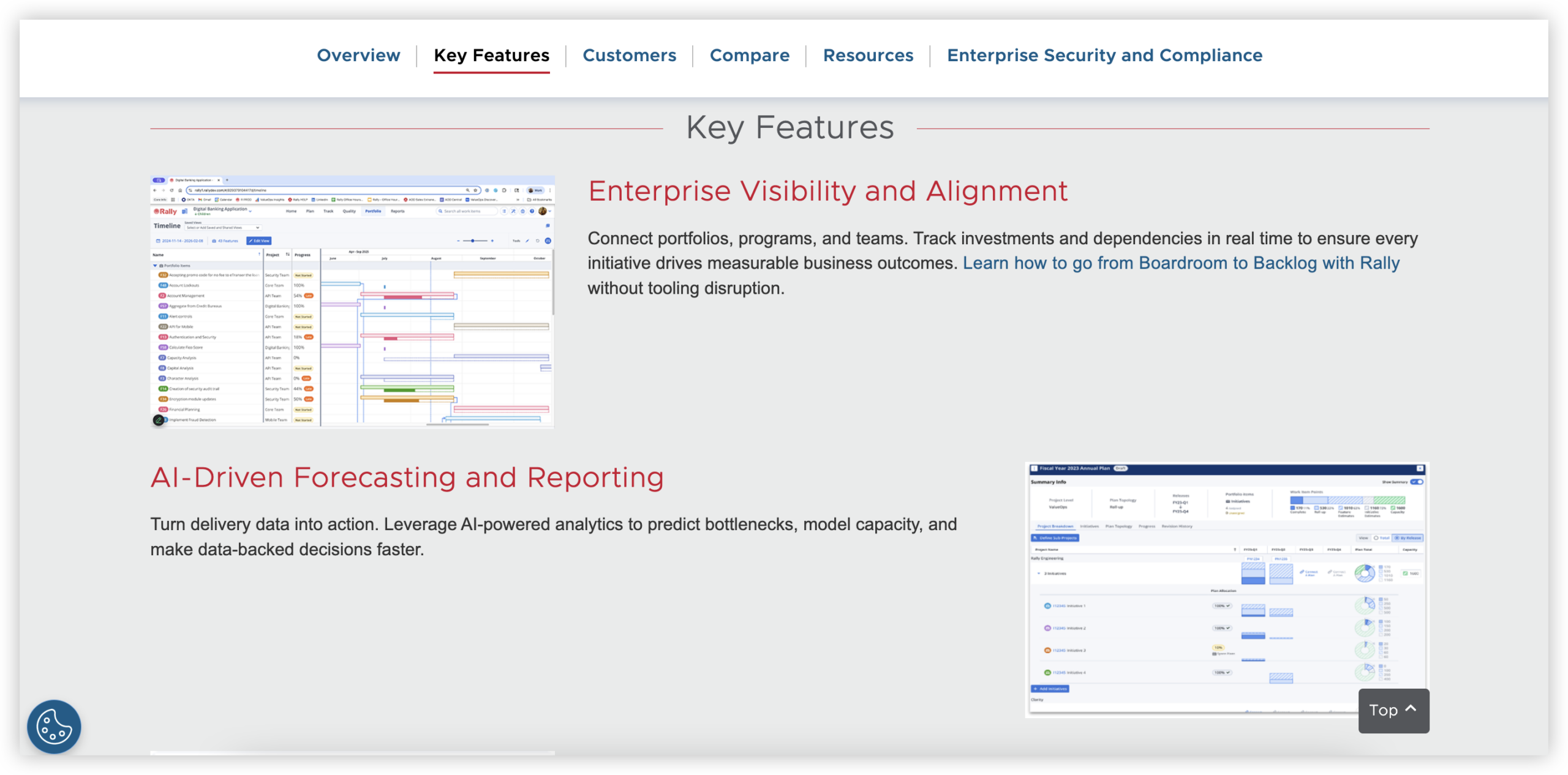
Rally is an enterprise agile planning and project tracking platform built for organizations coordinating work across multiple teams. Its model connects team-level backlogs and iterations with broader initiatives, portfolios, and delivery goals. That structure makes it a distinct option in a Jira vs Rally comparison: Rally is strongest when you need consistent agile planning across a large organization, rather than a highly flexible work tracker for every department.
Why It Was Selected
Rally is worth considering when your main challenge is coordinating agile execution at scale. Teams can plan sprints, track progress, and surface dependencies while leaders get a broader view of delivery across projects. Compared with Jira, Rally’s portfolio-oriented planning can feel more central to the product experience, while Jira offers a wider range of use cases and a larger extension ecosystem.
Core Capabilities
Rally supports backlog and release planning, iteration tracking, team boards, portfolio hierarchies, capacity planning, dependency visibility, and reporting. Teams can organize work from strategic initiatives down to features and user stories, then monitor progress as work moves through iterations. Reporting helps teams review burn and delivery trends, though the usefulness of those views depends on consistent data and agreed team practices. Workflow configuration supports different processes, but organizations should expect to invest time in setup and administration to keep workflows and reporting aligned.
Pros
Rally gives large agile organizations a structured way to connect team execution with portfolio planning. Its planning hierarchy helps leaders see how work relates across teams, while iteration and capacity tools support practical sprint decisions. It can be a good fit when teams already use common agile practices and want a shared system for tracking delivery rather than stitching together separate planning spreadsheets.
Cons
Rally can feel complex for teams that need a lightweight tracker or are still settling on their process. Configuration, permissions, and reporting may require dedicated administration, and its interface can feel less intuitive than newer project tools. Jira may be easier to extend for varied workflows because of its broad app ecosystem. A move from Jira also takes planning: teams need to assess how issue types, custom fields, workflows, history, and integrations will map, rather than assuming a direct transfer will preserve every detail.
Pricing
Rally pricing is generally handled through Broadcom sales and can depend on the organization’s requirements and agreement. Confirm current pricing, included capabilities, support terms, and any migration costs directly before budgeting; public list pricing may not reflect an enterprise quote.
Best For
Rally is best for larger organizations with established agile practices that need portfolio-level visibility and coordinated planning across many teams. Smaller teams, organizations with varied non-agile workflows, or buyers prioritizing a broad marketplace of integrations may find Jira or another project platform more adaptable.
Azure DevOps
Product Overview
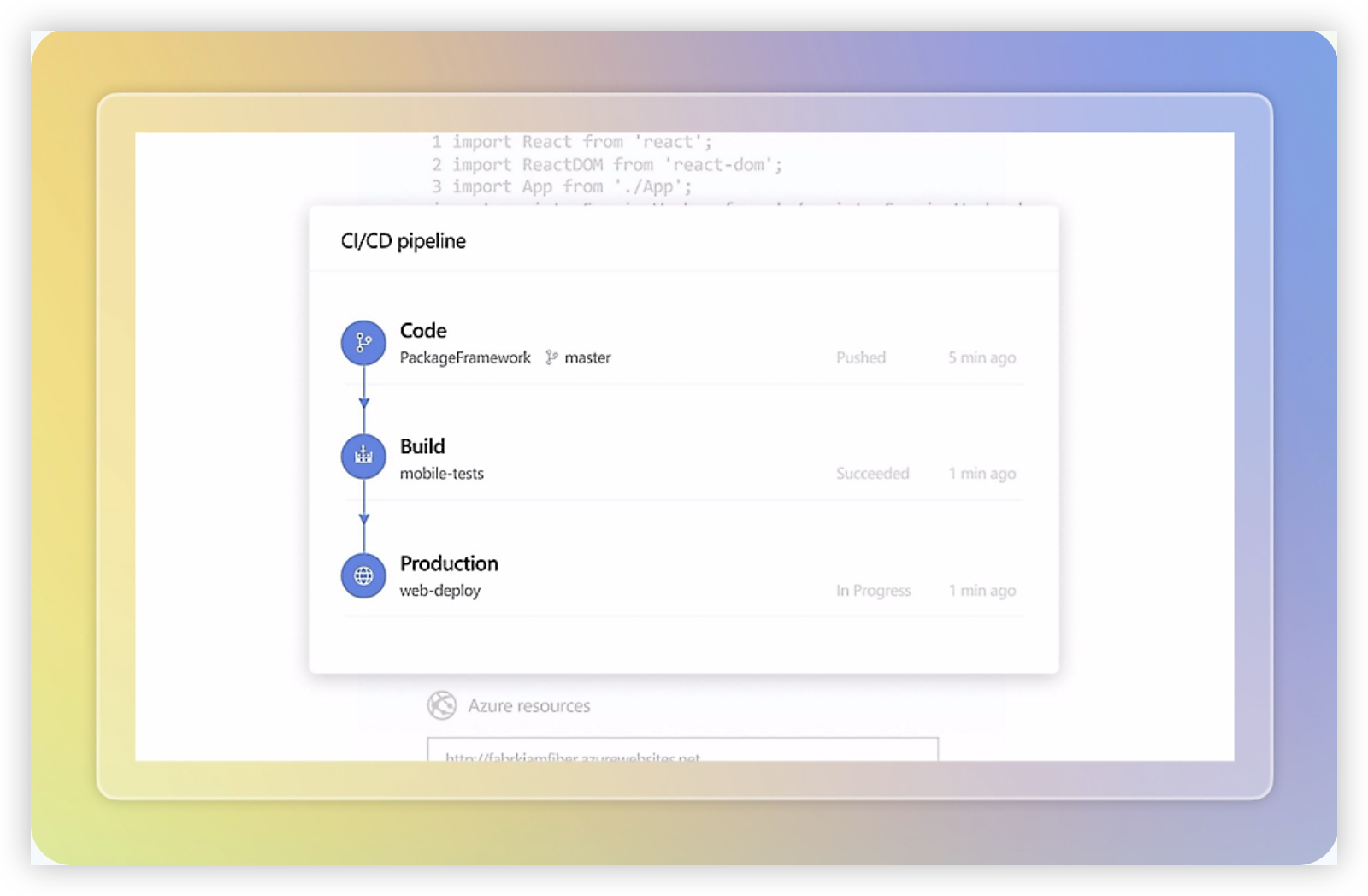
Azure DevOps combines work tracking with developer tools for planning, building, testing, and shipping software. Azure Boards handles backlogs, sprint planning, and work items, while Repos, Pipelines, Test Plans, and Artifacts connect those plans to code and delivery. For teams comparing Jira and Rally, its main distinction is this close connection between agile tracking and the Microsoft development toolchain.
Why It Was Selected
Azure DevOps is a useful comparison because it covers the same practical concerns—agile execution, project visibility, reporting, and configurable workflows—while offering a broader set of built-in engineering services. It can suit teams that want work items and delivery pipelines in one environment. Compared with Jira, it may reduce the need to connect separate development tools; compared with Rally, it can appeal to teams looking for integrated repositories and CI/CD alongside planning.
Core Capabilities
Azure Boards supports Scrum and Kanban boards, product and sprint backlogs, work-item queries, and team dashboards. Teams can track features, user stories, bugs, and tasks, then use sprint capacity and burndown views to monitor execution. Process templates based on Agile, Scrum, or CMMI provide a starting point, and administrators can customize work-item types, fields, states, and rules. Reporting options include dashboards, queries, and analytics views, with data also available for more tailored reporting. Repos, Pipelines, and Test Plans link planning to source control, builds, releases, and testing, though not every capability is included in the same plan.
Pros
The biggest advantage is traceability: a team can connect a backlog item to code changes, builds, test results, and releases. Boards cover common agile workflows without requiring a separate project-tracking product. Process customization can accommodate established team practices, and the free entry tier makes it practical to evaluate with a small group. Organizations already using Microsoft’s developer ecosystem may find the integrated experience especially convenient.
Cons
Azure DevOps can feel like a collection of connected services rather than one especially simple project workspace. New teams may need time to understand its navigation, permissions, and process settings. Customization is capable but often requires an administrator, and reporting can take extra setup when built-in views do not answer a specific portfolio question. Moving from Jira or Rally may also require mapping workflows, fields, and history; a direct migration should not be assumed to preserve every configuration. Teams that only need agile planning may find the wider toolset unnecessary.
Pricing
Azure DevOps Services offers a free tier, including the first five Basic users; additional Basic access is paid per user. Test Plans and some advanced capabilities require a higher-priced plan. Check current Microsoft pricing and licensing terms before budgeting, particularly if you need extensive testing features or Azure DevOps Server for self-hosted use.
Best For
Azure DevOps is best for software teams that want sprint tracking tied closely to repositories, automated builds, releases, and testing. It is a stronger fit when engineering delivery integration matters as much as backlog management, and a less compelling choice when the priority is a highly approachable project workspace with minimal administration.
Monday
Product Overview
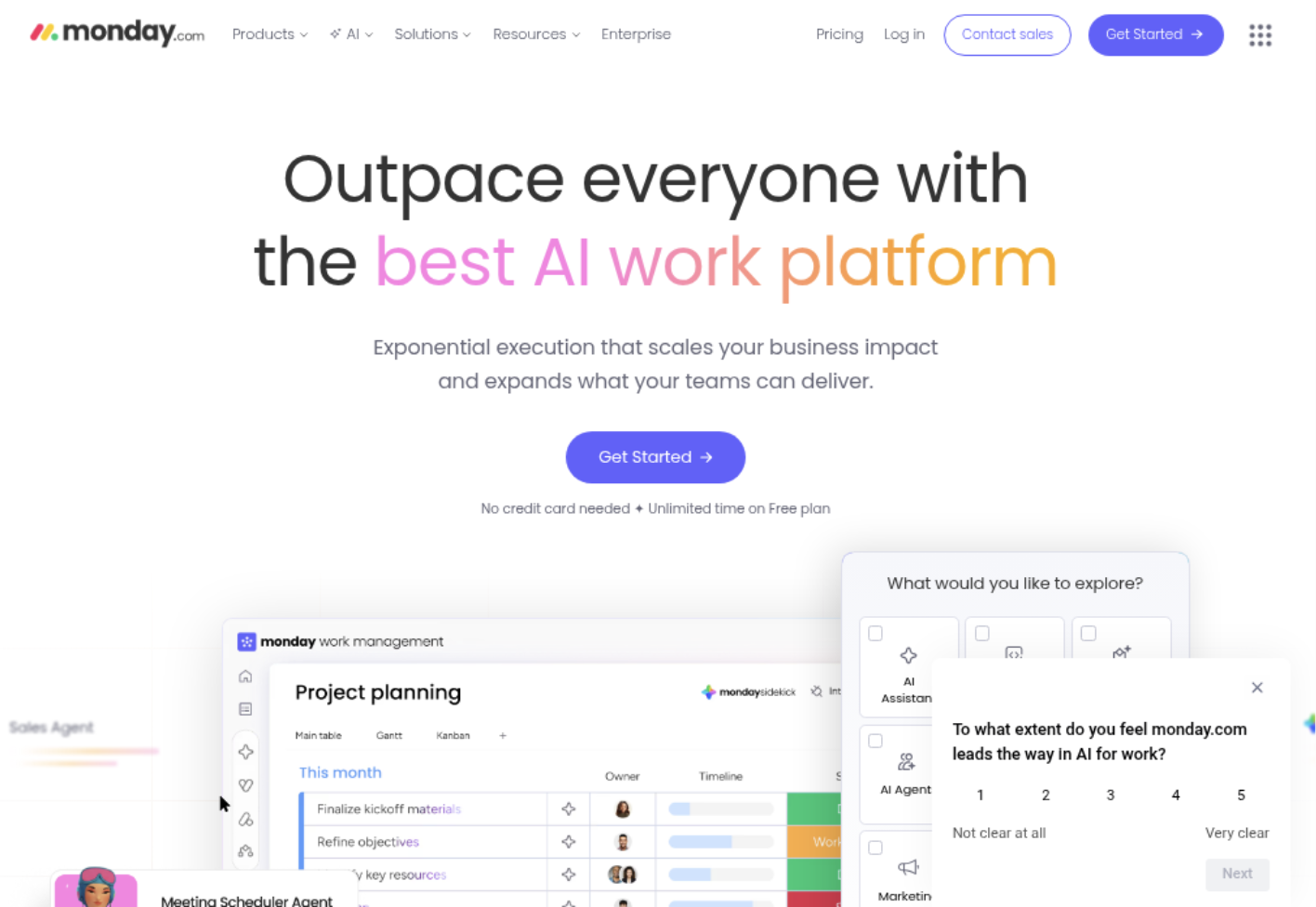
Monday.com is a visual work-management platform that teams can configure for project tracking, product work, and agile delivery. Its boards make owners, statuses, dates, and dependencies easy to scan, while monday dev adds software-focused templates and views. Compared with tools built around formal agile processes, Monday gives teams more freedom to shape how work is displayed and managed.
Why It Was Selected
In a Jira-versus-Rally comparison, Monday is a useful reference point for teams considering a more visual, configurable approach to tracking work. It can suit organizations that want business and engineering teams to share a workspace, or that find a specialist agile tool too structured for their needs. The tradeoff is that flexibility does not automatically provide the depth of a purpose-built software delivery process.
Core Capabilities
Teams can organize work in boards and connect items across projects. Custom columns, status labels, forms, and workflow automations help adapt boards to different processes. Dashboards combine selected project data into charts and progress views, while workload and timeline views help managers check ownership, capacity, and dates. Templates can provide a starting point for sprint planning, backlogs, or release tracking. Integrations connect boards with common development and collaboration tools, and permissions help control who can view or change work.
Pros
The visual interface is approachable for teams that do not want every contributor to learn a complex issue-tracking system. Custom boards make it straightforward to model different work types, and dashboards can give managers a quick view of status across projects. Automations can reduce repetitive updates, such as notifying an owner when an item changes status. Shared boards can also make cross-functional work more visible to people outside engineering.
Cons
Highly customized boards can become inconsistent across teams, making portfolio reporting harder unless administrators establish common conventions. Agile execution features may not satisfy organizations that depend on deep backlog hierarchies, specialized release controls, or mature software metrics. Advanced reporting and automation depend on plan level and setup, and broad customization can require ongoing administration. Moving from Jira or Rally may also involve rebuilding workflows, dashboards, and integrations; transferring records alone will not reproduce the original process or reporting model.
Pricing
Monday.com offers a limited free plan and paid tiers priced by seat, with available features varying by plan. Paid subscriptions may use seat bundles, and annual billing can differ from monthly billing. Check current plan limits, automation allowances, integrations, and dashboard access before estimating the cost for a full engineering organization.
Best For
Monday is best for teams that prioritize visual project tracking, adaptable workflows, and collaboration across technical and nontechnical groups. It is a reasonable fit when teams can keep their agile process relatively lightweight. Organizations with complex software delivery governance should validate their reporting, workflow, and migration requirements in a pilot before switching.
How to Choose the Right Jira Vs Rally Option
Start with your current planning model. If teams mainly need flexible issue tracking and can support workflow administration, Jira may be the simplest fit.
Pick Rally when enterprise agile coordination and portfolio planning are more important than a lightweight team board. Confirm that its planning model matches how your teams make decisions before migrating.
Consider ONES.com when you want a Jira alternative that brings requirements, tasks, sprints, reporting, knowledge, and delivery governance together. Its on-premise, private cloud, and air-gapped options matter when deployment control is a requirement.
Azure DevOps fits engineering groups that already work in Microsoft’s development ecosystem. Monday is worth considering when project visibility across nontechnical teams matters more than deep software delivery management.
Before choosing, map one real project from planning through reporting. Test its fields, statuses, integrations, and migration needs, then compare the effort and cost against your existing setup.
Selection Summary and Final Recommendation
There is no universal winner in the Jira versus Rally decision. Jira is a flexible choice for issue tracking and team workflows; Rally is stronger for organizations centered on enterprise agile planning.
If your priority is a connected development management platform with multiple deployment choices, assess ONES.com alongside both. A short pilot using a representative team can reveal workflow gaps, reporting effort, and migration friction before you commit.
FAQs About Jira vs Rally
What is the main difference between Jira and Rally?
Jira is commonly chosen for configurable issue tracking and team workflows. Rally is oriented toward enterprise agile planning and coordination across teams and portfolios.
Which tool is a better fit for enterprise agile planning?
Rally may fit organizations that rely on portfolio-level agile planning and cross-team coordination. Validate its planning model against your governance and reporting needs before switching.
Can ONES.com be considered as a Jira alternative?
Yes. For teams comparing Jira options, ONES.com offers requirements, task and sprint tracking, customizable workflows, reporting, knowledge support, and delivery governance, with cloud and self-managed deployment choices.
What should I check before migrating from Jira or Rally?
Inventory work item data, custom fields, workflows, reports, integrations, permissions, and team habits. Pilot a representative project and estimate migration effort alongside subscription and add-on costs.