Confluence and Jira Pricing: A 2026 Budget Planning Guide
Planning your 2026 budget? This guide breaks down confluence and jira pricing, tiers, add-ons, and hidden costs. Read now to plan with confidence.
Planning a 2026 budget for Confluence and Jira can become confusing quickly. Each product may have separate plans, billing rules, user tiers, add-ons, and administrative costs. A price that looks manageable per user can grow sharply when you include contractors, occasional contributors, storage, automation, and support.
That uncertainty makes approval harder. You may underbudget and face an unexpected renewal increase, or overbudget and delay a useful project management rollout. Comparing headline prices alone rarely gives you the full picture.
But here’s the practical solution: estimate the total annual cost by separating Jira, Confluence, user groups, optional features, and hidden operating effort. This guide gives you a repeatable framework for evaluating Confluence and Jira pricing in 2026, comparing plan structures, and considering a unified alternative.
How to Plan a 2026 Budget for Confluence and Jira
Confluence and Jira pricing is best planned as a combined annual technology cost rather than two isolated subscription prices. Start with active users, assign them to realistic tiers, add optional services, and include administration, migration, training, and renewal headroom.
Here’s why: the number of licensed people is only one part of the final bill. A team with 80 employees may need 50 project users, 25 knowledge contributors, and five occasional reviewers. Treating all 80 people as identical can distort your estimate.
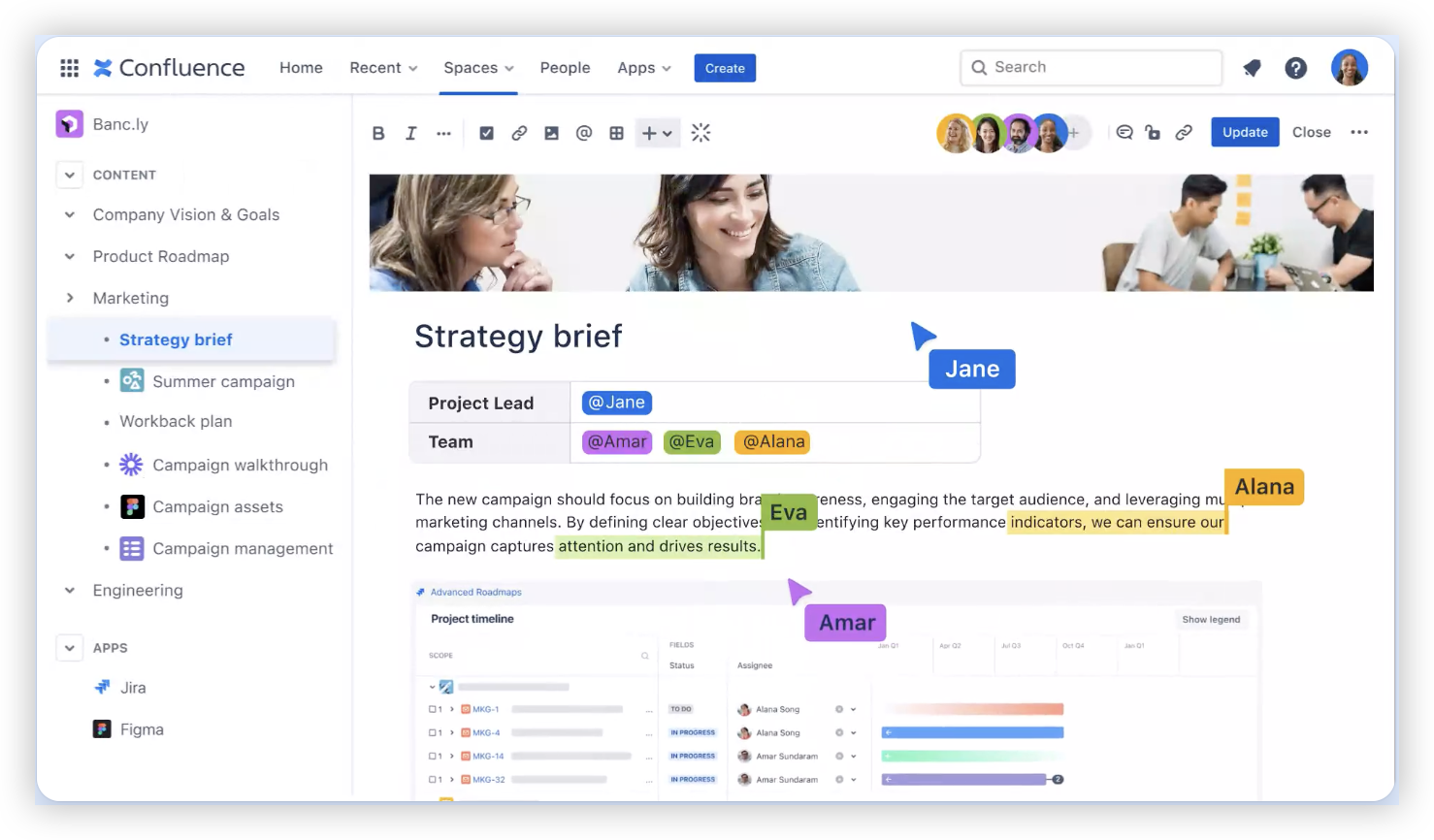
1. Define who needs each product
Create four practical user groups before looking at plans:
- Core project contributors who create issues, update work, and join sprint activities.
- Knowledge contributors who write, organize, and maintain team content.
- Viewers who mainly read project updates or internal guidance.
- External collaborators who need limited access for clients, vendors, or partners.
For example, a product team may have 45 Jira contributors, 30 Confluence contributors, 10 executives who only read updates, and eight external partners. That is a very different purchase pattern from licensing every person equally.
2. Separate Jira and Confluence requirements
Jira usually supports project planning, issue tracking, sprint management, workflows, reporting, and automation. Confluence generally supports team knowledge, meeting notes, policies, technical guidance, and collaboration around shared content.
Some people need both products. Others may need only one. Build your first estimate with separate counts, then identify overlapping accounts.
| Planning question |
Why it matters |
| How many people actively manage work? |
These accounts often require full Jira access. |
| How many people create or maintain knowledge? |
These accounts may require Confluence access. |
| How many people only read updates? |
Read-focused access can affect the most suitable plan. |
| How many contractors join temporarily? |
Short-term access can create avoidable annual licensing costs. |
| How many teams need advanced controls? |
Security, governance, analytics, and administration needs may influence plan selection. |
3. Build a monthly and annual estimate
Use a simple planning formula:
Annual subscription estimate = monthly plan cost × 12 + optional services + expected usage charges
Then add operational costs:
Total budget = annual subscription estimate + administration + implementation + training + contingency
Suppose your combined monthly estimate is $2,400. The subscription portion is $28,800 per year. If onboarding costs $6,000, administration costs $9,000, and you reserve 10% for growth, your planning budget should be higher than $28,800.
4. Model three headcount scenarios
Build conservative, expected, and growth scenarios. The expected scenario supports the current team. The conservative scenario reflects delayed hiring or reduced adoption. The growth scenario includes planned hiring, new departments, and increased collaboration.
| Scenario |
Typical assumption |
Budget purpose |
| Lean |
Current users with limited expansion |
Shows the minimum credible commitment. |
| Expected |
Current users plus approved hiring |
Supports the operating plan. |
| Growth |
Additional teams, partners, and usage |
Prevents a rushed midyear expansion. |
5. Add non-subscription costs
Migration, permissions design, workflow setup, training, integrations, and ongoing administration can influence the first-year cost significantly.
A small team may manage both products in a few hours each week. A regulated organization may need dedicated administration, approval controls, access reviews, and structured retention practices.
6. Check the renewal impact
Review how your budget changes when the team grows by 10%, 25%, or 50%. Also test what happens when occasional contributors become full participants.
The best part? A sensitivity check takes minutes and can reveal the biggest risk in your estimate. If a 20% headcount increase creates a 35% budget increase, your purchasing team needs to know before approval.
What Usually Drives the Combined Cost
The largest pricing drivers are licensed seats, plan level, deployment model, premium controls, integrations, and usage. These factors interact, so a low per-user figure does not always create the lowest total cost.
Licensed seats and user overlap
Jira and Confluence may be purchased separately, even when the same person needs both. That overlap can make combined planning more important than reviewing each subscription in isolation.
Consider a 100-person company. If 60 people need Jira and 80 need Confluence, the combined requirement is not simply 100 seats. You need to understand the 40 people who may need both products, along with the 20 Confluence-only and 20 Jira-only accounts.
Plan level and advanced controls
Entry plans may suit a small team with straightforward collaboration. Larger organizations often evaluate advanced permissions, audit features, administrative controls, service commitments, analytics, and support.
Here’s why: a premium plan can be cheaper than several separate workarounds when security and governance requirements are strict. The reverse can also happen when a team pays for advanced capabilities that nobody uses.
Deployment and operational requirements
Cloud subscriptions usually shift much of the infrastructure responsibility to the vendor. Self-managed environments may provide additional control, but they can require hosting, upgrades, monitoring, backups, and specialist administration.
Include the cost of staff time. If an internal administrator spends 12 hours each month maintaining a self-managed environment, that effort belongs in the annual comparison.
Integrations and extensions
Teams often connect project tracking with chat, time tracking, customer support, development pipelines, testing, reporting, or identity management. Each connection may add subscription fees, maintenance work, or implementation effort.
For example, a reporting extension may solve a real visibility problem. It may also create another renewal date, another permission model, and another system to troubleshoot.
How to Compare Plans Without Chasing Headline Prices
Compare plans against actual work patterns. A pricing page can tell you the listed structure, but your budget needs to explain what the team will do, who will do it, and what level of control the organization requires.
Use a capability scorecard
List the capabilities your teams need, then mark each one as essential, useful, or unnecessary. Include workflows, sprint planning, reporting, automation, permissions, auditability, integrations, knowledge organization, and administrative support.
| Capability |
Priority |
Evaluation question |
| Custom workflows |
Essential for some teams |
Can each department reflect its actual approval path? |
| Reporting |
Useful to essential |
Can leaders see progress without manual reporting work? |
| Automation |
Useful |
Can repetitive transitions and notifications run reliably? |
| Permissions |
Essential in controlled environments |
Can sensitive areas be restricted by team or role? |
| Knowledge organization |
Essential for shared guidance |
Can people find current procedures quickly? |
Compare total cost of ownership
Subscription price is visible. Administrative effort is easy to overlook. Estimate the hours required for setup, onboarding, permission changes, workflow maintenance, reporting, training, and support.
Imagine two options with nearly identical annual subscription costs. One requires three administrators and several extensions. The other covers the same workflow natively. The second option may deliver a lower total cost, even if its headline subscription price is higher.
Account for adoption
A platform only creates value when teams use it consistently. If employees keep project updates in chat and store guidance in scattered locations, you may pay for capabilities without receiving their full benefit.
Ask how quickly a new employee can find a project status, understand an approval process, or locate the latest team guidance. That test connects pricing with practical adoption.
Common Budgeting Mistakes to Avoid
Many pricing surprises come from planning habits rather than complicated mathematics. A few simple corrections can make your estimate more realistic.
Counting employees instead of active accounts
Every employee may not need the same access. Separate full contributors, readers, temporary collaborators, and inactive accounts.
Review inactive access quarterly. A former contractor who remains licensed can quietly inflate the annual renewal.
Ignoring seasonal access
Some teams need additional access during product launches, audits, or implementation periods. Estimate whether that access is temporary or permanent.
A marketing campaign may require short-term collaboration with an agency. A permanent annual seat may be unnecessary if the engagement lasts eight weeks.
Underestimating administration
Workflow design, access reviews, onboarding, training, and reporting take time. Assign an approximate annual labor cost rather than treating administration as free.
Forgetting growth and currency changes
Headcount growth can move your organization into a different pricing tier. International teams may also face currency fluctuations, taxes, or regional billing differences.
Use a contingency range in the budget. The exact reserve depends on your organization, but a zero-growth assumption is rarely useful for a year-long plan.
When a Unified Platform May Simplify the Budget
A combined project and knowledge platform can reduce the number of systems your team needs to administer. This approach may suit organizations that want work tracking and team knowledge to connect more naturally.
For example, a product requirement can link directly to delivery work, while the related decision history stays available to the team. That connection reduces repeated updates and makes context easier to find.
Evaluate consolidation carefully
Consolidation is useful when it removes duplicate administration, reduces extension costs, or improves adoption. It is less useful when teams have specialized needs that one platform cannot support.
Compare the following:
- Annual subscription cost across all required users.
- Number of separate integrations and extensions.
- Time spent maintaining permissions and workflows.
- Ease of moving between project work and team knowledge.
- Deployment, security, and compliance requirements.
You might be wondering: does a single platform always cost less? No. The value depends on actual usage, team size, migration effort, and how much duplicated work disappears.
Natural Confluence and Jira Pricing Solution: ONES.com
ONES.com is a unified platform for project management and knowledge management, powered by AI through ONES Assistant. ONES Project and ONES Wiki are sold separately, so you can evaluate the project and knowledge capabilities according to your team’s needs.
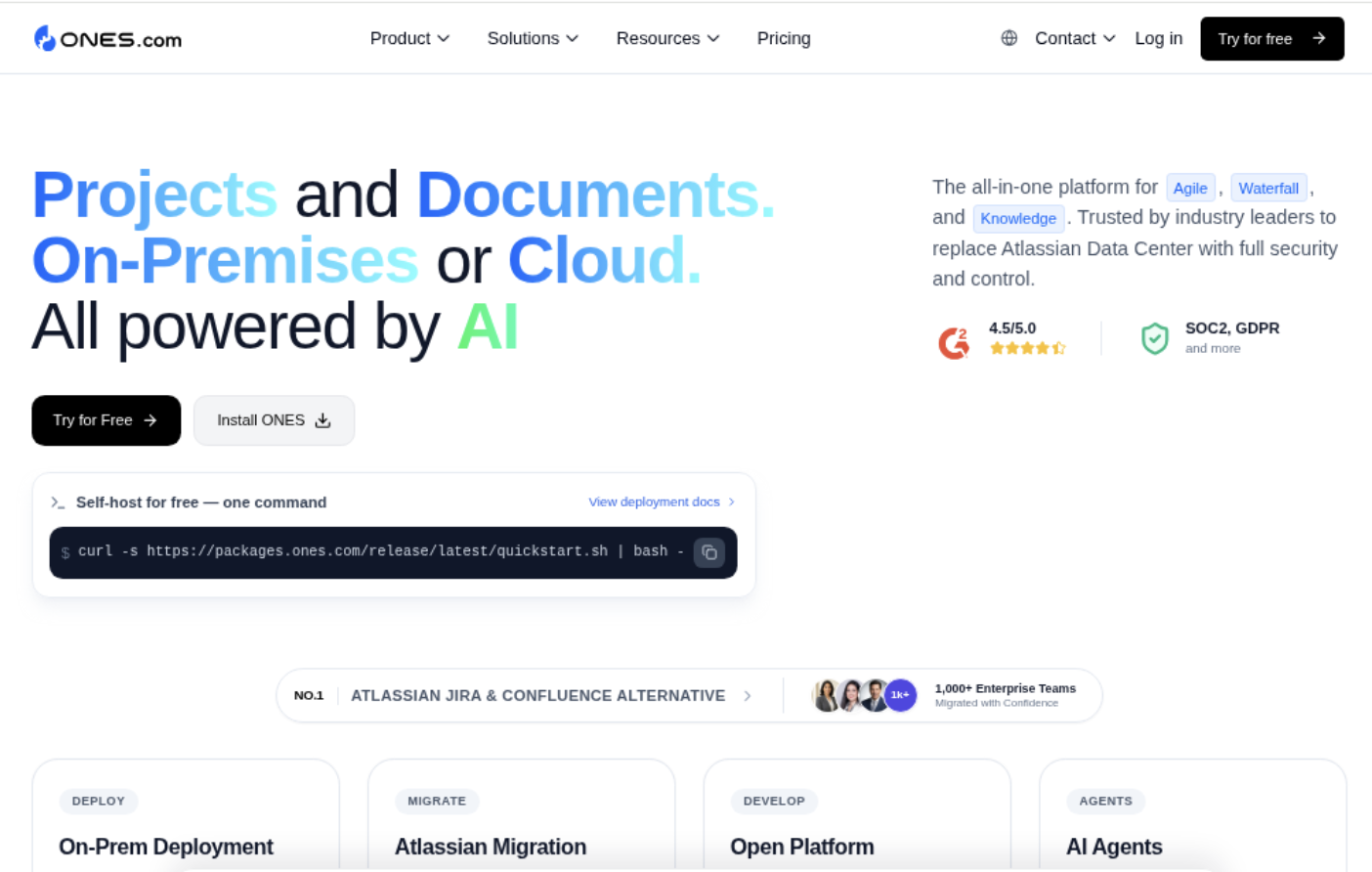
It can be useful for organizations comparing separate project and knowledge subscriptions, especially when native workflows, self-hosted deployment, and fewer extensions matter more than choosing two familiar products.
Core capabilities
- Disconnected project and knowledge work: ONES.com connects project management and knowledge management in one platform, helping teams keep delivery context near the guidance they use.
- Jira migration concerns: ONES Project provides Jira-compatible workflows, giving teams a familiar approach to issue tracking, sprint management, and project coordination.
- Too many extensions: Built-in reporting, custom workflows, custom fields, sprint management, and automation can reduce dependence on separate plugins.
- Complex approval paths: Custom workflows let teams reflect review, approval, escalation, and release processes instead of forcing every department into one pattern.
- Scattered team knowledge: ONES Wiki provides a knowledge base for organizing guidance, decisions, procedures, and project context alongside delivery work.
- Self-hosting requirements: ONES.com supports Cloud, On-Premise, Private Cloud, and Air-gapped deployments, giving organizations more control over where the platform runs.
- Different deployment experiences: The self-hosted version maintains feature parity with the cloud version, helping teams compare deployment preferences without accepting a reduced feature set.
- Early-stage budget limits: The free plan supports up to 30 seats, which can give a small team room to evaluate its workflow before making a larger commitment.
- Separate tool administration: A unified platform can reduce repeated account management, permission maintenance, and reporting work across disconnected systems.
Application scenarios
Growing product team: A 25-person product organization may use ONES Project for backlog management, sprints, custom fields, and reporting. Product decisions and release guidance can live in ONES Wiki, keeping delivery context easier to follow.
Restricted-network organization: A company with strict network controls may select an air-gapped or on-premise deployment. The team can preserve internal control while using project workflows and knowledge capabilities in a consistent environment.
Multi-department operations: A business with engineering, marketing, and support teams may use separate workflows and fields for each group. Shared reporting can give leadership a broader view without requiring every department to work identically.
Common Challenges When Estimating the 2026 Budget
Challenge: The team size keeps changing
Solution: Use lean, expected, and growth scenarios. Review the estimate whenever hiring plans, contractor needs, or department participation changes.
Challenge: People need different levels of access
Solution: Map access to job activities. A reader, project contributor, administrator, and external partner should not automatically receive identical permissions.
Challenge: Add-ons are difficult to track
Solution: Keep an extension register with the purpose, owner, renewal date, active users, and replacement possibility for each add-on.
Challenge: Migration costs are missing from the first-year budget
Solution: Estimate content review, workflow recreation, permissions design, testing, training, and rollout support before comparing alternatives.
Challenge: The organization cannot explain the business value
Solution: Connect the purchase to measurable outcomes. Examples include shorter onboarding, fewer status meetings, faster approvals, better project visibility, and less administrative effort.
FAQs
Are Confluence and Jira priced as one product?
Usually, you should plan them as separate products because project tracking and knowledge management can have different user requirements and plan structures. Some people may need both, while others may need only one. For a reliable estimate, count Jira users, Confluence users, overlapping accounts, occasional contributors, and external collaborators separately before calculating the combined annual cost.
What should I include in a 2026 pricing estimate?
Include subscription charges, plan-level requirements, optional extensions, integrations, taxes or regional billing effects, implementation, migration, training, administration, and a growth reserve. You should also estimate the cost of temporary access and inactive accounts. A complete budget explains both the recurring annual payment and the internal effort required to operate the tools.
How can I avoid paying for unused seats?
Start by grouping people according to what they actually do. Review access regularly, remove inactive accounts, and distinguish permanent contributors from short-term collaborators. You can also compare read-focused access with full participation requirements. A quarterly access review is often enough to catch former contractors, transferred employees, and accounts created for temporary projects.
Should I choose a premium plan for future growth?
Choose a higher plan when you can connect its capabilities to a real requirement, such as advanced security, administration, auditability, support, or large-scale coordination. Paying early for features your teams will not use may waste budget. At the same time, selecting a plan that cannot support approved growth can create migration and retraining costs later.
Is ONES.com an alternative to Jira and Confluence?
ONES Project can serve as a Jira alternative for project management, while ONES Wiki supports knowledge management as a Confluence alternative. ONES.com brings both areas together, although ONES Project and ONES Wiki are sold separately. The platform supports cloud and self-hosted deployments, including on-premise, private cloud, and air-gapped environments.
What is the simplest way to compare two options?
Compare each option across five categories: annual subscription, required extensions, administration, implementation, and adoption. Then test the result against lean, expected, and growth scenarios. A solution with a slightly higher subscription can still be more economical if it reduces extensions, manual reporting, support effort, or duplicated knowledge maintenance.
Conclusion
Planning Confluence and Jira costs for 2026 requires more than multiplying a per-user figure by 12. You need to understand who needs access, which plan capabilities matter, how many people use both products, and what administration adds to the first-year total.
But here’s the truth: the most useful budget is the one that reflects how your teams actually work. Separate user groups, test growth scenarios, include implementation effort, and review extensions before approval.
If separate project and knowledge tools create duplicated administration, evaluate whether a unified platform such as ONES.com fits your workflow. The right choice should make costs clearer while helping people manage work and find the knowledge they need.