Confluence and Jira Pricing: A Clear 2026 Cost Breakdown
Confused by confluence jira pricing? Get a clear 2026 cost breakdown of plans, users, and extras—click to discover your true total.
Confluence and Jira can look affordable at first glance. Then your team adds more users, upgrades storage, selects premium controls, and discovers that separate subscriptions can change the total quickly.
The confusion grows when Jira and Confluence use different user counts, plan limits, billing methods, and feature boundaries. A team may pay for both products without understanding which subscription drives the largest cost.
But here's the truth: you can estimate the real expense with a simple model. Count active users, separate product plans, include optional services, and check how annual billing changes the total.
This guide explains Confluence and Jira pricing in 2026, shows what each tier generally includes, and gives you a practical way to compare the combined cost with a unified platform.
How Confluence and Jira Pricing Works in 2026
Confluence and Jira are usually priced as separate Atlassian subscriptions. Your total cost depends on the number of users, the plan selected for each product, billing frequency, hosting model, and optional services.
Jira generally covers project tracking, issue management, sprint planning, automation, and reporting. Confluence focuses on team knowledge, planning pages, meeting notes, specifications, and internal collaboration.
You may buy both products together, but each product still has its own plan structure. A team with 40 Jira users and 25 Confluence users may therefore have different active-user counts for each subscription.
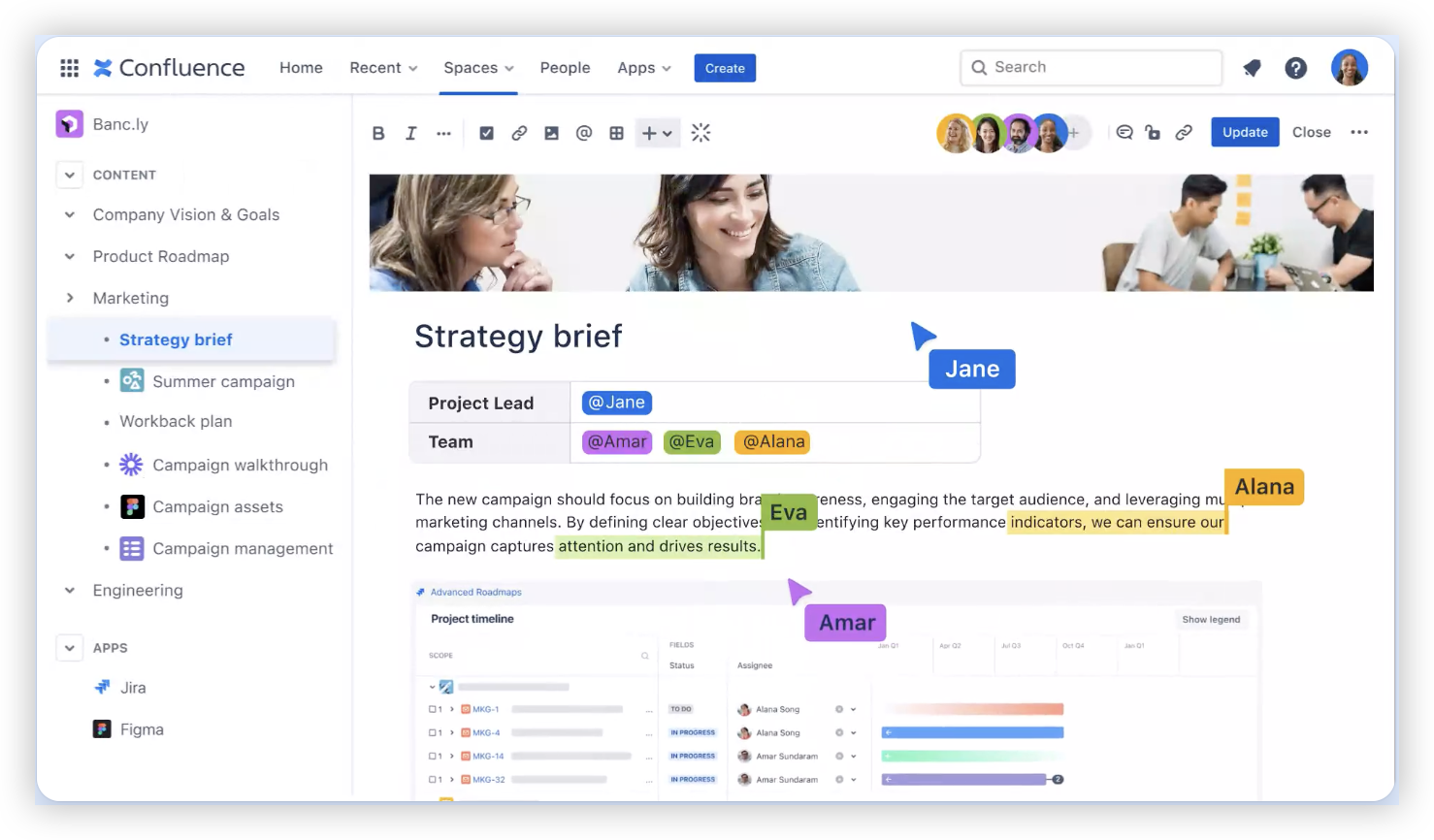
The main cost components
- Jira subscription: Covers project and issue management for the people who need access.
- Confluence subscription: Covers collaborative pages, spaces, permissions, and knowledge-sharing features.
- Plan level: Higher tiers generally add administration, reporting, security, storage, automation, or reliability controls.
- Billing term: Monthly billing gives flexibility, while annual billing can make budgeting easier and may use different user-band calculations.
- Optional services: Marketplace apps, advanced security, premium support, and migration assistance can raise the final amount.
- Taxes and currency: Your invoice may vary according to location, billing currency, and applicable taxes.
Typical plan differences
| Plan area |
What it usually means |
| Free |
Basic access for small teams with limits on users, storage, administration, automation, or support. |
| Standard |
More room for regular team operations, broader controls, and fewer usage restrictions. |
| Premium |
Advanced planning, administration, automation, analytics, reliability, or scale features. |
| Enterprise |
Large-organization controls, centralized governance, advanced security, and negotiated commercial terms. |
These labels do not mean the same features appear in both products. Jira Premium and Confluence Premium solve different problems, so compare features within each product before comparing the combined bill.
A simple pricing formula
Start with this estimate:
Monthly technology cost = Jira plan cost + Confluence plan cost + add-ons + support services + taxes.
For a practical example, imagine a 60-person company. Forty employees manage work in Jira, while all 60 read or contribute to Confluence.
- Jira is calculated for 40 users.
- Confluence is calculated for 60 users.
- Any premium plan applies only to the product that needs it.
- Marketplace apps are counted separately.
This approach prevents a common mistake: multiplying one product’s price by the company headcount when only part of the team needs that product.
Jira Pricing: What Your Project Team Pays For
Jira pricing mainly reflects the scale and complexity of your delivery process. A small team may need task tracking and sprint boards, while a regulated organization may need advanced controls and centralized administration.
Here's why: Jira plans can affect more than the number of seats. They can also influence automation limits, reporting depth, project configuration, administrative controls, and service reliability.

Free plans suit early-stage use
A free Jira plan can work for a small group testing agile planning or managing a limited number of projects. You might use it for a product team of eight people with a few active boards.
Free plans usually come with practical boundaries. These may involve team size, storage, automation executions, permissions, support, or administrative controls.
Before selecting free access, ask whether the team needs custom workflows, detailed permission schemes, long-term reporting, or integrations. A free plan can become restrictive when a process becomes more formal.
Standard plans support regular project operations
Standard Jira plans generally fit teams that need dependable issue tracking across multiple projects. You may gain broader configuration options, higher limits, and more room for growing delivery teams.
For example, a software team could use separate workflows for bugs, features, and service requests. Product managers could create roadmaps while engineers manage sprints and releases.
Standard access is often the starting point for organizations that have outgrown basic project tracking but do not need advanced portfolio or governance capabilities.
Premium plans target complexity and scale
Premium Jira plans generally appeal to teams coordinating many projects, departments, or delivery streams. They may add advanced planning, stronger automation capacity, improved reporting, or reliability features.
Consider a company with six product groups and shared engineering resources. Premium capabilities may help leaders coordinate dependencies without forcing every team into the same workflow.
The financial question is simple: will the additional controls replace manual work, separate apps, or recurring administrative effort? If not, the upgrade may add cost without solving a major problem.
Enterprise pricing usually requires a tailored quote
Enterprise arrangements are designed for larger organizations with complex governance, security, compliance, and procurement requirements. Commercial terms can depend on scale, products, support, and contract scope.
Do not estimate enterprise cost by multiplying a public per-user figure. A negotiated agreement may include several products and services with different commercial rules.
Confluence Pricing: Understanding Knowledge Management Costs
Confluence pricing reflects how your team creates, organizes, controls, and shares knowledge. The right plan depends on page permissions, collaboration needs, administration, storage, and the number of contributors.
A company may have 20 active writers and 300 readers. Whether all readers require paid access depends on the current plan rules and how your organization uses the workspace.
Free access can support small knowledge hubs
A free Confluence plan may be enough for a small team building a basic knowledge hub. Common examples include onboarding guidance, meeting notes, product ideas, and lightweight team procedures.
Limits can affect space administration, storage, permissions, collaboration controls, and support. These constraints matter when many departments need separate areas with different access rules.
Standard access fits growing teams
Standard Confluence plans generally provide more capacity for organized team knowledge. You may need this level when several departments publish pages and employees rely on the workspace every week.
Picture a 75-person agency. The marketing team maintains campaign guidance, the delivery team records project decisions, and leadership publishes operating updates.
As the number of spaces increases, permissions and content organization become more important than basic page creation. A standard plan can provide a more practical operating foundation.
Premium access adds stronger control and scale
Premium Confluence plans generally target organizations that need advanced administration, analytics, content controls, or broader collaboration capabilities.
For example, a company operating across several regions may need stronger oversight of who can create, view, or manage knowledge areas.
The benefit should be measured in reduced duplication and faster access to reliable guidance. If employees spend less time asking the same questions, the plan may justify its higher cost.
Enterprise needs depend on governance
Enterprise Confluence arrangements may suit organizations with strict security, compliance, identity, and administration requirements. Pricing commonly depends on the commercial package rather than a simple public calculation.
Include governance work in your evaluation. A lower subscription can still become expensive if administrators need many manual workarounds.
How to Calculate the Combined Subscription Cost
The fastest way to compare Confluence and Jira pricing is to build a separate estimate for each product. Then add optional services and check the result against your operating requirements.
Let me explain:
- Count Jira users. Include people who create, assign, update, report on, or manage project work.
- Count Confluence users. Include contributors and readers who need access under the selected plan.
- Choose a plan for each product. Do not assume both products need the same tier.
- Record monthly and annual amounts. Compare cash flexibility with total contract commitment.
- Add optional services. Include apps, advanced security, support packages, migration help, and integration costs.
- Include taxes and currency effects. Use the billing location and currency that apply to your organization.
- Calculate the three-year total. A longer view exposes renewal increases, extra apps, and administration costs.
Worked example with pricing variables
Assume a company has 100 employees. Sixty-five people need Jira, and all 100 need Confluence.
| Cost area |
Calculation |
| Jira |
Selected Jira tier × 65 eligible users or the applicable user band |
| Confluence |
Selected Confluence tier × 100 eligible users or the applicable user band |
| Apps |
Monthly charges for integrations, reporting, testing, or specialized workflows |
| Administration |
Internal hours for permissions, configuration, audits, and support |
| Total |
Subscription charges + add-ons + internal operating effort + taxes |
The exact invoice depends on the current commercial terms and applicable user bands. Use the vendor’s current calculator for the final quote, then validate it against your actual active-user list.
Monthly versus annual billing
Monthly billing is useful when headcount changes frequently or you are still testing adoption. It lets you adjust more often and avoid a longer commitment during an uncertain rollout.
Annual billing can simplify budgeting and procurement. However, it may use user bands or commitment rules that differ from a month-to-month calculation.
Compare both options using the same seat count. Otherwise, a lower monthly figure may appear attractive simply because it assumes fewer active users.
Hidden Costs That Change the Real Total
The subscription invoice is only one part of the cost. Teams often overlook administration, add-ons, migration, training, and the time spent maintaining separate workspaces.
The best part? These costs are easy to surface when you review the full workflow instead of reviewing product prices alone.
Marketplace apps and integrations
Teams often add apps for time tracking, advanced reporting, test management, planning, forms, or integration with other services.
Each app may use its own pricing model. Some charge by the number of licensed users, while others use usage levels or separate tiers.
For example, an app used by 15 project managers may still calculate its price against a much larger Jira user group. Confirm the app’s licensing method before installing it widely.
Administration and maintenance
Someone must manage permissions, workflow changes, automations, templates, integrations, and access reviews. That work has a real labor cost.
A team spending 12 hours each month maintaining several connected services may pay more in internal effort than the subscription itself.
Migration and training
Moving from another platform requires planning, content cleanup, workflow mapping, training, and adoption support. These activities can affect the first-year cost significantly.
Training also matters after launch. A low-cost plan delivers limited value when employees cannot find project context or maintain useful knowledge pages.
Redundant subscriptions
Separate products can lead to overlapping tools. A team may pay for Jira, Confluence, a planning app, a knowledge platform, and a reporting service.
Review the purpose of every subscription. If two tools solve nearly the same problem, consolidation may reduce both licensing and administration effort.
How to Choose the Right Plan Without Overpaying
Start with the work your team must complete. Then map each requirement to a plan capability and identify the lowest tier that supports it reliably.
Match the plan to operational needs
Use this requirement checklist:
- How many people actively manage project work?
- How many people need to read or contribute to shared knowledge?
- Do different teams need separate workflows?
- Do managers need cross-project reporting?
- Are advanced permissions or audit controls necessary?
- Will automation replace repeated manual tasks?
- Do you need self-hosting or a specific deployment model?
For instance, a 25-person product team may need Jira Standard and Confluence Standard. A large organization with strict governance may need premium or enterprise capabilities for only one product.
Separate must-have features from attractive extras
Create three categories: required now, useful later, and unnecessary. This prevents a premium upgrade from becoming a substitute for clear requirements.
If you only need better sprint reporting, compare a reporting app with a full plan upgrade. If you need centralized administration across many departments, a higher tier may provide broader value.
Review adoption every quarter
Check active accounts, project activity, page engagement, automation usage, and app utilization. Remove inactive access where appropriate and reconsider tools that teams rarely use.
A quarterly review can reveal that a department has stopped using a paid integration or that a new team now needs additional capabilities.
ONES.com combines project management and knowledge management in one platform powered by AI through ONES Assistant. ONES Project is the project management product and a Jira alternative, while ONES Wiki is the knowledge management product and a Confluence alternative. They are sold separately.

For teams comparing total ownership cost, the appeal is practical: native project and knowledge capabilities can reduce the need for multiple plugins and disconnected administration. You can choose Cloud, On-Premise, Private Cloud, or Air-gapped deployment, with feature parity between cloud and self-hosted versions.
Value Proposition
ONES.com can help you compare platform cost with workflow simplicity. A free plan supports up to 30 seats, making it suitable for an initial evaluation before a wider rollout.
Core Capabilities
- Disconnected project and knowledge tools: Teams often repeat context across separate systems. ONES Project and ONES Wiki connect project work with shared knowledge. People can find planning context and guidance in one broader environment.
- Plugin dependency: Separate add-ons can increase cost and maintenance. Built-in reporting, custom workflows, custom fields, sprint management, and automation cover common project operations natively.
- Jira migration concerns: Teams may worry about changing familiar processes. Jira-compatible workflows can make it easier to preserve established delivery patterns during evaluation.
- Knowledge silos: Project decisions can become difficult to locate. ONES Wiki provides a structured knowledge base for requirements, guides, meeting outcomes, and team practices.
- Hosting restrictions: Some organizations cannot place work in a public cloud. On-Premise, Private Cloud, and Air-gapped deployment options support restricted environments.
- Feature gaps between hosting models: Moving to self-hosting can create operational compromises. ONES maintains feature parity between cloud and self-hosted versions to support deployment choice.
- Growing user counts: A platform can become expensive when every department needs separate services. A unified environment can reduce duplicated administration across project and knowledge workflows.
- Manual status reporting: Leaders may wait for updates from several teams. Built-in reporting and automation can shorten the path from project activity to management visibility.
Application Scenarios
Software product team: Engineers can manage sprints, issues, custom fields, and workflows in ONES Project. Product managers can maintain requirements and decision history in ONES Wiki.
Restricted-network organization: A company handling sensitive work can evaluate an On-Premise or Air-gapped deployment. The team can retain project and knowledge workflows within its controlled environment.
Growing services company: A 30-seat team can begin with the free allowance, establish shared workflows, and review adoption before expanding access across departments.
Common Challenges When Estimating the Total
Challenge: Counting employees instead of actual product users
Problem: You may multiply both subscriptions by the full headcount, even though only certain employees manage Jira work.
Solution: Create separate user groups for Jira and Confluence. Check who needs editing, reporting, administration, or reading access before selecting a tier.
Challenge: Comparing different plan levels as if they were identical
Problem: A premium plan in one product may add capabilities unrelated to a premium plan in the other.
Solution: Map requirements independently. Select Jira for delivery needs and Confluence for knowledge needs, then compare the combined result.
Challenge: Ignoring add-on and administration costs
Problem: The base subscription appears affordable, but integrations and maintenance expand the annual budget.
Solution: Record every app, integration, support contract, and recurring administrative task. Assign an estimated annual cost to each item.
Challenge: Choosing a long commitment too early
Problem: An annual plan can lock you into a user count before adoption is clear.
Solution: Run a controlled trial, measure active usage, and confirm requirements before committing to a larger contract.
Challenge: Treating migration as a one-time technical task
Problem: Teams often underestimate content cleanup, workflow redesign, training, and change management.
Solution: Add migration phases to the budget. Include preparation, pilot testing, rollout, training, and post-launch support.
FAQs
Are Confluence and Jira billed together?
Usually, they are separate subscriptions, even when purchased from the same vendor. Jira and Confluence can have different user counts, plan levels, and billing calculations. A person may need access to both products, while another person may need only Confluence. Estimate each product separately before adding the totals.
Does every Confluence user need a Jira license?
No. Confluence and Jira serve different purposes, so access should reflect actual responsibilities. A content editor, executive reader, or operations specialist may need Confluence without managing Jira issues. Review current licensing rules, then assign each person only the access required for their role.
Is annual billing always cheaper?
Annual billing may improve budget predictability and can use different user-band calculations. However, it is not automatically the best choice for every organization. Compare the full annual commitment with expected headcount changes, plan upgrades, app charges, and taxes. A growing team should also consider whether its user count may change substantially.
What should I include in a three-year comparison?
Include both product subscriptions, plan changes, user growth, add-ons, administration, training, migration, support, taxes, and renewal assumptions. Also estimate the cost of delays caused by disconnected project and knowledge workflows. A three-year view helps you compare recurring ownership effort rather than only the first invoice.
Can a unified platform reduce the overall cost?
It can, depending on your team structure and requirements. A unified platform may reduce duplicated administration, integrations, and plugin costs. The right comparison includes feature coverage, deployment requirements, migration effort, and adoption. Compare the complete operating model rather than assuming a lower license price guarantees savings.
Conclusion
Confluence and Jira pricing becomes easier to understand when you separate the products, count actual users, compare plan requirements, and include the costs around the subscriptions.
Start with Jira users and Confluence users independently. Then evaluate plan levels, billing terms, add-ons, administration, taxes, and the three-year ownership picture.
But here's the truth: the cheapest visible subscription may not create the lowest total cost. A fragmented workflow can add app fees, maintenance work, training, and repeated context-sharing.
If your team wants project management and knowledge management with fewer disconnected services, evaluate ONES.com alongside the conventional approach. The right decision is the one that supports your work clearly while keeping the full cost visible.