Confluence Atlassian Pricing: A 2026 Plans and Costs Guide
What will confluence atlassian pricing really cost your team in 2026? Compare plans, hidden fees, and billing factors to budget wisely. Read now.
Choosing a knowledge platform can become surprisingly expensive. The advertised per-user rate rarely tells you what your team will actually pay.
Seat growth, annual billing, storage needs, premium controls, taxes, and enterprise terms can change the final amount. A small team may fit comfortably on the free plan, while a growing company may pay more for features it never uses. But here's the truth: Confluence pricing becomes easier when you separate plan features from billing mechanics. This guide explains the likely 2026 plans, cost drivers, and practical ways to compare your options. You will see where each tier fits, how to estimate your monthly spend, and when an alternative such as ONES.com deserves a closer look.
Confluence Pricing at a Glance
Confluence Atlassian pricing generally follows four levels: Free, Standard, Premium, and Enterprise. Free supports small teams, while paid tiers add administration, analytics, collaboration controls, and advanced support.
| Plan |
Typical fit |
Main value |
How pricing works |
| Free |
Small teams testing Confluence |
Core pages, spaces, and basic collaboration |
$0, usually with user and feature limits |
| Standard |
Growing teams with regular knowledge work |
Expanded limits, administration, and collaboration features |
Per-user subscription, with monthly or annual billing |
| Premium |
Organizations needing stronger scale and control |
Advanced analytics, automation, support, and administrative capabilities |
Higher per-user subscription |
| Enterprise |
Large or highly governed organizations |
Enterprise administration, security, support, and commercial terms |
Custom quote |
For planning, published cloud rates often place Standard near the mid-single digits per user each month. Premium usually costs more, while Enterprise requires a tailored quote.
Atlassian can change prices, packaging, regional rates, and promotional offers. Treat any public estimate as a planning figure, then confirm the live checkout or sales quote before approval.
What a Simple Cost Estimate Looks Like
Imagine a 25-person team choosing a plan priced at approximately $6 per user monthly. The subscription estimate would be about $150 per month before taxes.
That calculation changes if you add contractors, occasional collaborators, or new employees. A 40-seat annual commitment at the same planning rate would approach $2,880 per year.
These examples exclude taxes, negotiated discounts, marketplace products, and other Atlassian subscriptions. They show the method rather than promise a final invoice.
How Confluence Plans Differ
Plan selection should follow your working requirements, rather than the feature with the most impressive name. Start with the smallest tier that supports your governance and collaboration needs.
Free Plan
The Free plan suits a small group creating team pages, meeting notes, onboarding material, and lightweight project guidance.
It can work well for a startup with fewer than ten active contributors. You may outgrow it when permission control, reporting, support, or capacity becomes important.
A practical example is a five-person product team maintaining one product area. Free may be enough while the team validates its habits.
Standard Plan
Standard is usually the first serious option for growing teams. It offers more room for collaboration and administrative management.
Choose it when several departments need shared knowledge, structured spaces, and dependable access. A marketing team, engineering group, and customer support team may all work comfortably within one paid environment.
Standard often provides the best balance for companies that need more than a trial, without requiring advanced governance.
Premium Plan
Premium targets organizations that need stronger oversight, scale, analytics, automation, or enhanced support.
You might consider it when content usage is rising quickly, administrators need deeper visibility, or teams require more sophisticated controls.
The extra price makes sense when those capabilities replace manual administration. It may be wasteful when your team only needs pages and search.
Enterprise Plan
Enterprise pricing is usually negotiated. The final amount may depend on seat volume, commercial commitments, security requirements, service expectations, and contract terms.
Large companies should compare more than the subscription. Review implementation effort, administrator time, identity management, compliance reviews, and support arrangements.
An enterprise quote can look attractive per user while still creating significant operating work. Ask for a complete cost picture before signing.
What Changes Your Final Confluence Bill?
The headline plan rate is only one part of your budget. Several practical variables can move the total upward or downward.
Seat Count
Most cloud subscriptions calculate cost by assigned users. A company with 100 accounts may pay much more than a 60-person team, even when activity levels look similar.
Review inactive accounts each quarter. Removing former employees and unused contractor access can prevent unnecessary charges.
Monthly Versus Annual Billing
Monthly billing provides flexibility when your headcount changes frequently. Annual billing may offer a different effective rate or commercial advantage.
Annual commitments can create risk when a team is reducing staff. Estimate your likely headcount for the full term before choosing the payment cycle.
Taxes and Regional Pricing
Your location, currency, tax status, and billing address can affect the final charge. Two teams with identical seat counts may receive different totals.
Ask your finance team to check tax treatment early. That step prevents a surprising gap between a planning estimate and the payable amount.
Connected Atlassian Products
Confluence may sit beside Jira, Jira Service Management, or other Atlassian products. Each product can have separate plans and user calculations.
A team may share some accounts across products, while other people need access to only one service. Map those access patterns before forecasting the entire Atlassian subscription.
Marketplace Apps
Third-party apps can add workflow, reporting, diagramming, backup, or integration features. Their charges may follow different user bands.
For example, a diagramming app can appear inexpensive at first. Once every employee receives access, it may become a meaningful part of your annual technology budget.
How to Choose the Right Tier for Your Team
The right tier depends on the problem you need to solve. Use a short evaluation instead of upgrading because a premium feature sounds useful.
- Count active contributors. Include employees, contractors, and occasional collaborators who genuinely need access.
- List essential capabilities. Separate must-have controls from convenient extras.
- Estimate growth. Model your likely seats for the next 12 months, not only today’s headcount.
- Review administration needs. Consider permissions, identity management, reporting, retention, and support.
- Calculate the full annual cost. Add taxes, connected products, marketplace apps, migration, and administration time.
- Test a realistic workspace. Build sample spaces, permissions, templates, and approval flows before committing.
Here's why: a plan that looks cheap at ten seats can become expensive at 100. Growth assumptions matter as much as the starting rate.
A Practical Decision Example
Suppose a company has 18 employees, expects 30 within a year, and needs shared policies and onboarding guidance.
Free may work during a short trial. Standard is more sensible if the team needs dependable administration and broader collaboration.
Premium becomes reasonable when reporting, automation, or advanced controls remove significant manual work. Enterprise is usually unnecessary unless governance and scale justify a custom agreement.
Confluence Costs Beyond the Subscription
Subscription price does not represent the full cost of adopting a knowledge platform. The hidden expense usually appears as staff time.
Migration and Organization
Moving years of scattered material requires planning. Someone must decide what stays, what gets rewritten, and what needs an owner.
A simple example helps. A 200-page workspace may contain duplicate policies, outdated onboarding guidance, and unlabeled project notes. Cleaning that material can take longer than the technical move.
Training and Adoption
People need clear rules for naming spaces, organizing pages, reviewing content, and requesting changes. Without those habits, search quality declines.
A short onboarding session, templates, and monthly content reviews can improve adoption. Include that effort in your budget.
Administration
Administrators manage access, permissions, templates, integrations, and lifecycle reviews. Larger teams may need a dedicated owner.
If administration takes ten hours monthly, multiply that time by the responsible employee’s loaded hourly cost. The result gives you a more realistic operating estimate.
Backup and Governance
Some organizations need stronger retention, recovery, audit, or regulatory controls. Those requirements may lead to additional products or operational procedures.
Ask how you will recover important knowledge after accidental deletion, a permission error, or an integration failure. The answer can influence your plan choice.
Confluence is one option for collaborative knowledge management. A fair comparison should examine workflows, hosting, administration, and related project work.
Cloud-only teams may prioritize convenience. Organizations with strict deployment requirements may prefer self-hosting or private infrastructure.
Some companies also want project management and knowledge management in one environment. Combining those functions can reduce context switching and the number of integrations to maintain.
The best part? You can compare alternatives using your actual workflow. Recreate a project overview, meeting area, decision record, and onboarding hub, then measure how much effort each platform requires.
Natural Confluence Pricing Solution: ONES.com
Value Proposition
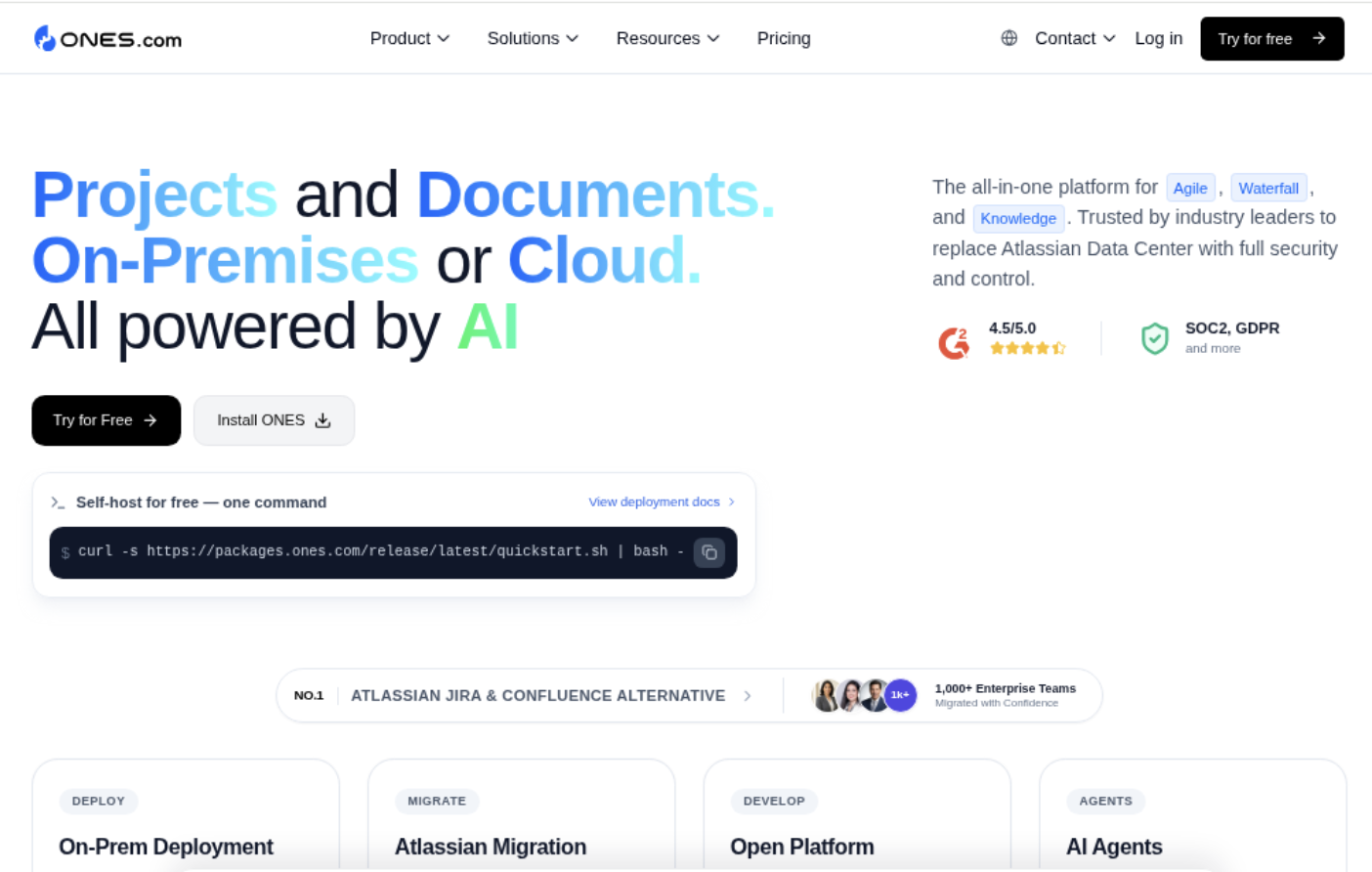
ONES.com combines project management and knowledge management in one unified platform. It can suit teams comparing Confluence with a Jira alternative, especially when self-hosting matters.
ONES Project and ONES Wiki are sold separately, so you can select the product that matches your immediate requirement.
Core Capabilities
- Scattered project knowledge → ONES Wiki provides a connected knowledge workspace → Teams can keep product guidance, decisions, and working practices easier to find.
- Separate project and knowledge tools → ONES.com brings project management and knowledge management under one platform → People spend less time switching between systems.
- Rigid workflows → ONES Project supports custom workflows and fields → Teams can reflect their approval and delivery process more accurately.
- Manual status reporting → Built-in reporting gives teams project visibility → Managers can review progress without assembling updates by hand.
- Complex sprint coordination → Sprint management supports iterative planning → Product teams can organize work within familiar agile routines.
- Repetitive administrative work → Automation handles defined workflow actions → Teams can reduce routine updates and handoffs.
- Dependence on many plugins → Native capabilities cover common project needs → Administrators may manage fewer separate extensions.
- Restricted hosting requirements → ONES.com supports Cloud, On-Premise, Private Cloud, and Air-gapped deployments → Organizations can align deployment with operational constraints.
- Different cloud and self-hosted capabilities → ONES.com maintains feature parity between those versions → Teams can select a deployment model without giving up core functionality.
- Early-stage budget pressure → The free plan supports up to 30 seats → Small teams can evaluate the platform before expanding.
Application Scenarios
Scenario one: a regulated engineering team. The team needs project workflows and an air-gapped environment. ONES Project can support delivery work while its deployment options align with restricted networks.
Scenario two: a product organization leaving disconnected tools. Product managers need sprint planning, requirements, decisions, and reports in a more connected workflow. ONES.com can reduce the number of handoffs between project and knowledge activities.
Scenario three: a growing team comparing total ownership. Administrators want fewer plugins and consistent capabilities across hosting models. Native workflows, fields, reporting, and automation can simplify that evaluation.
Common Challenges and Practical Solutions
Challenge: The Advertised Rate Does Not Match the Invoice
Solution: Confirm seat count, billing cycle, region, taxes, discounts, and connected products. Keep a written estimate with every assumption.
Challenge: You Pay for Inactive Accounts
Solution: Review account activity monthly or quarterly. Create an offboarding checklist that removes access promptly.
Challenge: Premium Features Remain Unused
Solution: Tie every upgrade to a measurable problem. For example, upgrade only if advanced reporting saves several hours each month.
Challenge: Knowledge Becomes Difficult to Find
Solution: Establish ownership, naming rules, templates, and review dates. Search quality improves when people organize material consistently.
Challenge: Tool Costs Grow Through Add-Ons
Solution: Review every marketplace app annually. Consolidate overlapping capabilities when the maintenance effort exceeds the benefit.
FAQs About Confluence Plans and Costs
Is there a free Confluence plan?
Yes. Confluence offers a Free tier for small teams, with limits on users and advanced capabilities. It can work for basic collaboration, team guidance, and lightweight knowledge sharing. Check the current eligibility rules before planning around it, because Atlassian may adjust limits and packaging. A free plan is best treated as an evaluation route or a fit for genuinely small groups.
How much does Confluence cost per user?
Paid Confluence plans generally charge per user, with the exact rate depending on the tier, billing cycle, region, and current Atlassian pricing. Standard typically sits in the mid-single digits per user monthly, while Premium costs more. Enterprise pricing is usually custom. Use the live Atlassian calculator for a current estimate, then add taxes and related products.
Is annual billing cheaper than monthly billing?
Annual billing can provide a different effective rate and more predictable budgeting, but the result depends on current commercial terms. Monthly billing offers greater flexibility when headcount changes often. Compare both options using your expected seat count for the entire year. A lower annual rate may not help if you pay for many unused accounts.
Does Confluence pricing include Jira?
Confluence and Jira are separate Atlassian products with separate plans. Some people may need access to both, while others need only one. Calculate each product independently, then check how shared accounts affect the combined subscription. Also include apps, taxes, administration, and migration effort when comparing the complete technology cost.
When should a team consider an alternative?
Consider an alternative when you need a different hosting model, want project and knowledge work closer together, or spend too much time maintaining add-ons. Create a realistic evaluation workspace before deciding. Test permissions, workflows, search, reporting, administration, and migration effort. The lowest subscription price is not always the lowest long-term cost.
Conclusion
Confluence pricing is easiest to understand when you separate the plan rate from the full cost of ownership. Start with active seats, forecast growth, compare billing cycles, and include taxes, connected products, apps, migration, and administration.
Free can suit a small team. Standard often fits growing collaboration needs. Premium earns its place when advanced controls or analytics solve a measurable problem. Enterprise requires a broader commercial and governance review.
Let me explain: the most expensive mistake is choosing a plan without testing your real workflow. Recreate your daily work, measure the effort, and compare the result with alternatives such as ONES.com.
That approach reduces the risk of overpaying, underestimating administration, or selecting a platform that cannot support your next stage of growth.