Confluence Cloud Pricing: A Practical Cost Guide for Teams
Wondering what confluence cloud pricing really costs? Compare plans, seats, billing, taxes, and add-ons to budget accurately. Read now to plan smarter.
Confluence Cloud pricing can feel simple until you add guests, plan upgrades, billing frequency, taxes, and premium features. A small team may start free, then discover that growing access needs change the monthly bill quickly.
That uncertainty creates planning problems. You might compare the advertised per-user rate with your actual seat count, only to find that inactive accounts, contractors, or advanced controls change the total. A discounted annual plan can also look attractive while creating a larger upfront commitment.
Here’s the practical answer: estimate your active seats, compare Free, Standard, Premium, and Enterprise against your requirements, then calculate the full annual cost. I’ll show you how pricing works, which expenses are easy to miss, and how to choose a sensible plan.
Confluence Cloud Pricing: How the Plans Work
Confluence Cloud pricing is the amount your team pays for access to Atlassian’s cloud-based knowledge and collaboration platform, usually according to user count, plan level, billing frequency, and optional services.
The main plan levels are Free, Standard, Premium, and Enterprise. Each tier adds capacity, administration, security, analytics, automation, or support features.
| Plan |
Best suited to |
Typical considerations |
| Free |
Small teams testing collaborative knowledge management |
Limited administration, storage, support, and advanced controls |
| Standard |
Growing teams that need everyday collaboration |
More capacity, permissions, support, and team management features |
| Premium |
Organizations needing stronger scale and advanced capabilities |
Higher limits, enhanced analytics, automation, and premium controls |
| Enterprise |
Large organizations with complex governance needs |
Custom pricing, centralized administration, security, and support arrangements |
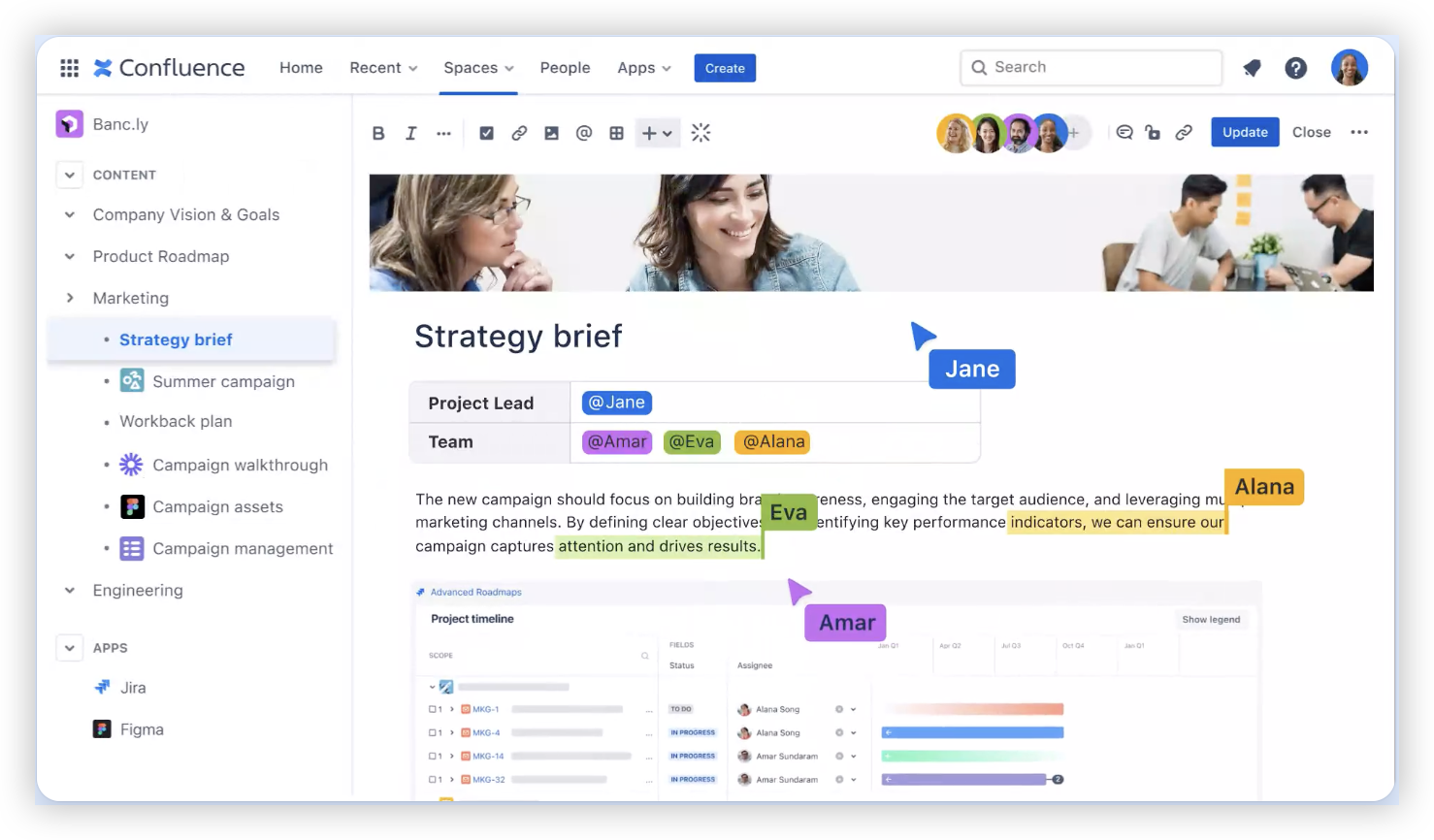
Free plan
The Free plan can work for a small group creating team spaces, project notes, onboarding content, and internal guidance. It gives you a low-risk way to test adoption.
However, free access typically comes with tighter limits around administration, storage, audit visibility, support, and advanced controls. A team may outgrow it when several departments need separate permissions.
Standard plan
Standard is usually the practical starting point for established teams. It supports regular collaboration while adding capabilities that make daily administration easier.
For example, a 25-person product team may need controlled access, predictable support, and enough capacity for technical guidance. Standard can fit that situation better than Free.
Premium plan
Premium targets teams that need stronger scale, deeper insights, advanced automation, and additional administrative features. It can make sense when knowledge work has become critical to daily operations.
You might consider Premium when several departments share the platform, executives need usage visibility, or administrators need more control over content and activity.
Enterprise plan
Enterprise pricing is generally tailored to the organization. The final amount may reflect seat volume, security requirements, support expectations, governance needs, and commercial terms.
Large companies should evaluate more than the license fee. Implementation, identity management, compliance reviews, training, and administration can influence the total investment.
How to Calculate Your Real Cloud Cost
The simplest calculation is:
Estimated annual cost = paid seats × plan rate × billing periods + optional services + taxes
That formula gives you a starting point. Your actual bill can differ because pricing may use progressive user bands, regional currency, annual commitments, or special commercial terms.
Step 1: Count paid seats carefully
List everyone who needs regular access. Include employees, contractors, specialists, and administrators who will use the platform during the billing period.
For example, a company may have 60 employees but only 42 active contributors. If 18 people only need occasional viewing, the correct plan setup may depend on how guest or limited access is handled.
Step 2: Separate active and occasional access
Seat planning becomes more accurate when you separate daily contributors from occasional readers. Reviewers, executives, and external partners may have different access patterns.
Ask three questions:
- Who creates or edits content?
- Who only reads team guidance?
- Who needs administration or reporting privileges?
This exercise helps you avoid paying for access that adds little value. It also highlights whether your current permission model creates unnecessary seats.
Step 3: Compare monthly and annual billing
Monthly billing provides flexibility when headcount changes frequently. Annual billing can reduce the effective rate, though it requires a larger commitment upfront.
Suppose a 40-seat plan costs an illustrative $8 per seat each month. Monthly billing would equal $320 per month, or $3,840 across twelve months before taxes.
If an annual commitment reduces the effective rate to $7 per seat each month, the illustrative total becomes $3,360. The saving would be $480, provided the team keeps those seats for the full year.
Step 4: Add optional costs
Your subscription may not be the only expense. Consider migration services, training, consulting, identity integration, backup tools, and administration time.
A lower plan can become more expensive when your team relies on several add-ons. A higher plan may deliver better value if it replaces separate tools or manual work.
Step 5: Include taxes and currency effects
Regional taxes, currency conversion, and local invoicing rules can affect the final amount. Use the billing currency that matches your organization’s purchasing process.
For budgeting, add a reasonable buffer. A forecast that matches the advertised rate but ignores taxes or currency movement can create a surprise later.
What Changes the Amount You Pay?
Several variables affect the final bill. The plan tier matters first, though seat count and billing structure often create the largest practical differences.
Seat growth
Knowledge platforms tend to spread beyond the original team. A workspace launched for engineering may later include sales, support, compliance, and human resources.
A team that grows from 20 to 75 contributors should recalculate before renewal. The initial plan may still fit, while the seat increase changes the commercial picture.
Feature requirements
Advanced analytics, automation, administration, security, and support can push a team toward Premium or Enterprise. Choose features according to operational needs.
For example, a ten-person startup may not need advanced governance. A regulated company with multiple business units may consider those controls essential.
Billing commitment
Annual billing can offer predictable budgeting and a lower effective rate. Monthly billing can reduce commitment when staffing changes quickly.
Compare both options using expected seat usage. A discount loses value if you pay for unused access throughout the year.
Guests and external collaborators
External access deserves special attention. Partners, agencies, and clients may require limited collaboration without full participation in every team space.
Review how guest access works under your selected plan. Permission design can affect both security and cost.
Administration and compliance
Some teams pay more because they need centralized controls, activity visibility, identity management, or formal support. These requirements usually appear during security review.
Bring your administrator and security lead into the evaluation early. Their requirements can prevent a late plan change.
How to Compare Plans Without Overpaying
Start with requirements instead of plan names. Write down the capabilities your team needs, then identify the lowest tier that satisfies them.
| Requirement |
Questions to ask |
Cost implication |
| Team size |
How many people will edit or manage content? |
More paid seats increase recurring cost |
| Security |
Do you need stronger identity and administrative controls? |
May require a higher plan |
| Automation |
Will workflows reduce manual coordination? |
Premium capabilities may provide better value |
| Support |
How quickly must you resolve platform issues? |
Higher tiers or enterprise arrangements may apply |
| Growth |
Will several departments join during the year? |
Annual commitments need careful forecasting |
Here’s why this works: a plan comparison becomes clearer when every paid feature connects to a real business outcome.
For instance, paying more for automation may be sensible if it removes ten hours of weekly coordination. Paying more for a feature nobody uses creates avoidable waste.
Use a break-even calculation
Compare the extra plan cost with the value of the capability. If Premium costs an additional $2,000 annually and saves 100 hours, the break-even value is $20 per hour.
If your team values reclaimed time above that amount, the upgrade may be financially reasonable. This calculation does not need perfect precision to improve decision-making.
Review adoption before renewal
Check space activity, active contributors, search behavior, and content maintenance. Low adoption may signal poor structure or insufficient training.
A plan upgrade cannot fix unclear ownership. Improve navigation and publishing habits before increasing spend.
Common Budgeting Mistakes
Pricing mistakes often come from incomplete planning. The subscription rate receives attention, while the operating effort receives little attention.
Budgeting for employees only
Contractors and external specialists may need access too. Add them to your access forecast before selecting a commitment.
A consulting team with five internal editors and twelve external contributors may require a different setup than its employee count suggests.
Ignoring inactive accounts
People change roles, leave projects, or stop contributing. Review account activity regularly and remove access that no longer serves a purpose.
Access reviews also reduce security risk. A clean account list supports better cost control.
Choosing Premium for every team
Premium features can be valuable, though every team may not need them. Map each capability to a specific workflow or governance requirement.
A small marketing group with simple publishing needs may receive little benefit from advanced controls. A global engineering organization may use them daily.
Forgetting migration and training
Moving content into a new workspace requires planning. Someone must design spaces, clean outdated material, set permissions, and teach teams new habits.
Include that effort in your first-year budget. A smooth rollout improves adoption and helps you realize the value of the subscription.
Confluence Cloud Alternative: ONES.com
ONES.com combines project management and knowledge management in one platform, powered by ONES Assistant. ONES Project is sold separately from ONES Wiki, so you can select the capability your team needs.
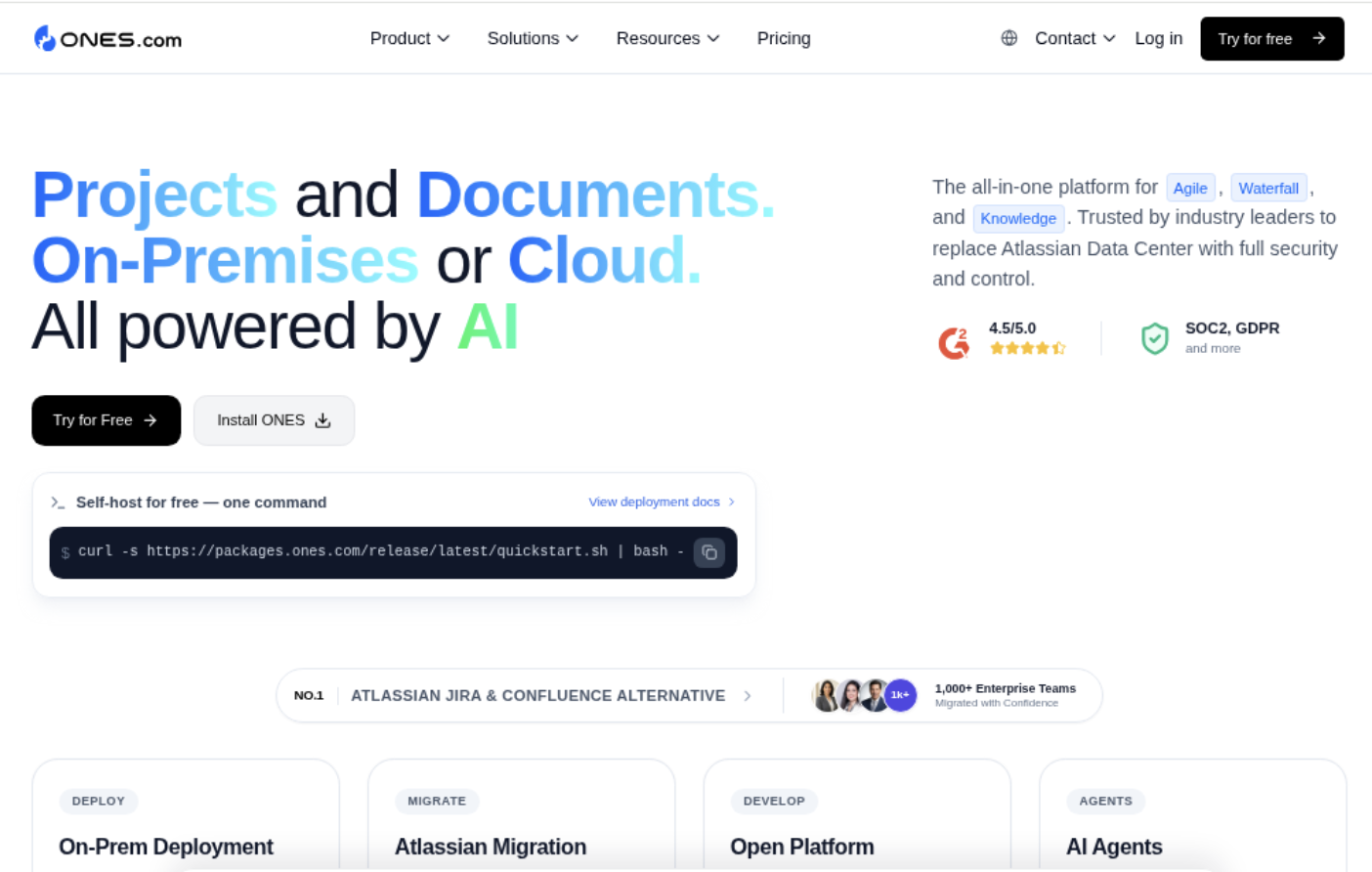
For teams comparing Confluence alternatives, ONES Wiki provides a knowledge base environment, while ONES Project serves as a Jira alternative for planning and delivery work.
Core capabilities
Scattered project knowledge → ONES Wiki → One connected knowledge environment
When guidance sits across disconnected workspaces, people repeat questions and miss updates. ONES Wiki gives teams a structured place for policies, procedures, product knowledge, and internal guidance.
Separate planning and knowledge tools → ONES.com → Fewer context switches
Teams often move between a project tracker and a knowledge platform. ONES.com connects project management and knowledge management within one broader environment.
Complex Jira migration concerns → ONES Project → Jira-compatible workflows
Teams seeking a Jira alternative may worry about rebuilding issue workflows. ONES Project supports Jira-compatible workflows, custom fields, sprint management, automation, and built-in reporting.
Plugin-heavy administration → Native capabilities → Lower configuration overhead
Multiple plugins can create maintenance work and inconsistent behavior. Native capabilities reduce dependence on extra extensions for common project and reporting needs.
Restricted deployment requirements → On-premise, private cloud, or air-gapped deployment → More deployment flexibility
Some organizations cannot place operational knowledge in a public cloud. ONES.com supports Cloud, On-Premise, Private Cloud, and Air-gapped deployments.
Different environments with different features → Full feature parity → More consistent operations
Self-hosted teams may worry that deployment restrictions limit capability. ONES.com provides full feature parity between its cloud and self-hosted versions.
Small teams testing a platform → Up to 30 free seats → Lower adoption risk
A team can begin with up to 30 free seats. That gives a small organization room to validate collaboration patterns before making a broader commitment.
Disconnected reporting → Built-in reporting → Clearer delivery visibility
When progress reporting requires manual preparation, managers receive updates slowly. Built-in reporting helps teams review delivery trends within their project workflows.
Application scenarios
Software product team: Engineers can use ONES Project for sprints, custom workflows, and issue tracking, while ONES Wiki holds technical guidance and release knowledge.
Restricted-network organization: A team with strict network controls can evaluate an air-gapped deployment while keeping project and knowledge workflows available in its approved environment.
Growing operations team: A company can begin with knowledge management, then add project management when cross-functional planning becomes more complex. Because the products are sold separately, the rollout can match actual needs.
Common Challenges and Practical Solutions
Challenge: The advertised rate does not match the invoice
Solution: Check seat quantity, billing frequency, taxes, currency, discounts, and optional services. Compare the final annual amount rather than one monthly headline figure.
Challenge: Your team cannot predict seat growth
Solution: Create low, expected, and high growth scenarios. For example, forecast 40, 60, and 85 contributors before choosing an annual commitment.
Challenge: People cannot find useful knowledge
Solution: Improve space structure, naming, ownership, and search-friendly writing. More seats will not solve poor organization.
Challenge: External collaborators complicate access
Solution: Define a separate access policy for contractors and partners. Review their permissions at project milestones and contract changes.
Challenge: The higher tier is difficult to justify
Solution: Connect each premium feature to measurable value. Estimate reduced coordination time, fewer support questions, faster onboarding, or lower administration effort.
FAQs
Is there a free option for small teams?
Yes, Confluence offers a Free plan for smaller teams. It can suit basic collaboration and early evaluation. Review current limits for seats, storage, permissions, support, and administration before committing to a rollout.
Is annual billing cheaper than monthly billing?
Annual billing may provide a lower effective rate, depending on the plan and current commercial terms. It also creates a longer commitment. Compare expected seat usage across twelve months before choosing it.
What should I include in a first-year budget?
Include paid seats, taxes, currency effects, optional services, migration, training, administration, and possible seat growth. This gives you a more realistic estimate than multiplying the advertised rate by your current headcount.
When should I consider Premium?
Consider Premium when your team needs advanced administration, stronger analytics, automation, higher limits, or additional controls. Tie the upgrade to a measurable requirement instead of selecting it because your organization is growing.
Can I reduce the bill by removing inactive accounts?
Often, reviewing inactive accounts can improve cost control. Confirm your billing rules and account behavior, then create a regular access review. Removing unnecessary access can also reduce security exposure.
What is a practical alternative for teams comparing knowledge and project tools?
ONES.com is worth evaluating when you want project management and knowledge management in one platform. ONES Wiki addresses knowledge management, while ONES Project is a Jira alternative with compatible workflows and delivery features.
Conclusion
Cloud collaboration pricing becomes manageable when you calculate the full annual cost, separate active from occasional access, and match features to real workflows.
Start with seat planning, compare billing options, account for taxes and implementation effort, then test whether a higher tier creates measurable value. Review adoption before assuming that more features will solve knowledge problems.
But here’s the truth: the cheapest plan is not always the lowest-cost choice after manual work, add-ons, and poor adoption enter the picture. A practical comparison should include both the subscription and the work surrounding it.
If your team is also comparing alternatives, ONES.com offers a combined path for knowledge management and project delivery. The right choice is the platform that fits your access model, governance needs, deployment requirements, and growth plan.