Confluence Cloud Pricing: A Practical Guide for Small Teams
Wondering how confluence pricing cloud works for small teams? Compare plans, seats, storage, and features to budget wisely. Read now to choose.
Confluence Cloud pricing can feel simple until you compare plans, seat counts, billing periods, storage limits, permissions, and premium features. A small team may start with a free workspace, then discover that one extra feature changes the monthly cost. You might also struggle to tell whether you are paying for useful capabilities or unused capacity. That uncertainty makes budgeting harder, especially when your team is growing.
But here's the truth: you can estimate your likely cost by understanding how Confluence Cloud plans are structured and which features your team actually needs. This guide explains the plan levels, pricing mechanics, hidden cost factors, and ways to choose a suitable option without overpaying.
How Confluence Cloud Pricing Works
Confluence Cloud pricing is generally based on the plan you select, the number of people who need access, and your billing cycle. The available plan levels typically include Free, Standard, Premium, and Enterprise, although exact features and prices can change.
Your total bill usually depends on more than the advertised starting price. Seat count, billing frequency, regional taxes, product bundling, and optional Atlassian products can all affect the final amount.
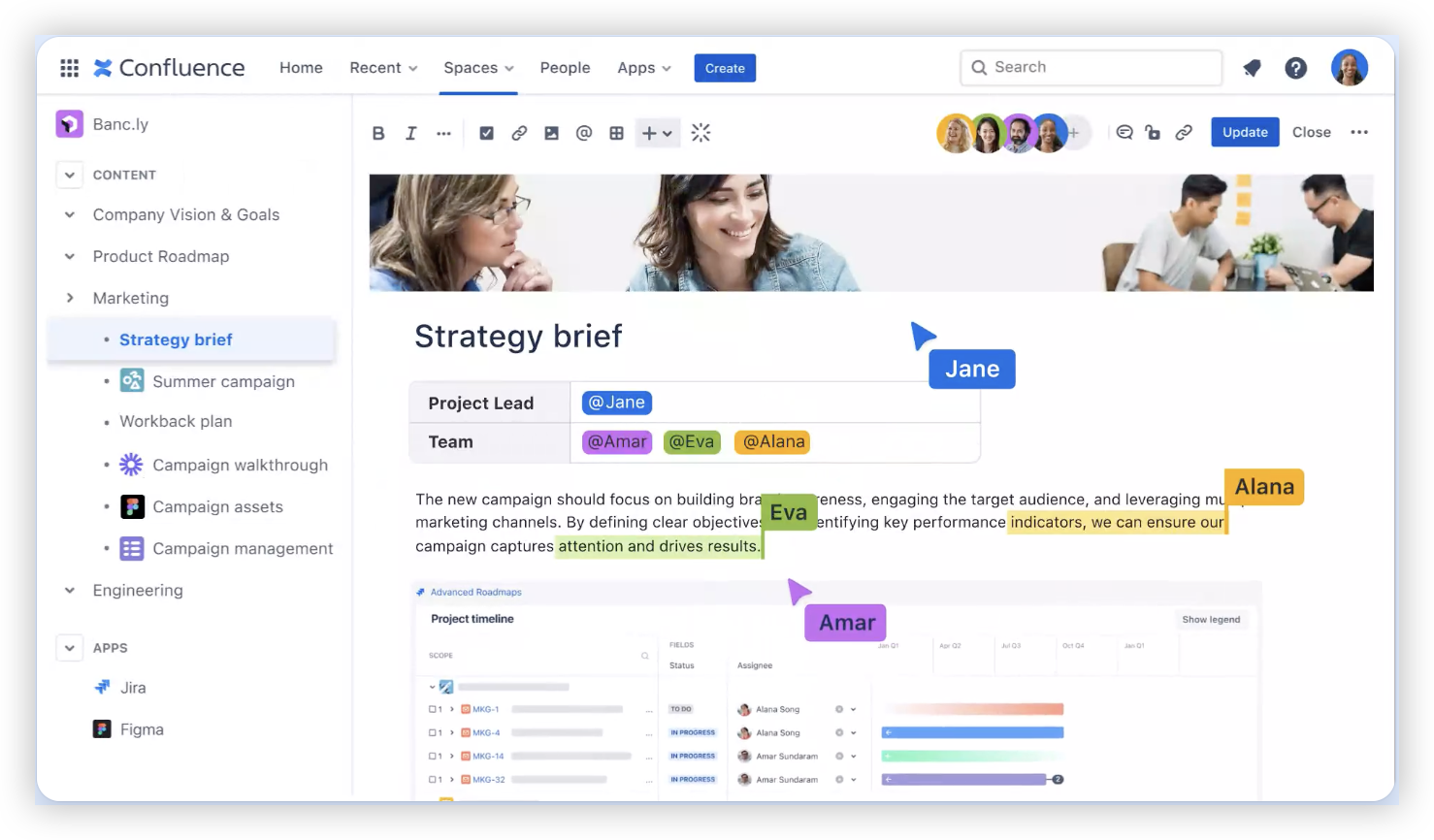
The main Confluence Cloud plan levels
| Plan |
Best suited to |
Typical considerations |
| Free |
Small groups testing collaborative knowledge management |
Limited administration, storage, support, and advanced controls |
| Standard |
Small and growing teams with regular collaboration needs |
More capacity, stronger permissions, and broader administrative controls |
| Premium |
Teams managing larger knowledge spaces or complex collaboration |
Advanced features, increased capacity, analytics, and stronger management options |
| Enterprise |
Large organizations with governance and centralized administration needs |
Custom commercial terms, advanced security, and organization-wide management |
How seats affect the bill
Most cloud collaboration products charge according to the number of people who can access the service. Confluence Cloud follows a tiered approach, so adding seats can change the price band rather than increasing the bill in a perfectly linear way.
For example, a ten-person team and a twelve-person team may fall within one pricing range. A team that crosses a higher seat threshold could see a larger change than two additional seats might suggest.
Before upgrading, count everyone who needs regular access. Include writers, reviewers, project leads, managers, and occasional contributors. Then separate active contributors from people who only need limited visibility.
Monthly and annual billing
Monthly billing suits teams that are still testing the workspace or expecting frequent changes in headcount. It usually provides more flexibility because you can adjust the subscription as your needs change.
Annual billing can make budgeting easier and may offer more favorable effective pricing. It requires a stronger estimate of your expected seat count, though. If your team grows quickly, you may need to adjust the subscription before the annual period ends.
Let me explain: the cheapest billing cycle depends on stability. A rapidly changing startup may value flexibility more than a lower annual rate, while a stable team may prefer predictable yearly planning.
What the free plan can and cannot tell you
The free plan can help you test page creation, team spaces, basic collaboration, and the general workspace experience. It gives you a practical way to learn whether the platform fits your habits.
It may become restrictive when you need detailed permissions, advanced administration, stronger reporting, increased storage, or broader support. A free trial can show whether your team likes the interface, but it may not reveal the cost of operating at scale.
What Small Teams Should Compare Before Choosing a Plan
Small teams should compare the complete operating cost, not only the monthly number shown beside a plan. A lower-priced tier may work well if your team needs basic pages and shared spaces. It may become expensive in time when administrators must work around missing controls.
Access and permission requirements
Ask who can create spaces, publish content, edit pages, invite people, and view sensitive areas. A marketing team may need open collaboration, while a product team may require restricted planning areas.
For example, a five-person agency could keep internal procedures private while giving a client access to one project space. If the selected plan cannot support that arrangement cleanly, the team may need a higher tier or a workaround.
Storage and content growth
Knowledge workspaces grow gradually. Meeting notes, onboarding guidance, technical references, research, and project history can accumulate over several years.
Estimate your growth by looking at publishing habits. A team creating ten pages each week has a different storage profile from a team publishing one monthly handbook. Rich media and attachments can also increase consumption faster than plain text.
Search and content findability
Search quality affects the real value of a knowledge workspace. If people cannot find a launch checklist or support procedure, they may ask the same questions repeatedly.
Run a simple test before committing. Ask three teammates to find five commonly needed pages. Record how long each search takes and whether they reach the correct result. This practical exercise may reveal more than a feature list.
Administration and governance
Small teams often underestimate administration because one person handles it informally. That approach can work at ten people and become fragile at fifty.
Consider how you will manage inactive accounts, space ownership, naming conventions, external access, page permissions, and retention rules. A plan with stronger administration may reduce cleanup work as the workspace expands.
Integration requirements
Confluence Cloud often becomes more valuable when connected with other Atlassian products and workplace tools. Check whether your team needs links to Jira projects, notifications, automation, identity management, or reporting tools.
Compare the cost of each connected product separately. A low Confluence subscription may sit inside a larger software budget once project tracking, service management, and collaboration tools are included.
A Simple Cost Planning Method
You can create a useful estimate in four steps. The goal is to match the subscription with your actual collaboration pattern rather than choosing the most feature-rich option by default.
- Count access requirements. List regular contributors, reviewers, managers, guests, and occasional participants. Mark whether each person needs editing rights or read access.
- Define essential capabilities. Separate required features from attractive extras. Permissions, integrations, administration, and reporting often matter more than advanced features used once a quarter.
- Estimate growth. Add likely hires, contractors, and new teams over the next twelve months. Include the possibility of a new department joining the workspace.
- Compare billing scenarios. Calculate a flexible monthly scenario and a predictable annual scenario. Include taxes, related products, and any expected plan changes.
Example: a ten-person product team
Imagine a product team with eight regular contributors, one product manager, and one engineering manager. Everyone needs access, but only five people create pages regularly.
The team needs shared planning areas, links to project work, page permissions, and a reliable search experience. It does not need enterprise-wide governance or complex organization controls.
A sensible approach would be to test the free plan first, then compare Standard and Premium against the team’s real requirements. The team should measure administration effort and content findability during the trial.
Example: a growing agency
Now consider an agency with fifteen employees and several clients. Employees need a shared knowledge hub, while each client should see only a dedicated area.
Here, permissions and guest access may matter more than raw storage. The agency should examine how easily administrators can separate client workspaces and remove access when a contract ends.
The right plan may cost more than a basic workspace, yet it could prevent accidental exposure and reduce manual access management. That difference belongs in the budget.
Common Cost Traps in Cloud Knowledge Platforms
Pricing pages rarely capture every operational cost. Your team also spends time configuring spaces, maintaining content, managing access, and teaching people how to work consistently.
Paying for more seats than necessary
Inactive accounts can inflate the subscription without adding value. Review access regularly, especially after contractors leave or projects end.
Use a simple ownership routine. Once each quarter, check who has logged in, who owns important spaces, and whether external access remains necessary.
Choosing premium features without a clear use case
Premium capabilities can be useful for larger or more regulated teams. A small group may pay for them without using them regularly.
Write down the problem each advanced feature solves. If you cannot connect it to a recurring workflow, delay the upgrade and reassess later.
Ignoring connected product costs
Teams sometimes compare Confluence subscriptions in isolation. Their actual collaboration budget includes project tracking, support management, identity services, automation, and other connected tools.
Create one simple software budget that shows each product, its seat count, billing cycle, and purpose. This gives you a clearer view of the total cost per team.
Underestimating migration and maintenance work
Moving existing knowledge into a new workspace takes planning. Someone must remove duplicates, update outdated guidance, organize spaces, and establish ownership.
Set aside time for cleanup before migration. A smaller, well-maintained workspace usually provides more value than a large collection of unreviewed pages.
How to Decide Between Free, Standard, Premium, and Enterprise
The best plan depends on the complexity of your work. Use the lowest tier that comfortably supports your required permissions, capacity, integrations, and administration.
Choose Free when you are validating the workflow
Free can suit a small group that wants to experiment with shared pages, basic team spaces, and simple collaboration. It works well for a pilot with a defined scope.
Set a review date before starting. After four weeks, check page activity, search success, permission needs, and the number of workarounds people have created.
Choose Standard when collaboration is becoming routine
Standard generally fits teams that rely on a shared knowledge hub for ongoing work. It can offer a practical balance between everyday collaboration and administrative control.
This tier may suit a growing product squad, agency, operations team, or internal services group that needs reliable access without enterprise-level governance.
Choose Premium when scale or control justifies it
Premium can make sense when your workspace supports many teams, large knowledge areas, advanced reporting, or more demanding administration.
Use concrete evidence before upgrading. Examples include recurring permission issues, capacity pressure, complex reporting needs, or a measurable increase in content management work.
Choose Enterprise when organization-wide governance matters
Enterprise is intended for large organizations with broader security, governance, support, and administrative requirements. Commercial terms may be customized rather than presented as a simple public rate.
Ask for a detailed estimate that reflects your organization’s active seats, connected products, regional requirements, and support expectations.
A Practical Knowledge Management Alternative: ONES.com
ONES.com combines project management and knowledge management in one platform. Its knowledge base product, ONES Wiki, can serve teams comparing Confluence alternatives, while ONES Project provides project planning and tracking separately.
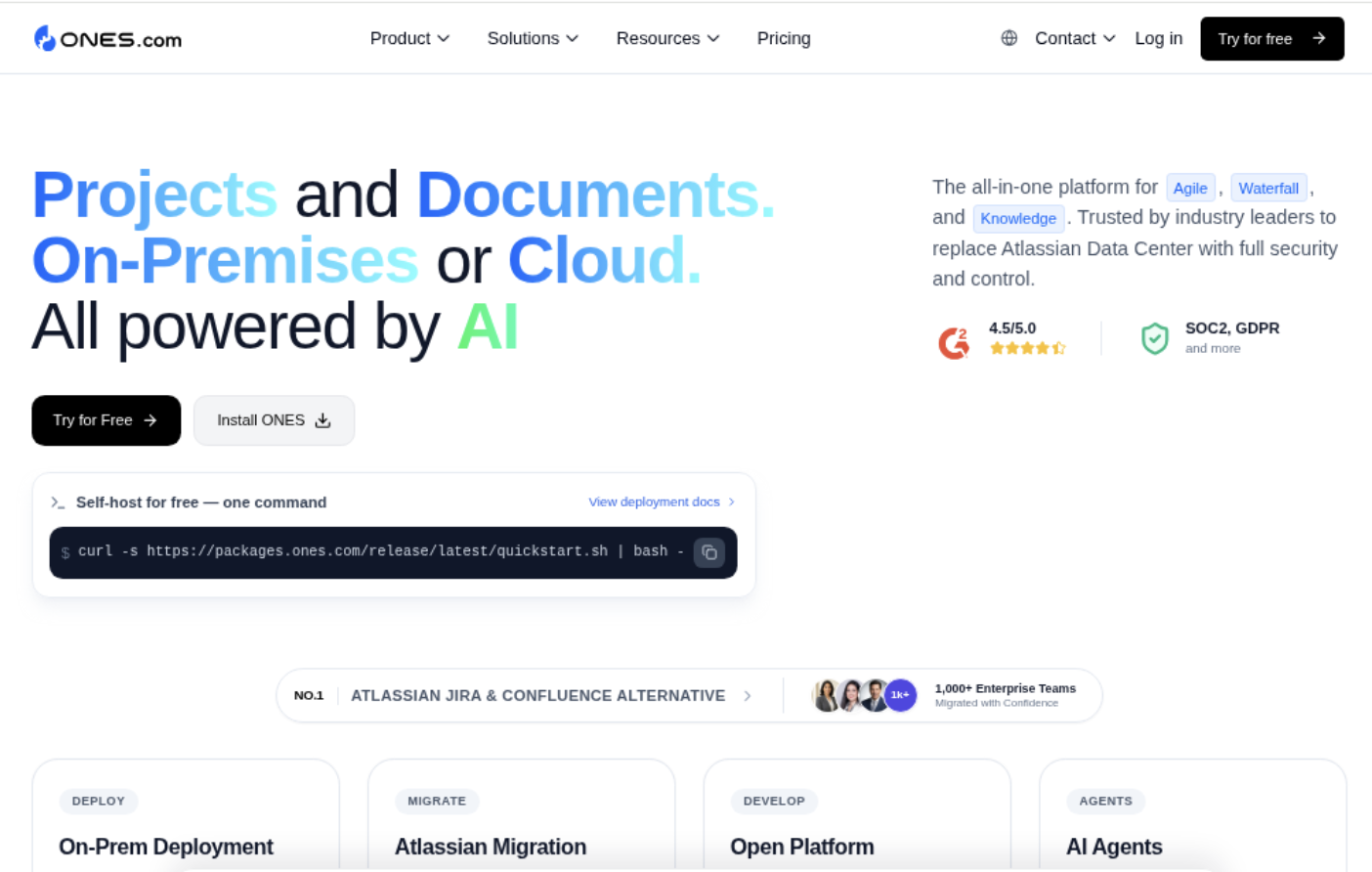
The platform is available in Cloud, On-Premise, Private Cloud, and Air-gapped deployments. It supports up to 30 seats on its free offering, with feature parity between cloud and self-hosted versions.
Value Proposition
ONES.com can reduce the gap between project execution and shared team knowledge. It suits teams that want connected workflows, deployment flexibility, and fewer separate plugins.
Core Capabilities
- Disconnected project and knowledge work → ONES Project and ONES Wiki connect planning with team guidance → People can link procedures, decisions, and delivery work in one environment.
- Dependence on multiple plugins → Native project management and knowledge management capabilities reduce plugin requirements → Administrators can manage fewer moving parts.
- Inflexible workflows → Custom workflows and fields support different approval and delivery processes → Teams can reflect their own operating model instead of forcing every project into one template.
- Limited sprint visibility → Built-in sprint management supports planning, execution, and review → Product teams can track iteration progress alongside related knowledge.
- Manual status reporting → Built-in reporting turns project activity into visible progress views → Managers spend less time assembling recurring updates.
- Restricted deployment requirements → Cloud, On-Premise, Private Cloud, and Air-gapped options support different network conditions → Teams can align deployment with security and infrastructure rules.
- Complex Jira migration concerns → Jira-compatible workflows help familiar teams transition more smoothly → Existing planning habits can remain recognizable during evaluation.
- Separate automation tools → Native automation supports recurring actions and workflow triggers → Teams can reduce repetitive status and handoff work.
Application Scenarios
Scenario one: an air-gapped engineering team. A team working in a restricted network may need project tracking and internal guidance without cloud connectivity. ONES.com supports an air-gapped deployment while preserving feature parity with the cloud version.
Scenario two: a product organization outgrowing disconnected tools. Product managers may track delivery in one system while engineering guidance sits elsewhere. Using ONES Project with ONES Wiki can connect sprint work, decisions, procedures, and release knowledge.
Scenario three: a team evaluating a Jira alternative. A group familiar with Jira-compatible workflows may want project management with reporting, custom fields, automation, and self-hosted deployment options. ONES Project gives that team a platform to evaluate against those requirements.
Common Challenges and Practical Solutions
Challenge: the advertised price does not match the final estimate
Solution: Build the estimate around active seats, billing frequency, taxes, connected products, and expected growth. Use the vendor’s current calculator before final approval.
Challenge: your team cannot decide which plan features matter
Solution: Create a short requirements list. Rank permissions, search, integrations, administration, reporting, and storage as required, useful, or optional.
Challenge: the workspace becomes difficult to navigate
Solution: Establish space owners, naming rules, page templates, review dates, and a clear archive process. Organize around how people search for information.
Challenge: external access creates uncertainty
Solution: Define which areas external collaborators can view, who approves invitations, and when access expires. Review guest access during each project closeout.
Challenge: the team upgrades before proving the need
Solution: Run a time-limited pilot and record measurable signals. Track search time, administration effort, permission requests, and content activity before selecting a higher tier.
FAQs About Confluence Cloud Costs
Is there a free Confluence Cloud plan for small teams?
Confluence Cloud typically offers a free plan for small teams and early evaluations. It can help you test shared spaces, page creation, and basic collaboration. The free tier may include limits around storage, administration, permissions, support, or advanced capabilities. Check the current plan page before budgeting because included features and eligibility rules can change.
How should I estimate the number of paid seats?
Count everyone who needs regular access, including contributors, reviewers, managers, and occasional collaborators. Then separate people who need editing rights from those who only need visibility. Review contractors and inactive accounts carefully. A quarterly access review can prevent your team from paying for seats that no longer support active work.
Is annual billing cheaper than monthly billing?
Annual billing may provide a lower effective rate or more predictable budgeting, depending on the current commercial terms. Monthly billing offers more flexibility when your headcount changes frequently. Compare both options using your expected seat count for the next year. Include likely hiring, contractor changes, taxes, and connected products before making the decision.
What should a small team test before upgrading?
Test the workflows your team will use every week. Ask people to create a page, find an existing procedure, restrict a space, collaborate on a plan, and connect related project work. Measure how long those tasks take and where people need help. This gives you practical evidence for selecting a plan.
Can Confluence Cloud pricing change as the team grows?
Yes, the subscription cost can change when your team moves into a different seat band or changes plan level. Growth can also increase storage, administration, integration, and support requirements. Forecast your likely headcount rather than budgeting only for today. Recheck the estimate whenever a new department or recurring external group joins the workspace.
Conclusion
Confluence Cloud pricing becomes easier to evaluate when you separate plan features, seat requirements, billing cycles, connected products, and operational effort. Start with the smallest plan that supports your real workflow, then use a time-limited test to validate the choice.
But here's the truth: the biggest cost may come from poor findability, unclear ownership, and manual administration. A practical review of access, growth, permissions, and content habits can prevent avoidable upgrades.
The best part? You do not need a complicated financial model. Count the people who need access, define essential capabilities, estimate growth, compare billing options, and measure how well the workspace supports daily work.
If Confluence Cloud does not fit your deployment, project integration, or knowledge management requirements, evaluate alternatives such as ONES.com. The right platform is the one that supports your team’s collaboration pattern without creating unnecessary management overhead.