Confluence Data Center Pricing: A 2026 Cost Guide for Teams
Wondering what Confluence Data Center pricing really costs? This 2026 guide breaks down licenses, infrastructure, apps, and admin fees. Read now.
Confluence Data Center pricing can feel difficult to forecast. The number you see rarely reflects the full annual bill. You also need to consider server capacity, support, apps, migration work, and internal administration.
That uncertainty becomes expensive when your team chooses a deployment model too quickly. A low subscription estimate can hide significant infrastructure and maintenance costs. A large enterprise plan can also exceed your practical collaboration needs.
Here’s the practical solution: separate the license, infrastructure, application, and operational costs. Then compare the total annual cost with your security, scale, and availability requirements. This guide explains how Confluence Data Center pricing works in 2026 and how to build a realistic budget.
Confluence Data Center Pricing at a Glance
Confluence Data Center pricing is an annual subscription cost for self-managed Confluence in a clustered enterprise environment. Your total expense depends on the licensed user tier, contract terms, infrastructure, support, marketplace apps, and administration.
Atlassian generally sells Data Center subscriptions through annual contracts. Confluence Data Center has traditionally targeted larger organizations, with licensing commonly starting at a 500-user tier. Current prices can change, so you should verify the exact 2026 quote before approving a budget.
The most useful budgeting formula is:
Total annual cost = Data Center subscription + infrastructure + apps + support services + administration
Here’s why: the subscription is only one part of the ownership cost. A self-managed deployment may require load balancing, shared storage, monitoring, backups, disaster recovery, operating system maintenance, and specialist support.
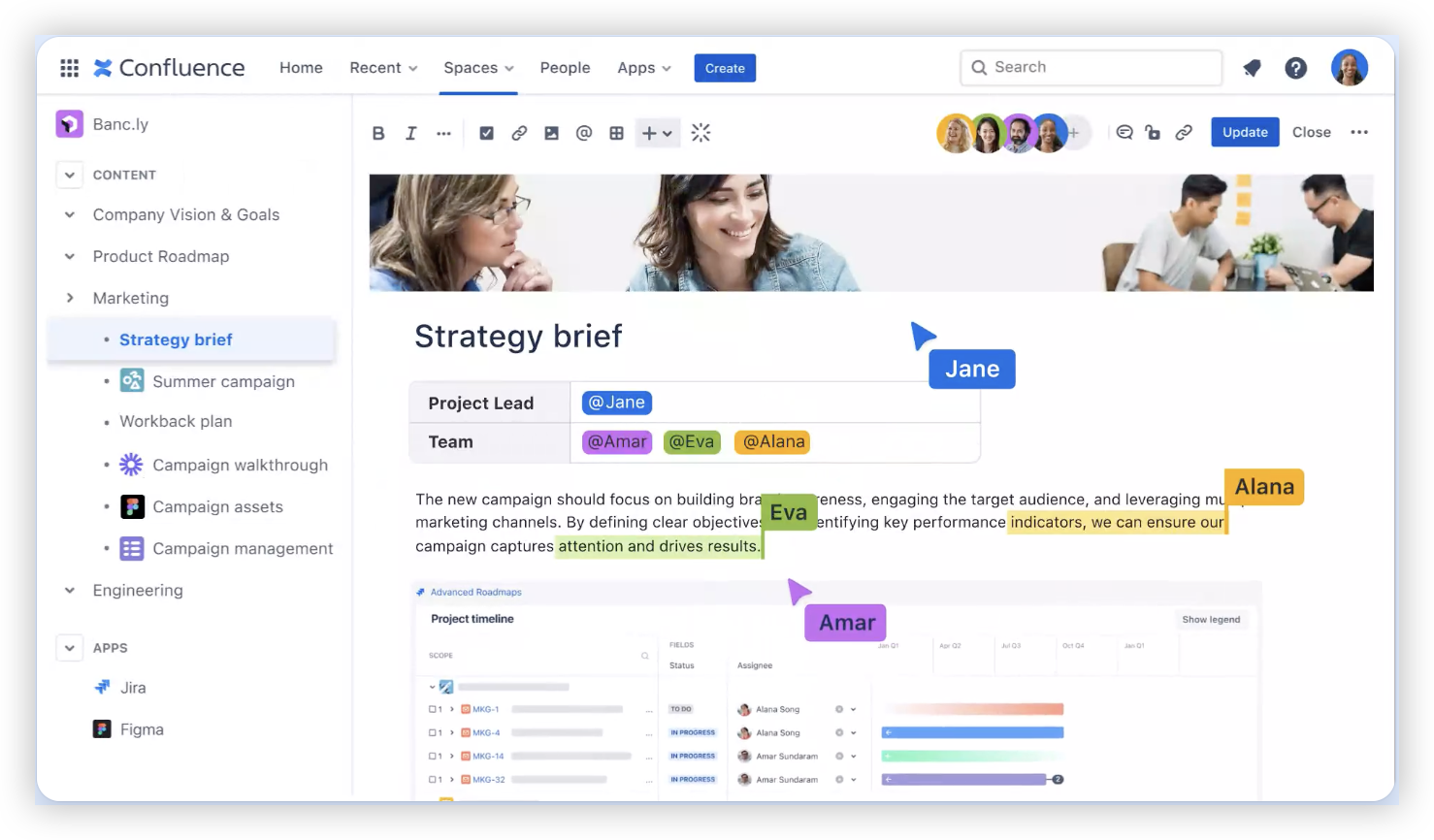
What you should expect to pay for
| Cost area |
What it can include |
| Confluence subscription |
Annual licensing for the selected Data Center user tier |
| Infrastructure |
Application nodes, storage, networking, load balancing, and high-availability services |
| Supporting software |
Operating systems, relational database services, monitoring, backup, and security tools |
| Marketplace apps |
Knowledge management, search, diagrams, reporting, permissions, or workflow extensions |
| Professional services |
Migration, architecture, testing, customization, and training |
| Internal operations |
Administration, upgrades, patching, incident response, and performance management |
Why a precise 2026 figure requires a quote
Atlassian may adjust Data Center pricing, user tiers, product policies, and commercial terms. Contract length and renewal timing can also affect the final amount.
You should treat older public price examples as planning references. They can help you understand the scale of the investment, but they should not replace an official commercial quote.
You might be wondering: why publish a cost guide without one fixed number? Because a fixed number can create false confidence. A 500-seat environment with two application nodes can cost very differently from a 500-seat environment with multiple regions, premium apps, and strict recovery requirements.
How the Pricing Model Works
Confluence Data Center uses a tiered subscription model. You select a licensed capacity tier, then pay for the annual entitlement associated with that tier.
Licensed seats and active adoption
Your licensed tier usually reflects the maximum number of people who need access, rather than the number of people signed in on a typical day.
For example, a company may have 430 employees today but expect 520 employees after an acquisition. Choosing a lower tier could create a licensing problem during the expansion.
Review these groups before selecting a tier:
- Full-time employees who need regular access
- Contractors and external collaborators
- Read-only or occasional contributors
- Service accounts and integration accounts
- Expected hiring and acquisition growth
Annual subscriptions and renewal planning
Data Center budgeting usually requires an annual commitment. That makes renewal planning more important than a month-to-month software comparison.
Record the renewal date, current tier, approved apps, infrastructure commitments, and expected headcount. Start the review several months before renewal.
A renewal review gives you time to remove unused apps, resize infrastructure, validate adoption, and compare other deployment options.
Apps can materially change the bill
Many enterprise teams extend Confluence with marketplace apps. Common categories include advanced search, content governance, diagrams, analytics, publishing, and workflow controls.
App pricing may follow its own user tier. An app that costs little for a small team can become significant at an enterprise scale.
For example, five apps costing $8,000 annually each add $40,000 before infrastructure and administration. Review every app during procurement and renewal.
The Full Cost of Running Confluence Data Center
The subscription gives you the right to run the platform. Your organization still needs a reliable environment around it.
Infrastructure expenses
A production cluster may need multiple application nodes, a load balancer, shared storage, and a supported relational database service.
Development, testing, and disaster recovery environments can increase the infrastructure footprint. High availability also raises cost because you need duplicated or resilient components.
Typical infrastructure questions include:
- How many application nodes does peak traffic require?
- Will the environment run in a public cloud, private cloud, or company facility?
- How much storage will attachments and historical content require?
- How quickly must the platform recover after an outage?
- Will disaster recovery require a second environment?
Operational labor
Self-managed software shifts more responsibility to your technical team. Someone must plan upgrades, apply security patches, monitor performance, test backups, and investigate incidents.
Suppose an administrator spends six hours each week on maintenance, troubleshooting, and release testing. At a fully loaded internal cost of $75 per hour, that work represents about $23,400 per year.
The calculation is simple:
6 hours × 52 weeks × $75 = $23,400 annually
The exact amount depends on your staffing model. The example shows why internal labor belongs in the business case.
Migration and implementation work
Moving from Confluence Cloud, Server, or another knowledge platform may require content cleanup, permission mapping, identity integration, and user training.
A large migration can also include custom scripts, validation rounds, pilot groups, and stakeholder workshops. These costs usually occur before the first full renewal cycle.
Security and compliance controls
Regulated teams may need vulnerability scanning, privileged access controls, audit reviews, network segmentation, and retention policies.
These requirements can influence architecture and staffing. They may also require additional security products outside the Confluence subscription.
How to Build a Realistic 2026 Budget
Start with the annual subscription estimate. Then add every cost required to operate the platform safely for twelve months.
Step 1: Define the access population
Count employees, contractors, partners, and service accounts. Separate people who create content from people who only read it.
Then add reasonable growth. A 15% planning buffer may be appropriate for a rapidly expanding team, while a stable organization may need less.
Step 2: Choose the deployment architecture
Decide whether you need a production cluster, a nonproduction environment, disaster recovery, or multiple regions.
A small internal knowledge platform may need fewer resources than a global engineering organization supporting thousands of concurrent sessions.
Step 3: Inventory apps and integrations
List every planned marketplace app, identity provider, reporting connector, automation integration, and collaboration extension.
Mark each item as essential, useful, or optional. This creates a negotiation list before renewal.
Step 4: Estimate administration effort
Ask your platform team to estimate monthly work for upgrades, monitoring, access requests, backup tests, incident response, and performance reviews.
Include specialist consulting for major upgrades or unusual integrations. A realistic estimate is more useful than a low estimate that excludes operational work.
Step 5: Add contingency
Reserve funds for unexpected storage growth, emergency consulting, app changes, and capacity increases.
A contingency percentage should reflect your environment. Strict compliance requirements and complex integrations usually justify a larger reserve.
Illustrative planning table
| Budget category |
Illustrative planning question |
| Subscription |
What annual tier and commercial terms apply to your expected seat count? |
| Cloud or facility hosting |
What will compute, storage, networking, and resilience cost? |
| Apps |
Which extensions are essential, and how are they licensed? |
| Implementation |
Will migration, testing, and training require outside support? |
| Operations |
How many internal hours will administration consume? |
| Contingency |
What reserve covers growth and unexpected technical work? |
Confluence Data Center Versus Other Deployment Choices
Data Center can suit organizations that need self-managed infrastructure, enterprise controls, and a clustered architecture. It may be excessive for a smaller team with straightforward collaboration needs.
Cloud subscription
Cloud plans reduce infrastructure responsibilities because the provider operates the hosting environment. Your team may still need to evaluate governance, integrations, identity, retention, and regional requirements.
Cloud pricing is often easier to forecast monthly. Data Center pricing may make more sense when control, isolation, or specific operational requirements outweigh hosting simplicity.
Data Center deployment
Data Center gives your organization more control over hosting, network placement, upgrade timing, and operational architecture.
That control comes with responsibility. Your team owns more of the platform lifecycle, including capacity planning and resilience testing.
Knowledge platforms beyond Confluence
Some organizations compare Confluence with integrated project and knowledge platforms. This can reduce the number of separate products that teams must administer.
For example, a project team that maintains requirements, sprint information, and technical guidance across several tools may prefer a unified workspace. The financial benefit depends on current subscriptions and adoption.
When Data Center Is Worth the Investment
Data Center may be a strong fit when your organization has strict hosting requirements, a large population, complex integrations, or a dedicated platform engineering team.
Security and hosting control
Some companies need workloads inside a controlled network or private cloud. Others require specific identity, monitoring, and access controls.
In these situations, self-managed deployment can simplify alignment with internal architecture standards. It can also increase the work required from security and infrastructure teams.
Large-scale collaboration
High adoption can justify an enterprise platform when the knowledge base supports engineering, support, operations, product, and corporate teams.
The business case becomes stronger when improved information access reduces repeated questions, onboarding time, or incident investigation effort.
Existing platform expertise
Data Center is easier to operate when your organization already manages clustered applications, relational database services, observability, backups, and release processes.
If those skills are missing, include training or managed services in the budget. Otherwise, the platform may appear cheaper than it will be in practice.
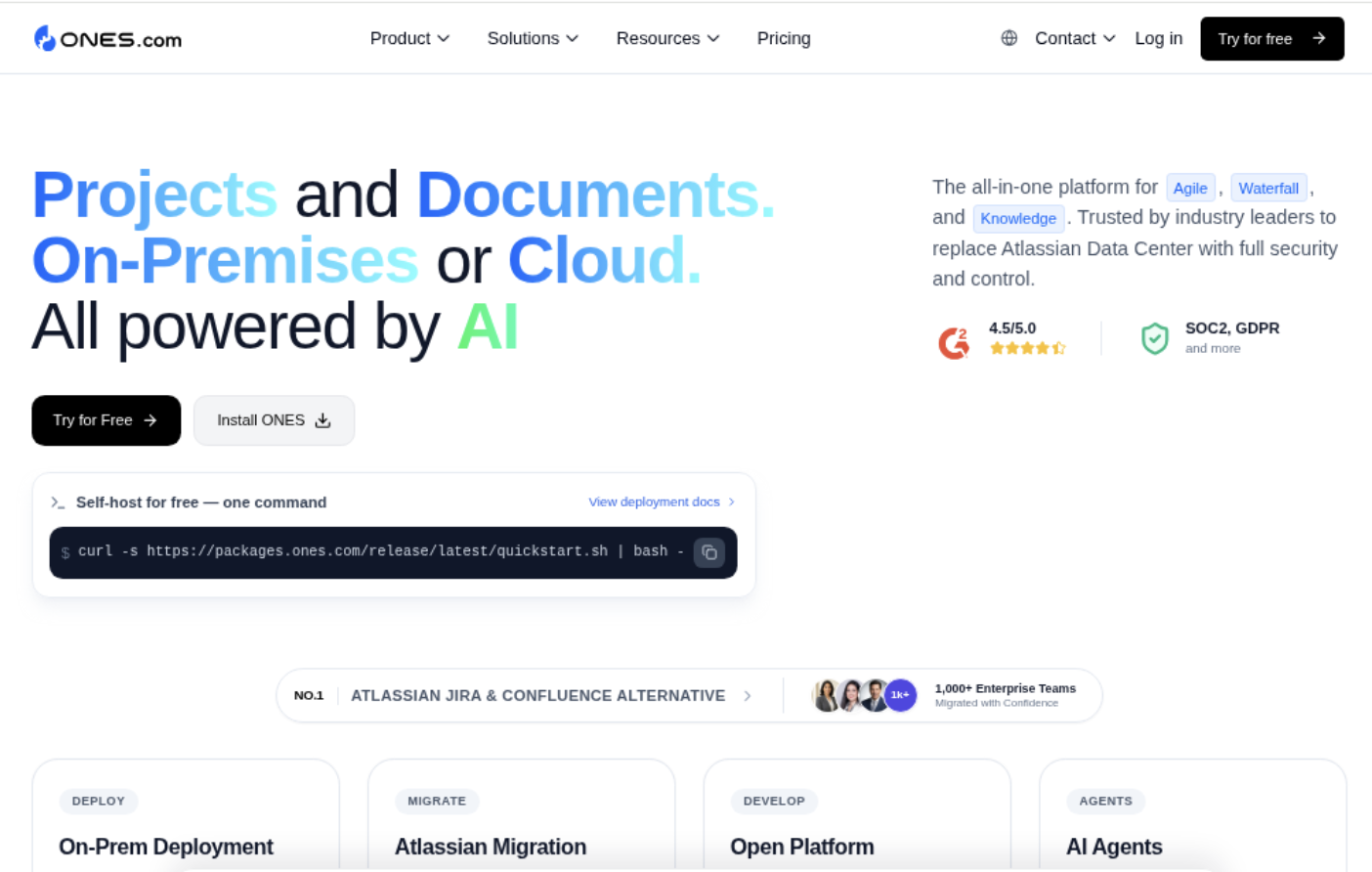
Value Proposition
ONES.com combines project management and knowledge management in one platform. It can help teams evaluate an alternative to separate project tracking and collaboration products.
ONES Project is the project management product and a Jira alternative. ONES Wiki is the knowledge management product and a Confluence alternative. They are sold separately.
Core Capabilities
- Scattered project information → ONES Project and ONES Wiki → Teams can connect delivery work with related planning and knowledge areas.
- Complex Jira-compatible workflows → Custom workflows and fields → Teams can model approvals, issue states, ownership, and specialized project records.
- Manual sprint coordination → Sprint management → Engineering teams can plan iterations, assign work, and review progress in one project workspace.
- Limited visibility into delivery → Built-in reporting → Managers can review project progress without assembling every report through separate extensions.
- Repeated administrative actions → Automation → Teams can reduce routine transitions, notifications, and assignment work.
- Plugin-heavy platform administration → Native capabilities → Organizations may reduce dependence on multiple add-ons for common workflows.
- Restricted hosting requirements → Four deployment options → Teams can choose Cloud, On-Premise, Private Cloud, or Air-gapped deployment.
- Different capabilities across hosting models → Full feature parity → Self-hosted teams can retain the same core feature coverage available in the cloud version.
- Separate knowledge and delivery contexts → Unified platform → Teams can keep project execution and internal knowledge closer together.
Application Scenarios
Scenario one: an engineering organization with restricted networks. The team can evaluate an air-gapped deployment when project work and technical knowledge must remain inside an isolated environment.
Scenario two: a growing product company reviewing tool overlap. The company can compare the cost of separate project and knowledge platforms with ONES Project and ONES Wiki, purchased according to its needs.
Scenario three: an enterprise replacing a fragmented workflow. The organization can use Jira-compatible workflows, custom fields, reporting, and automation while reducing the number of connected plugins.
ONES.com offers a free plan for up to 30 seats. That can support an initial evaluation before a larger deployment decision. Your team should still validate security, migration, integration, and governance requirements.
Common Challenges and Practical Solutions
Challenge: confusing license cost with total cost
Solution: Create separate lines for subscription, hosting, apps, labor, implementation, and contingency. Review the full annual figure with finance and technical operations.
Challenge: choosing a tier without growth planning
Solution: Count expected access needs for the next renewal period. Include planned hiring, acquisitions, contractors, and service accounts.
Challenge: underestimating app expenses
Solution: Build an app register with annual prices, business owners, renewal dates, and adoption figures. Remove extensions that no longer support a measurable need.
Challenge: overlooking operational workload
Solution: Track monthly administration hours for patching, upgrades, access management, backup testing, and incident response. Convert those hours into an annual labor estimate.
Challenge: comparing products only by subscription price
Solution: Compare three-year total cost, migration effort, operational responsibility, deployment flexibility, and expected adoption. A lower subscription may require more internal work.
FAQs
Is Confluence Data Center priced monthly or annually?
Confluence Data Center is generally purchased through annual subscription terms. Your commercial amount depends on the licensed tier, contract conditions, and current Atlassian pricing. Hosting, apps, administration, and professional services are separate budget areas. Confirm the exact renewal amount before planning the next financial year.
What is the minimum size for Confluence Data Center?
Confluence Data Center has traditionally targeted larger organizations, with licensing commonly beginning at a 500-user tier. Atlassian policies can change, so confirm the current eligibility and minimum tier for your organization. If your team is smaller, compare Cloud plans and other self-managed platforms.
Does the subscription include hosting?
No. Data Center is self-managed, so your organization generally provides the hosting environment and supporting services. Those services may include compute, storage, networking, load balancing, database operations, backups, monitoring, and disaster recovery. Add them to the annual business case.
Do marketplace apps increase the total price?
They can. Many apps have separate licensing and may follow their own user tiers. Review app costs during procurement and renewal. Also estimate the operational effort required to test compatibility, apply updates, and troubleshoot issues after platform upgrades.
How should I compare Data Center with a Confluence alternative?
Compare the complete operating model rather than the subscription alone. Review hosting control, security requirements, migration effort, user adoption, app dependence, administration, and three-year cost. A platform such as ONES.com may be relevant when you want project management and knowledge management in one environment.
Can a self-managed platform reduce plugin dependence?
It can, depending on your workflows. Review which capabilities currently require extensions, then check whether another platform provides those functions natively. ONES.com includes custom workflows, custom fields, sprint management, reporting, and automation. Validate feature fit through a practical pilot before making a migration decision.
Conclusion
Confluence Data Center pricing should be treated as a total ownership question. Start with the annual subscription tier, then add infrastructure, apps, implementation, administration, security, and contingency.
But here’s the truth: the best choice depends on your operating requirements. Data Center can suit large organizations that need self-managed infrastructure and enterprise control. Cloud or another platform may fit better when simplicity and predictable administration matter more.
Use a three-year comparison, validate your 2026 quote, and challenge every recurring cost. If your teams also need project management, knowledge management, and flexible deployment, include ONES.com in the evaluation.