Confluence Pricing in 2026: Plans, Costs, and Key Limits
Unsure about Confluence pricing in 2026? Compare plans, costs, billing, and key limits to choose wisely. Click to discover the best fit.
Choosing a Confluence plan can feel simple until you compare user tiers, storage, administration, security, and billing frequency. A low monthly rate may look attractive, yet your total cost can rise as more people need access.
That uncertainty creates real problems. You may overpay for advanced controls you never use, or choose a lower tier that lacks audit visibility, guest access, or storage capacity. Switching later can also disrupt team permissions and workspace habits.
But here's the truth: Confluence pricing in 2026 depends on more than the number shown beside each plan. You need to evaluate users, billing terms, plan limits, governance needs, and extra apps together. This guide explains the main plans, likely cost structure, important limits, and practical alternatives so you can make a clearer decision.
Confluence Pricing in 2026: Plans, Costs, and Limits
Confluence pricing is Atlassian’s plan structure for its collaborative knowledge and workspace platform. In 2026, the main options are expected to include Free, Standard, Premium, and Enterprise, with costs varying by user count, billing frequency, region, and contract terms.
The fastest way to understand the plans is to compare their role:
| Plan |
Typical fit |
Primary cost model |
Important considerations |
| Free |
Small teams testing Confluence |
$0 |
Limited users, storage, administration, and support |
| Standard |
Growing teams with everyday collaboration needs |
Per-user subscription |
Higher capacity and broader administrative controls |
| Premium |
Larger teams requiring advanced governance |
Higher per-user subscription |
More sophisticated analytics, security, and management features |
| Enterprise |
Large organizations with complex governance |
Custom quote |
Contract terms, organization-wide controls, and enterprise support |
Atlassian can change list prices, plan features, storage allowances, and billing rules. Treat public prices as planning figures, then confirm the current checkout amount before purchasing.
Free plan
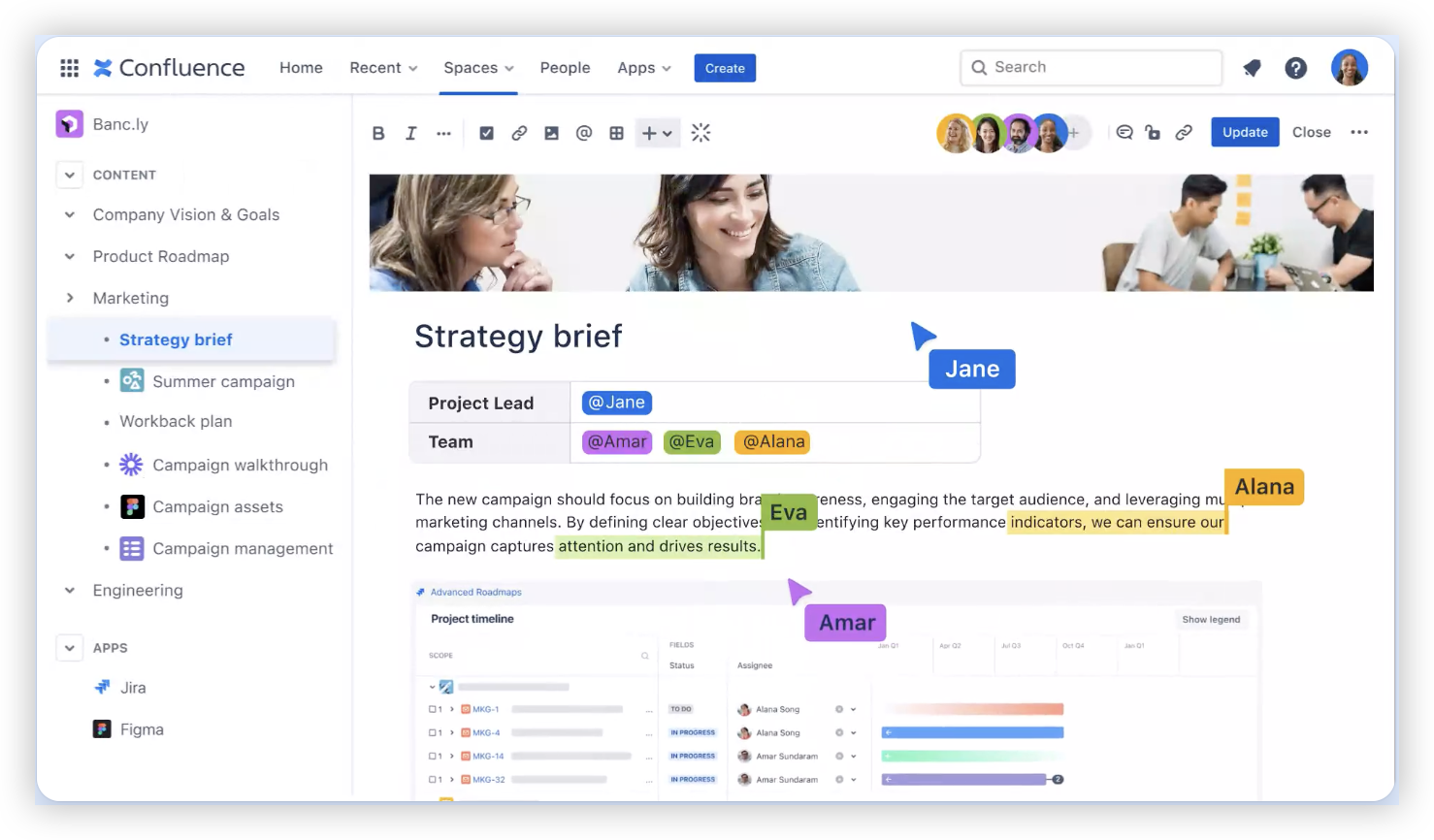
The Free plan is designed for small teams that need a shared workspace without a subscription charge. It is useful for a department wiki, a startup handbook, or a lightweight project hub.
Common restrictions include a user cap, limited storage, fewer administrative controls, and reduced support. A team can begin with Free and upgrade when collaboration becomes more formal.
Standard plan
Standard is usually the practical starting point for a growing organization. It provides more capacity and administration than Free while keeping the subscription structure relatively simple.
This tier can suit teams that need broader access, regular page collaboration, permission management, and dependable business support. Your bill generally increases as the number of licensed users grows.
Premium plan
Premium targets organizations that need stronger oversight and advanced workspace capabilities. It may include expanded analytics, higher operational limits, stronger administrative features, and enhanced support options.
Premium makes sense when a team needs visibility into how its knowledge space is used. It may also fit organizations with complex permission structures or a stronger continuity requirement.
Enterprise plan
Enterprise is typically negotiated rather than purchased through a simple public checkout. Pricing can depend on user volume, contract length, security requirements, support expectations, and organization-wide deployment needs.
Large companies should request a written quote that separates subscription charges, implementation services, marketplace apps, and any premium support costs.
How Much Does Confluence Cost?
The Free plan costs nothing, while paid plans generally use a per-user subscription model. Standard and Premium pricing can differ between monthly and annual billing, user bands, currencies, and promotional offers.
For early planning, many teams use a rough estimate of approximately US$5–$6 per user each month for an entry paid tier and approximately US$10–$12 for a higher tier. These figures are directional only and may differ in 2026.
Here's why: SaaS pricing often uses progressive user bands. The rate for a 25-person team may differ from the rate for a 200-person team, even when the advertised price appears to be per user.
Monthly billing versus annual billing
Monthly billing gives you flexibility. You can add or remove paid seats more frequently, which helps when headcount changes quickly.
Annual billing may reduce the effective monthly cost, but it can create a larger upfront commitment. Before choosing annual billing, estimate your expected hiring pace and seasonal staffing changes.
For example, a 40-person agency that expects to hire ten people during the year may prefer monthly billing. A stable 120-person department may benefit from an annual contract.
How user count affects the bill
Most paid collaboration platforms charge by licensed seats. A person who only reads pages may still require access under the plan’s licensing rules.
Before calculating cost, separate these groups:
- People who create and edit pages
- People who only need occasional access
- External guests or contractors
- Administrators and workspace owners
- Inactive accounts that may still consume seats
A quarterly access review can prevent you from paying for former employees, duplicate accounts, or contractors who no longer need entry.
Additional costs beyond the subscription
Your Confluence bill may not be the complete cost of running a knowledge program. Consider marketplace apps, migration work, consulting, training, identity management, and internal administration.
A team might pay $600 per month for platform access, then spend several thousand dollars on restructuring years of scattered content. That migration effort can matter more than a small difference between two plan tiers.
| Cost area |
What to examine |
| Platform subscription |
Users, plan tier, currency, and billing term |
| Marketplace apps |
Separate subscriptions for calendars, diagrams, reporting, or approvals |
| Migration |
Content cleanup, restructuring, permissions, and quality checks |
| Administration |
Time spent managing access, templates, policies, and support |
| Training |
Onboarding, writing standards, and workspace governance |
Key Confluence Limits to Check Before Choosing a Plan
Price matters, but limits often determine whether a plan works in practice. A plan that fits your budget may still create friction if it restricts team size, storage, history, administration, or reporting.
You might be wondering: which limits deserve attention first? Start with the limits that affect everyday work, then review security and governance requirements.
User and guest limits
Free access commonly supports a small team, often up to 10 users. Paid plans support larger groups, though the exact billing treatment for guests can vary.
Ask how external collaborators are counted. A software agency may have 30 employees but work with 80 client contacts. Guest rules can change the economics significantly.
Storage limits
Free plans commonly provide a small storage allowance, while paid tiers provide substantially more capacity. Premium or enterprise tiers may offer very generous or unlimited storage under current plan rules.
Storage affects more than uploaded materials. Images, videos, attachments, page history, and duplicated content can all increase consumption over time.
Page history and recovery
Version history helps you restore an earlier page after an accidental change. Check how long history remains available and whether recovery tools vary by plan.
For example, an engineering team may need to recover a retired troubleshooting procedure after six months. A short history window could make that difficult.
Permissions and external access
Confluence permissions can operate at several levels, including the workspace, space, page, and individual content level. Complex permission trees can become difficult to maintain.
Review whether your chosen tier supports the access controls you need for confidential policies, customer areas, partner collaboration, or regulated work.
Audit and administrative visibility
Audit capabilities help administrators understand significant workspace activity. Depending on the plan, you may receive different retention periods, export options, or administrative insights.
A financial services team may need to investigate who changed access to a restricted space. A small creative team may never need that level of oversight.
Automation and analytics
Advanced plans may offer more automation capacity, usage analytics, or administrative reporting. These features can reduce repetitive work when your workspace becomes large.
Check the limits for automation runs, reporting history, analytics availability, and the number of spaces or teams included in each feature.
Which Confluence Plan Should You Choose?
Choose Free when a small group needs a basic knowledge hub and can accept limited administration. Choose Standard when your team needs dependable collaboration at a larger scale.
Choose Premium when advanced governance, reporting, or administrative visibility justifies the extra cost. Consider Enterprise when you need negotiated terms, organization-wide controls, or specialized support.
The best choice depends on the gap between your current needs and your next 12 months of growth. Paying for a feature you will use weekly may be sensible. Paying for one you cannot explain may be wasteful.
A simple selection framework
- Count active users. Include editors, readers, administrators, contractors, and guests.
- Estimate content growth. Consider attachments, media, page history, and new teams.
- List required controls. Include permissions, audit visibility, identity management, and support.
- Review workflow needs. Identify approvals, publishing steps, templates, and recurring updates.
- Calculate the complete cost. Add apps, migration, training, administration, and taxes where applicable.
- Test the plan with a pilot group. Use realistic permissions and collaboration patterns.
Example: a 25-person product team
A 25-person product team may need a roadmap area, release procedures, meeting notes, onboarding guidance, and customer research pages.
Free might work during an experiment, but Standard could be more practical if the group needs broader access and structured administration. Premium may be unnecessary unless analytics or advanced controls solve a clear operational problem.
Example: a 500-person enterprise
A 500-person company may require centralized identity management, multiple business areas, formal governance, and stronger administrative oversight.
At this scale, the platform subscription is only one part of the decision. The organization should assess migration effort, ownership policies, access reviews, regulatory expectations, and support terms.
Ways to Reduce Your Collaboration Platform Costs
Cost control starts with usage discipline. A smaller, well-managed workspace can deliver more value than a larger workspace filled with abandoned areas and duplicate pages.
Remove inactive accounts
Review accounts every quarter. Deactivate former employees, merge duplicate identities, and confirm whether contractors still need access.
A team with 150 paid seats may discover that 18 accounts have had no activity for several months. Removing those seats can create meaningful savings.
Use templates and ownership rules
Templates reduce repeated setup work and help people create consistent content. Ownership rules make it clear who reviews important pages and when.
For example, every operational procedure can include an owner, review date, status, and escalation contact. This improves quality without requiring a higher plan.
Limit marketplace app sprawl
Extra apps can solve real problems, yet they also add subscriptions, permissions, maintenance, and administration.
Before installing an app, confirm whether the platform already supports the workflow through templates, native automation, page properties, or structured spaces.
Measure adoption before upgrading
Upgrade because a current limitation creates a measurable problem. Examples include repeated permission issues, insufficient analytics, or a storage threshold that affects daily work.
Do not upgrade solely because a higher tier sounds more complete. A pilot can show whether the feature changes outcomes.
Confluence Compared With a Unified Knowledge and Project Platform
Confluence is often paired with Jira, especially when development teams want project tracking and team knowledge in the same Atlassian ecosystem. That arrangement can work well, but it may also create separate administration, permissions, and subscription decisions.
A unified platform can appeal to teams that want project management and knowledge management under one operating model. The comparison should focus on workflow fit, deployment, administration, and total ownership cost.
When a separate knowledge platform makes sense
A separate knowledge platform may be suitable when your organization already has strong Atlassian expertise, depends on Jira integrations, or needs a mature content collaboration environment.
It can also make sense when different departments want independent governance and the additional subscriptions are acceptable.
When consolidation may be better
Consolidation may help when teams switch between project tracking and knowledge areas throughout the day. Fewer platforms can reduce duplicate permissions, disconnected reporting, and repeated administration.
For example, a hardware team might plan a sprint, record a design decision, and update a testing procedure in one connected environment rather than maintaining separate workspaces.
Value Proposition
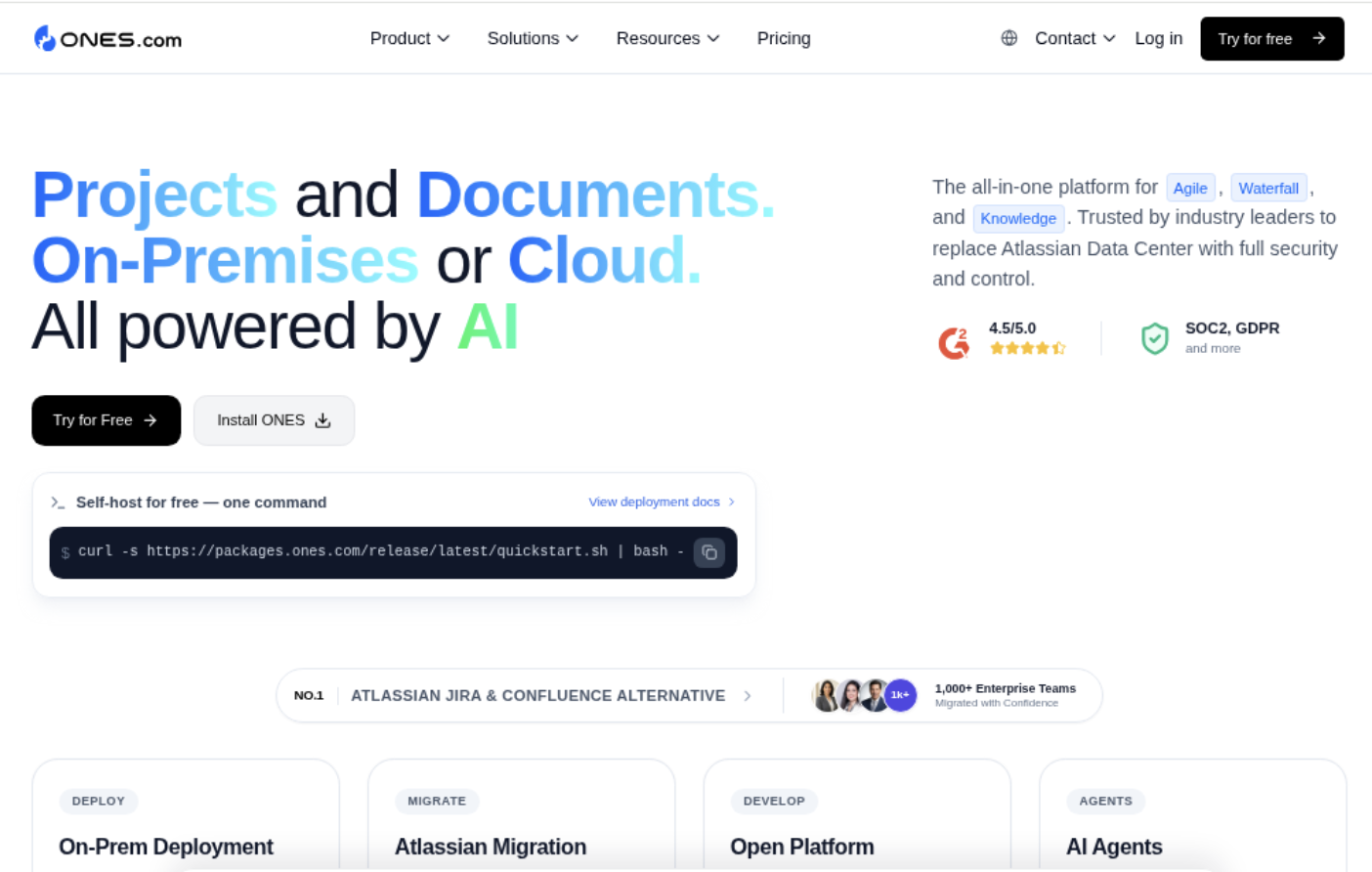
ONES.com is a unified platform for project management and knowledge management. ONES Project serves as a Jira alternative, while ONES Wiki provides a Confluence alternative, and the two products can be purchased separately.
This approach can suit organizations that want connected project and knowledge workflows, multiple deployment choices, and fewer add-ons to manage.
Core Capabilities
- Disconnected project and knowledge areas → ONES.com connects ONES Project and ONES Wiki → Teams can link delivery work with the knowledge that explains it.
- Jira workflow migration concerns → ONES Project supports Jira-compatible workflows → Teams can preserve familiar issue and sprint practices while evaluating a new platform.
- Plugin-heavy reporting → Built-in reporting reduces reliance on separate reporting extensions → Managers can review progress with fewer moving parts.
- Rigid project structures → Custom workflows and custom fields support different operating models → Teams can reflect approval, delivery, or service processes more accurately.
- Manual sprint administration → Sprint management and automation handle recurring activities → Project coordinators spend less time repeating routine setup.
- Restricted deployment requirements → ONES.com supports Cloud, On-Premise, Private Cloud, and Air-gapped deployments → Organizations can match deployment with security and network policies.
- Uneven capabilities across hosting models → The self-hosted version provides feature parity with the cloud version → Teams can choose deployment without accepting a reduced feature set.
- Separate knowledge administration → ONES Wiki provides a dedicated knowledge base product → Teams can evaluate knowledge management independently from project management.
- Budget pressure for small teams → A free plan supports up to 30 seats → Small groups can test the platform before making a wider commitment.
Application Scenarios
Air-gapped engineering: A defense contractor can evaluate an air-gapped project and knowledge workflow for restricted networks. Engineering tasks, procedures, and delivery updates can remain within the approved environment.
Growing software teams: A 25-person team moving beyond basic task tracking can connect sprint work with release guidance and technical decisions. ONES Project and ONES Wiki can be assessed together or separately.
Distributed enterprise operations: An organization with private infrastructure requirements can review On-Premise or Private Cloud deployment while keeping familiar project workflows and structured knowledge areas.
Common Challenges
Challenge: The advertised rate does not match the final bill
Why it happens: User bands, currency conversion, taxes, annual commitments, and extra apps can change the final amount.
Practical solution: Request a quote or use the live calculator with your real seat count. Keep platform fees and add-on costs separate during approval.
Challenge: You upgrade for features nobody uses
Why it happens: Higher tiers often bundle several capabilities, while your team may need only one.
Practical solution: Name the operational problem first. Then confirm whether the upgrade directly solves it and how often the team will use the feature.
Challenge: Old accounts inflate licensing costs
Why it happens: People leave, change departments, or stop participating while their access remains active.
Practical solution: Schedule quarterly access reviews and connect account deactivation with your staff departure process.
Challenge: Knowledge becomes difficult to maintain
Why it happens: Teams create pages without owners, review dates, naming rules, or clear navigation.
Practical solution: Assign ownership to important areas and use templates with status, audience, and review information.
Challenge: A separate project tool increases administration
Why it happens: Teams may manage permissions, reporting, and integrations across several platforms.
Practical solution: Compare the total operating effort with a unified platform such as ONES.com. Include migration, training, governance, and administration in the comparison.
FAQs
Is Confluence free in 2026?
Confluence is expected to continue offering a Free plan for small teams. The free tier may include limits on users, storage, support, administration, and advanced capabilities. Atlassian can revise those limits, so check the current plan page before relying on a specific allowance. A free workspace can work for a small team, but growing organizations should review future seat and governance needs.
How much should I budget for Confluence?
Begin with the number of licensed users and the selected tier. As a broad planning estimate, an entry paid tier may start around US$5–$6 per user monthly, while a higher tier may start around US$10–$12. These figures are not guaranteed 2026 rates. Add marketplace apps, migration, support, taxes, and administration before approving a budget.
What is the main difference between Standard and Premium?
Standard generally covers everyday collaboration for growing teams. Premium is aimed at organizations that need more advanced administration, analytics, governance, or operational capacity. The exact feature split can change. Compare the current plan matrix with your requirements, especially around audit visibility, automation, reporting, storage, and support.
Does Confluence charge for every person who views a page?
Licensing rules can differ for full users, guests, and external collaborators. A person who only reads content may still require access under the applicable plan rules. Review how Atlassian counts each audience type before estimating cost. List employees, contractors, partners, and occasional readers separately so your estimate reflects real usage.
Can I buy only a knowledge base from ONES.com?
Yes. ONES Wiki is the knowledge base product and can be purchased separately from ONES Project. ONES Project is the project management product and serves as a Jira alternative. Organizations can evaluate the knowledge workflow alone or combine both products when they want connected project and knowledge management.
Conclusion
Confluence pricing in 2026 should be evaluated through four lenses: plan cost, user count, feature limits, and total administration effort. Free can support a small experiment, Standard often fits growing teams, Premium suits stronger governance needs, and Enterprise requires a customized commercial review.
But here's the truth: the cheapest subscription is not always the lowest-cost choice. Unused seats, extra apps, unclear ownership, and migration work can outweigh the difference between plan tiers.
Start with your active users, required controls, expected growth, and daily workflows. Then compare the complete cost with alternatives such as ONES.com, ONES Project, and ONES Wiki. That process gives you a clearer path to a knowledge environment your team can maintain and afford.