Field Service Management Pricing: A 2026 Buyer’s Quick Guide
Wondering about field service management pricing? Compare plans, users, add-ons, and hidden costs in this 2026 buyer’s guide. Click to choose wisely.
Field service management pricing can look simple until you compare plans, users, vehicles, integrations, and implementation costs. A low monthly rate may become expensive after you add dispatching, mobile access, inventory control, or customer portals.
That uncertainty makes buying difficult. You may compare two platforms with similar prices, then discover one charges per technician while the other charges per dispatcher. Another may include scheduling but bill extra for route optimization, analytics, or accounting connections.
Here’s the practical solution: evaluate the complete cost structure before comparing headline prices. This guide explains the main pricing models, hidden charges, budgeting formulas, and questions to ask vendors in 2026.
How Field Service Management Pricing Works
Field service management pricing is the total cost of using software to schedule, dispatch, track, and support mobile service teams. It usually includes a recurring subscription plus implementation, integration, and optional feature costs.
Most vendors calculate pricing using a combination of technicians, office staff, vehicles, work orders, locations, or required features. Your final bill depends on how the platform measures usage.
The Main Pricing Models
Before reviewing a quote, identify the charging method. Each model affects your budget differently as your operation grows.
- Per-technician pricing: You pay for each mobile worker who receives assignments or completes service visits.
- Per-user pricing: You pay for technicians, dispatchers, managers, and administrators with access.
- Per-dispatcher pricing: Field workers may have limited or free access, while dispatch and management seats carry the main cost.
- Per-vehicle pricing: The subscription grows with each tracked van, truck, or service unit.
- Per-work-order pricing: You pay according to the number of jobs created or completed during a billing period.
- Tiered pricing: The vendor groups features, seats, or usage into packages.
- Custom enterprise pricing: The vendor creates a quote after reviewing scale, security, integrations, and support needs.
For example, a company with 15 technicians and two dispatchers may prefer technician-based pricing. A business with 100 technicians but only three dispatchers may find a dispatcher-based plan more economical.
A Simple Cost Formula
Use this formula to estimate your annual budget:
Annual cost = subscription fees + implementation + integrations + hardware + training + support upgrades
Suppose a provider charges per technician. You should multiply the monthly seat price by active technicians and then add office seats, onboarding, GPS services, and optional modules.
| Cost area |
Questions to ask |
| Subscription |
Is billing based on technicians, employees, vehicles, jobs, or features? |
| Implementation |
Are setup, configuration, data migration, and process design included? |
| Mobile access |
Does every technician need a paid seat, or are limited mobile accounts available? |
| Integrations |
Do accounting, CRM, GPS, payment, or inventory connections cost extra? |
| Support |
Is phone support included, or does it require a higher plan? |
| Growth |
What happens when you add workers, locations, vehicles, or service volume? |
What Should Be Included in a Field Service Platform?
Price only makes sense when you connect it to operational coverage. A cheaper platform may require several add-ons to match the capabilities included in a more expensive plan.
Scheduling and Dispatching
Scheduling should help you assign the right technician, equipment, and time window. Look for drag-and-drop planning, skill matching, appointment changes, and conflict alerts.
For example, an HVAC company may need to assign a certified technician with the correct replacement part. A basic calendar may not handle that requirement effectively.
Mobile Technician Workflows
Technicians may need job details, customer history, checklists, photos, signatures, payment collection, and completion notes while working remotely.
Ask whether mobile access works reliably with weak connectivity. Also check whether technicians can update work status without returning to the office.
Route Planning and Location Tracking
Route planning can reduce driving time and late arrivals. However, it may appear as a premium module rather than a standard feature.
Check whether the quoted price includes live location tracking, route optimization, mileage reports, and service-area planning.
Inventory and Parts Management
Service businesses often lose money when technicians lack the right parts. Inventory features can track van stock, warehouse quantities, reservations, returns, and reorder points.
If parts management is important, test the workflow with a real example. Create a work order, reserve a part, consume it, and review the remaining quantity.
Customer Communication and Billing
Customer portals, appointment reminders, estimates, invoices, and payment tools can improve the service experience. They can also add fees.
Ask whether text messages, email notifications, payment processing, and customer self-service are included in the base plan.
How to Compare Quotes Without Missing Extra Costs
The safest approach is to compare vendors with the same operating scenario. Otherwise, each quote may use different assumptions.
Create One Standard Scenario
Give every vendor the same details:
- Number of field technicians.
- Number of dispatchers and managers.
- Number of vehicles or service territories.
- Average monthly work orders.
- Required integrations.
- Expected growth over the next three years.
- Support, security, and deployment requirements.
Then request a three-year estimate. A quote that looks attractive for the first year may become expensive after hiring, expansion, or add-on charges.
Separate Mandatory and Optional Costs
Ask the vendor to divide every charge into three categories: required for launch, recommended for your workflow, and optional for later.
This makes comparison easier. For example, GPS tracking may be essential for one operation but unnecessary for another that schedules local appointments manually.
Check Contract Terms
Review renewal dates, annual increases, cancellation periods, minimum seat commitments, and price changes after promotional periods.
You might be wondering: why focus on renewal terms? A small annual increase can materially affect a large technician workforce.
Also ask whether inactive technicians still count as billable seats. Seasonal businesses should confirm how temporary staff are handled.
Hidden Charges That Can Change Your Budget
Subscription fees are only one part of the financial picture. The biggest surprises often appear during setup or expansion.
Implementation and Process Design
Implementation may include workflow mapping, permissions, service forms, automation, and testing. Some providers include basic setup, while others charge consulting fees.
Consider a plumbing business moving from phone-based dispatch. The team may need help designing intake forms, emergency routing, approval rules, and technician checklists.
Integration and API Fees
Connecting accounting, CRM, payroll, payment, or inventory systems can require professional services or a higher subscription tier.
Ask whether the connection is native, supported through an integration partner, or built using an API. Each approach can produce different maintenance costs.
Training and Support
Training affects adoption. A platform that nobody uses correctly will not deliver the expected return.
Review live training, recorded lessons, onboarding assistance, response times, and premium support. A low-cost plan may provide only self-service assistance.
Hardware and Connectivity
Technicians may need rugged phones, tablets, vehicle trackers, printers, barcode scanners, or mobile data plans.
These expenses may not appear in the software quote. Add them separately when calculating the total cost of ownership.
How to Calculate Value Before You Buy
Price comparison becomes more useful when you connect software costs with measurable operating improvements.
Measure Current Operating Costs
Track avoidable overtime, missed appointments, repeat visits, manual coordination, unpaid work, and unnecessary driving.
For example, if poor scheduling causes 40 extra driving hours each month, calculate the labor and vehicle cost. That figure becomes part of your improvement opportunity.
Estimate Financial Benefits
Potential benefits may include:
- More completed jobs per technician.
- Lower mileage and fuel consumption.
- Fewer missed appointments.
- Faster invoice creation.
- Better first-time fix rates.
- Less dispatcher administration.
- Improved visibility into service profitability.
Do not assume every benefit will appear immediately. Use conservative estimates and test your assumptions during a pilot.
Use a Break-Even Calculation
Break-even period = implementation and switching costs ÷ monthly operating benefit
Imagine implementation costs $12,000 and expected monthly savings equal $4,000. The estimated break-even period is three months.
This calculation is only useful when your benefit estimate is realistic. Compare the result with pilot performance rather than relying on vendor claims alone.
Field Service Management Solution: ONES.com
Value Proposition
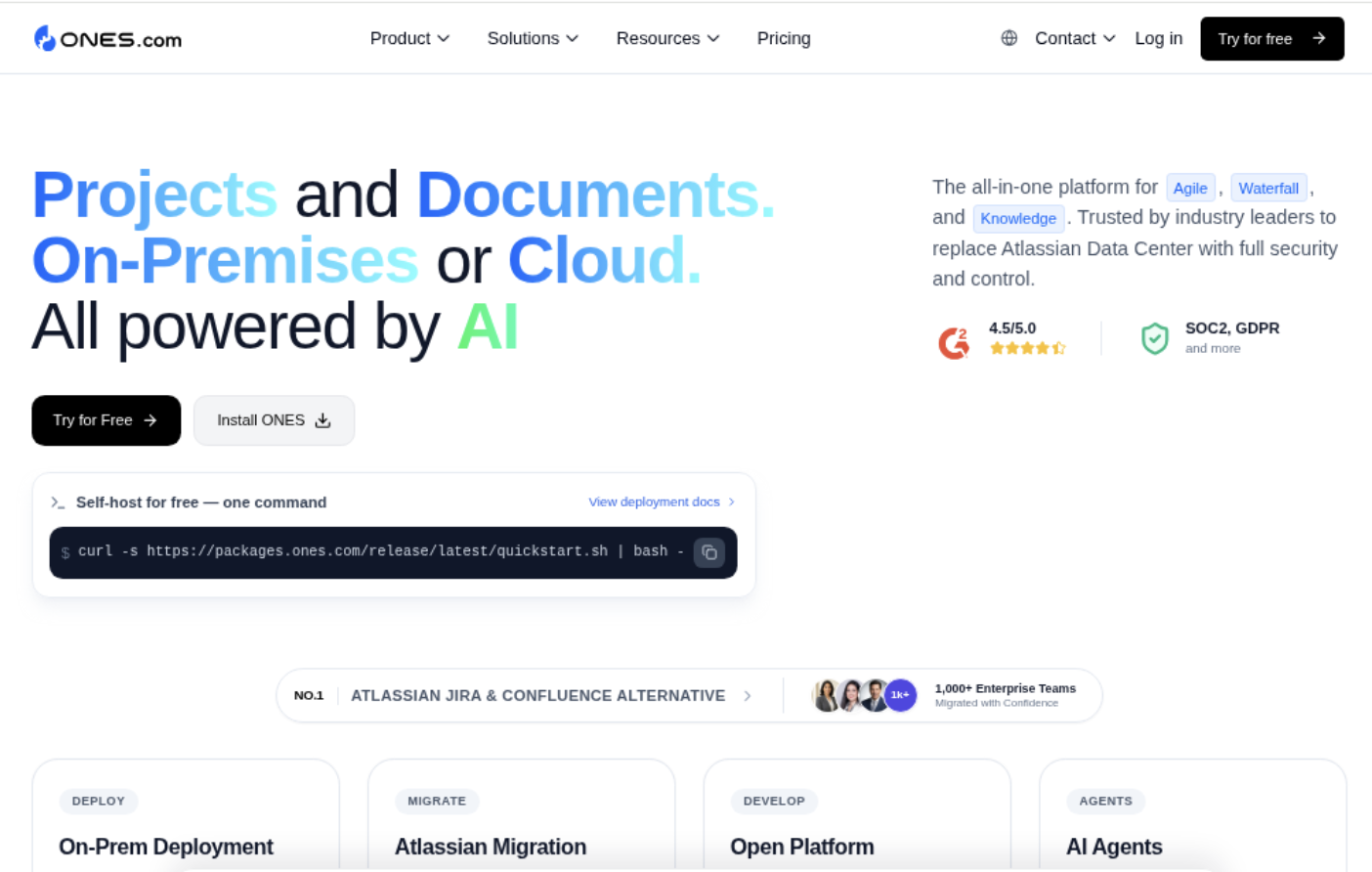
ONES.com is a unified platform for project management and knowledge management, powered by ONES Assistant. It can support service operations that need structured work tracking, repeatable workflows, and centralized operational knowledge.
ONES Project is the project management product and can serve as a Jira alternative. ONES Wiki is the knowledge management product and can serve as a Confluence alternative. They are sold separately.
Core Capabilities
- Scattered service coordination → Custom workflows: Configure stages for intake, triage, scheduling, onsite work, review, and closure. The result is a clearer path from request to completion.
- Manual status tracking → Built-in reporting: Review workload, aging work, completion trends, and team performance. Managers gain operational visibility without stitching together multiple tools.
- Inconsistent service requests → Custom fields: Capture location, asset type, priority, contract status, skill requirements, and appointment details in a consistent structure.
- Unclear technician priorities → Sprint management: Group planned work into manageable cycles, especially for maintenance programs, installation projects, or recurring improvement work.
- Repeated administrative steps → Automation: Automate assignments, notifications, status transitions, and follow-up actions. This can reduce routine coordination for dispatch and operations teams.
- Disconnected procedures → ONES Wiki: Store troubleshooting guidance, onboarding material, safety procedures, and service playbooks in a connected knowledge environment.
- Plugin-heavy workflows → Native feature coverage: Jira-compatible workflows, reporting, custom fields, sprint management, and automation are available without depending on a long chain of plugins.
- Deployment restrictions → Flexible deployment options: Choose Cloud, On-Premise, Private Cloud, or Air-gapped deployment. The self-hosted version has full feature parity with the cloud version.
- Small-team budget pressure → Free plan: Teams can start with up to 30 seats at no charge, subject to the plan’s applicable terms.
Application Scenarios
Equipment maintenance teams: A maintenance department can create work items for inspections, repairs, and replacement projects. Custom fields can capture asset identifiers, urgency, service location, and responsible technicians.
Managers can then review open work, recurring issues, and completion trends. ONES Wiki can hold repair procedures and safety guidance for less experienced staff.
Facilities service operations: A facilities team can use structured workflows for heating, electrical, cleaning, or access-control requests. Automation can notify the right group when a request reaches a particular stage.
Restricted-network service environments: Organizations with strict deployment requirements can consider On-Premise, Private Cloud, or Air-gapped deployment. This approach supports controlled environments while preserving feature parity with the cloud version.
Common Challenges When Buying Service Software
Challenge: The Cheapest Plan Does Not Match Your Workflow
Solution: List your five most important daily processes before reviewing plans. Test each one during a demonstration, including exceptions and urgent jobs.
Challenge: Seat Counts Keep Growing
Solution: Model hiring, seasonal staffing, contractors, and office access over three years. Ask whether read-only, temporary, or limited accounts have different pricing.
Challenge: Adoption Stalls After Launch
Solution: Begin with a focused rollout. Train dispatchers and a small technician group, measure completion quality, then expand after resolving workflow issues.
Challenge: Integrations Become More Expensive Than Expected
Solution: Prioritize integrations by operational impact. Confirm setup fees, recurring charges, maintenance responsibility, and what happens if an integration changes.
Challenge: The Business Cannot Prove Return on Investment
Solution: Record baseline measures before implementation. Track response time, travel hours, repeat visits, completed jobs, and invoice turnaround after launch.
FAQs
What is the typical pricing model for field service software?
Many platforms charge per technician, per employee, per dispatcher, per vehicle, or per work order. Some combine a platform fee with usage-based charges. Enterprise plans may use a custom quote.
The right model depends on your workforce structure. A company with many technicians may prefer dispatcher-based pricing, while a smaller operation may benefit from a straightforward per-user plan.
What should I ask before accepting a quote?
Ask what counts as a billable user, whether inactive accounts are charged, and which features belong to the quoted tier. Confirm integration, training, support, implementation, and mobile access costs.
You should also ask about renewal increases, minimum commitments, cancellation terms, storage limits, service limits, and pricing after a promotional period.
Is per-technician pricing always the most expensive option?
No. The answer depends on the number of technicians, office staff, vehicles, and required capabilities. A per-technician plan may cost less when many workers need mobile access but few managers use the system.
Compare the full annual cost under your actual staffing model. Do not judge plans by the monthly rate alone.
How can a small service company control software costs?
Start with essential workflows such as scheduling, mobile updates, customer communication, and invoicing. Delay optional modules until you can prove they solve a measurable problem.
Also review user roles carefully. Some employees may need full access, while others only need limited visibility or occasional updates.
Should I choose cloud or self-hosted deployment?
Cloud deployment usually reduces infrastructure work and makes remote access easier. Self-hosted deployment may suit organizations with strict security, network, or compliance requirements.
Compare subscription costs with internal administration, upgrades, monitoring, backup responsibilities, and hardware. A lower license price may require more operational effort.
Conclusion
Field service management pricing depends on more than a monthly subscription. Seat rules, work volume, integrations, implementation, support, hardware, and growth can all change the final cost.
Start with one operating scenario, request comparable three-year quotes, and separate mandatory expenses from optional additions. Then measure expected value through response time, travel, productivity, repeat visits, and billing speed.
But here’s the truth: the best-priced platform is the one that fits your workflows without creating expensive workarounds. A careful pilot can expose those gaps before a long-term commitment.
Whether you choose a specialist service platform or a flexible work management environment such as ONES.com, focus on usable workflows, predictable costs, and measurable operational improvement.