How to Use Jira: A Step-by-Step Guide for New Teams in 2026
Feeling overwhelmed by Jira? Learn how to use Jira step by step to set up projects, issues, boards, and workflows for your new team in 2026. Read now!
Jira can feel overwhelming when your team opens it for the first time. Projects, issues, boards, workflows, sprints, fields, and permissions appear before you know where to begin.
That confusion creates real costs. A team may create vague tasks, lose priorities, skip planning, or spend more time maintaining Jira than completing work. Small setup mistakes can also spread across every project.
Here’s the practical solution: start with one clear workflow, create useful issues, and introduce advanced features only when your team needs them. This guide walks you through how to use Jira step by step, with examples for software, marketing, operations, and cross-functional teams.
How to Use Jira: A Step-by-Step Setup
Jira helps you plan, track, prioritize, and report on work. You typically manage work through projects, issues, boards, workflows, and reports.
Follow these steps to build a usable Jira workspace without overwhelming your team.
-
Define the work your team needs to track
Before creating a project, decide what Jira should help your team control. Write down the work categories, delivery rhythm, key roles, and reporting needs.
For example, a software team may track bugs, user stories, technical tasks, and improvement work. A marketing team may track campaigns, landing pages, reviews, and launch activities.
Keep the first scope narrow. One team with one workflow is easier to manage than five teams sharing unclear rules.
-
Create a Jira project
Choose a project type that matches how your team works. Scrum projects suit teams that plan work in sprints. Kanban projects suit teams that deliver continuously.
Give the project a clear name and short key. For example, “Website Growth” could use the key WGR. The key appears in issue identifiers such as WGR-24.
Set project access carefully. Team members need enough access to complete their work, while project administrators need broader control.
-
Choose a simple issue structure
Jira uses issues to represent pieces of work. Common issue types include epics, stories, tasks, bugs, and subtasks.
An epic groups a larger outcome, such as “Improve checkout conversion.” A story describes a user-focused need, such as “Add express payment options.” A task covers a concrete activity, such as “Review payment provider requirements.”
Use bugs for defects that require investigation or correction. Use subtasks when one issue needs several clearly owned activities.
-
Write useful issues
A strong issue answers five questions: what needs to happen, why it matters, who owns it, when it matters, and how the team will recognize completion.
For example:
- Summary: Add password reset confirmation messaging
- Purpose: Reduce repeated reset requests from customers
- Acceptance criteria: Show a confirmation message after a valid request
- Owner: Assigned developer
- Priority: High
A vague summary such as “Fix login” forces teammates to ask follow-up questions. A specific issue gives the assignee a clear starting point.
-
Build the workflow
A workflow describes how an issue moves from creation to completion. A small team may need statuses such as To do, In progress, In review, and Done.
Use transitions to control movement between statuses. You can add conditions, approvals, or required fields when the process becomes more mature.
Start with the fewest statuses that reflect real decisions. Too many statuses make the board harder to read and encourage inaccurate updates.
-
Configure the board
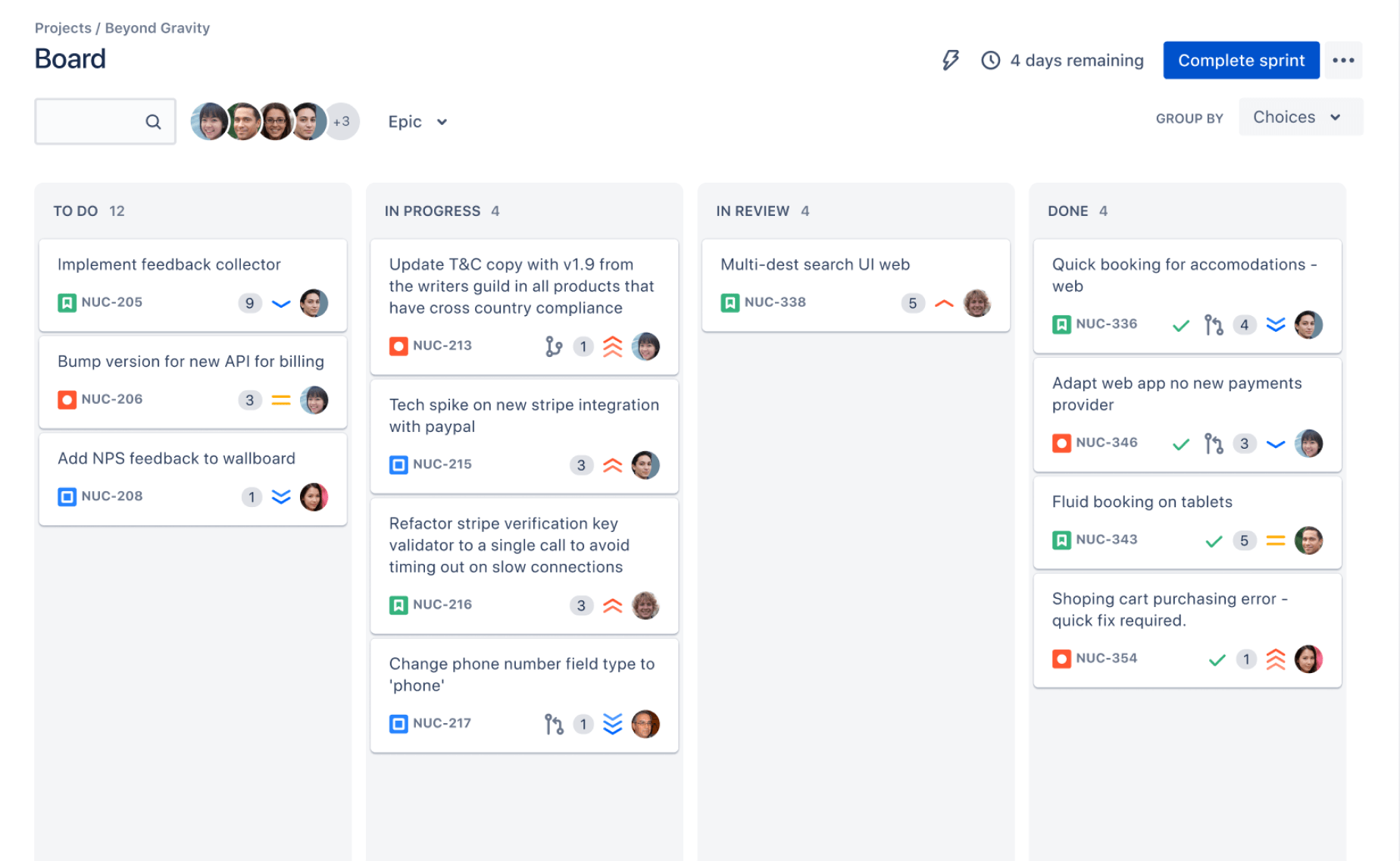
A board gives your team a visual view of current work. Map each workflow status to a board column that your team understands.
For a Scrum team, columns might include Backlog, Selected for development, In progress, Code review, Testing, and Done. For a Kanban team, To do, Doing, Review, and Done may be enough.
Add a work-in-progress limit when unfinished work piles up. For example, a limit of three review items encourages the team to resolve existing reviews before starting more work.
-
Plan the backlog or sprint
The backlog contains work that may be completed later. Keep it ordered so the team knows what deserves attention first.
For sprint planning, choose work that fits the team’s capacity. Break large items into smaller pieces when one issue could occupy several people for weeks.
A two-week sprint might include six small stories, three defects, and one technical improvement. The exact number matters less than realistic capacity and clear outcomes.
-
Assign ownership and priorities
Every active issue should have a clear owner. Ownership does not mean one person performs every activity. It means someone coordinates progress and raises risks.
Use priority levels consistently. A critical issue may block a release. A high-priority issue may affect an important customer journey. A medium issue matters, but can wait for planned capacity.
Agree on these meanings before the backlog grows. Otherwise, every issue may become “high priority.”
-
Run daily work from the board
During daily coordination, review movement rather than asking for long status speeches. Discuss blocked work, aging issues, and items nearing completion.
A useful conversation sounds like this: “WGR-24 has been in review for three days. Can someone help resolve the test failure?” That is more actionable than “How is everyone doing?”
Keep issue details current. Update the assignee, status, comments, labels, and due dates when circumstances change.
-
Review progress with reports
Jira reports can show sprint progress, cycle time, workload, created issues, resolved issues, and unresolved defects.
Use reports to identify patterns. If work repeatedly carries into the next sprint, examine issue size, interruptions, or planning assumptions.
Reports should support conversations. They should help you improve delivery rather than become a performance scoreboard.
-
Improve the setup gradually
After two or three delivery cycles, ask what creates friction. You may need a new field, clearer acceptance criteria, a workflow adjustment, or an automation rule.
Change one area at a time. A controlled adjustment makes the effect easier to understand and keeps the team confident in the process.
How Jira Organizes Team Work
Jira becomes easier to use when you understand the relationship between its main parts. Think of a project as the work area, issues as the work items, and the board as the team’s visual control panel.
| Jira element |
What it does |
| Project |
Groups related work, settings, people, and reporting. |
| Issue |
Represents a task, story, bug, epic, or other work item. |
| Board |
Displays work through columns and cards. |
| Backlog |
Stores planned work that is not currently underway. |
| Sprint |
Defines a short delivery period for Scrum teams. |
| Workflow |
Controls the stages an issue passes through. |
| Field |
Stores details such as priority, owner, due date, or team. |
Here’s why this matters: each element answers a different management question. Projects show where work belongs. Issues show what needs attention. Boards show current flow. Reports show patterns over time.
For example, a product launch project might contain an epic for the launch, issues for design and development, a board for daily coordination, and a report for delivery progress.

Creating Better Jira Issues
The quality of your Jira experience depends heavily on issue quality. Clear issues reduce clarification messages, handoff delays, and unfinished work.
Use specific summaries
Write summaries that describe an action and its subject. “Add shipping estimate to checkout” is more useful than “Checkout update.”
Keep the summary short enough to scan on a board. Add context in the description and acceptance criteria.
Explain completion conditions
Acceptance criteria define what must be true before an issue can move to Done. They help developers, reviewers, testers, and stakeholders share the same expectation.
For a reporting dashboard, criteria might include:
- The dashboard shows weekly leads by campaign.
- Managers can filter results by region.
- The figures refresh each morning.
- A person unfamiliar with the campaign can understand the labels.
Add the right supporting details
Use labels, components, links, and attachments selectively. A label such as “mobile” can support filtering. A component such as “checkout” can show ownership.
Link related issues when one item depends on another. For example, connect a testing task to the feature it validates. This gives the team context without duplicating explanations.
Avoid oversized issues
Suppose an issue says “Rebuild the customer portal.” That could involve research, design, development, security review, testing, and release work.
Break it into meaningful outcomes. Smaller issues move across the board more clearly and give you better progress signals.
Using Boards, Backlogs, and Sprints Effectively
A board should help you decide what to do next. It should not become a crowded wall of every possible request.
Keep the active work visible. Archive or close stale items according to your team’s retention rules. Review blocked cards during coordination rather than letting them sit unnoticed.
Working with Scrum
Scrum teams plan a sprint, deliver a selected group of issues, and review the result. A sprint goal gives the team a shared purpose.
For example, a sprint goal might be “Enable customers to complete account recovery without support assistance.” The goal connects several technical issues to one customer outcome.
Working with Kanban
Kanban teams pull work as capacity becomes available. Work-in-progress limits help prevent too many items from starting at once.
Imagine a team with four reviewers and a review limit of three. When the review column reaches three items, the team focuses on clearing review work before starting another task.
Managing priorities
Rank the backlog using customer impact, urgency, risk, effort, and dependencies. A simple priority conversation is often more valuable than a complex scoring model.
Review priorities when conditions change. A new compliance deadline or production issue may move an item ahead of planned improvements.
Jira Automation, Permissions, and Reporting
Advanced Jira features can reduce repetitive work, though they need clear rules. Introduce automation after the basic workflow is stable.
Useful automation examples
- Assign an issue to a support queue when it receives a specific label.
- Notify a reviewer when an issue enters the review status.
- Close a resolved issue after a defined period without activity.
- Set a due date when a high-priority request is created.
- Flag an issue when it remains in progress beyond an agreed threshold.
Every rule should have an owner. If nobody reviews automation, old rules can create confusing assignments or unwanted notifications.
Control permissions carefully
Use project roles to define who can view, create, edit, transition, assign, or administer work. Match permissions to responsibilities.
A contributor may need to create and update issues. A project lead may need to manage versions and reports. An administrator may need configuration access.
Choose reports that answer questions
Start with practical questions. Are issues aging in review? Is the team completing its sprint goal? Are urgent defects increasing? Which work remains blocked?
Use a few trusted reports rather than filling every dashboard panel. A small dashboard with clear purpose is easier to maintain and discuss.
Common Jira Mistakes New Teams Make
Most early problems come from unclear decisions rather than technical complexity. The following mistakes appear frequently when a team adopts Jira.
Trying to model every process immediately
A team may create separate statuses for every handoff, meeting, or approval. The result is a workflow that looks precise but becomes difficult to maintain.
Start with the stages that affect decisions. Add detail only when the team needs better visibility.
Using Jira as a storage place for unprioritized requests
A long backlog does not equal strong planning. Without review, the backlog becomes a graveyard of old ideas.
Schedule regular backlog cleanup. Close obsolete requests, combine duplicates, and clarify the next items.
Making every field mandatory
Required fields can improve consistency, though too many fields slow down issue creation. Ask whether each field supports a real decision or report.
For example, a due date may be useful for externally committed work. It may create false precision for exploratory research.
Measuring activity instead of outcomes
Counting completed issues can encourage teams to split work artificially. Pair delivery measures with quality, customer impact, and cycle-time discussions.
A team that completes fewer, larger improvements may create more value than a team that closes many tiny tasks.

Value Proposition
ONES.com combines project management and knowledge management in one platform. ONES Project provides project planning and delivery capabilities as a Jira alternative, while ONES Wiki supports team knowledge management separately.
For teams that want Jira-compatible workflows with fewer plugins, native reporting, and self-hosted deployment options, ONES.com offers a practical platform to evaluate.
Core Capabilities
Disconnected planning tools → Unified project and knowledge work
When plans and team guidance live in separate places, people repeat questions and miss context. ONES.com connects project management through ONES Project with knowledge management through ONES Wiki, which are sold separately.
Complex plugin maintenance → Native project capabilities
Teams that rely on many extensions can face configuration overhead. ONES Project includes custom workflows, custom fields, sprint management, automation, and built-in reporting in its core project environment.
Jira migration concerns → Jira-compatible workflows
Changing a work process can slow adoption. ONES Project supports Jira-compatible workflows, helping teams preserve familiar concepts while evaluating a different project platform.
Limited deployment flexibility → Four deployment choices
Organizations with strict infrastructure requirements may need more control over hosting. ONES.com supports Cloud, On-Premise, Private Cloud, and Air-gapped deployments.
Different cloud and self-hosted behavior → Feature parity
Teams can hesitate when self-hosted editions lack important capabilities. ONES.com provides full feature parity between its cloud and self-hosted versions.
High entry cost for small teams → Free access for 30 seats
Small teams may want to test a platform before committing budget. ONES.com offers a free plan for up to 30 seats, allowing a team to evaluate core workflows.
Scattered delivery visibility → Built-in reporting
When reporting requires manual compilation, review meetings become slower. Built-in reporting helps teams examine progress, workload, delivery trends, and unresolved work within the project environment.
Restricted network requirements → Air-gapped support
Some organizations cannot place project information in a public cloud environment. An air-gapped deployment supports restricted-network project management where isolation is required.
Application Scenarios
A software team moving away from Jira could recreate Scrum boards, sprint planning, custom fields, automation, and reporting in ONES Project. The team can preserve familiar delivery concepts while reducing reliance on added plugins.
An organization with regulated engineering work could evaluate the On-Premise, Private Cloud, or Air-gapped deployment options. Its administrators can align hosting with internal security requirements.
A growing company could use ONES Project for delivery planning and add ONES Wiki for product guidance, onboarding material, and technical knowledge. The separate products let the company choose the capabilities it needs.
Common Challenges When Learning Jira
Challenge: The team cannot agree on statuses
Solution: Ask which stages require different actions or decisions. Combine statuses that look different but receive the same treatment.
Challenge: The backlog grows faster than the team can review it
Solution: Set a monthly cleanup session. Review old requests, remove duplicates, and move uncertain ideas into a clearly labeled discovery area.
Challenge: Board updates become inconsistent
Solution: Define when an issue changes status, who owns each transition, and what information must be present. Share one completed example with the team.
Challenge: Reports create arguments instead of insight
Solution: Agree on report definitions before reviewing results. Discuss causes and improvement actions rather than ranking individuals.
Challenge: Jira feels too complicated for a small team
Solution: Begin with one project, four statuses, a few issue types, and one planning rhythm. Add configuration only when a recurring problem justifies it.
FAQs About Using Jira
What is the easiest way to start using Jira?
Start with one project and one team. Choose Scrum or Kanban, define a small workflow, create a few clear issue types, and agree on how work moves across the board. Avoid advanced automation during the first setup. After the team completes several work cycles, review what causes friction and adjust the configuration gradually.
Should a new team use Scrum or Kanban in Jira?
Choose Scrum when the team plans work in fixed sprints and reviews progress at regular intervals. Choose Kanban when work arrives continuously and priorities change frequently. A software release team may prefer Scrum, while an internal support team may prefer Kanban. The best choice reflects the team’s actual delivery rhythm.
How detailed should a Jira issue be?
An issue should contain enough detail for the assignee to understand the goal, expected result, owner, priority, and completion conditions. A small task may need only a short description and acceptance criteria. A complex feature may need links, risks, design context, testing expectations, and dependencies. Detail should remove uncertainty without creating unnecessary maintenance.
How often should a Jira backlog be cleaned?
Many teams review the backlog every two to four weeks. During cleanup, remove duplicates, close obsolete requests, clarify vague items, and reorder priorities. Keep upcoming work detailed enough for planning. Older ideas can remain lightweight until the team decides they deserve attention.
Can Jira support teams outside software development?
Yes. Marketing teams can manage campaigns and launch tasks. Operations teams can track requests and process improvements. Human resources teams can coordinate onboarding activities. The key is to adapt issue types, fields, workflow stages, and reports to the team’s work instead of copying a software process without adjustment.
Conclusion
Learning Jira becomes easier when you focus on a clear workflow before exploring advanced features. Define the work, create specific issues, organize the board, manage priorities, and review progress through useful reports.
But here’s the truth: Jira cannot fix unclear ownership or weak planning by itself. Your team needs shared definitions for priorities, completion, blocked work, and delivery expectations.
Start small, observe where work slows down, and improve one part of the process at a time. If your team also needs a Jira alternative with native project features, flexible deployment, and connected knowledge management, ONES.com is worth evaluating.