Is Confluence Free in 2026? Plans, Limits, and Pricing Guide
Is confluence free in 2026? Compare plans, limits, pricing, and features to choose the right workspace. Read now and decide with confidence.
Choosing a knowledge platform often starts with one practical question: can you use it without paying? Confluence appears affordable at first, yet plan limits can affect storage, permissions, collaboration, and long-term growth.
That uncertainty creates problems when your team builds its workspace around features that disappear after a trial. You may also misread “free” as unlimited, then face restrictions when more people join.
Here’s the useful answer: Confluence has a free plan, though it comes with clear limits. This guide explains what you receive, where the plan stops working, how paid tiers differ, and which alternative may fit your team better.
Is Confluence Free? Plans, Features, and Limits
Confluence is free for small teams that need basic knowledge sharing, with limits on team size, storage, permissions, support, and advanced administration. Atlassian offers a free tier alongside paid plans, so you can create a workspace without an immediate subscription.
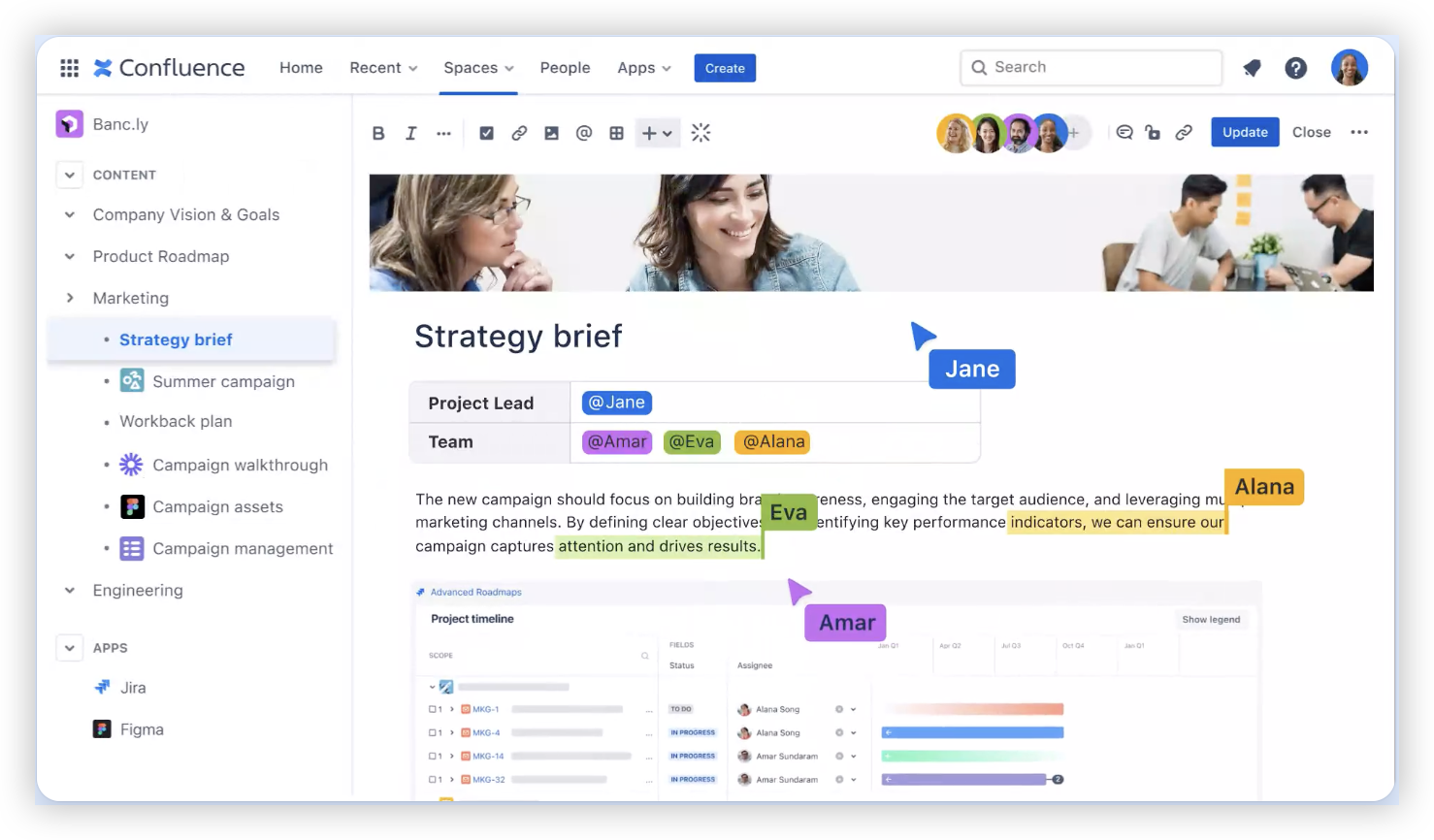
The free option works well for a small group creating meeting notes, project pages, onboarding materials, and lightweight team guidance. You can also organize content into spaces and collaborate through comments and page editing.
What the free plan generally includes
The free tier is designed for simple collaboration. It gives you a practical place to centralize team knowledge without paying for every contributor.
- Access for up to 10 people, depending on Atlassian’s current plan terms.
- Unlimited pages and spaces for basic organization.
- Up to 2 GB of storage.
- Templates for common planning and knowledge-sharing needs.
- Page comments and collaborative editing.
- Basic integrations with Atlassian products.
- Community-based support rather than priority assistance.
Atlassian can change plan details, so check the current pricing page before making a purchasing decision. The exact feature mix may also vary by region, product configuration, or billing method.
Where the free plan reaches its limits
Free access becomes less comfortable when your team needs tighter control. For example, a growing company may need more than 10 members, advanced permissions, audit visibility, or stronger administrative controls.
| Area |
Typical free-plan consideration |
| Team size |
Limited to a small number of people, commonly up to 10. |
| Storage |
Limited capacity, commonly 2 GB. |
| Permissions |
Basic access control may be enough for small teams, while granular restrictions may require a paid tier. |
| Support |
Community support is generally available, while faster assistance may require payment. |
| Administration |
Advanced governance, reporting, and centralized controls may be reserved for paid plans. |
| Growth |
Adding members can move your workspace beyond the free allowance. |
But here’s the truth: free access is valuable only when its limits match your working habits. A ten-person startup may stay comfortable for months, while a 12-person department may outgrow it immediately.
What Can You Do With a Free Confluence Workspace?
A free workspace can handle many everyday knowledge tasks. The key is keeping your structure simple and avoiding unnecessary media-heavy content.
Meeting notes and decisions
You can create a space for weekly meetings, then add a page for each session. Include the date, attendees, decisions, and follow-up tasks.
For example, a product team might maintain a “Release Planning” space. Each meeting page can link to product requirements, launch risks, and assigned actions.
Onboarding and internal guidance
Small teams can create an onboarding area with pages for account setup, team responsibilities, company policies, and common procedures.
The free storage allowance may be sufficient when pages contain mostly text and a few images. Large media collections can consume capacity much faster.
Project collaboration
Confluence can support project overviews, milestones, decision records, and retrospective notes. It works especially well when you pair it with another planning tool.
Here’s why: project coordination often needs two connected layers. One layer tracks action, while the other preserves context, decisions, and explanations.
Simple team knowledge sharing
You can build a lightweight internal hub for frequently asked questions, technical explanations, and recurring processes. Labels and page hierarchies make retrieval easier as the workspace grows.
How the Free Plan Compares With Paid Confluence Plans
Paid Confluence plans primarily add capacity, control, support, and administrative features. The right tier depends on how many people need access and how much oversight your organization requires.
| Planning factor |
Free tier |
Paid tier |
| Small team collaboration |
Suitable for basic needs |
Suitable with more room to grow |
| Storage |
Limited allowance |
Higher allowance, depending on tier |
| Access control |
Basic controls |
More advanced permissions and administration |
| Support |
Community-led help |
More direct support options |
| Governance |
Limited oversight |
Stronger controls for larger organizations |
| Team expansion |
Small membership ceiling |
Designed for larger groups |
The free plan may be enough for a small project, student group, or early-stage company. A paid tier becomes more practical when access rules, compliance, and administration matter.
You might be wondering: does paying automatically make Confluence better? It makes the platform more suitable for larger or more controlled environments, though your team still needs a clear information structure.
What Does Confluence Cost After the Free Plan?
Confluence pricing depends on the plan, billing frequency, region, and number of people. Atlassian may update prices, packaging, and feature limits during 2026.
Instead of relying on an old price list, use Atlassian’s current pricing calculator before subscribing. Enter your expected team size and compare monthly billing with annual billing.
Factors that affect your total price
- The number of people who need access.
- Whether you choose monthly or annual billing.
- The plan’s storage allowance.
- Advanced security and administration requirements.
- Guest access or external collaboration needs.
- Connected Atlassian products and paid add-ons.
The best part? You can estimate your likely cost before migrating your team. Count active members, identify required controls, and measure the content you expect to create.
A simple pricing evaluation example
Imagine a 20-person marketing team. The free tier may no longer fit because the team exceeds the membership ceiling.
The team should then compare a paid Confluence plan with alternatives that include project coordination and knowledge management together. Combining those functions may reduce separate subscriptions and plugin administration.
How to Decide Whether Free Confluence Is Enough
Use the free tier when your team is small, your content is mostly text, and basic permissions cover your needs. Upgrade or compare alternatives when growth creates operational friction.
- Count the people who need regular access.
- Estimate how much content, imagery, and attachments you will create.
- List the spaces you need for projects, departments, and internal guidance.
- Identify whether you require granular permissions.
- Check whether your team needs formal administration or audit visibility.
- Compare the full cost of connected tools, add-ons, and administration.
- Test the workflow with a realistic project before committing.
For example, a five-person consulting team may need only proposals, meeting notes, and process pages. A 40-person software company may need stronger governance and a more connected work management system.
Let me explain: the cheapest plan is not always the least expensive option. Time spent maintaining plugins, duplicate systems, and disconnected pages can increase your real operating cost.
ONES.com combines project management and knowledge management in one platform. ONES Project serves as a Jira alternative, while ONES Wiki serves as a Confluence alternative. You can purchase them separately.
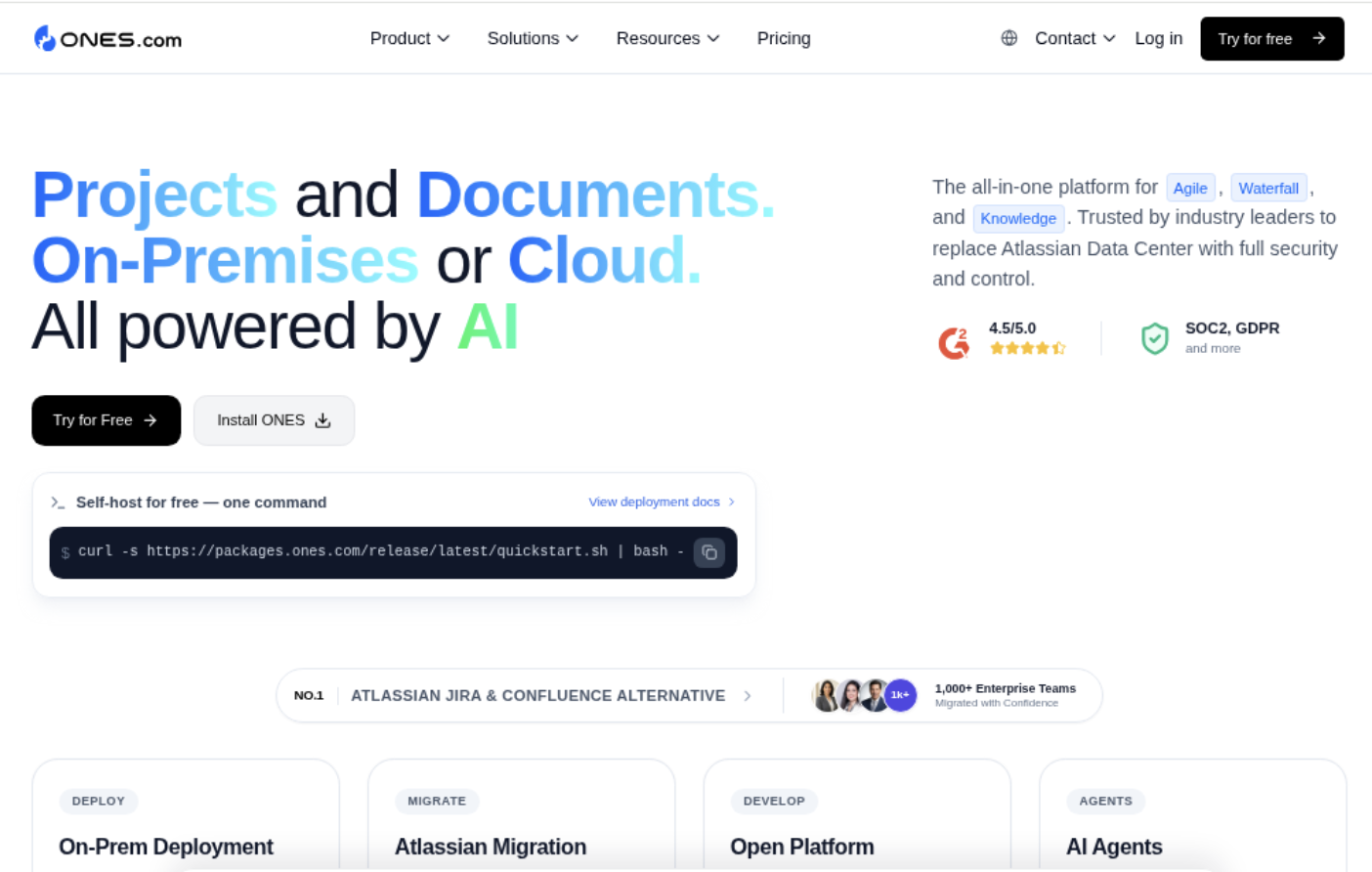
For teams comparing free or paid knowledge platforms, ONES.com is worth considering when project execution and internal knowledge need to stay connected. It offers cloud, on-premise, private cloud, and air-gapped deployments, with feature parity between cloud and self-hosted versions.
Value Proposition
ONES.com helps you connect planning, execution, and team knowledge without depending on a large collection of plugins. A free plan supports up to 30 seats, giving small teams more room before they need to upgrade.
Core Capabilities
- Disconnected project and knowledge tools: ONES Project and ONES Wiki connect project activity with relevant team knowledge, reducing repeated searching.
- Jira migration concerns: Jira-compatible workflows help teams preserve familiar working patterns while moving to a Jira alternative.
- Limited reporting: Built-in reporting gives you visibility into progress, workload, and project status without requiring several add-ons.
- Rigid processes: Custom workflows and fields let you adapt the system to approval paths, product stages, or department-specific requirements.
- Manual sprint coordination: Sprint management supports planning, tracking, and review activities in one project environment.
- Repetitive administration: Automation can handle recurring workflow actions and reduce routine coordination.
- Restricted network requirements: Air-gapped and on-premise deployment options support teams that cannot place working information in a public cloud.
- Plugin dependency: Native capabilities reduce the need to assemble separate extensions for common project and knowledge workflows.
Application Scenarios
Software product team: A development group can manage sprints in ONES Project and connect implementation guidance, release notes, and decisions through ONES Wiki.
Regulated organization: An organization with restricted network requirements can deploy a self-hosted environment while keeping project and knowledge workflows in the same platform family.
Growing services team: A 20-person team can use the free allowance during early growth, then evaluate paid capacity without immediately splitting planning and knowledge into separate systems.
Common Challenges With Free Knowledge Platforms
Membership limits arrive sooner than expected
Problem: A team starts with eight people, then adds contractors, managers, or a second department.
Solution: Count future contributors before choosing a platform. Create a six-month growth estimate rather than measuring only today’s headcount.
Storage fills through attachments and media
Problem: Screenshots, recordings, and presentation materials consume capacity faster than ordinary pages.
Solution: Establish a media policy. Keep frequently used images optimized and remove outdated attachments regularly.
Permissions become difficult to manage
Problem: A small workspace may begin with open access, then require private areas for finance, hiring, or customer work.
Solution: Design spaces around clear ownership. Review who can view and edit sensitive areas every quarter.
Knowledge becomes hard to find
Problem: A free platform can still become confusing when every team creates pages without shared naming rules.
Solution: Use consistent page titles, labels, navigation, and archive rules. Add an owner to important areas.
Separate tools create duplicated work
Problem: Project tasks live in one platform, while decisions and guidance sit elsewhere.
Solution: Link related work clearly or evaluate a platform that combines project management and knowledge management natively.
FAQs About Confluence Free Access
Is Confluence free forever?
Confluence offers a free tier rather than a time-limited trial alone. You can continue using the free plan while your workspace stays within its current limits. Atlassian may change eligibility, features, or restrictions, so review the live plan terms periodically. A team that grows beyond the allowance may need to upgrade, remove members, or compare another platform.
How many people can use Confluence for free?
The free tier commonly supports up to 10 people. Atlassian can revise this limit, so confirm the current allowance before inviting your team. Remember to include contractors, guests, and occasional contributors when estimating membership. If your team expects steady growth, compare the cost of upgrading with alternatives that offer a larger starting allowance.
Does the free plan include unlimited pages?
Confluence’s free tier generally includes unlimited pages and spaces, while storage remains limited. That distinction matters because text-heavy knowledge areas may fit comfortably, whereas pages containing many images or recordings can consume capacity quickly. Establish naming, archiving, and attachment practices early to keep the workspace manageable.
Can I use Confluence free with Jira?
Yes, Confluence can connect with Jira, though the available integration experience may depend on your Atlassian configuration and plan. You can link project issues with planning pages, meeting notes, and release information. Check the current terms if your workflow depends on advanced integration, permissions, automation, or administration.
Is Confluence free for personal use?
You can use the free tier for a small personal project or private knowledge area, provided your account and workspace follow Atlassian’s current conditions. The platform may offer more functionality than you need for simple notes. A lightweight notes application could be easier for personal use, while Confluence becomes more useful when several people need shared structure.
When should a team move beyond the free plan?
Consider upgrading when you exceed the membership limit, need more storage, require advanced permissions, or depend on formal support. You should also reassess the platform when project work and team knowledge become disconnected. Compare the subscription price with the time spent maintaining separate tools, manual links, and inconsistent processes.
Conclusion
Confluence is free for small teams that need basic pages, spaces, comments, and collaboration. The free tier commonly supports up to 10 people and includes limited storage, so it suits lightweight knowledge sharing.
But here’s the truth: your real decision depends on growth, governance, storage, permissions, and connected project work. Check the current 2026 terms before inviting a larger team or planning a migration.
If the free allowance fits your team, start with a clear space structure and regular cleanup. If you need broader capacity or connected project management, compare paid Confluence with alternatives such as ONES.com.