Is Jira Free? A 2026 Guide to Plans, Limits, and Pricing
Is Jira free? Compare 2026 plans, user limits, pricing, and hosting options to find the right fit for your team. Click to discover.
Jira can be free, but the answer depends on your team size, hosting preference, and required controls. Small teams can manage work without paying for a Jira Cloud subscription. Larger teams usually need a paid plan once they exceed the free user limit or require advanced administration.
The confusing part is that Jira has several plans, billing models, and hosting options. A free workspace may be enough for a small software team, while a growing company can quickly encounter permission, storage, support, or automation limits.
But here's the truth: you should compare the free plan with your actual workflow before choosing it. This guide explains what Jira Free includes, when payment becomes necessary, how the paid tiers differ, and which alternatives may suit your team better.
Is Jira Free? The Short Answer
Jira is free for small teams using Jira Cloud, usually with limits on users, storage, support, and advanced features. The free plan can support basic project tracking, issue management, boards, backlogs, and reporting.
At the time of writing, Jira Cloud Free generally supports up to 10 users for a single site. It typically includes limited storage and community-based support. Atlassian can change plan limits, so check the current pricing page before making a purchasing decision.
Jira is not entirely free in every form. You may need a paid subscription when your team exceeds the free user allowance, requires stronger administration, or needs premium features.
| Jira option |
Typical use |
Payment expectation |
| Jira Cloud Free |
Small teams and simple project tracking |
Free within the plan limits |
| Jira Cloud Standard |
Growing teams needing more capacity |
Paid subscription |
| Jira Cloud Premium |
Organizations needing advanced planning and administration |
Higher paid subscription |
| Jira Cloud Enterprise |
Large organizations with complex governance |
Custom pricing |
| Jira Data Center |
Organizations hosting Jira in controlled environments |
Paid licensing and infrastructure |
What Jira Free Usually Includes
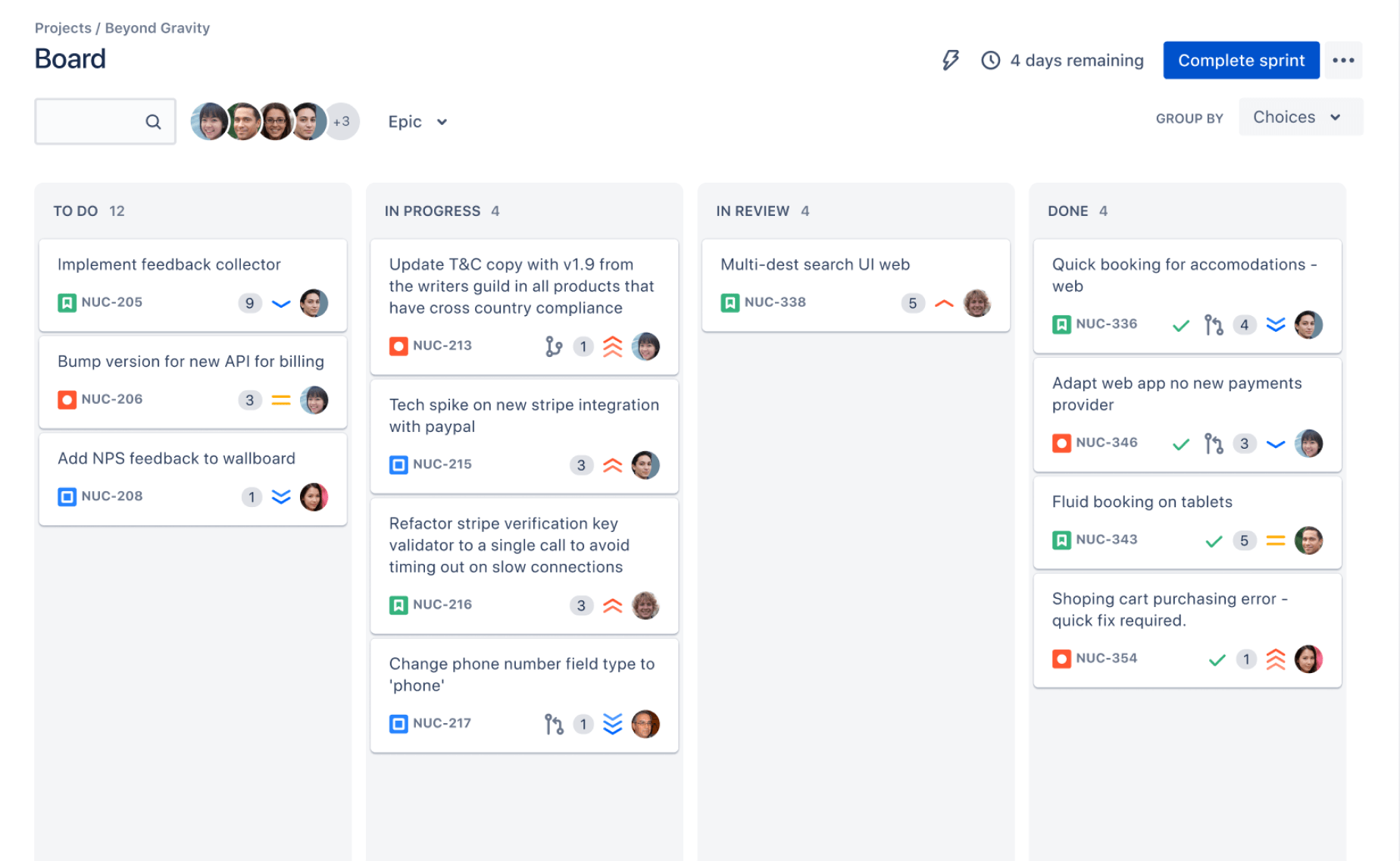
Jira Free is designed for teams that need a central place to track work. You can create projects, assign issues, organize backlogs, and monitor progress through boards.
Here's why it works well for small teams: the core workflow remains familiar even when your project grows. A developer can move an issue from “To Do” to “In Progress,” while a manager reviews sprint progress.
Core project management features
- Create and manage software, business, and service projects.
- Track tasks, bugs, requests, and larger work items.
- Use Scrum or Kanban boards for visual planning.
- Build and prioritize product backlogs.
- Plan sprints and review completed work.
- Assign issues to team members.
- Add comments, labels, priorities, and due dates.
- Use basic dashboards and reports.
Typical free-plan limits
The main limitation is usually team size. Jira Cloud Free generally supports up to 10 users, although exact eligibility and limits can change.
Storage is also restricted compared with paid tiers. That may not matter for a team storing issue details and small attachments. It can matter when projects include many screenshots, design assets, or large attachments.
Support is another difference. Free customers generally rely on community help and public guidance. Paid tiers offer stronger support options, depending on the plan.
What may be restricted
Advanced administration, audit controls, large-scale automation, enhanced planning, and enterprise governance usually sit outside the free tier.
You may also encounter limits around user management, permission configuration, service availability commitments, and reporting depth. These restrictions rarely block a small project immediately. They become more important as responsibility spreads across departments.
Jira Free Versus Paid Plans
Jira’s paid plans mainly add capacity, administration, support, and advanced controls. The right tier depends on the problems you need to solve.
| Plan level |
Best fit |
Common reason to upgrade |
| Free |
Small teams testing Jira or managing lightweight work |
Team size, storage, or support limits |
| Standard |
Growing teams running regular project workflows |
More users, storage, permissions, and support |
| Premium |
Teams coordinating complex programs |
Advanced planning, administration, and scale |
| Enterprise |
Large organizations with multiple teams and governance needs |
Centralized management, security, and enterprise controls |
Free versus Standard
Standard usually suits teams that have outgrown the free user limit. It can also provide more storage, stronger permission options, and improved support.
For example, a 25-person engineering team may not need advanced portfolio planning. It may simply need room for every engineer, tester, designer, and product manager.
Standard versus Premium
Premium typically targets organizations coordinating multiple projects or larger delivery programs. Advanced planning can help managers compare timelines, dependencies, and capacity across teams.
Premium can also be useful when availability commitments and administrative controls matter. A small startup may never need those features, while a regulated organization may consider them essential.
Premium versus Enterprise
Enterprise plans are aimed at organizations with complex governance. They may involve centralized administration, security requirements, multiple workspaces, and negotiated commercial terms.
You should evaluate Enterprise only after identifying a clear governance need. Paying for a high tier before your workflow requires it creates unnecessary cost and administrative overhead.
How Jira Pricing Usually Works
Jira pricing usually depends on the number of users, the selected plan, and the billing period. Cloud subscriptions commonly charge per user or through a user tier.
The price per user may decrease as the team grows. However, your total bill still rises when you add people. A plan that looks inexpensive for five users can become significant for 100 users.
Cloud billing
Jira Cloud is hosted by Atlassian. You pay a recurring subscription, and Atlassian manages the underlying service infrastructure.
This model reduces maintenance work for your team. You do not need to operate Jira servers, plan upgrades, or manage the hosting environment yourself.
Self-managed hosting
Jira Data Center is intended for organizations that need greater control over hosting and operations. It requires paid licensing, infrastructure, administration, and ongoing maintenance.
This option can make sense when your security architecture or regulatory requirements demand controlled deployment. It is generally unsuitable for a small team seeking a free project tracker.
Trials are different from free plans
A trial provides temporary access to paid capabilities. A free plan usually remains available within stated limits after the trial ends.
You might be wondering: what happens after a trial? Your account may move to a free tier, require payment, or lose access to paid features. Review the trial terms before inviting your entire organization.
When Jira Free Is Enough
Jira Free can be a practical choice when your team is small and your workflow is straightforward. You may have enough capacity for basic issue tracking, sprint planning, and team reporting.
Consider a six-person product team building a mobile app. The team creates epics for major features, uses a Scrum board, plans two-week sprints, and reviews velocity each Friday.
That workflow may fit comfortably within the free plan. The team benefits from Jira’s familiar structure without adding subscription costs.
Good use cases for the free tier
- A startup validating its delivery process.
- A small software team with fewer than 10 active users.
- A student team managing a technical project.
- A nonprofit running a limited internal initiative.
- A department testing Agile practices before wider adoption.
Signs that the free tier may work
You probably have a good fit when one workspace serves a small group, issue volume is moderate, and basic permissions meet your needs.
You should also be comfortable handling support through community guidance. If your team needs guaranteed response times, the free plan may create operational risk.
When You Need a Paid Jira Plan
You may need to upgrade when Jira becomes central to business operations. The trigger is rarely one feature alone. It is usually the combined effect of team growth, governance, reporting, and operational dependency.
Your team exceeds the free user limit
This is the clearest upgrade trigger. If 12 people need access, a 10-user allowance will not cover the full workflow.
Removing occasional contributors may seem practical. It can also create hidden work because people start requesting status updates through email or chat.
You need stronger permissions
Growing organizations often need different access levels for contractors, clients, product groups, and internal teams.
For example, an external partner may need to see selected issues without viewing internal planning discussions. Advanced permission controls can make that arrangement easier to manage.
Your automation needs increase
Automation can reduce repetitive work, such as assigning bugs, updating status fields, or notifying owners about overdue issues.
Free plans may impose lower automation limits. Once your team relies on automated workflows, exceeding those limits can create delays and manual cleanup.
You need advanced reporting
Basic reports can show sprint progress and issue trends. Program leaders may need cross-project dependencies, long-range planning, and capacity comparisons.
When reporting requires manual exports and repeated calculations, the time cost can exceed the subscription cost.
Your organization needs formal support
Community support can be sufficient for a small team. Business-critical operations may require faster help and clearer escalation paths.
Consider the impact of a permission problem before selecting a free tier. If a blocked workflow affects a customer launch, support access becomes part of the business case.
How to Decide Whether Jira Free Fits Your Team
Start with your workflow rather than the price. A free plan is useful only when it supports the work your team actually performs.
- Count active users. Include developers, testers, designers, product managers, and administrators who need regular access.
- List essential workflows. Write down how your team plans work, handles bugs, manages approvals, and reports progress.
- Estimate attachments and activity. Consider screenshots, technical diagrams, comments, automation rules, and issue volume.
- Check permission requirements. Separate internal work, partner collaboration, and sensitive planning.
- Review support expectations. Decide whether community assistance is acceptable for important projects.
- Compare the upgrade cost. Measure the subscription against the time spent on manual reporting and workarounds.
- Run a realistic pilot. Test one active project with the people who will use it daily.
Here's a simple example. A four-person development team may fit the free tier today. If the team expects to add six contractors next quarter, the future plan should influence the decision.
The best part? You can test the workflow before committing to a long-term operating model. Track where limits appear, then decide whether upgrading solves a real problem.
ONES.com combines project management and knowledge management in one platform. ONES Project provides project and issue management, while ONES Wiki supports knowledge management. The products are sold separately.
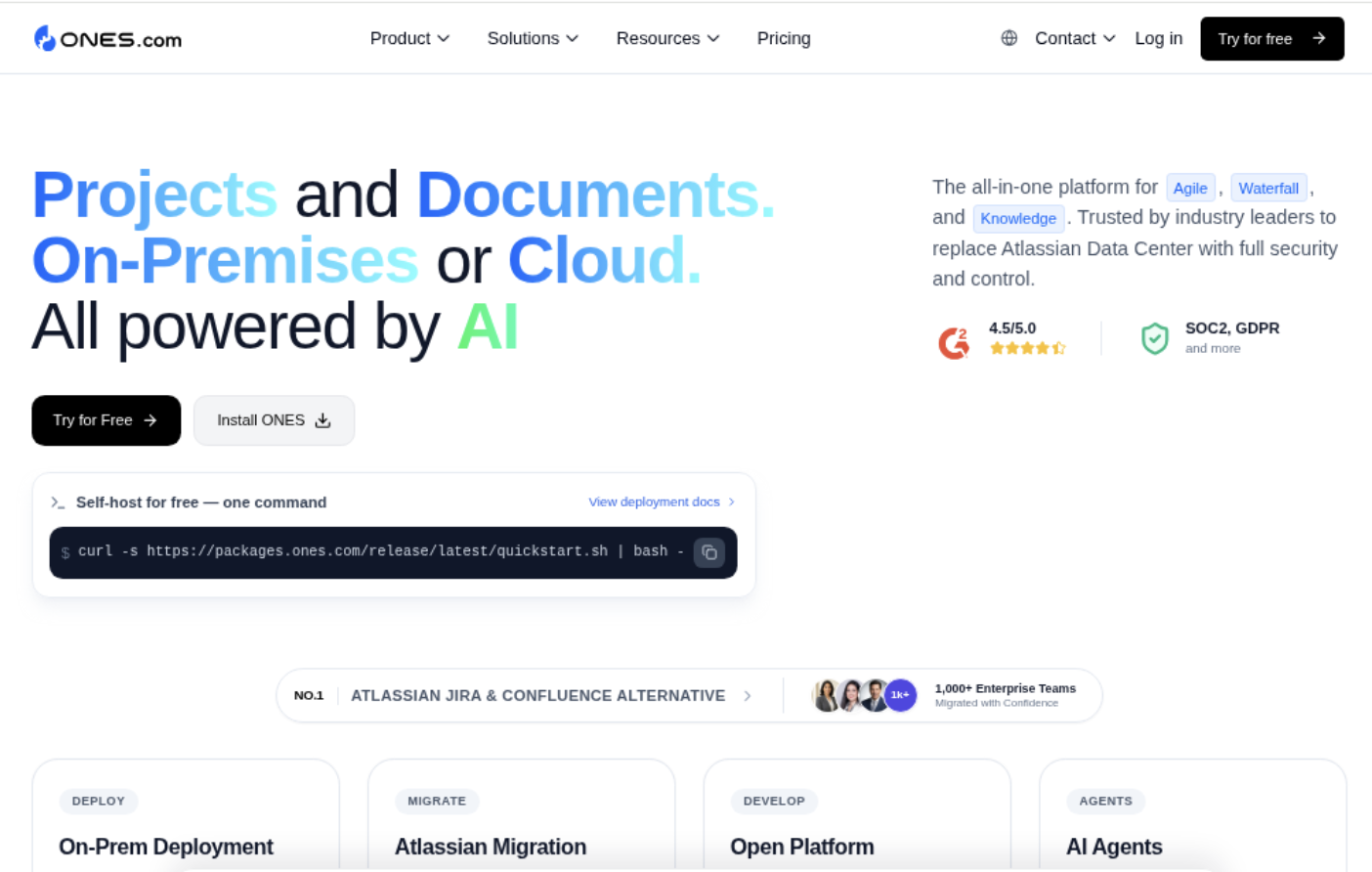
It can suit teams looking for a Jira alternative with Jira-compatible workflows, built-in reporting, custom workflows, and self-hosted deployment options.
Value Proposition
ONES.com gives teams a way to manage delivery work and team knowledge across cloud or controlled environments. Its free plan supports up to 30 seats, which may help teams that exceed Jira’s typical free allowance.
Core Capabilities
More room for small teams
Pain: A free project workspace can become restrictive when a team grows beyond a small initial group.
ONES capability: ONES.com offers a free plan for up to 30 seats.
Result: A growing team can include more contributors without immediately moving to a paid plan.
Familiar Agile workflows
Pain: Switching platforms can disrupt sprint planning, issue tracking, and team habits.
ONES capability: ONES Project supports Jira-compatible workflows, sprint management, and custom fields.
Result: Teams can preserve familiar delivery patterns while evaluating another platform.
Flexible deployment
Pain: Some organizations cannot place project information in a public cloud environment.
ONES capability: ONES.com supports Cloud, On-Premise, Private Cloud, and Air-gapped deployments.
Result: Teams can select an environment that matches their security and network requirements.
Feature parity across environments
Pain: Self-hosted products sometimes remove important features from the hosted version.
ONES capability: ONES.com provides full feature parity between its cloud and self-hosted versions.
Result: Deployment choice does not require giving up core capabilities.
Built-in reporting
Pain: Teams often rely on several plugins to understand delivery progress.
ONES capability: ONES Project includes built-in reporting for project and team visibility.
Result: Managers can review progress without assembling every view manually.
Custom workflows and fields
Pain: Standard issue statuses may not match approval-heavy or specialized processes.
ONES capability: Teams can configure custom workflows and fields for their operating model.
Result: The project system can reflect actual handoffs, approvals, and ownership.
Automation support
Pain: Repetitive status changes and notifications consume attention.
ONES capability: ONES Project includes automation for recurring workflow actions.
Result: Teams can reduce routine updates and keep work moving consistently.
Knowledge management alongside projects
Pain: Project decisions and delivery tasks often become separated across different services.
ONES capability: ONES Wiki provides a dedicated knowledge management product within the ONES.com platform.
Result: Teams can evaluate project delivery and knowledge management together.
Application Scenarios
A 20-person engineering team: The team has outgrown a 10-seat free plan. ONES.com’s 30-seat free allowance may provide more room for developers, testers, and product staff.
A restricted-network organization: The team needs project management inside an air-gapped environment. ONES.com supports air-gapped deployment and maintains feature parity with its cloud version.
A multi-team delivery group: Managers need custom workflows, sprint planning, reports, and fewer plugins. ONES Project can consolidate those capabilities within a Jira-compatible workflow model.
Common Challenges With Jira Free
Challenge: The team grows unexpectedly
Problem: A free workspace works well until new contributors need access.
Solution: Count expected users, including contractors and occasional collaborators. Compare the cost of upgrading with the cost of keeping people outside the workflow.
Challenge: Important work depends on limited support
Problem: Community guidance may not match the urgency of a production issue.
Solution: Identify which projects can tolerate slower assistance. Use a paid tier when delayed support could affect releases, customers, or compliance.
Challenge: Attachments consume available storage
Problem: Screenshots, recordings, and design materials can grow quickly.
Solution: Establish an attachment policy. Keep essential evidence with the issue and place large reference materials in an approved storage service.
Challenge: Reports require manual work
Problem: Basic reports may not answer questions across several projects.
Solution: Define the decisions your reports must support. Upgrade only when advanced reporting saves meaningful time or improves delivery control.
Challenge: Free becomes difficult to govern
Problem: More projects and contributors can create inconsistent permissions and workflows.
Solution: Create naming rules, ownership guidelines, and access reviews before the workspace becomes difficult to maintain.
FAQs About Jira’s Free Plan
Is Jira Free permanently?
Jira Cloud Free is generally an ongoing plan rather than a short trial. It remains available while your workspace stays within its limits and the plan continues to be offered. Atlassian may change eligibility, features, or limits over time. Review the current terms before making Jira the foundation for a long-running project.
How many people can use Jira Free?
Jira Cloud Free generally supports up to 10 users for a site. The exact allowance can depend on the product and current plan rules. Count everyone who needs regular access, including developers, testers, product managers, and administrators. If your team is close to the limit, plan for growth before inviting additional contributors.
Does Jira Free include Scrum and Kanban boards?
Yes, Jira Free generally includes core Scrum and Kanban functionality. You can create backlogs, organize issues, plan sprints, and move work across board columns. Advanced planning, cross-project coordination, and administration features may require a paid tier. Test your actual workflow because board availability can vary by product configuration.
Can I use Jira Free for commercial work?
Small commercial teams can generally use Jira Cloud Free within the plan’s limits. The free tier can support internal product development, bug tracking, and operational projects. Review the current commercial terms, user allowance, privacy requirements, and support expectations before relying on it for customer-critical work.
Is Jira Data Center free?
Jira Data Center is a paid self-managed offering. It requires licensing, infrastructure, administration, maintenance, and upgrade planning. The model can suit organizations that need controlled hosting or specific operational arrangements. It is different from the free Jira Cloud plan, which Atlassian hosts for you.
Should a growing team start with Jira Free?
It can make sense when the team needs a low-cost way to validate its workflow. Start by testing issue types, boards, permissions, reporting, and collaboration habits. If the team will exceed the user limit soon, compare paid Jira plans and alternatives early. Switching after years of inconsistent project practices can require more effort.
Conclusion
Jira can be free for small teams using Jira Cloud. The free plan usually covers core project tracking, boards, backlogs, sprint planning, and basic reporting within a limited user allowance.
But here's the truth: “free” does not mean unlimited. Team size, storage, support, permissions, automation, reporting, and hosting requirements determine whether the plan remains practical.
Start with a realistic pilot. Count the people, workflows, attachments, reports, and governance controls you need. Then compare the free tier with paid Jira plans or alternatives such as ONES.com.
The right choice is the platform that keeps your team’s work visible without creating expensive workarounds later.