Is Jira Free in 2026? Plans, Limits, and Feature Details
Is Jira free in 2026? Explore plans, limits, and features to find the right tier for your team. Click to discover what you get.
Is Jira free in 2026? Yes. Jira offers a $0 Free plan for small teams, with core project tracking, Scrum and Kanban boards, backlog management, reports, and limited automation.
The catch appears when your team grows. The Free plan has user, storage, automation, permission, and support limits. Some advanced planning, administration, and security features also require a paid tier.
But here’s the truth: Jira Free can handle a real software project if your team stays within its limits. This guide explains the current plan structure, what you get, where the restrictions appear, and when upgrading makes sense.
Is Jira Free in 2026?
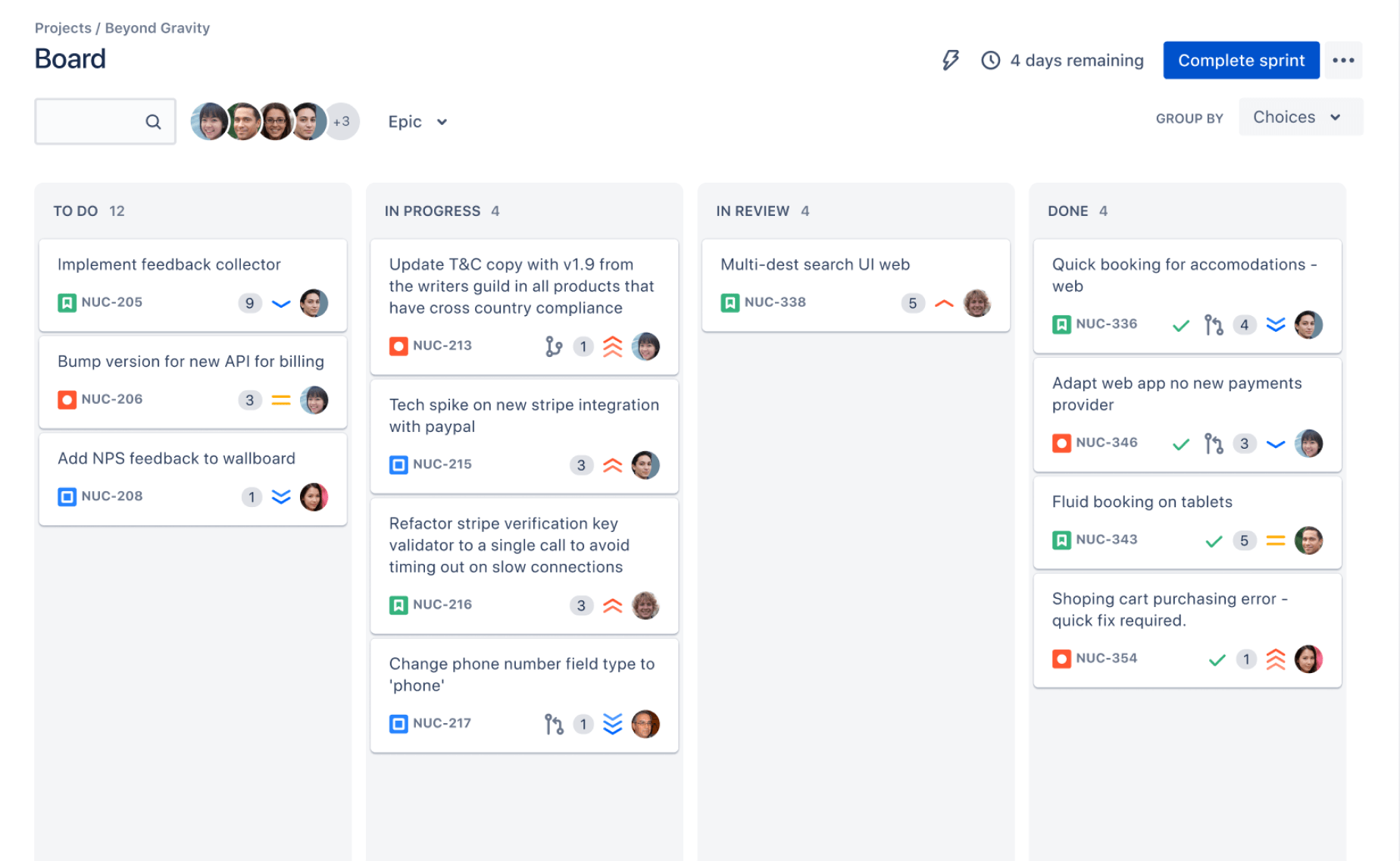
Jira Free is Atlassian’s $0 cloud plan for small teams that need project and issue tracking. It includes essential tools for planning work, assigning tasks, managing backlogs, running sprints, and monitoring progress.
The Free plan generally supports up to 10 users for a single site. It also includes limited storage, community support, and a monthly allowance for automation rule runs.
What Jira Free includes
- Scrum and Kanban boards
- Backlog management
- Task, bug, story, and epic tracking
- Custom issue fields and basic workflows
- Sprint planning and sprint reports
- Roadmaps for straightforward planning
- Dashboards and standard reporting
- Integrations through the Atlassian ecosystem
- Basic automation with a monthly usage limit
- Cloud hosting and automatic product maintenance
Jira Free works especially well for a small development team, student project, startup, or internal engineering group. You can create a project, add work items, assign owners, and move tasks across a board without paying a subscription.
You might be wondering: does “free” mean every Jira feature is available? No. The plan covers the core workflow, while advanced controls and higher capacity belong to Standard, Premium, or Enterprise plans.
Jira plan comparison for 2026
Jira’s paid tiers mainly differ in capacity, administration, support, security, reporting depth, and planning features. Exact prices can vary by region, billing frequency, product combination, and Atlassian’s current pricing updates.
| Plan |
Best for |
Main advantages |
Typical limitations or considerations |
| Free |
Small teams and personal projects |
Core project tracking at $0 |
Small user cap, limited storage, limited automation, and community support |
| Standard |
Growing teams |
Higher capacity, expanded administration, and broader collaboration controls |
Requires paid seats and may still lack premium planning features |
| Premium |
Teams managing complex work |
Advanced planning, stronger administration, higher service expectations, and expanded automation capacity |
Higher per-user cost |
| Enterprise |
Large organizations |
Enterprise governance, security, scale, and account management |
Custom pricing and commercial discussion |
For many teams, Standard is the first paid step. Premium becomes more relevant when you need advanced planning across projects, stronger controls, or additional capacity for automation and administration.
Here’s why: the right plan depends less on the number of features you can see and more on the restrictions your workflow can tolerate.
Free versus Standard
The Free plan is suitable when 10 users are enough and your team can work with its capacity limits. Standard becomes useful when you need more seats, additional administrative control, or a larger working environment.
For example, a six-person product team can often remain on Free. A 20-person engineering department usually needs Standard because the user cap becomes an immediate obstacle.
Standard versus Premium
Standard supports regular project delivery, while Premium targets organizations with more complicated planning and governance needs. Premium can be a better fit when several teams share dependencies across a larger portfolio.
A single Scrum team may have little reason to pay for Premium. A company coordinating product, infrastructure, compliance, and release work may benefit from its broader planning capabilities.
When Enterprise makes sense
Enterprise is designed for large organizations that need centralized oversight, advanced security expectations, broad governance, and commercial support. It is rarely necessary for a small software team.
Jira Free limits you should check
The most important Free plan restrictions affect people, capacity, automation, support, and administration. These limits may change, so check your Atlassian administration area before making a long-term decision.
User limit
Jira Free generally supports up to 10 users. A user is typically someone with access to the Jira site, even if that person rarely opens a project.
That detail can surprise teams. A contractor, manager, tester, or stakeholder may count toward the same allowance. Review inactive accounts before inviting additional people.
Storage limit
The Free plan generally includes 2 GB of storage. This may be enough for lightweight project work, especially when your team keeps attachments small and organized.
Storage can become a concern when tickets contain many screenshots, videos, build packages, or design assets. A team that attaches a 200 MB video to every major bug will reach the limit faster than expected.
Automation limit
Jira Free includes a limited number of automation rule runs each month. A rule run happens when an automation rule performs an action, such as updating a field, sending a notification, or transitioning an issue.
Simple rules consume capacity slowly. A rule that reacts to every issue update can use the allowance quickly. Review automation usage regularly and remove rules that create little value.
Support level
Free customers generally receive community-based assistance rather than the priority support available with paid tiers. You can still find setup guidance and troubleshooting advice, but response expectations differ.
This matters when Jira supports a critical release process. A small team can often handle community support, while a regulated organization may require a stronger support arrangement.
Permissions and administration
Jira Free provides basic project administration, though advanced permission schemes, governance controls, and organization-wide administration may require a paid plan.
For instance, a small team may be comfortable giving project administrators broad control. A larger company may need strict separation between project ownership, security administration, and user management.
Which Jira features are free?
Jira Free covers the fundamental work cycle: create an issue, prioritize it, assign it, move it through a workflow, and review the result. That makes it practical for agile delivery.
Boards and backlog planning
You can use Scrum and Kanban boards to visualize work. Scrum teams can maintain a backlog, plan sprints, and review completed work. Kanban teams can organize tasks by workflow stage.
A basic workflow might use To Do, In Progress, Code Review, and Done. That structure gives a five-person team enough visibility for daily coordination.
Issues, epics, and priorities
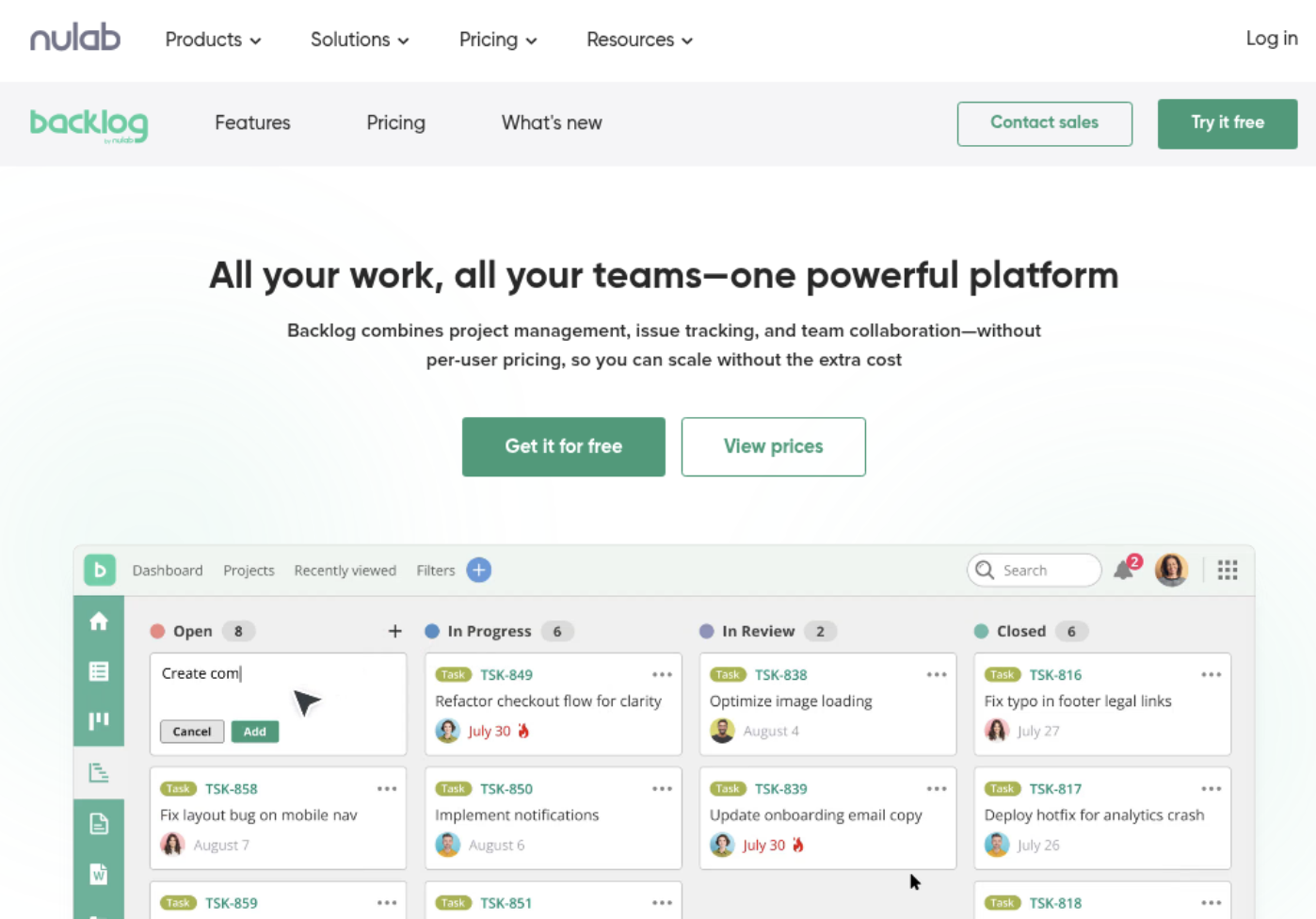
Jira lets you track common work types, including tasks, bugs, stories, and epics. You can assign owners, set priorities, add due dates, and record status changes.
An epic might represent “Mobile checkout.” Individual stories could cover payment validation, address selection, and confirmation messages.
Reports and dashboards
Standard reports help you review sprint progress, completed work, cycle patterns, and unresolved issues. Dashboards can bring important project views together for a team or manager.
Reports are most useful when your team updates issues consistently. A dashboard cannot accurately show delivery risk when half the work remains in an outdated status.
Custom workflows and fields
Jira supports workflow customization and additional fields, though the level of control can vary by plan and project configuration. A team can adapt the workflow to match its review or release process.
For example, a security team may add a review stage before an issue reaches completion. A product team may add fields for customer impact and target release.
Integrations
Jira can connect with tools for communication, development, testing, reporting, and collaboration. Available integration depth may depend on the connected product and its own subscription.
Check the commercial terms for every connected service. A Jira Free plan does not automatically make external applications free.
What Jira Free does not include
The Free plan gives you a working project tracker, yet it may fall short when your team needs complex governance or large-scale coordination.
Advanced cross-project planning
Teams coordinating many projects may need more advanced planning features than the Free plan provides. Cross-team dependencies, capacity planning, and portfolio-level views can require Premium capabilities or additional products.
Large-team administration
A team with more than 10 Jira users cannot remain within the normal Free allowance. Even a small company can exceed that limit when product, engineering, quality assurance, and leadership all need access.
High-volume automation
Automation is powerful when it removes repetitive work. It becomes restrictive when dozens of rules run every day across a busy project.
For example, automatically updating labels for 500 issue changes can consume capacity much faster than a rule that runs only when an issue reaches a release stage.
Enterprise security and support
Organizations with strict compliance, centralized identity management, audit requirements, or formal support expectations may need a paid plan or additional Atlassian services.
How to decide whether Jira Free is enough
Start with your actual workflow rather than a feature checklist. Count the people who need access, estimate attachment growth, review automation activity, and identify required administrative controls.
Use this quick eligibility checklist
- Your active Jira users fit within the Free plan allowance.
- Your team can work within the available storage.
- Your automation rules fit the monthly run allowance.
- Community support is acceptable for your project.
- Basic permissions meet your governance needs.
- Standard boards and reports cover your planning process.
- You do not need advanced portfolio or cross-project planning.
If every answer is yes, Jira Free may be a sensible starting point. You can validate the workflow before paying for additional capacity.
The best part? You do not need to predict every future requirement on day one. Start small, monitor actual usage, and upgrade when a clear constraint affects delivery.
Example: a five-person software team
Imagine a five-person team releasing a web application. Two developers, one designer, one tester, and one product manager share a Kanban board.
They track roughly 80 issues per month, use three simple automation rules, and add occasional screenshots. Jira Free can likely support this workflow because the team remains below the user limit and uses modest capacity.
Example: a growing company
Now consider a company with four product squads and 18 people who need regular access. The team also uses automation for notifications, labels, transitions, and release reminders.
Jira Free is unlikely to remain practical. The user cap creates an immediate problem, while automation and administration may become additional concerns.
How to avoid unexpected Jira costs
Free plans rarely create surprise invoices because the subscription price is zero. The greater risk is assuming connected products, marketplace apps, or expanded services are included automatically.
Review connected applications
Check every integration your team installs. A chat connector, testing service, time tracker, or reporting application may use a separate subscription.
Monitor user access
Remove inactive accounts and review guest access regularly. This keeps administration clean and helps you understand whether the Free allowance still fits.
Control attachments
Set a practical attachment policy. Encourage screenshots with sensible dimensions and avoid storing large media items in issue attachments when a dedicated media service is more appropriate.
Audit automation rules
Review rules each month. Combine overlapping actions, disable old experiments, and use precise triggers so one event does not create unnecessary activity.
Check billing before upgrading
Compare monthly and annual billing, seat counts, product bundles, and regional pricing before selecting a paid tier. Pricing details can change over time.
ONES.com is a unified platform for project management and knowledge management, powered by ONES Assistant. ONES Project is the project management product and a Jira alternative; ONES Wiki is the knowledge management product and a Confluence alternative. They are sold separately.
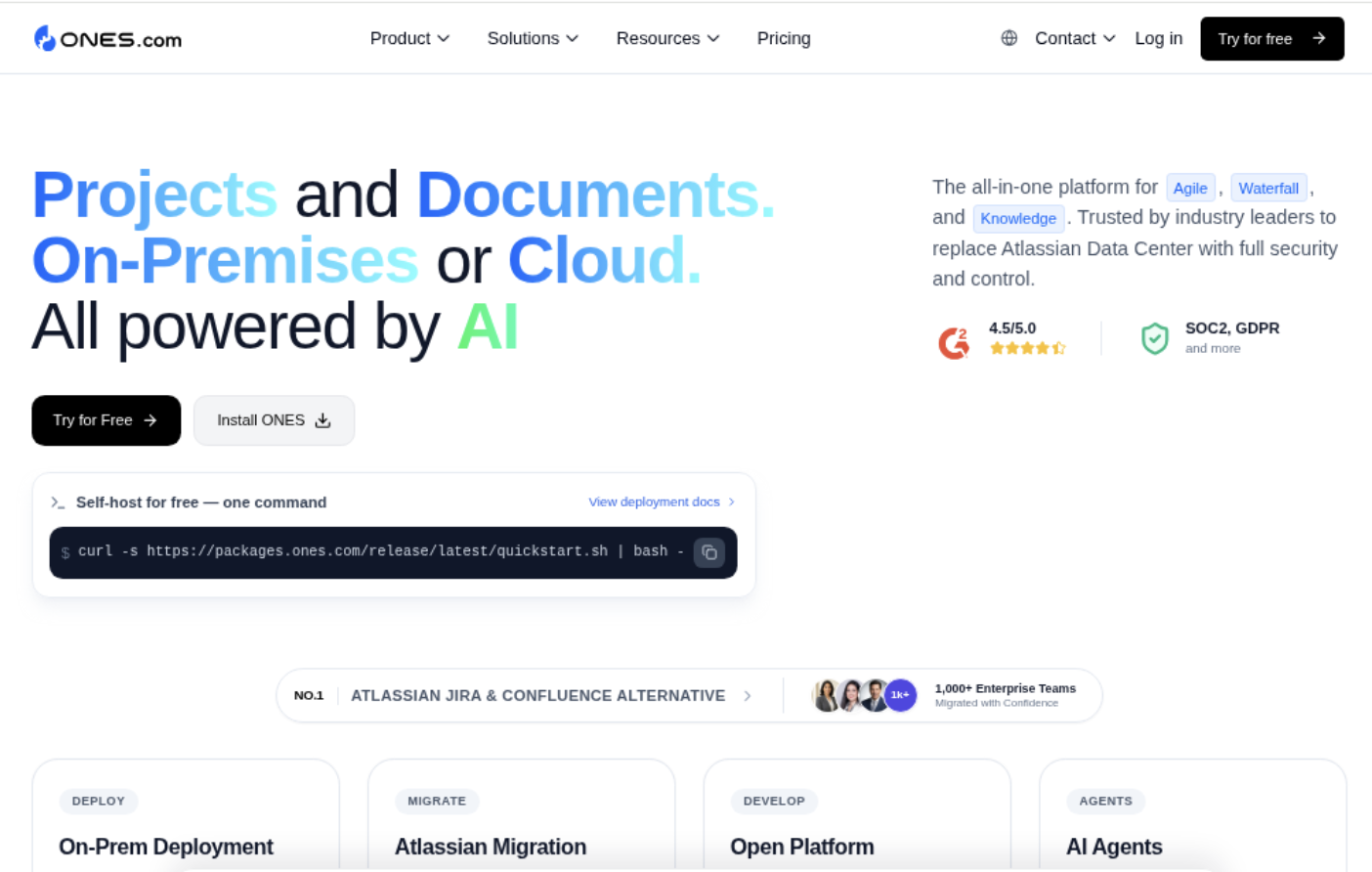
For teams evaluating Jira Free, ONES.com may be relevant when deployment flexibility, native capabilities, and reduced dependence on plugins matter more than starting at zero cost.
Core capabilities
- Growing beyond a small user allowance: A limited free-plan user cap can block team participation. ONES capability: ONES.com provides a Free plan for up to 30 seats. Result: A larger small team can begin collaboration without immediately dividing access.
- Restricted hosting requirements: Some organizations cannot place project information in a public cloud environment. ONES capability: ONES offers Cloud, On-Premise, Private Cloud, and Air-gapped deployments. Result: You can align the deployment model with security and network requirements.
- Different behavior between hosting models: Teams may worry that self-hosting means losing important capabilities. ONES capability: ONES provides full feature parity between its cloud and self-hosted versions. Result: Your deployment choice does not require giving up the core product experience.
- Plugin-heavy workflows: Multiple add-ons can increase administration effort and create inconsistent behavior. ONES capability: ONES Project includes built-in reporting, custom workflows, custom fields, sprint management, and automation. Result: More of the delivery process stays native to the platform.
- Familiar Jira processes: Teams may hesitate to change because their issue types, boards, and sprint habits are already established. ONES capability: ONES Project supports Jira-compatible workflows. Result: Migration planning can focus on mapping existing practices instead of redesigning every process.
- Scattered project knowledge: Delivery decisions can become difficult to find when planning and knowledge management sit in disconnected tools. ONES capability: ONES.com combines project management and knowledge management, while ONES Wiki handles team knowledge. Result: Teams can connect execution with the guidance needed to complete the work.
- Deployment and compliance pressure: A public-cloud-only approach may not suit every organization. ONES capability: On-Premise, Private Cloud, and Air-gapped options support restricted environments. Result: Sensitive teams gain more control over where their work operates.
- Need for AI-assisted work: Teams may want help with project and knowledge tasks without replacing human decisions. ONES capability: ONES Assistant adds AI-powered assistance within the platform. Result: You can explore AI support alongside structured project workflows.
Application scenarios
Software teams outgrowing Jira Free: A 20-person engineering group can compare ONES Project with a paid Jira tier while preserving familiar sprint and issue workflows.
Restricted-network organizations: A defense contractor, industrial company, or regulated team may evaluate an air-gapped or on-premise deployment where public cloud access is unsuitable.
Teams reducing add-on dependence: A product organization that relies on multiple plugins can assess whether built-in reporting, automation, custom fields, and workflow controls cover more of its daily process.
Common challenges with Jira Free
Challenge: Your team reaches the user limit
Problem: New engineers, testers, or stakeholders need access, but the Free allowance no longer covers everyone.
Solution: Remove inactive accounts first. If every account is necessary, compare the cost of Standard with the cost of excluding important participants.
Challenge: Automation runs out early
Problem: Rules trigger too often because they react to routine edits, comments, or repeated transitions.
Solution: Narrow the triggers, combine overlapping rules, and reserve automation for actions that save meaningful manual effort.
Challenge: Storage grows faster than expected
Problem: Screenshots, videos, and large attachments consume the Free allowance.
Solution: Establish attachment guidelines, remove obsolete material, and store large media in a suitable service with appropriate access controls.
Challenge: Reporting does not answer management questions
Problem: Standard reports show activity, yet leaders still cannot see capacity, dependency, or release risk clearly.
Solution: Improve issue hygiene first. Then assess whether a higher Jira tier, a reporting application, or another project platform provides the required planning depth.
Challenge: Project administration becomes inconsistent
Problem: Several administrators create different workflows, fields, and naming conventions.
Solution: Define ownership rules, maintain a short configuration guide, and restrict administrative changes to a small group.
FAQs about Jira Free
Can I use Jira Free indefinitely?
Yes, a qualifying team can generally continue using the Free plan without a time-limited trial expiration. The plan remains subject to Atlassian’s eligibility rules, product terms, capacity limits, and feature changes. Review your account regularly because a project that fits today may exceed its user, storage, or automation allowance later.
How many people can use Jira Free?
Jira Free generally supports up to 10 users on a cloud site. The relevant count usually includes people who have access, even when they rarely participate. Review inactive accounts and external collaborators before assuming you have available seats. If more than 10 people need regular access, compare Standard pricing or another platform.
Does Jira Free include Scrum and Kanban?
Yes, Jira Free includes the core Scrum and Kanban experience. You can organize a backlog, create sprints, move issues across a board, assign work, and review standard progress reports. Advanced planning across multiple teams may require a higher plan or another product, especially when you need capacity views, dependency management, or portfolio-level coordination.
Does Jira Free include automation?
Yes, Jira Free includes automation with a monthly run allowance. The exact allowance and measurement rules may change, so inspect the automation usage panel in your Jira administration area. Use specific triggers and remove obsolete rules to stretch the allowance. High-volume workflows may require a paid tier with greater automation capacity.
Is Jira Free suitable for personal projects?
Yes. Jira Free can work well for a personal software project, learning exercise, small open-source effort, or lightweight product backlog. You may not need every administrative feature, and the core board experience can provide useful structure. Keep the workflow simple because excessive fields, rules, and statuses can create more maintenance than value.
Should I choose Jira Free or a paid alternative?
Choose Jira Free when its user cap, storage, automation allowance, support model, and planning features match your needs. Consider a paid Jira tier or an alternative when access restrictions, deployment requirements, plugin dependence, or cross-team planning create friction. Compare the complete workflow, including administration and migration effort, rather than comparing subscription prices alone.
Conclusion
Jira is free in 2026 through its Free cloud plan, which gives small teams core issue tracking, boards, backlogs, sprints, reports, and limited automation at no subscription cost.
Its practical limits include a small user allowance, limited storage, restricted automation, community support, and fewer advanced administration and planning features. Those boundaries matter more as your team grows or your workflow becomes more complex.
But here’s the solution: start by measuring users, attachments, automation activity, reporting needs, and security requirements. Stay on Free when it supports your work comfortably. Upgrade or evaluate an alternative when the limits begin slowing delivery.