Is Jira Free in 2026? Plans, Limits, and Fees Explained
Is Jira free in 2026? Learn the plans, limits, and fees to avoid surprise costs. Read now to choose the right tier.
Jira’s pricing can feel harder to follow than your project board. You may see a free plan, paid tiers, user limits, storage rules, automation caps, and features that change with cloud billing.
That creates a practical problem. A small team may start without paying, then discover that more users, advanced permissions, reporting, or automation require an upgrade. A wrong estimate can affect your budget before your project is properly organized.
Here’s the straightforward answer: Jira is free in 2026 for small teams that fit within Atlassian’s Free plan limits. This guide explains what the free plan includes, where its limits appear, how paid plans work, and when another platform may suit your team better.
Is Jira Free in 2026?
Yes, Jira offers a Free plan in 2026. The free tier is generally designed for small teams, with a limit of up to 10 users on Jira Cloud and a restricted set of administration, storage, support, and automation features.
You can create projects, manage issues, build workflows, organize sprints, and collaborate without paying a monthly subscription while your team remains within the plan limits.
Atlassian can adjust pricing and plan details by region, billing cycle, product bundle, or account type. Check the current pricing page during checkout before making a final budget decision.
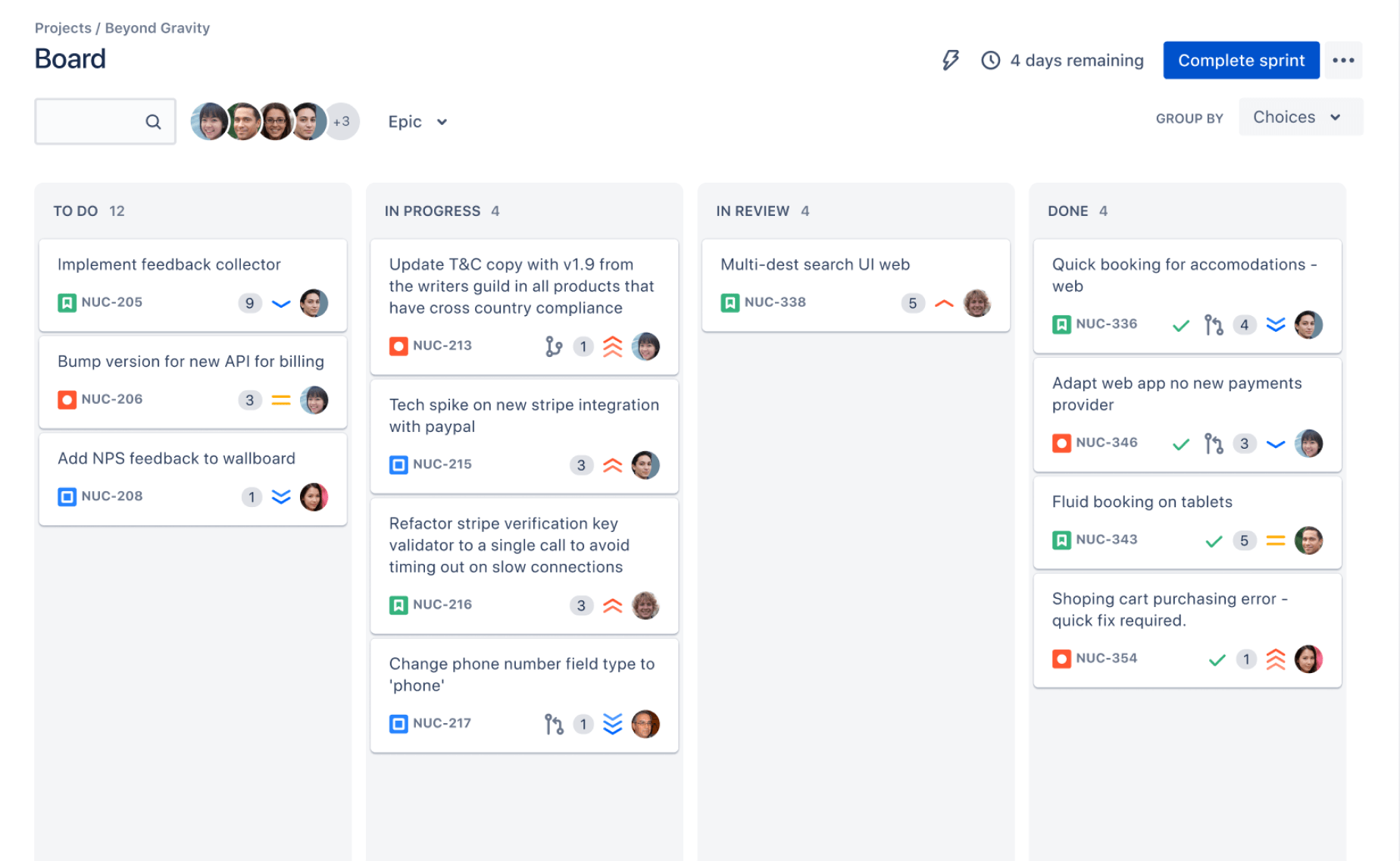
What the free plan usually includes
Jira’s free tier gives a small team the core tools needed to plan and track work. Typical capabilities include:
- Issue creation and assignment
- Backlog and board views
- Basic project workflows
- Scrum and Kanban planning
- Sprint management
- Basic reporting
- Team collaboration
- Limited automation
- Limited storage
The exact feature mix can vary as Atlassian changes its plans. A team should therefore treat the free tier as a practical starting point rather than a permanent guarantee of every listed feature.
Who can use Jira without paying?
Jira Free is usually suitable for a small product team, student project, startup, personal software project, or department testing an agile workflow.
For example, six developers and two product managers can often work within the 10-user limit. A separate group of contractors, managers, or stakeholders may push the account beyond that threshold.
Guests and collaborators can also affect how access is counted. Review the current account rules if people outside your core team need project access.
What happens when you exceed the free limits?
Jira may prompt you to upgrade when your account exceeds a user, storage, automation, or feature limit. You may need to remove users, reduce usage, or select a paid plan.
Exceeding a limit does not usually mean your project disappears immediately. However, delaying a plan decision can interrupt collaboration, reporting, or access management.
Jira Free Plan Limits You Should Understand
The free price is attractive, but limits determine whether it remains practical. Here’s why: a plan can cost nothing and still create friction when your team grows.
User limits
The most visible restriction is the team-size limit. Jira Cloud’s Free plan is commonly associated with up to 10 users.
Consider a 10-person engineering group. If a new QA specialist joins, you may need to choose between upgrading and removing someone’s access.
That limit can also affect temporary contributors. A designer, consultant, or customer representative may need access during a release, even if that person only participates for a few weeks.
Storage limits
Free plans usually provide limited storage for attachments and other project content. The allowance may be enough for issue screenshots, small design references, and occasional attachments.
It may become restrictive when your team stores large videos, design exports, build artifacts, or repeated copies of the same material.
A simple example shows the risk. Ten team members each attach several large screen recordings every week. Storage consumption can grow much faster than the number of issues.
Automation limits
Jira automation can reduce repetitive work. Rules can update fields, assign issues, send notifications, or transition work after a trigger.
Free accounts generally receive a smaller automation allowance than paid plans. A few lightweight rules may work well, while frequent issue updates or complex cross-project actions can consume the allowance quickly.
Track which rules run most often. A rule that fires whenever a status changes may consume more capacity than a rule that runs once each morning.
Permission and administration limits
Advanced permissions, audit controls, project administration, and organization-wide governance are often stronger on paid tiers.
A small team may not need detailed access policies. A company handling confidential customer work may need granular controls for teams, projects, roles, and external collaboration.
Security requirements can therefore become the reason to upgrade, even when the user count remains below the free threshold.
Support and service expectations
Free plans commonly provide community-based help or a lower support priority than paid subscriptions. Paid plans may offer stronger administrative support and service commitments.
If a blocked workflow delays a customer release, the value of faster assistance can exceed the monthly subscription cost.
What Jira Paid Plans Add
Jira’s paid tiers are designed for teams that need more capacity, administration, automation, reporting, or support. The names and prices can change, so compare the current plan page with your actual requirements.
| Plan level |
Typical fit |
Common reason to choose it |
| Free |
Small teams and early evaluation |
Core issue tracking without a subscription |
| Standard |
Growing teams |
More users, storage, collaboration, and administration |
| Premium |
Larger or more complex teams |
Higher capacity, advanced planning, and stronger service features |
| Enterprise |
Large organizations |
Organization-wide governance, scale, and commercial controls |
Standard plans
A Standard subscription is usually the next step after Free. It can provide more room for users, attachments, automation, and project administration.
Imagine a 35-person software company with several active teams. The Free plan may no longer fit the headcount, while the Standard plan can support broader participation without treating every new collaborator as a special case.
Premium plans
Premium plans generally target teams that need advanced planning, greater capacity, or stronger operational controls.
A company coordinating several products may value cross-team planning, higher usage limits, and features that help managers see dependencies across projects.
Premium pricing can make sense when delays, manual coordination, or limited visibility cost more than the subscription.
Enterprise plans
Enterprise arrangements are intended for large organizations with complex governance, procurement, security, and support requirements.
They often involve custom commercial terms rather than a simple public per-user checkout. Ask for a detailed quote if your organization needs centralized administration across many teams.
How Jira calculates paid costs
Jira pricing can depend on the number of users, billing frequency, product combination, region, and plan level.
Monthly billing may adjust as your user count changes. Annual billing can use a user tier that remains stable for the billing period.
Before choosing a plan, estimate your active users, occasional collaborators, expected growth, and product integrations. A plan that fits today may become expensive after a hiring cycle.
Jira Cloud Versus Self-Managed Costs
You might be wondering: is the free option available in every deployment model? Jira Cloud is the clearest path for a no-cost trial of core project tracking.
Jira Cloud
Jira Cloud runs through Atlassian’s hosted service. You avoid server maintenance, upgrades, backups, and much of the technical administration.
This model usually works well for small teams that want to create a project quickly. You pay through a subscription when your account requires a paid tier.
Self-managed Jira
Self-managed deployment can provide greater control over infrastructure and administration. It also creates responsibilities for hosting, maintenance, updates, backup planning, security hardening, and technical support.
The license price is only one part of the total cost. You should also consider infrastructure, staff time, monitoring, maintenance windows, and recovery planning.
Cloud cost versus ownership cost
A hosted subscription is easy to compare because the recurring charge appears clearly. Self-managed software can look different because operational work sits outside the license fee.
For example, a small IT team may spend several hours each month maintaining a self-managed system. That labor can outweigh the apparent savings from avoiding a hosted subscription.
How to Decide Whether Jira Free Is Enough
The best answer depends on your team size, workflow complexity, governance needs, and expected growth. Use this quick evaluation before committing to the free tier.
- Count every person who needs access. Include developers, testers, product managers, designers, contractors, and regular stakeholders.
- List the workflows you need. Write down statuses, approvals, custom fields, sprint routines, notifications, and recurring actions.
- Estimate attachment usage. Consider screenshots, videos, design materials, logs, and other large attachments.
- Review automation frequency. Count how often your planned rules will run during a typical week.
- Check administration requirements. Identify whether you need detailed permissions, audit visibility, centralized control, or stronger support.
- Model growth for 12 months. Include expected hires, new teams, external collaborators, and additional projects.
- Compare the cost of friction. Estimate time lost to manual updates, limited visibility, or repeated workarounds.
A free plan is usually a strong fit when your team is small, your workflows are straightforward, and your usage remains light.
An upgrade becomes easier to justify when you repeatedly approach limits, need advanced controls, or spend hours maintaining workarounds.
Jira Free Alternatives for Growing Teams
Jira is popular because it supports detailed issue tracking and agile workflows. Still, another platform may fit better if you want project management and knowledge management in one environment.
The right comparison should include workflow flexibility, deployment choices, reporting, administration, collaboration, and the number of add-ons required.
When an alternative may be practical
You may benefit from a different platform when your team wants fewer plugins, stronger self-hosting options, simpler knowledge sharing, or one connected workspace.
For instance, a product team may track a release in one system while keeping requirements, decisions, meeting notes, and process guidance nearby.
Questions to ask before switching
- Can the platform reproduce your current issue workflows?
- Can you migrate projects and preserve useful history?
- Does it support cloud and self-managed deployment?
- Are reporting and automation built in?
- Can technical and nontechnical teams collaborate comfortably?
- Will you need fewer plugins to achieve the same result?
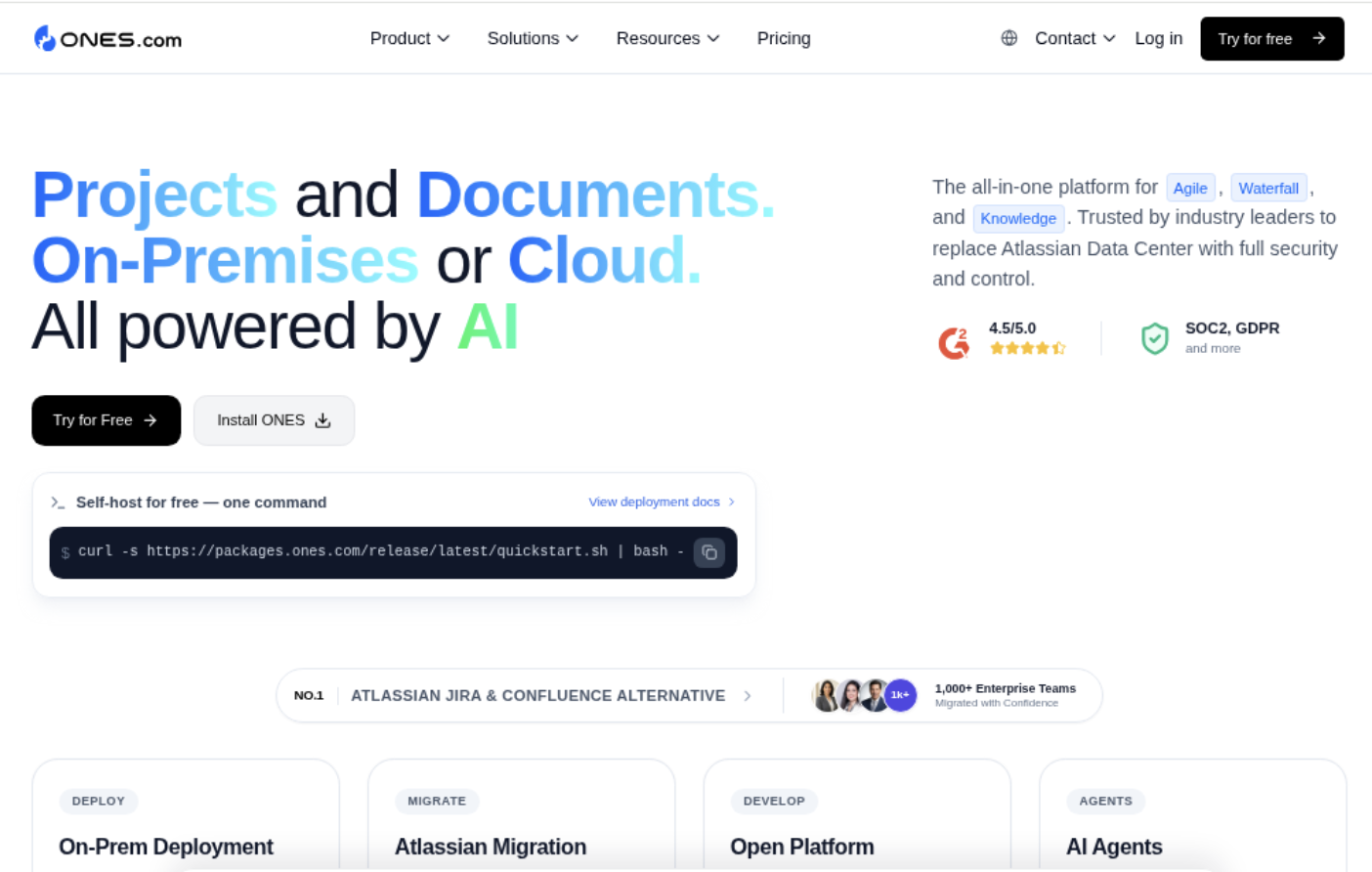
Value Proposition
ONES.com combines project management and knowledge management through ONES Project and ONES Wiki. It can suit teams evaluating a Jira alternative alongside a Confluence alternative.
ONES Project and ONES Wiki are sold separately, while the broader platform connects project work with team knowledge. ONES.com supports Cloud, On-Premise, Private Cloud, and Air-gapped deployments, with feature parity between cloud and self-hosted versions.
Core Capabilities
1. Separate tools create scattered project context
ONES capability: ONES Project handles project management, while ONES Wiki provides a knowledge base for requirements, decisions, procedures, and team guidance.
Result: Your team can connect delivery work with the explanations and decisions that help people complete it correctly.
2. Jira migration can create workflow disruption
ONES capability: ONES Project supports Jira-compatible workflows, including issue tracking, sprint management, custom workflows, and custom fields.
Result: A team can evaluate a Jira alternative without redesigning every delivery process from the beginning.
3. Plugin-heavy setups increase maintenance
ONES capability: Built-in reporting, automation, workflow controls, and project features reduce the need to assemble every function through separate plugins.
Result: Administrators can manage a more consistent environment with fewer third-party dependencies to review and maintain.
4. Self-hosting can require deployment flexibility
ONES capability: ONES.com supports Cloud, On-Premise, Private Cloud, and Air-gapped deployment models.
Result: Teams with restricted-network, compliance, or infrastructure requirements can select a deployment that matches their operating environment.
5. Cloud-only planning may conflict with security policies
ONES capability: The self-hosted versions maintain feature parity with the cloud version, including project management functions.
Result: A security-conscious organization can retain access to familiar capabilities while keeping the system within its chosen environment.
6. Manual reporting slows release reviews
ONES capability: ONES Project includes built-in reporting for monitoring progress, workload, and delivery activity.
Result: Teams can spend less time assembling status updates and more time investigating risks or making decisions.
7. Different teams need different workflows
ONES capability: Custom workflows and custom fields allow teams to reflect approval stages, review requirements, risk categories, or operational handoffs.
Result: A product team, support team, and infrastructure team can manage work according to their real processes.
8. Small teams need a low-risk starting point
ONES capability: ONES.com offers a free option for up to 30 seats.
Result: A team can evaluate a broader workspace before making a larger subscription commitment.
Application Scenarios
Software product team: Developers manage sprints and defects in ONES Project, while product managers maintain requirements and release guidance in ONES Wiki.
Restricted-network organization: An organization with strict infrastructure rules deploys the platform in an air-gapped environment, keeping project activity within its approved network.
Growing services company: A 20-person team uses the available free capacity to organize client projects, recurring workflows, reports, and internal knowledge in a connected workspace.
Common Challenges When Using Jira Free
Challenge: Your team reaches the user cap
Problem: New contributors need access, but the free tier cannot accommodate everyone.
Solution: Audit inactive accounts, identify occasional viewers, and compare the cost of upgrading with the cost of restricting collaboration.
Challenge: Automation stops working as expected
Problem: Frequent triggers consume the available automation allowance, leaving important rules delayed or unavailable.
Solution: Combine overlapping rules, remove low-value notifications, and reserve automation for actions that prevent real manual work.
Challenge: Attachments consume storage quickly
Problem: Large recordings, repeated exports, and high-resolution images use storage faster than expected.
Solution: Establish attachment guidelines, remove obsolete materials, and keep large media in a suitable storage service with clear links in Jira.
Challenge: Advanced administration becomes necessary
Problem: A growing organization needs detailed permissions, better oversight, or stronger support than the free tier provides.
Solution: Map each requirement to a paid plan feature before upgrading. This prevents paying for capacity your team will never use.
Challenge: Pricing changes complicate long-term planning
Problem: Product plans, limits, and regional charges can change over time.
Solution: Recheck the current pricing page before renewal, record your active user count, and keep a 12-month cost estimate for comparison.
FAQs About Jira’s Free Plan
Can I use Jira Free for a personal project?
Yes. Jira Free can work for a personal software project, portfolio build, study plan, or small side project. You can create issues, organize work on boards, and test agile planning without a paid subscription. Keep in mind that the same user and usage limits apply. If you invite collaborators, count every person who needs access before assuming the free tier will remain sufficient.
How many people can use Jira Free?
Jira Cloud’s Free plan is commonly available for up to 10 users. Atlassian can change eligibility rules or apply different conditions to particular products and account types. Count developers, testers, managers, contractors, and other regular collaborators. If your team is close to the limit, plan for growth because one new contributor may require a paid upgrade.
Does Jira Free include sprints and agile boards?
Yes, Jira Free generally includes core agile capabilities such as backlogs, Scrum boards, Kanban boards, issues, and sprint management. These features are enough for many small software teams. Advanced planning, reporting, administration, capacity, and automation limits may differ by plan. Test your actual workflow during evaluation instead of assuming every premium feature is included in the free tier.
Is Jira Free suitable for a business?
It can be suitable for a small business with a limited team and straightforward requirements. A company should review its need for permissions, governance, support, storage, automation, and external collaboration. Free access can be a sensible starting point for a new team. It may become unsuitable when the business depends on advanced controls or when growth regularly pushes the account beyond its limits.
Does Jira Free expire?
Jira Free is generally designed as an ongoing plan rather than a short trial, provided your account remains eligible and within the applicable limits. Atlassian may change plan conditions over time. Review your account settings and current plan details if you notice a feature restriction or billing prompt. A free plan can also be replaced by a paid plan when your usage exceeds its thresholds.
Should I choose Jira Free or a paid plan immediately?
Start with Free when your team is small and you are validating a workflow. Choose a paid plan earlier when access control, support, reporting, storage, automation, or growth planning are already important. Compare the subscription with the hours your team spends on workarounds. A paid plan is easier to justify when it removes a recurring operational problem rather than adding features nobody uses.
Conclusion
Jira is free in 2026 when your team fits the Free plan’s eligibility and usage limits. Small teams can use core issue tracking, agile boards, sprint planning, and collaboration without a monthly subscription.
But here’s the truth: the free price does not remove planning decisions. User access, storage, automation, permissions, support, and future growth can determine your real cost.
Start by counting users and mapping your workflow. Then compare Jira’s paid tiers with alternatives such as ONES.com, especially if you want built-in reporting, flexible deployment, Jira-compatible workflows, and connected project and knowledge management.