Jira AI Pricing Explained: Plans, Costs, and Key Limits Today
Understand 2026 Jira Rovo and AI pricing: included credits, shared pools, extra usage and ONES plan comparisons, with verified sources for your budget.
Policy review: September 9, 2026. The dated update below distinguishes announced changes from currently effective rules.
Rovo: distinguish included credits from extra usage
The documented monthly allowance for standalone Jira or Confluence is 25, 70 or 150 credits per user for Standard, Premium or Enterprise respectively. Service and Teamwork Collections have different allowances: 250, 700 and 1,500. Credits from eligible subscriptions contribute to the organization pool. Count each actual subscription once; a collection and its bundled products are not independent purchases to add again. Credits reset monthly and do not roll over.
A quick answer uses 10 credits; deeper research has variable consumption. Search and inline AI can remain included while other workflows consume credits, so one generic charge per AI request is misleading. Atlassian lists extra Rovo usage at $0.01 per credit. Most expanded usage billing starts December 3, 2026, with the actual date depending on the subscription and billing cycle. Review the allowance and spending controls in your account.
Rovo Dev is a separate developer product and credit model. Its $20 per developer monthly plan includes 2,000 credits per user, with additional credits at $0.01 each. Do not merge those developer credits into the ordinary Rovo organization pool or treat them as Jira plan credits.
Sources: Rovo credit rules; Rovo licensing; usage pricing and billing controls.
Automation update: model steps, not only rule runs
The new model measures Automation steps rather than treating an entire rule run as a single unit. Inventory the billable actions and branches in each rule and measure actual consumption. An old run allowance is not a reliable forecast of step usage. Enterprise should not be modeled as unlimited under the new policy.
Atlassian lists additional Automation usage at $0.50 per 1,000 steps. Most expanded usage billing starts December 3, 2026; check the subscription-specific start and allowance. Shared allowances and purchasing options depend on the products you own. Follow the AI-action metering rules so the same action is not charged twice in a Rovo and Automation estimate.
Review whether additional usage is enabled and configure an appropriate limit. If a limit pauses rules, trigger events during the pause are not queued for automatic replay; in-flight executions can finish. A spending cap therefore also needs an operational fallback for important workflows.
Sources: Automation pricing, counting and limits; usage billing dates and controls.
Jira AI pricing can feel confusing because artificial intelligence appears across several Atlassian products, plans, and usage models. You may see AI features included with a subscription, then encounter separate limits for advanced assistance or automated actions.
That uncertainty makes budgeting difficult. A team may choose a cheaper plan, only to discover that important AI capabilities require a higher tier, extra capacity, or a separate product. Small differences in eligibility can also affect a large engineering team differently from a ten-person startup.
Here’s the practical answer: Jira AI pricing usually depends on your Jira plan, the AI capability you need, your user count, and any usage limits attached to that capability. This guide explains each factor so you can estimate costs before committing.
What Jira AI Pricing Usually Includes
Jira AI pricing refers to the cost and availability of artificial intelligence features connected with Jira, including AI assistance, search, summaries, automation, work-item generation, and knowledge retrieval.
The final amount rarely comes from one simple AI line item. Your total cost may depend on the Jira edition, billing period, team size, product combination, and whether advanced AI features have separate consumption rules.
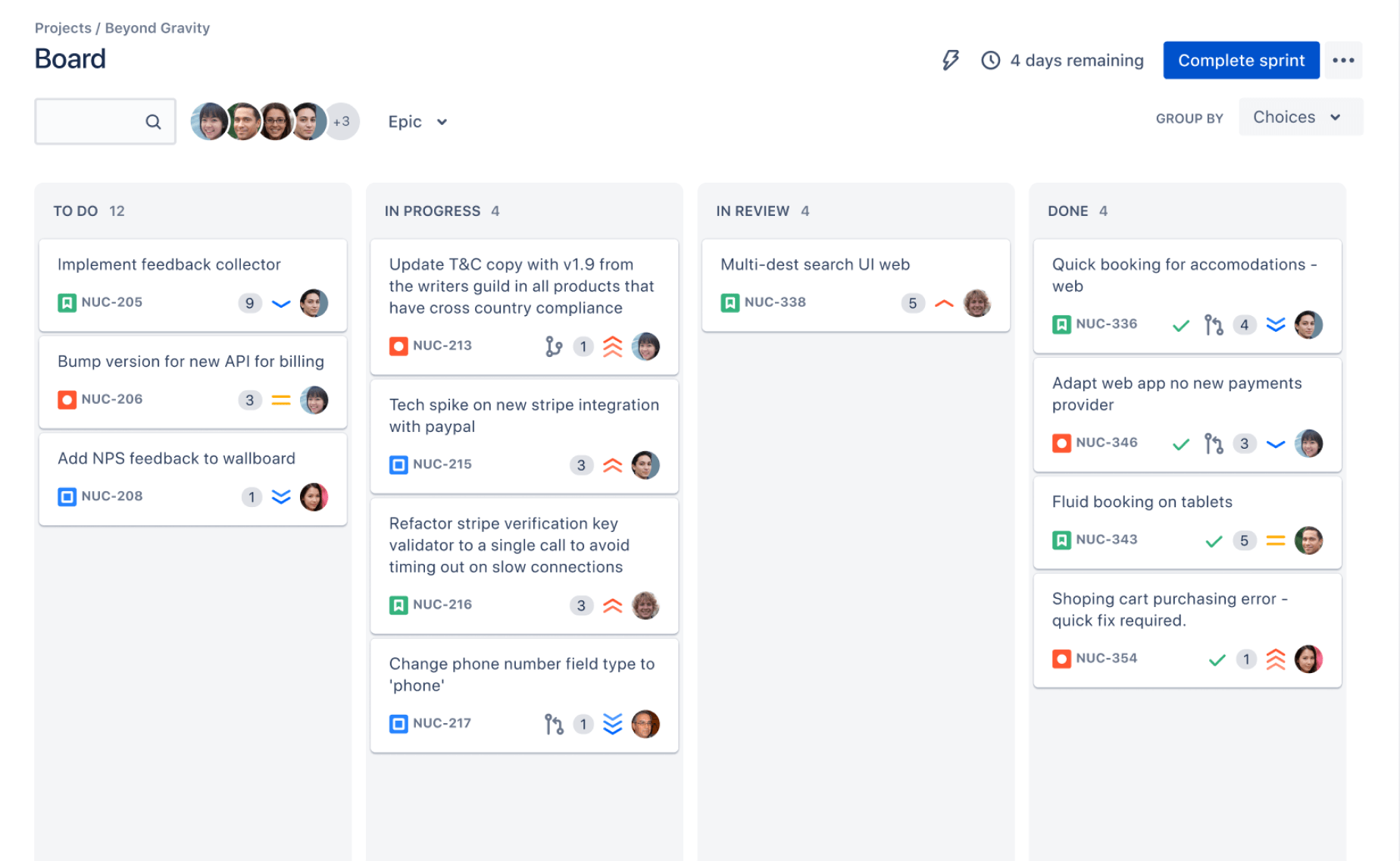
The main pricing layers
Jira AI typically sits across several commercial layers. Understanding them first makes the rest of the calculation easier.
- Jira subscription: Your plan determines which core project management features and AI experiences are available.
- Plan tier: Free, Standard, Premium, and Enterprise plans can differ in administration, security, reporting, automation, and feature access.
- AI availability: Some AI capabilities may be included with eligible plans, while others may depend on a related Atlassian product or service.
- Usage controls: Advanced assistance can involve limits, fair-use rules, request allowances, or feature-specific restrictions.
- Related products: AI experiences can span Jira, Confluence, Jira Service Management, and other Atlassian services.
Included access does not always mean unlimited usage
A plan can include an AI feature without giving every team unlimited access to every AI action. The capability may be available, while usage remains subject to product limits or operational safeguards.
For example, a team might use AI to summarize work items regularly but apply stricter controls to large-scale content generation or automated workflows. Always check the current commercial terms for your region and plan.
A simple cost formula
You can estimate your recurring spend with this formula:
Total monthly cost = Jira plan cost + related product cost + any AI-specific charge or overage + optional administration or support costs.
Suppose 25 people need Jira Standard, five administrators need advanced controls, and the team also uses a knowledge product with AI features. The correct estimate must include the eligible user count for each product, not just the number of Jira seats.
How to Evaluate the Real Cost
The fastest way to understand your likely spend is to separate plan access from AI consumption. Follow these steps before comparing prices.
- Count active users. Include engineers, product managers, testers, support staff, and occasional contributors who need access.
- List the AI tasks you need. Examples include summarizing work, creating descriptions, finding related knowledge, writing automation rules, and generating reports.
- Identify the required Jira tier. Security, audit, administration, analytics, and scale requirements may push you toward Standard, Premium, or Enterprise.
- Check product boundaries. Determine whether the capability lives in Jira, Confluence, Jira Service Management, or another Atlassian service.
- Review usage limits. Look for request caps, fair-use conditions, consumption allowances, and eligibility restrictions.
- Compare monthly and annual billing. Annual commitments may change the effective monthly rate, while monthly billing can offer more flexibility.
- Calculate the cost per active AI user. A low subscription price may become expensive if only a small portion of the team uses the AI features.
- Run a realistic pilot. Test ordinary work across planning, delivery, support, and reporting before making a long-term decision.
Example calculation
Imagine a software company with 40 Jira users. Its team needs advanced permissions, portfolio planning, and AI-assisted summaries.
The team should calculate the price of the required Jira tier for 40 users first. Then it should confirm whether the desired AI experiences are included, limited, or connected to another subscription.
If 12 people also need knowledge search and AI-assisted answers, the company should calculate that product separately. This avoids assuming that one Jira subscription covers every AI experience across the organization.
Which Factors Change the Price?
Several variables can move your final bill even when two companies use similar AI features. Here’s why: pricing usually follows the commercial structure of the platform, while AI value depends on how your team works.
Team size and user activity
Seat-based pricing generally grows with the number of people who need access. However, a small number of heavy AI users can create a different cost pattern from a large group using AI occasionally.
For example, 100 developers who ask for a short summary twice a week may create less AI demand than 20 analysts who generate extensive planning content every day.
Plan tier and administration
A higher Jira tier may be necessary for reasons unrelated to AI. Enterprise security, advanced governance, organization-wide controls, and large-scale administration can influence the decision.
That means you should not compare plans only by asking, “Which one includes AI?” Ask which tier supports the way you need to manage work.
Product combinations
Jira manages project and engineering work, while Confluence manages team knowledge. Jira Service Management supports service operations. AI experiences may appear across all three environments.
A team that needs AI across project planning, internal knowledge, and customer support may need more than one product subscription. Mapping each workflow prevents unexpected costs.
Billing period and contract terms
Monthly billing can suit a growing team with changing headcount. Annual billing may suit an established organization that values predictable budgeting.
Enterprise agreements can introduce negotiated terms, support options, or volume arrangements. Those contracts make public list prices less useful as a final estimate.
Jira AI Features and Their Practical Value
Price matters only when the capability solves a real bottleneck. The best part? You can evaluate AI by measuring time saved in specific workflows rather than treating it as a vague productivity benefit.
| AI use case |
Practical benefit |
| Work-item summaries |
Helps a new team member understand status, decisions, and blockers quickly. |
| Description assistance |
Turns rough requirements into clearer work-item descriptions and acceptance details. |
| Search and discovery |
Helps people find related project context without opening many separate pages. |
| Automation assistance |
Reduces the effort required to design routine workflow actions. |
| Risk and status analysis |
Highlights patterns that may deserve attention during planning or delivery. |
| Knowledge answers |
Provides conversational access to approved team guidance and working practices. |
Measure time saved per workflow
Suppose a product manager spends 30 minutes preparing a weekly status update. An AI summary reduces that task to 10 minutes.
For ten product managers, the saved time reaches more than three hours each week. That calculation gives you a better business case than saying AI “improves productivity.”
Check quality and review effort
AI output still needs human review, especially for requirements, release plans, security decisions, and customer-facing communication.
If a generated summary saves ten minutes but creates fifteen minutes of correction work, the feature may not provide a net benefit. Include review time in your evaluation.
Common Jira AI Cost Mistakes
Many pricing surprises come from assumptions rather than complex mathematics. Let me explain the mistakes that appear most often.
Assuming every AI feature belongs to Jira
Jira, Confluence, and Jira Service Management can work together, but they remain distinct products. A capability displayed in one environment may require a related subscription.
Draw a simple workflow map. Mark where planning, knowledge, service requests, and AI assistance occur. Then match each activity with the product that supports it.
Comparing only the entry-level plan
An entry-level plan may look attractive until you add required security, reporting, automation, or administration features. Compare the complete plan needed for your operating model.
Ignoring review and governance
AI output needs ownership. Someone must check accuracy, protect sensitive information, and decide which generated content can become part of an official team process.
For a regulated team, governance time can matter as much as subscription cost. Include approval steps, access controls, and auditing in the evaluation.
Using one average for every team member
AI usage differs by role. A project lead may need daily summaries, while a developer may use AI only when refining a work item.
Segment your estimate by role instead of multiplying one assumed usage level across the entire organization.
Evaluate ONES on matched scope
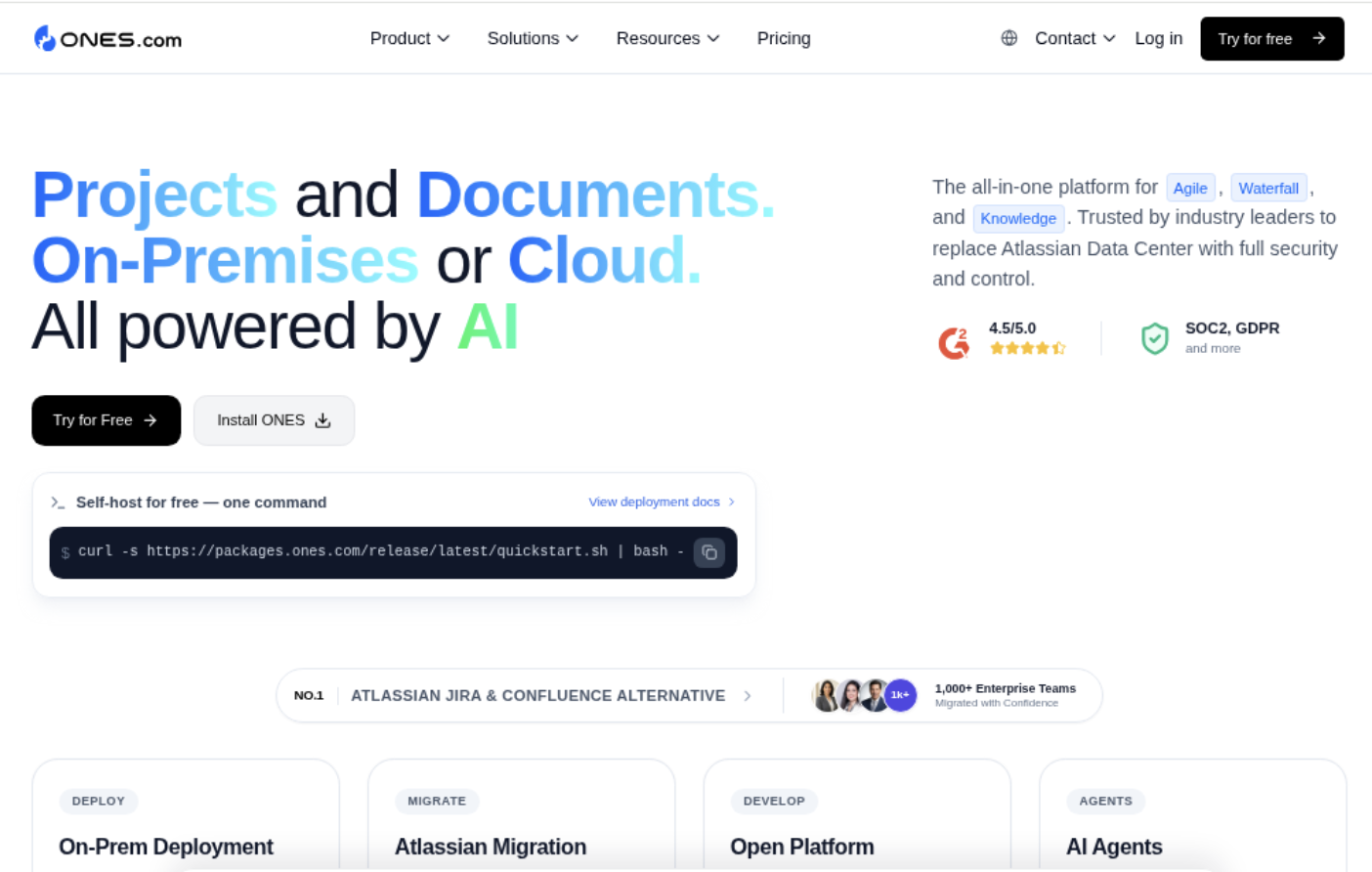
ONES is relevant when your team wants deployment choice and native R&D plus knowledge capabilities. Map the Jira, Confluence, test-management, planning and reporting functions you actually use to the selected ONES plan. Only subtract App costs after validating replacement coverage; keep custom integrations and one-time migration in the comparison. A missing production quote is not a zero-dollar cost.
ONES Cloud Free supports up to 30 users. The self-hosted trial is a separate 20-user, 30-day offer. Production self-hosting requires an appropriate quote. The current Cloud pricing page lists monthly AI credits by plan: 20 for Free, 50 for Standard, 100 for Business and 200 for Enterprise per user. Confirm the action meter, excess usage and deployment-specific AI configuration rather than claiming free or unlimited AI.
A published financial-services case describes 1,000 users, 70,000+ Jira issues and 260 GB of Confluence content migrated to ONES On-Prem in phased waves. Use that case to define your own field, permission, attachment and reconciliation tests; it is not a promise of identical duration or outcomes.
Check ONES plans; evaluate deployment; read the full migration case. Compare the alternatives.
Common Challenges and Practical Solutions
Challenge: You cannot tell which plan includes the capability
Solution: Create a capability checklist before reviewing prices. Mark each feature as included, limited, available through another product, or requiring confirmation.
Challenge: Your team’s usage varies widely
Solution: Divide people into light, regular, and heavy AI users. Track the number of requests and the time spent reviewing results during a pilot.
Challenge: Your estimate excludes related products
Solution: Map project, knowledge, service, and reporting workflows separately. Price every product that supports a required activity.
Challenge: AI output creates governance concerns
Solution: Define review rules before launch. Decide which work can receive automated assistance and which decisions require an accountable person.
Challenge: The team cannot prove return on investment
Solution: Track measurable outcomes such as planning time, search time, status-report preparation, and repetitive administration. Compare those results with the complete subscription cost.
FAQs About Jira AI Costs
Is Jira AI included in the Jira subscription?
Some AI capabilities may be available within eligible Jira or Atlassian plans, but inclusion can vary by product, plan tier, region, and current commercial terms. You should confirm the exact feature list for your account. Also check whether the capability is delivered through Jira, Confluence, Jira Service Management, or another Atlassian service.
Does Jira AI have a separate per-request price?
There may not be one universal per-request charge for every Jira AI capability. Some features can be included with eligible subscriptions, while advanced or related AI services may have usage rules or separate commercial terms. Review the specific feature’s limits rather than assuming every AI action follows the same pricing model.
Does the Jira plan affect AI access?
Yes, the Jira plan can affect the surrounding capabilities that make AI useful, including permissions, administration, automation, reporting, and security controls. The AI feature itself may be available across more than one tier, but your operational requirements can still require a higher plan.
How should a small team estimate AI-related Jira costs?
Start with active users and the Jira tier required for everyday work. List the AI tasks your team expects to perform, then check whether each task belongs to Jira or another Atlassian product. Run a short pilot and measure request frequency, review time, and hours saved before selecting annual billing.
Is ONES.com an alternative to Jira for AI-enabled project work?
ONES Project is a Jira alternative with Jira-compatible workflows, sprint management, custom workflows and fields, built-in reporting, and automation. ONES.com also offers ONES Wiki for knowledge management, sold separately. Its Cloud, On-Premise, Private Cloud, and Air-gapped deployment options may suit teams with infrastructure or network restrictions.
Conclusion
Jira AI pricing depends on more than the word “AI” on a feature page. Your real cost reflects the Jira plan, user count, related Atlassian products, usage controls, billing terms, and governance effort.
Start by listing the AI tasks you need. Match each task with its product and plan, then test the workflow with real team members. Measure time saved, correction effort, and adoption instead of relying on a general productivity claim.
But here’s the truth: the cheapest subscription is not always the lowest-cost choice. A platform that fits your deployment model, reduces administration, and supports your team’s working habits may create greater value over time.
ONES offers Cloud and self-hosted deployment choices. Validate the selected plan, AI configuration, integrations and required features in a deployment-specific pilot.