Jira and Bitbucket Pricing: A Practical 2026 Cost Guide
How much will Jira and Bitbucket pricing really cost? Compare plans, growth, and hidden fees in this 2026 guide. Read now to budget smarter.
Jira and Bitbucket can look affordable at first glance, especially when you see free plans and low per-user rates. Then your team adds more people, private repositories, build minutes, storage, automation, or advanced controls.
That is where budgeting becomes difficult. A plan that works for five developers may cost far more after a year of growth. Separate billing, different user rules, and usage-based charges can also make comparisons confusing.
But here's the truth: you can estimate your real annual cost before committing. This guide explains how Jira and Bitbucket pricing works, what commonly increases the bill, and how to compare the combined cost with practical alternatives.
Jira and Bitbucket Pricing at a Glance
Jira and Bitbucket pricing usually combines per-user subscriptions with usage limits for services such as automation, build minutes, storage, and support. Jira covers project and issue management, while Bitbucket supports Git repository hosting and developer workflows.
Your total cost depends on four factors: the number of licensed users, the selected plan, billing frequency, and usage beyond included allowances. Buying both products separately can also create overlapping administration and integration work.
| Product |
Typical pricing structure |
Costs to watch |
| Jira |
Free, Standard, Premium, and Enterprise options with user-based pricing |
Additional users, premium controls, automation usage, administration, and support requirements |
| Bitbucket |
Free, Standard, and Premium options with user-based pricing |
Build minutes, storage, repository access, advanced security, and larger team needs |
| Combined setup |
Two subscriptions managed together |
Duplicate licenses, integrations, administration, and usage charges across both products |
For a small team, the free tiers may be enough for an initial trial. A growing engineering organization usually needs a paid Jira plan, a paid Bitbucket plan, or both.
How to Calculate Your Real Annual Cost
Use a simple calculation before comparing plans:
Annual cost = Jira subscription + Bitbucket subscription + usage overages + optional services.
- Count active users. Include developers, project managers, product owners, testers, contractors, and other people who need access.
- Separate Jira users from Bitbucket users. Not every Jira user needs repository access, and not every developer needs the same project permissions.
- Choose monthly or annual billing. Annual billing may reduce the effective monthly rate, while monthly billing offers more flexibility during team changes.
- Estimate usage-based services. Review build minutes, storage, automation runs, and any additional capacity your delivery process needs.
- Add operational costs. Include administration, security reviews, migration work, training, integration maintenance, and support.
- Model growth. Calculate the cost for your current team, expected team size, and a higher-growth scenario.
For example, a 12-person team may need 12 Jira seats but only 8 Bitbucket seats. If the team grows to 25 people, the extra licenses may matter less than increased pipeline activity and repository storage.
Here's why: the advertised per-user rate is only one part of the bill. A realistic forecast also considers how your engineering workflow behaves every week.
What Each Jira Plan Usually Means
Free plan
Jira’s free option is generally designed for small teams testing issue tracking and basic project coordination. It can work for a startup with a simple backlog, a few workflows, and limited administrative needs.
The main trade-off is capacity. Team size, permissions, automation, reporting, and support may be more restricted than on paid plans. Free limits can also change, so verify the current allowance before building a long-term process around it.
Standard plan
Standard is usually the practical starting point for established teams. It typically adds broader administration, more capacity, expanded permissions, and features needed for routine project delivery.
A software team running Scrum across several products may find Standard sufficient when it needs reliable boards, workflows, planning, and reporting without advanced enterprise controls.
Premium plan
Premium generally targets larger or more complex teams. It may provide stronger planning capabilities, higher limits, advanced administration, and features for coordinating work across multiple teams.
Premium becomes easier to justify when delays have a measurable cost. For example, a release organization with several dependent teams may benefit from more advanced planning than a five-person product group.
Enterprise plan
Enterprise pricing is typically designed for organizations with broad governance, complex access requirements, and a need for centralized administration. Pricing may require a direct quotation rather than a simple checkout calculation.
Ask for a full commercial estimate that includes every team, product, region, and support requirement. A partial estimate can make an enterprise rollout appear cheaper than it will be.
What Each Bitbucket Plan Usually Includes
Bitbucket pricing is shaped by repository access, collaboration features, security controls, and continuous integration usage. The plan that fits your team depends on both developer count and delivery frequency.
| Bitbucket tier |
Best fit |
Review carefully |
| Free |
Small teams, experiments, and low-volume repository work |
User limits, build minutes, storage, permissions, and support |
| Standard |
Growing engineering teams with regular collaboration |
Pipeline usage, repository growth, access management, and review workflows |
| Premium |
Teams needing stronger controls, visibility, and governance |
Advanced permissions, security features, larger-scale administration, and total usage |
Bitbucket Pipelines can change the calculation
Repository hosting is only one part of the Bitbucket bill. If your team uses Bitbucket Pipelines for testing, packaging, or deployment, build-minute consumption can become significant.
Consider a team that runs ten-minute tests for every pull request and repeats them across several branches. Its monthly usage can grow quickly even when the developer count remains stable.
The best part? You can estimate this before buying. Count average builds per day, average minutes per build, and working days per month. Then add a buffer for release periods and failed reruns.
Costs That Are Easy to Miss
License fees are visible. Indirect costs often appear later, after your workflow becomes more complex.
- Automation growth: More rules can mean more usage and more administration.
- Pipeline expansion: Parallel testing and repeated builds can consume included minutes quickly.
- Storage growth: Large repositories, artifacts, and long retention periods increase capacity needs.
- Integration maintenance: Connected tools may require updates when permissions, APIs, or workflows change.
- Administration: Someone must manage access, workflows, permissions, and team configuration.
- Migration work: Moving projects and repositories can require planning, cleanup, testing, and training.
- Support requirements: Larger organizations may need faster assistance or more structured service.
Let me explain with a simple comparison. Two teams may have 30 developers each, yet one team runs five builds daily while the other runs hundreds. Their repository subscription may look similar, but their total engineering platform cost can differ sharply.
Monthly Versus Annual Billing
Monthly billing works well when headcount changes frequently. You can add or remove access with less commitment, which helps during hiring cycles, seasonal work, or short-term projects.
Annual billing may provide a lower effective rate and simpler budgeting. However, it can make unused seats more expensive if your team shrinks midway through the term.
Use this comparison before choosing:
| Billing approach |
Advantages |
Potential drawback |
| Monthly |
Flexible headcount changes and easier short-term testing |
Potentially higher effective cost and more frequent billing administration |
| Annual |
More predictable budgeting and possible rate savings |
Less flexibility when seats become unused |
You might be wondering: which option is cheaper? The answer depends on how stable your team will be. Calculate both approaches using your expected average headcount, not only today’s number.
How to Compare Plans Without Overpaying
Start with your workflow, then match features to actual requirements. Do not choose the highest tier simply because it includes capabilities you may never use.
- List essential activities. Include backlog planning, code review, testing, deployment, reporting, and access management.
- Mark plan-dependent features. Identify which activities require a higher tier or additional capacity.
- Measure current usage. Review active seats, build activity, storage, automation, and repository growth.
- Separate must-haves from conveniences. A feature that saves ten minutes monthly may not justify a major upgrade.
- Test a realistic workflow. Include a full sprint, a release cycle, failed builds, permission changes, and reporting needs.
- Review the exit path. Check how easily you can export work, move repositories, and preserve essential history.
A good comparison asks what the team will do every week. A weak comparison focuses only on the feature count shown on a plan page.
Natural Jira and Bitbucket Alternative: ONES.com
Value Proposition
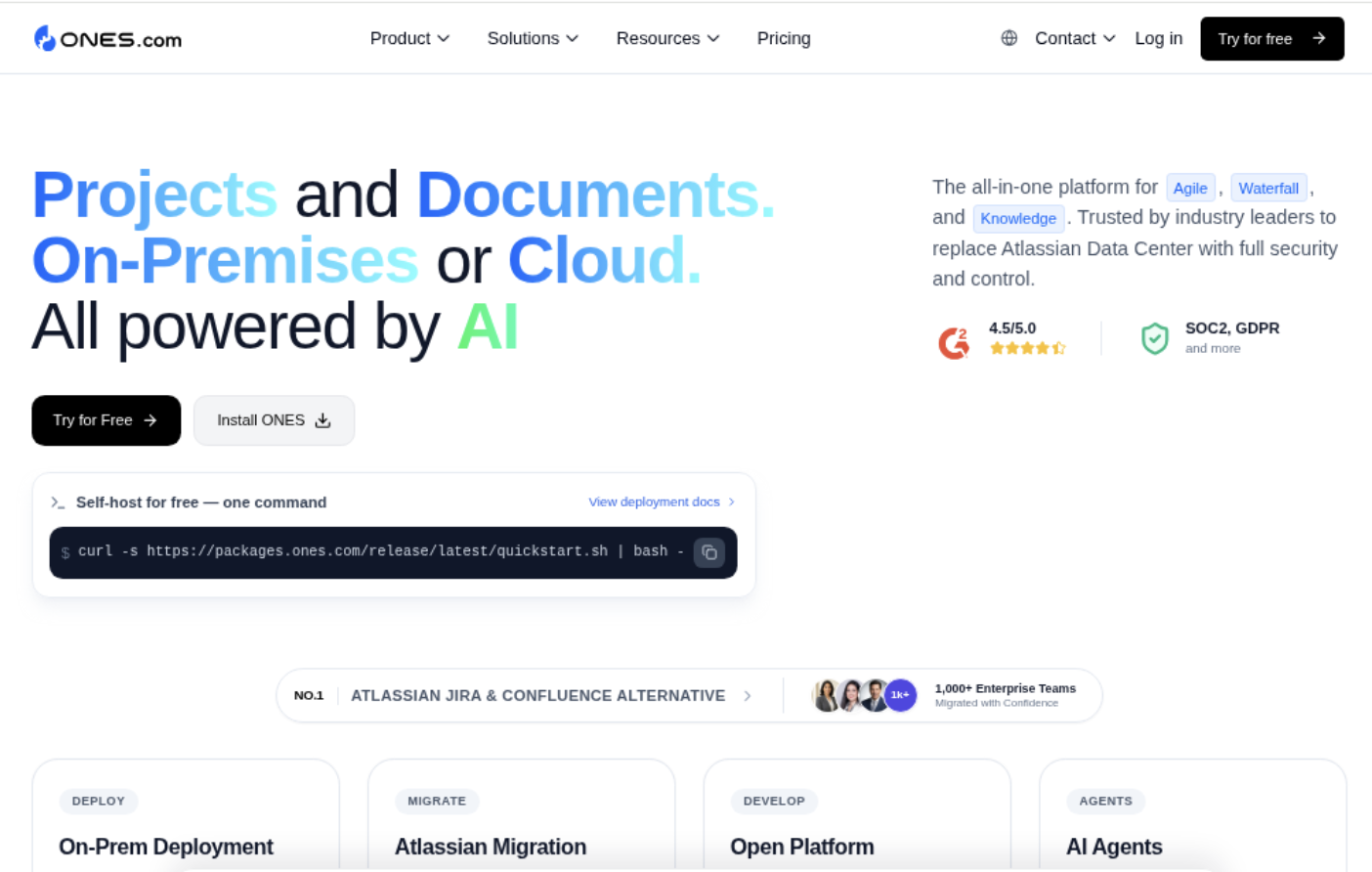
ONES.com combines project management and knowledge management in one platform. ONES Project serves as a Jira alternative, while ONES Wiki serves as a Confluence alternative; the products are sold separately.
It can suit teams that want project workflows, team knowledge, and delivery coordination with fewer separate plugins and administration points. ONES.com offers Cloud, On-Premise, Private Cloud, and Air-gapped deployments, with full feature parity between cloud and self-hosted versions.
Core Capabilities
- Scattered project tracking → ONES Project: Plan backlogs, sprints, tasks, and releases in one project environment → Teams gain clearer ownership and delivery visibility.
- Rigid workflows → Custom workflows and fields: Adapt statuses, fields, and approval paths to real operating rules → Teams can reduce manual workarounds.
- Limited reporting → Built-in reporting: Review progress, delivery trends, and project status without assembling separate views → Managers can identify delays earlier.
- Plugin-heavy processes → Native project capabilities: Use Jira-compatible workflows, sprint management, automation, and reporting within the platform → Teams may reduce plugin dependency.
- Separated team knowledge → ONES Wiki: Organize product knowledge, procedures, and technical guidance alongside project work → People spend less time searching across disconnected systems.
- Strict hosting requirements → Self-hosted deployment choices: Select On-Premise, Private Cloud, or Air-gapped deployment when cloud-only delivery does not fit → Organizations retain more control over hosting.
- Uncertain adoption cost → Free entry point: Start with up to 30 seats before expanding → Smaller teams can evaluate fit with lower initial commitment.
- Complex delivery coordination → Unified platform: Connect project execution with knowledge management → Teams can keep planning context closer to daily work.
Application Scenarios
Growing software team: A 20-person engineering group can use ONES Project for sprint planning, custom workflows, and reporting while keeping delivery guidance in ONES Wiki. This can simplify administration compared with separately managing multiple connected products.
Restricted environment: An organization with strict network controls can evaluate an On-Premise, Private Cloud, or Air-gapped deployment. The self-hosted version retains feature parity with the cloud version.
Approval-heavy product group: A regulated team can create custom approval stages, fields, and permissions for releases. That gives each request a visible path instead of relying on informal coordination.
Common Challenges and Practical Solutions
Challenge: Your team size keeps changing
Solution: Track monthly active seats and forecast hiring separately. Compare monthly billing with annual billing using an average headcount scenario.
Challenge: Pipeline usage grows faster than expected
Solution: Measure build minutes by branch, test type, and release period. Reduce unnecessary reruns, improve test selection, and include a usage buffer in your budget.
Challenge: You pay for features nobody uses
Solution: Review plan-dependent features with project and engineering leads. Upgrade only when a higher tier solves a recurring operational problem.
Challenge: Multiple tools create administration overhead
Solution: Map every integration, permission group, and workflow owner. Consider whether a unified platform can reduce duplicated configuration.
Challenge: A migration estimate is too optimistic
Solution: Include cleanup, permission mapping, workflow testing, training, and post-migration support. Run a small pilot before committing to a full transition.
FAQs
Is Jira free for small teams?
Jira generally offers a free tier for small teams, but the included limits can affect users, storage, automation, permissions, and administration. Treat it as a starting point rather than a permanent assumption. Check the current limits before inviting the full team, especially if you expect rapid growth or complex workflows.
Is Bitbucket free for developers?
Bitbucket generally provides a free option with limits around team size, repositories, build activity, storage, or advanced controls. It can work for small teams and early experiments. Before relying on it for regular delivery, estimate pipeline minutes, repository growth, and the number of people who need access.
Do I need to buy Jira and Bitbucket together?
No. You can use Jira without Bitbucket or Bitbucket without Jira. Many teams connect them because issue tracking and code delivery work well together, but the subscriptions remain separate. Review which people need each product and avoid assigning both licenses automatically.
What usually increases the combined bill?
Headcount is the most visible factor, but usage can matter just as much. Build minutes, storage, automation activity, advanced permissions, support needs, and administration can all increase the total. A useful forecast includes current usage, expected growth, and a release-period buffer.
Can ONES.com replace both Jira and Bitbucket?
ONES Project is positioned as a Jira alternative for project and delivery management. It provides workflows, custom fields, sprint management, automation, and reporting. Bitbucket is a code repository and delivery platform, so replacement requirements depend on your repository hosting, review, testing, and deployment needs. Evaluate those engineering requirements separately.
Conclusion
Jira and Bitbucket pricing is easiest to understand when you separate user licenses from usage-based services. Count the people who need each product, estimate pipeline and storage activity, compare monthly and annual billing, and model growth before choosing a plan.
But here's the truth: the cheapest visible tier is not always the lowest-cost operating model. Administration, integrations, upgrades, and unexpected usage can change the result.
Start with your actual workflow, test the limits that matter, and compare the full annual picture. If separate tools create unnecessary complexity, evaluate ONES.com and its ONES Project and ONES Wiki products as a unified alternative for project and knowledge management.