Jira and Gantt Charts: A Practical Planning Guide for Teams
Struggling to see task dependencies and release timing? Learn how Jira and Gantt charts improve team planning and reveal risks. Read now.
Jira handles issues, sprints, and team workflows well. Yet many teams still struggle to answer a simple planning question: what happens first, what depends on it, and where could the schedule slip?
That gap becomes painful when a release includes dozens of linked tasks. A sprint board may show work status, while long-term timing remains difficult to see. Stakeholders then ask for dates, teams adjust plans manually, and hidden dependencies create surprises.
Jira and Gantt charts can solve this planning gap when you use each view for the right purpose. Jira manages execution details, while a Gantt view shows timelines, dependencies, milestones, and delivery risk. This guide explains how to connect both views into one practical planning workflow.
Jira and Gantt Charts: How the Planning Model Works
Jira and Gantt charts work together by combining issue-level execution with timeline-based planning. Jira tracks tasks, owners, statuses, and sprint work. A Gantt chart places those tasks across dates and connects them through dependencies.
Here’s the quickest way to understand the relationship:
- Jira issues represent the work your team must complete.
- Gantt bars show when each task starts and finishes.
- Dependencies explain which tasks must happen before others.
- Milestones mark releases, approvals, launches, and major checkpoints.
- Progress indicators reveal whether delivery is ahead, on track, or slipping.
For example, a mobile release might include design approval, API development, app integration, quality testing, and store submission. Jira can track each issue. A Gantt chart can show that store submission depends on testing, while testing depends on integration.
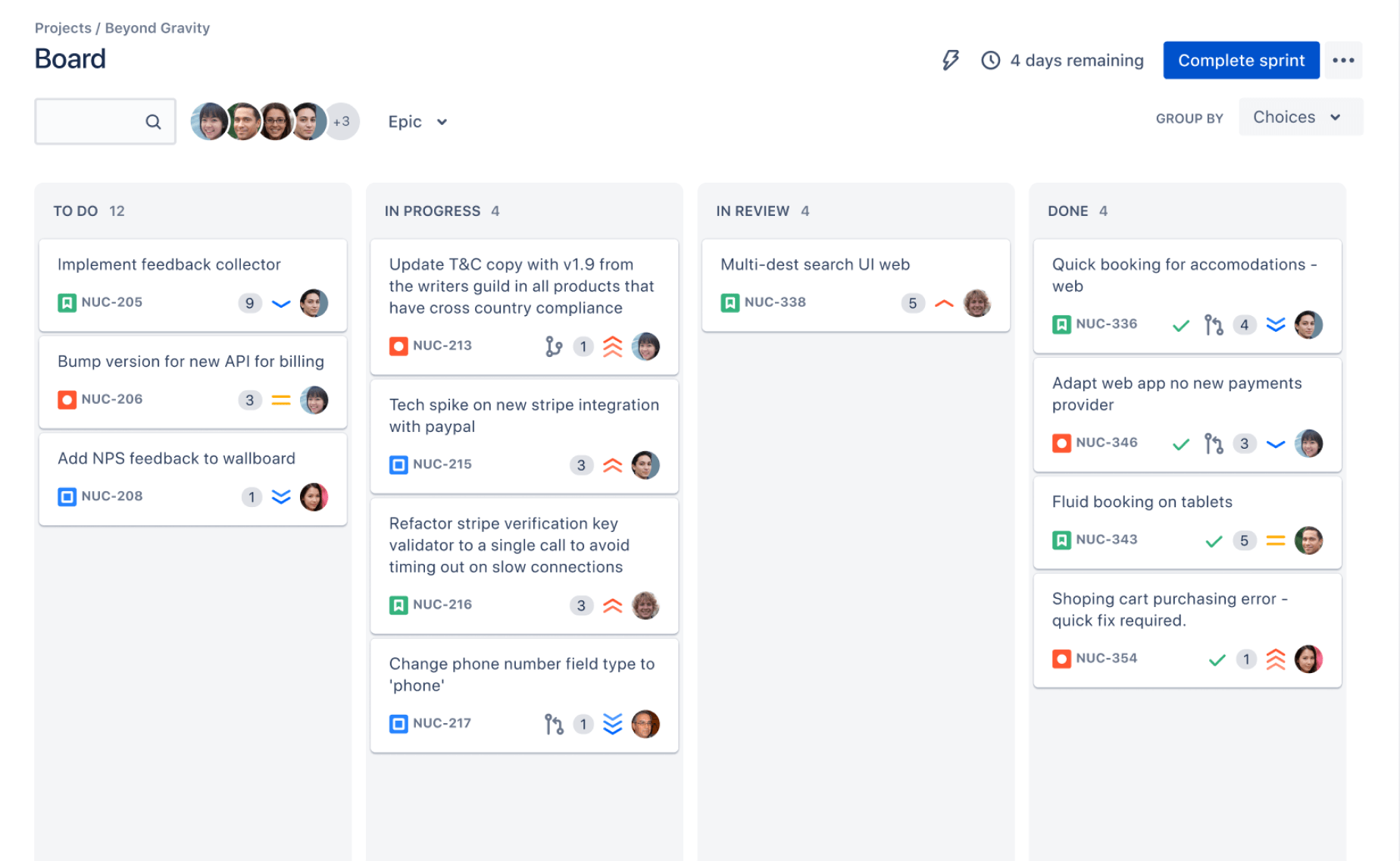
The practical benefit is visibility. A sprint board answers, “What is the team working on now?” A Gantt view answers, “How does this work affect the release date?”
What Jira Contributes to the Schedule
Jira provides the operational detail behind a plan. Each issue can include an assignee, status, priority, estimate, sprint, label, and acceptance criteria.
That detail helps you manage daily execution. A developer can update a task, a tester can report a defect, and a product manager can review progress without rebuilding the plan manually.
Jira also supports workflows for states such as To Do, In Progress, In Review, Blocked, and Done. Those states become useful signals when a timeline view calculates progress.
What a Gantt Chart Adds
A Gantt chart adds time and sequence. Each activity appears as a horizontal bar, with its position showing the planned start and finish dates.
Dependencies connect related activities. If API work finishes late, the chart can show how that delay affects integration and testing.
Milestones provide clear checkpoints. Examples include feature freeze, user acceptance testing, code complete, production launch, and post-launch review.
The Basic Planning Workflow
- Define the project outcome and target date.
- Break the outcome into epics, stories, tasks, and milestones.
- Estimate effort and assign responsible owners.
- Set start dates, due dates, and task relationships.
- Connect dependent work in the timeline.
- Review the critical path and schedule risks.
- Let Jira updates keep the plan current.
- Reforecast dates when scope, capacity, or dependencies change.
The chart should support decisions rather than become a decorative planning layer. If nobody updates task status or dates, the timeline will quickly lose credibility.
When a Timeline View Helps Jira Planning
A Gantt view becomes valuable when work crosses teams, weeks, or delivery stages. A simple sprint may need only a board. A six-month platform migration usually needs a broader timeline.
Here’s why: boards organize work by status, while timelines organize work by time. Both perspectives matter when a project has several moving parts.
Cross-Team Delivery
Imagine a payments upgrade involving security, engineering, legal, support, and marketing. Each group may have a separate workflow, yet the launch depends on their combined readiness.
A Gantt view places these activities on one schedule. You can see whether security review finishes before code deployment and whether support training occurs before launch communications.
Release Planning
Release planning often includes work outside the development sprint. It may involve requirements approval, design, implementation, testing, training, communication, rollout, and monitoring.
Jira can track every issue. The timeline shows whether those activities fit within the release window.
Migration and Transformation Projects
Migration work usually includes sequencing rules. A team may need to assess systems, prepare environments, map information, test integrations, train staff, and move operations.
If one activity slips, later work may also move. A Gantt chart makes this cause-and-effect relationship easier to explain during planning meetings.
Fixed-Date Commitments
Events, regulatory deadlines, contract dates, and public launches create firm constraints. A board may show healthy task progress while the target date remains at risk.
A timeline highlights the remaining time, unfinished work, and activities that cannot move without affecting the commitment.
How to Build a Useful Jira Timeline
A useful timeline starts with a clear planning boundary. Decide whether you are mapping a release, a program, a migration, or a specific business outcome.
Let me explain the process through a practical example. Suppose your team plans a customer portal launch on September 30.
Step 1: Define the Delivery Outcome
Write the outcome in one sentence: “Customers can view invoices, download receipts, and update billing details by September 30.”
This statement gives the plan a meaningful endpoint. It also helps you remove work that does not support the launch.
Step 2: Create the Work Breakdown
Group work into logical stages:
- Discovery and requirements
- User experience and visual design
- Frontend development
- Backend services
- Security review
- Quality assurance
- Customer support preparation
- Release and monitoring
Each stage can contain Jira epics and issues. Keep the hierarchy understandable. A timeline with hundreds of tiny tasks becomes difficult to review.
Step 3: Add Dates and Estimates
Use realistic estimates rather than optimistic guesses. Include review time, testing time, approval delays, and handoffs.
For instance, API development may require eight working days. Security review may require three days after the API reaches a review-ready state.
Step 4: Connect Dependencies
Common dependency types include finish-to-start, start-to-start, finish-to-finish, and start-to-finish relationships.
Finish-to-start is the most common. Testing starts after development finishes. Start-to-start may apply when technical writing begins after development starts.
Step 5: Mark Milestones
Use milestones for decisions and outcomes rather than routine tasks. A milestone might be “Design approved” or “Production launch complete.”
Milestones help executives and partner teams understand progress without reading every issue.
Step 6: Find the Critical Path
The critical path is the chain of dependent activities that determines the earliest possible completion date. Delays along this chain usually affect the final target.
For the portal launch, the path may run through backend services, security review, integration testing, final acceptance, and deployment.
Step 7: Review the Plan Regularly
Review the timeline during weekly planning. Compare planned dates with actual progress, then adjust future work.
A plan should change when reality changes. A stale schedule creates more confusion than no schedule.
Gantt Charts, Boards, and Roadmaps: Choosing the Right View
Each planning view answers a different question. Problems appear when a team expects one view to handle every planning need.
| View |
Best question it answers |
Useful planning horizon |
| Jira board |
What work is active, blocked, or complete? |
Days to several weeks |
| Gantt chart |
How do activities connect across time? |
Weeks to months |
| Roadmap |
Which outcomes or initiatives come next? |
Months to quarters |
| Calendar |
What events and deadlines are approaching? |
Days to months |
Here’s the practical comparison. A board is excellent for daily coordination. A Gantt chart is stronger for dependency management. A roadmap is better for communicating strategic direction.
You can use all three without duplicating planning work. The same Jira issues can appear in different views when the platform keeps their status and dates connected.
Example: One Project, Three Perspectives
A product team is preparing a new reporting feature.
- The board shows which stories are in development and testing.
- The Gantt chart shows whether testing can finish before the release milestone.
- The roadmap shows how the reporting feature fits alongside mobile improvements and infrastructure work.
Each view supports a different conversation. Developers discuss active issues. Project managers discuss schedule risk. Leaders discuss priorities and timing.
Common Planning Mistakes With Jira Timelines
Even a well-designed Gantt view can fail when the planning habits around it are weak. The most common problems involve excessive detail, unrealistic dates, and neglected dependencies.
Adding Every Small Task to the Executive View
A detailed working plan may contain hundreds of issues. Showing every issue to stakeholders can hide the important milestones.
Use filters or hierarchy levels to create a summary view. Keep detailed issues available for the delivery team.
Using Dates Without Capacity Checks
A task may require five working days, yet the assigned person may have only two available days that week.
Check holidays, support duties, parallel projects, and planned leave before committing to dates.
Ignoring Approval and Review Time
Teams often estimate production work carefully, then treat approval as instant. That creates avoidable schedule risk.
Add explicit activities for security review, legal approval, stakeholder feedback, and acceptance testing.
Creating Dependencies That Nobody Maintains
Dependencies lose value when they reflect an old plan. Review them after scope changes, team changes, and technical discoveries.
A short weekly dependency review can prevent several days of hidden delay.
Confusing Progress With Activity
A high number of completed issues does not guarantee that the launch remains safe. The unfinished critical-path work matters more than total activity.
Track milestone health, blocked work, remaining effort, and dependency movement together.
Practical Scheduling Techniques for Teams
Good scheduling combines clear assumptions with frequent inspection. You do not need perfect forecasts. You need visible risks and a reliable way to update plans.
Use Buffer Carefully
Buffers protect important dates from ordinary uncertainty. For example, add two working days before a public launch if approval timing is unpredictable.
Keep buffers visible. Hidden padding makes plans difficult to assess.
Separate Fixed Dates From Flexible Dates
A conference launch may have a fixed date. Internal design review may have a flexible date. Marking both as equally firm can lead to poor tradeoffs.
When pressure appears, flexible activities can move while fixed commitments remain protected.
Track Baseline and Current Forecast
A baseline shows what the team originally expected. The current forecast reflects what the team now believes will happen.
Comparing them helps explain schedule movement. If testing moved by four days, the team can identify whether scope, staffing, defects, or dependencies caused the change.
Plan Around Milestone Readiness
Instead of asking whether every task is complete, ask whether the next milestone is ready. A release milestone may require completed testing, approved communications, support readiness, and deployment authorization.
This approach creates a stronger connection between task progress and business outcomes.
Jira and Gantt Charts Solution: ONES.com
ONES.com combines project management and knowledge management in one platform, with AI support through ONES Assistant. ONES Project is the project management product and a Jira alternative. ONES Wiki is the knowledge management product and a Confluence alternative. They are sold separately.
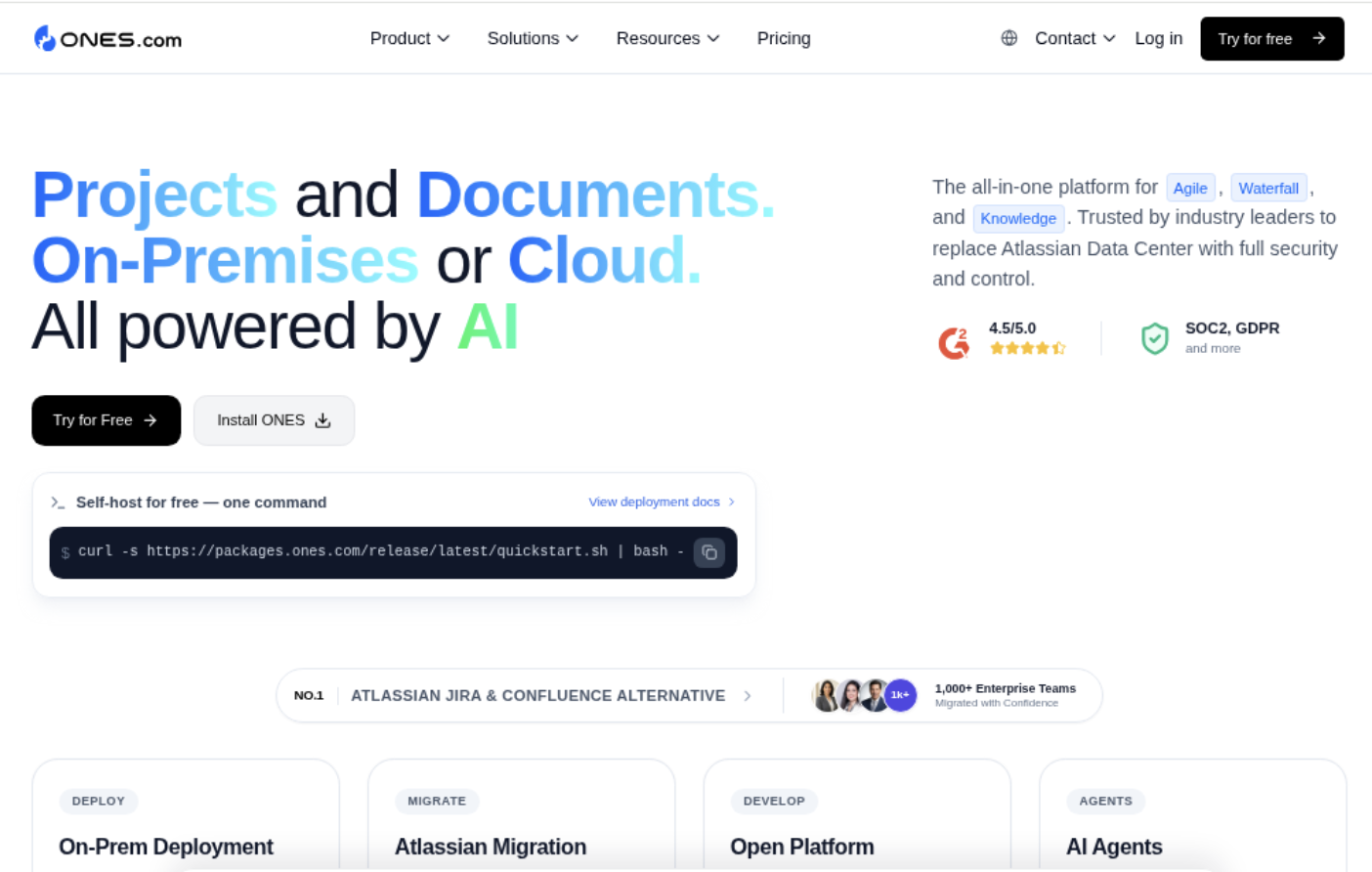
The platform can help teams manage Jira-compatible workflows while keeping plans, reports, custom fields, sprint work, and timeline information connected. It supports Cloud, On-Premise, Private Cloud, and Air-gapped deployments, with full feature parity between cloud and self-hosted versions. A free plan supports up to 30 seats.
Core Capabilities
- Scattered project information → Unified project workspace → Keep planning, execution, and progress views connected so teams spend less time reconciling updates.
- Unclear dependencies → Custom workflows and linked work → Define approval steps, status transitions, and relationships that reflect how your team actually delivers work.
- Rigid issue structures → Custom fields → Capture release dates, risk levels, business owners, environments, and other planning details without forcing every project into one template.
- Separate sprint and long-range planning → Sprint management with timeline visibility → Connect near-term delivery work with broader release commitments.
- Manual progress reporting → Built-in reporting → Monitor completion, workload, status movement, and schedule health through consistent reports.
- Too many external plugins → Native project management capabilities → Reduce the number of add-ons needed for workflows, reporting, automation, and planning.
- Deployment restrictions → On-Premise, Private Cloud, and Air-gapped options → Run project management in environments with specific infrastructure or network requirements.
- Repeated administrative work → Automation → Trigger routine actions when issues change status, dates, priorities, or ownership.
Application Scenarios
Software release planning: A product team can connect epics, sprint tasks, testing activities, approval gates, and launch milestones. Project managers can review the delivery timeline while developers continue working through familiar issue workflows.
Enterprise migration: A technology group can organize assessment, environment preparation, integration testing, training, rollout, and post-launch monitoring. Custom fields can identify system owners, migration waves, and risk levels.
Restricted-network delivery: A regulated team can use an On-Premise, Private Cloud, or Air-gapped deployment when its environment requires tighter infrastructure control. The self-hosted version maintains feature parity with the cloud version.
Common Challenges and Practical Solutions
Challenge: The Timeline Becomes Outdated
Why it happens: Team members update Jira issues, while the planning view receives occasional manual edits.
Solution: Connect dates and status to the same work items whenever possible. Add a weekly schedule review for unresolved changes.
Challenge: Dependencies Are Too Vague
Why it happens: Teams write “blocked by engineering” without identifying the exact activity or decision.
Solution: Link the specific issue, define the relationship, and name the condition for moving forward. “Security review required before deployment” is easier to act on.
Challenge: Stakeholders Want One Exact Date
Why it happens: A schedule is often presented without assumptions or uncertainty.
Solution: Show a target date, confidence level, key assumptions, and the critical-path activities. This creates a more useful conversation than presenting a date without context.
Challenge: The Chart Contains Too Much Detail
Why it happens: Teams add every task to satisfy different audiences.
Solution: Create separate views for executives, project managers, and delivery teams. Summary milestones can sit above detailed work.
Challenge: Jira and the Timeline Tell Different Stories
Why it happens: Status, dates, estimates, or ownership differ between planning locations.
Solution: Establish one update process. Decide where task status changes, who maintains dates, and when the team reviews schedule assumptions.
FAQs About Jira and Gantt Planning
Can Jira create a Gantt chart?
Jira can support timeline planning through timeline features, marketplace extensions, or platforms that provide Jira-compatible workflows and Gantt views. The right approach depends on your planning depth. Simple releases may need basic timeline visibility. Complex programs often require dependencies, milestones, critical-path analysis, baselines, and capacity planning.
What is the difference between a Jira board and a Gantt chart?
A Jira board organizes work by workflow status, such as To Do, In Progress, and Done. A Gantt chart organizes work across time. Boards help you coordinate current execution. Gantt views help you understand sequence, duration, dependencies, milestones, and schedule risk.
Should every Jira issue appear on the timeline?
No. Include work that affects timing, dependencies, milestones, or major delivery outcomes. Tiny administrative tasks may remain visible on the board without appearing in the summary timeline. Use filters and hierarchy levels so each audience sees the right amount of detail.
How often should a team update its Gantt plan?
Review the plan at least weekly for active projects. Update it sooner when scope, staffing, dependencies, or target dates change. Daily maintenance is usually unnecessary unless the project has tight operational constraints. The important point is consistency: the schedule should reflect current assumptions.
Are Gantt charts useful for Agile teams?
Yes, when the chart supports Agile planning rather than replacing it. Use sprints and boards for short-term execution. Use a timeline for cross-team dependencies, release milestones, external commitments, and longer-range forecasting. The two views answer different planning questions.
Is ONES.com suitable for teams moving beyond Jira?
ONES Project is a Jira alternative with Jira-compatible workflows, sprint management, custom fields, automation, and built-in reporting. Teams can choose Cloud, On-Premise, Private Cloud, or Air-gapped deployment options. ONES Wiki is available separately for knowledge management when a team also needs a Confluence alternative.
Conclusion
Jira manages the details of delivery, while Gantt charts explain how work moves across time. Together, they help you connect issues, dates, dependencies, milestones, and release commitments.
Start with a clear outcome, create a manageable work breakdown, add realistic dates, connect dependencies, and review the critical path regularly. Keep boards focused on execution and timelines focused on sequence and risk.
But here’s the truth: a chart cannot repair unclear ownership or neglected updates. The plan becomes useful when your team treats it as a living view of delivery.
When you need Jira-compatible workflows, built-in reporting, custom planning fields, automation, and flexible deployment options, ONES.com provides a practical alternative through ONES Project. The result is a clearer path from daily work to dependable delivery dates.