Jira by Atlassian: A Practical Guide for Growing Team Needs
Is your team outgrowing Jira? Learn how jira atlassian simplifies workflows, ownership, and reporting for growing teams—click to discover practical tips.
Growing teams often start with Jira because it brings tasks, bugs, sprints, and releases into one visible workspace. Then the cracks appear: unclear ownership, crowded boards, inconsistent workflows, and reports nobody trusts.
As more people join, a simple project board can become a maze of issue types, permissions, custom fields, and integrations. A marketing request may follow a completely different path from a software defect, yet both still need clear accountability.
But here's the truth: Jira works best when you understand what it is designed to manage and configure it around your team’s real delivery process. This guide explains Jira by Atlassian, its core features, common limitations, and practical ways to scale it without creating unnecessary complexity.
What Is Jira by Atlassian?
Jira by Atlassian is project and work management software for planning, tracking, prioritizing, and reporting on team work. Teams use it to manage software development, product delivery, service requests, business projects, bugs, and recurring operational tasks.
At its center, Jira uses issues. An issue can represent a task, bug, story, improvement, request, or another unit of work. Each issue can include an owner, status, priority, deadline, comments, activity history, and related work.
Here's why: a shared issue record gives everyone the same view of progress. A developer can see the acceptance criteria, a product manager can track delivery, and a team lead can identify blocked work without chasing separate updates.
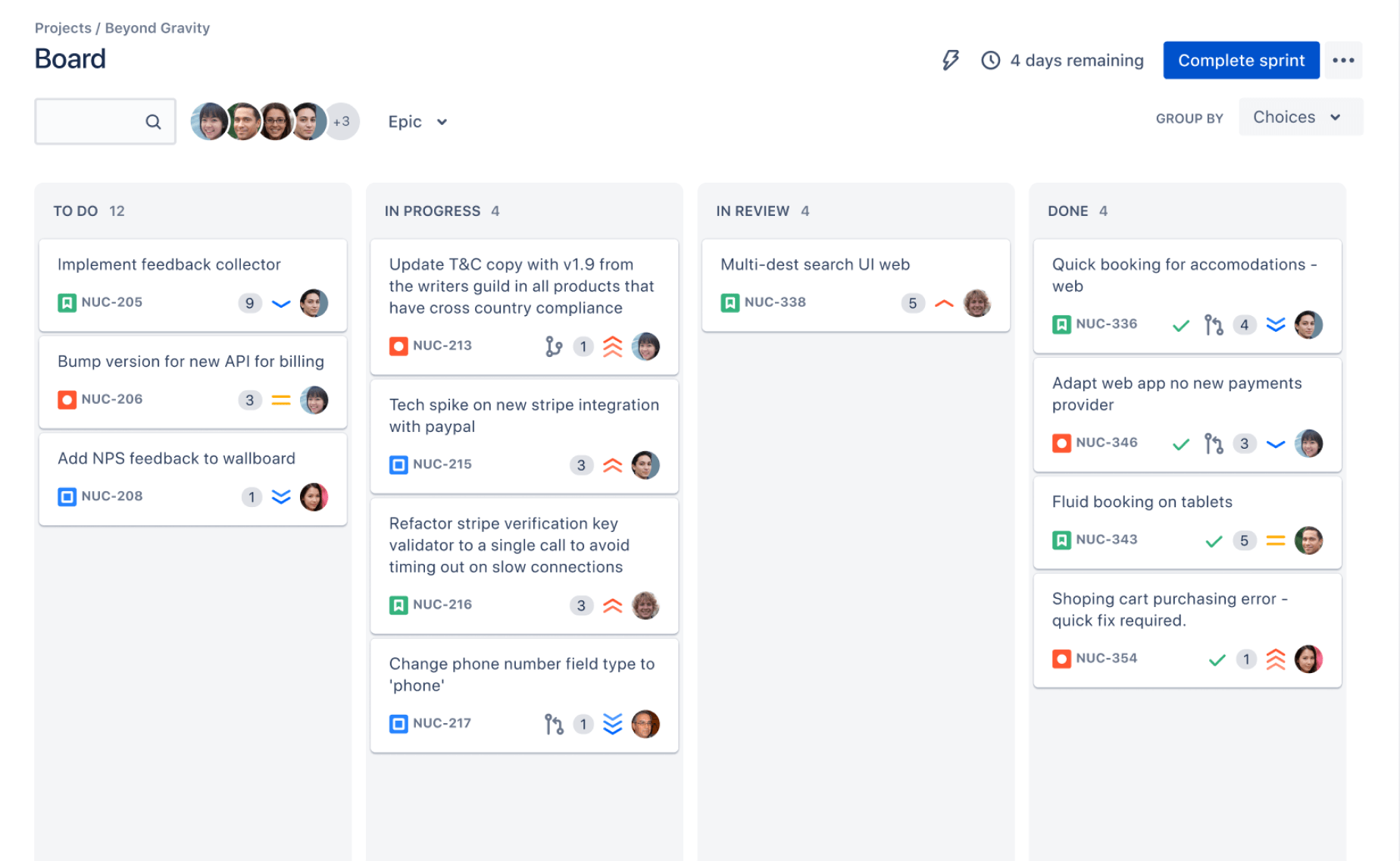
How Jira fits into the Atlassian product family
Atlassian offers several connected products, each aimed at a different part of team collaboration. Jira is commonly associated with project and issue tracking, while Jira Service Management supports service desks and support operations.
Confluence is designed for team knowledge and collaboration. Bitbucket supports code hosting and development workflows. Teams can connect these products so planning, technical work, support requests, and knowledge stay linked.
The exact product names, packaging, and features can change over time. Before choosing a plan, check the current Atlassian offering for your team size, hosting preference, and required capabilities.
Key features at a glance
- Issues: Track individual tasks, defects, requests, and delivery items.
- Projects: Group related work under shared settings, permissions, and workflows.
- Boards: Visualize work through Scrum, Kanban, or customized board views.
- Backlogs: Prioritize upcoming work before moving it into active delivery.
- Sprints: Plan time-boxed development cycles and review completed work.
- Workflows: Define how work moves from creation to completion.
- Reports: Review velocity, cycle time, workload, progress, and delivery trends.
- Automation: Trigger actions when conditions or events occur.
- Permissions: Control who can view, create, edit, transition, or administer work.
- Integrations: Connect Jira with communication, development, testing, and planning tools.
Who typically uses Jira?
Software teams often use Jira for user stories, defects, sprint planning, release tracking, and technical improvements. Product teams may use it to organize a roadmap and connect customer needs to planned work.
Outside engineering, operations, marketing, finance, and internal service teams can use Jira for approval requests, campaign activities, onboarding, audits, or recurring business processes.
That flexibility creates an advantage and a risk. A flexible system can match many processes, but each team may configure it differently. Clear governance becomes increasingly important as adoption grows.
How Jira Works in a Growing Team
Jira usually becomes more valuable when your team treats it as a working system rather than a passive task list. The following workflow shows how a typical request can move through planning, delivery, review, and reporting.
- Create a clear issue. Describe the work in plain language. Include the goal, expected result, owner, priority, and any useful acceptance criteria.
- Choose the right project and issue type. A product defect, customer request, and internal approval may need different fields or workflow steps.
- Prioritize the work. Place the issue against competing requests. A backlog becomes useful when the team can explain why one item comes before another.
- Assign ownership. Give one person responsibility for moving the issue forward. Other contributors can be listed through watchers, linked work, or comments.
- Move work through a defined workflow. Typical stages include To Do, In Progress, Review, Testing, and Done. Use only the stages that help decisions.
- Connect related work. Link a defect to a story, an approval to a delivery task, or a service request to the engineering work that resolves it.
- Review progress regularly. Use stand-ups, backlog refinement, sprint reviews, or weekly planning to keep the board accurate.
- Study delivery patterns. Reports can reveal aging work, repeated bottlenecks, excessive work in progress, or unrealistic commitments.
- Improve the workflow gradually. Change one confusing step or field at a time. Large redesigns often create more disruption than improvement.
For example, imagine a team preparing a mobile app release. A product manager creates a feature story, engineers add subtasks, quality specialists create related defects, and the release lead tracks the final milestone.
If the workflow includes a review stage, unresolved questions become visible before release. If every issue jumps directly from In Progress to Done, the team may miss testing gaps and approval delays.
Jira Project Types, Boards, and Workflows
Jira offers different ways to organize work. The best choice depends on how your team plans, delivers, and measures progress.
Scrum projects
Scrum projects are designed for teams that plan work in sprints. The team selects items from a backlog, commits to a sprint goal, and reviews the result at the end of the cycle.
This setup works well when priorities can be reviewed regularly. A two-week sprint, for example, gives a product team a predictable rhythm for planning and feedback.
The danger is treating sprint commitments as fixed promises when priorities change daily. In that case, the board may show activity without showing reliable progress.
Kanban projects
Kanban projects visualize a continuous flow of work. Items move across columns such as Ready, In Progress, Review, and Complete.
Kanban is useful for support, operations, maintenance, and teams receiving unpredictable requests. Work-in-progress limits can help prevent five tasks from being started while none are finished.
Consider an internal IT team handling access requests. A Kanban board can show how many requests are waiting for approval, technical action, or requester confirmation.
Workflows and statuses
A workflow determines how an issue changes status. It can also control which transitions are available, who can perform them, and what information must be completed.
A practical workflow might include New, Selected, In Progress, Peer Review, Validation, and Done. A complex enterprise workflow may include additional approval and compliance stages.
More statuses do not automatically create better control. If team members cannot explain the difference between two stages, simplify them or clarify the operating rule.
Project-managed and organization-managed setups
Jira commonly supports project configurations with different levels of administrative control. Some setups allow a project team to manage more of its own settings. Others centralize schemes, permissions, and workflow decisions.
Local control helps teams move quickly. Central control helps maintain consistency across a large organization. Growing companies often need a balance between both approaches.
Jira for Software Development and Product Delivery
Jira is widely used in software delivery because it connects planning with engineering execution. A product idea can become an epic, then stories, tasks, subtasks, and defects.
Here's an example. A team plans a checkout improvement as an epic. One story covers the payment screen, another covers error handling, and a third covers analytics. A defect discovered during testing links back to the relevant story.
This structure gives leaders a more complete view than a list of isolated tasks. They can ask which work supports a release, what remains blocked, and how many defects are linked to a feature.
Backlogs and prioritization
A backlog holds work that may be completed later. It should not become a storage area for every idea anyone has mentioned.
Review backlog items regularly. Clarify vague requests, remove duplicates, add rough priority, and archive work that no longer supports a current goal.
A healthy backlog helps a team answer three questions: what matters most, what is ready to start, and what should wait?
Sprints and releases
Sprints create a short planning cycle. Releases group related work into a version, launch, milestone, or customer outcome.
For example, a team may complete several stories in Sprint 12 and associate them with the April mobile release. The sprint describes the working period, while the release describes the delivery target.
Keeping those concepts separate prevents a common mistake: assuming every sprint automatically represents a customer-ready release.
Development connections
Jira can connect planning items with branches, commits, pull requests, builds, and deployment activity through supported development integrations.
This connection can reduce manual status updates. A reviewer can move from a story to related technical activity, while a product manager can see whether planned work has reached a delivery stage.
Connections still need clear conventions. If branch names and commit references are inconsistent, the relationship between planning and engineering becomes harder to trust.
Jira Reporting, Automation, and Governance
Jira reporting helps teams understand delivery patterns. Common views include sprint reports, velocity charts, cumulative flow diagrams, control charts, workload views, and custom dashboards.
Reports are most useful when the team agrees on what each metric means. A rising issue count may indicate growing demand, improved reporting, or weaker prioritization. The number alone does not explain the cause.
Useful metrics for growing teams
| Metric |
What it can reveal |
| Cycle time |
How long work takes after active delivery begins. |
| Lead time |
How long a request waits from creation to completion. |
| Work in progress |
Whether the team starts more work than it can finish. |
| Throughput |
How many items the team completes during a period. |
| Blocked time |
Where dependencies or approvals slow progress. |
| Defect trends |
Whether quality issues are increasing, decreasing, or shifting. |
Use metrics to improve conversations, not to rank individuals. A developer who closes fewer issues may be handling complex work, mentoring colleagues, or resolving a difficult production problem.
Automation rules
Automation can handle repetitive actions. A rule might assign a new request to a queue, add a label when priority changes, notify a reviewer, or close an issue after a defined condition.
The best automation removes small delays without hiding important decisions. For example, automatically assigning every request to one person may create a bottleneck rather than solve one.
Keep a written register of important automation rules. When several rules affect the same transition, troubleshooting becomes difficult without a clear explanation of the intended behavior.
Governance for scale
Governance means agreeing how Jira should be used across teams. It can cover naming, issue types, workflow design, custom fields, permissions, automation, and reporting standards.
A lightweight governance model may include a platform owner, a request process for new fields, quarterly cleanup, and a small group that reviews major configuration changes.
Without governance, each team may create its own version of “Done.” Reports then compare unlike processes and produce misleading conclusions.
Common Jira Challenges and Practical Fixes
Too many custom fields
Problem: Teams add fields for every request, exception, and reporting idea. People then skip fields or enter inconsistent values.
Solution: Keep fields that support a real decision. Review field usage periodically and remove fields that no longer affect prioritization, delivery, reporting, or compliance.
Overcomplicated workflows
Problem: An issue passes through many statuses, even when no decision occurs at each stage.
Solution: Ask what changes at every transition. If the answer is unclear, combine stages or explain the rule through short guidance near the workflow.
Inaccurate boards
Problem: Work remains marked as active after completion, or blocked items are hidden in a backlog.
Solution: Make board maintenance part of the team’s routine. Add status checks to stand-ups and planning meetings, then assign someone to resolve stale items.
Unclear ownership
Problem: Several people contribute to an issue, but nobody is responsible for the next action.
Solution: Assign one accountable owner. Use watchers, labels, linked issues, and comments to represent wider participation without creating shared ownership confusion.
Too many integrations
Problem: Notifications arrive from several connected services, creating noise and duplicated updates.
Solution: Keep integrations that support a clear handoff or decision. Adjust notification rules and review whether each connection still saves more time than it consumes.
ONES.com is a unified platform for project management and knowledge management, powered by AI through ONES Assistant. ONES Project is its project management product and can serve as a Jira alternative, while ONES Wiki supports team knowledge management.
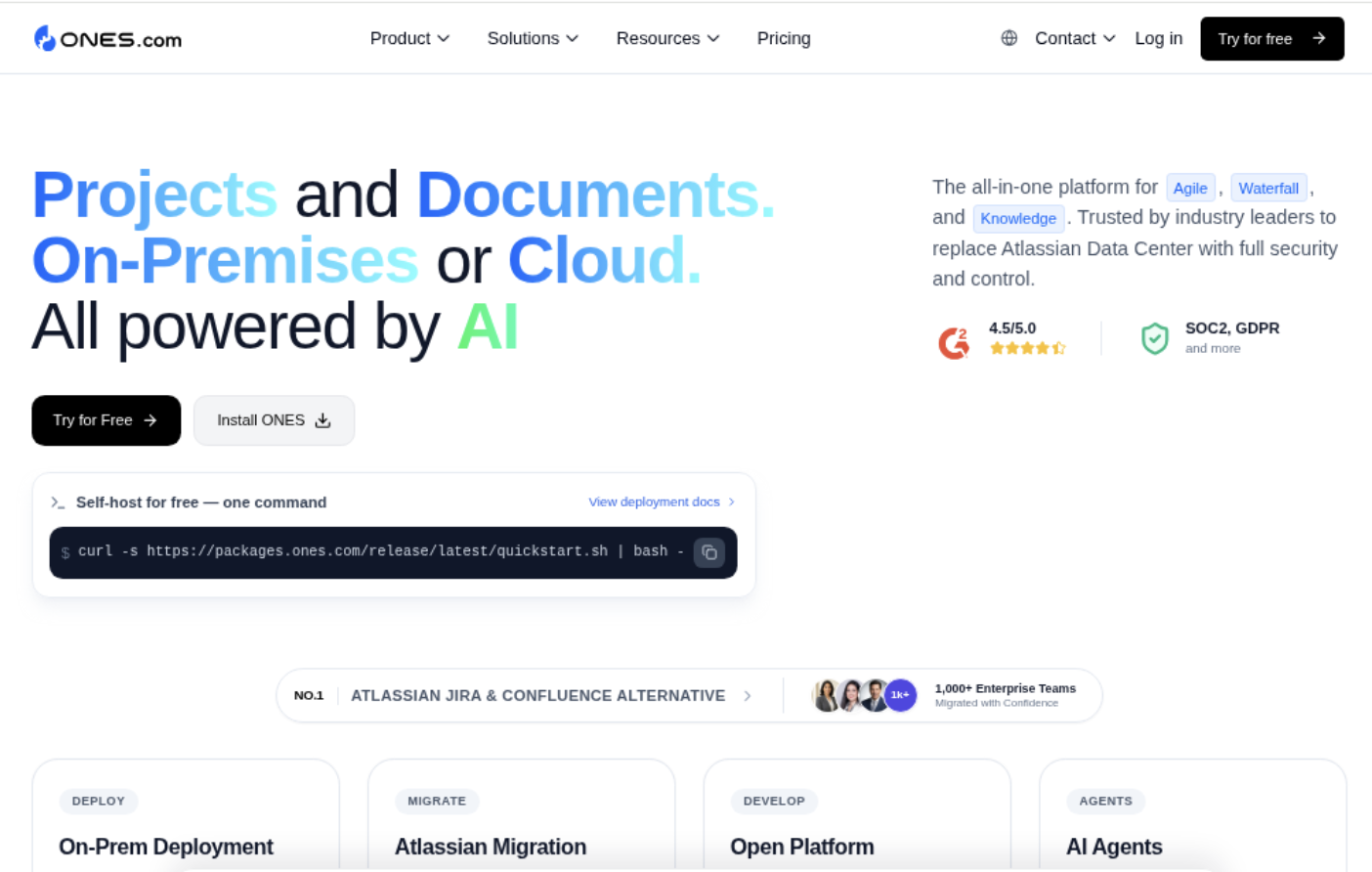
ONES Project is sold separately from ONES Wiki. The platform supports cloud, on-premise, private cloud, and air-gapped deployments, with feature parity between cloud and self-hosted versions. A free plan supports up to 30 seats.
Value Proposition
ONES.com can suit teams that want Jira-compatible workflows with native project capabilities and fewer separate plugins. Its deployment choices may also help organizations that need on-premise or restricted-network operation.
Core Capabilities
- Scattered project tracking → ONES Project centralizes issues, backlogs, boards, and releases → Teams gain one consistent view of delivery work.
- Migration concerns → Jira-compatible workflows help teams preserve familiar planning patterns → People can adapt without redesigning every process immediately.
- Plugin dependency → Built-in reporting, automation, custom fields, and workflow controls reduce reliance on separate extensions → Administrators can manage fewer moving parts.
- Unclear sprint execution → Sprint management supports planning, active delivery, and review → Teams can connect commitments with completed work.
- Limited deployment choice → Cloud, on-premise, private cloud, and air-gapped options support different operating requirements → Organizations can align hosting with security and infrastructure needs.
- Disconnected knowledge → ONES Wiki provides a connected knowledge management option within the wider ONES.com platform → Teams can relate project activity to reusable team knowledge.
- Inconsistent reporting → Built-in reporting helps teams review delivery trends within the project environment → Leaders can spend less time assembling status views.
- Growing process complexity → Custom workflows and fields represent different team processes → Teams can add structure while keeping each workflow relevant.
Application Scenarios
Software product team: A development group can organize epics, stories, defects, sprints, and releases in ONES Project. Custom workflows can separate engineering review from quality validation without requiring several unrelated systems.
Restricted-network organization: A company with strict infrastructure requirements can evaluate an on-premise or air-gapped deployment. This can help keep project operations within an approved environment.
Cross-functional delivery team: Product, design, engineering, and operations can use shared workflows and reports. If the team also needs structured knowledge, ONES Wiki can support that need as a separate product.
How to Decide Whether Jira Fits Your Team
Jira may be a strong fit when your team needs structured issue tracking, Scrum or Kanban planning, detailed workflows, release visibility, and connections with development activity.
It may require more administration when many departments use different processes. Before rollout, estimate the effort for permissions, configuration, training, reporting, and ongoing cleanup.
Here's a practical comparison framework:
| Question |
What to evaluate |
| What work needs tracking? |
Software issues, service requests, business projects, approvals, or several categories. |
| How much process control is needed? |
Simple task movement or detailed approvals, validations, and permissions. |
| Who will administer the platform? |
A central team, individual project administrators, or a shared operating group. |
| Which hosting model is required? |
Cloud, self-hosted, private infrastructure, or restricted-network deployment. |
| Which reports matter? |
Delivery speed, workload, sprint performance, service levels, or portfolio progress. |
| How will people adopt it? |
Training, templates, naming rules, onboarding, and regular workflow reviews. |
Run a small pilot before a broad rollout. Choose one real workflow, such as product bug fixing or internal access requests, and measure whether Jira improves visibility without adding unnecessary administration.
You might be wondering: should you configure everything before launch? Usually, no. Start with the smallest useful workflow, observe how people work, and refine the system after real usage reveals friction.
Common Challenges
Jira feels too complex for a small team
Challenge: A small team may see advanced permissions, reports, and workflow options before it needs them.
Solution: Begin with a small number of issue types, statuses, fields, and board columns. Add complexity only when a specific delivery problem justifies it.
Teams use different definitions of completion
Challenge: One team marks work complete after coding, while another waits for testing or customer approval.
Solution: Define completion in practical terms for each workflow. Then explain the rule through workflow transitions, required fields, and team routines.
Reports show activity instead of outcomes
Challenge: A dashboard may show many updates while customers see little improvement.
Solution: Connect work to outcomes such as a released capability, resolved incident, approved request, or reduced processing time. Review delivery results alongside activity metrics.
Configuration grows without ownership
Challenge: New fields, workflows, and automations appear whenever a team encounters a small inconvenience.
Solution: Create a simple review process. Ask whether the proposed change solves a recurring problem, affects other teams, and has a clear owner for maintenance.
FAQs
What is Jira mainly used for?
Jira is mainly used to plan, track, prioritize, and report on team work. Software teams commonly manage stories, bugs, sprints, and releases in it. Other teams can track approvals, operational requests, marketing activities, or internal projects. Its usefulness depends on clear workflows and consistent maintenance. A poorly designed Jira setup can become difficult to navigate, while a focused setup can give a growing team strong visibility.
Is Jira only for software developers?
No. Jira is strongly associated with software development, but teams outside engineering can use it for structured work. Marketing, operations, finance, human resources, and internal service teams may track requests and approvals through custom workflows. The process should remain simple enough for the people completing the work. If a team only needs a short personal task list, Jira may offer more structure than necessary.
What is the difference between a Jira project and a Jira board?
A Jira project groups related work, settings, permissions, and configuration. A board is a visual view of issues, often arranged by status, priority, or sprint. One project can support multiple boards for different teams or perspectives. For example, engineering may use a sprint board while leadership views the same work through a release or portfolio view.
Is Jira suitable for a growing company?
Jira can suit a growing company when the organization needs shared workflows, issue history, sprint planning, reporting, and permission controls. Growth also increases the need for governance. Decide who owns configuration, how teams request changes, and which fields and statuses should remain consistent. A small pilot can reveal whether the platform improves coordination before you expand it across departments.
What should a team configure first in Jira?
Start with the work types, workflow stages, ownership rules, board columns, and essential fields. Define what “Done” means and decide how priorities are set. Avoid creating every possible report or automation at launch. For example, a product team might begin with a backlog, sprint board, defect workflow, release view, and a small set of required fields.
How does ONES Project compare with Jira?
ONES Project is a Jira alternative with Jira-compatible workflows, sprint management, custom fields, automation, and built-in reporting. It also offers cloud, on-premise, private cloud, and air-gapped deployment options. Teams evaluating it should compare workflow flexibility, administration, migration effort, integrations, hosting requirements, and reporting needs. ONES Wiki is available separately for knowledge management through the wider ONES.com platform.
Conclusion
Jira by Atlassian helps teams manage work through issues, boards, backlogs, workflows, sprints, reports, and automation. Its flexibility makes it useful for software delivery and many operational processes.
But here's the truth: growth exposes weak configuration. Too many fields, unclear ownership, complicated workflows, and unreliable boards can reduce the value of any project management platform.
Start with a focused workflow, define completion clearly, keep reports tied to meaningful outcomes, and review configuration as your team changes. If deployment flexibility, native capabilities, or reduced plugin reliance matter, evaluate ONES Project as a Jira alternative alongside your requirements.