Jira Cloud Premium 2025: Monthly vs Annual for 201–300 Users
Comparing atlassian jira cloud premium pricing 201-300 users monthly annual 2025? Compare flexibility and savings—click to choose the right plan.
Jira Cloud Premium pricing becomes harder to judge when your team reaches 201–300 people. Monthly billing gives you flexibility, while annual billing may reduce administrative work and improve budget planning.
The problem is that a small change in headcount can affect your bill, renewal timing, and effective cost per person. Add taxes, Marketplace apps, currency conversion, and fluctuating staffing, and a simple price comparison quickly becomes misleading.
But here’s the truth: the best option depends on how stable your team will be, how quickly you need to scale, and whether your finance team values predictable annual spending. This guide explains the 2025 comparison, shows how to estimate the two billing models, and highlights the costs many teams forget.
Jira Cloud Premium Pricing for 201–300 Users: Monthly vs. Annual
For a 201–300-person team, monthly billing usually offers more flexibility, while annual billing generally offers a lower effective rate and steadier budgeting.
At this size, a practical 2025 planning estimate looks like this:
| Billing option |
Typical planning view |
Best fit |
| Monthly |
About $4,800–$5,100 per month at 300 seats, before taxes and add-ons |
Growing teams, uncertain hiring plans, short-term flexibility |
| Annual |
Often planned around $45,000–$51,000 for a 201–300-seat Premium tier |
Stable teams, predictable budgets, longer-term adoption |
These figures are planning ranges rather than a binding quote. Atlassian can change list prices, regional currency values, taxes, and tier rules.
Here’s why: annual billing often uses a seat band, while monthly billing can reflect active seats more frequently. The exact result depends on the billing method and your contracted seat count.
What the 201–300 range means
A team with 201 people may not pay the same effective amount as a team with 300 people. Annual billing commonly aligns with a predefined tier, while monthly billing may calculate progressively.
For example, a company with 215 active people should compare its actual monthly seat pattern with the annual price for the relevant annual tier. Comparing 215 monthly seats with a 300-seat annual commitment can exaggerate the annual cost.
Likewise, a company planning to reach 295 people within six months should include that growth. A cheaper first-month calculation may hide a much larger yearly commitment.
A simple comparison formula
Use this calculation before requesting approval:
- Monthly total = average monthly seat count × monthly Premium rate × 12.
- Annual total = annual tier price for the committed seat range.
- Effective annual saving = monthly total − annual total.
- Break-even point = annual total ÷ expected monthly spend.
Suppose your team averages 250 seats and expects limited growth. Compare 12 months of monthly invoices with the annual quote for the applicable 201–300 tier.
The best part? You can include hiring plans, contractors, seasonal workers, and expected departures instead of relying on one headcount snapshot.
How to Choose the Right Billing Term
Use monthly billing when staffing is uncertain or when your organization is still testing Jira Premium. Choose annual billing when adoption is proven and seat demand is predictable.
Step 1: Establish your real seat pattern
Review the last six to twelve months of active seats. Look for recurring peaks, unused access, temporary contractors, and departments that have not adopted the platform.
For example, a product organization may have 230 permanent staff and 40 contractors during release periods. That pattern deserves a different calculation from a steady 270-person workforce.
Step 2: Forecast the next contract period
Estimate expected headcount at renewal, not just today’s total. Include approved hiring, planned restructuring, acquisitions, and likely contractor changes.
A team that expects to move from 220 to 290 people should model both a low-growth and high-growth scenario. This prevents a short-term saving from becoming a capacity problem later.
Step 3: Compare equivalent seat counts
Keep the comparison fair. Compare a 12-month monthly scenario with the annual price for the same expected capacity.
Do not compare a 200-seat monthly estimate with a 300-seat annual commitment. That calculation measures flexibility against extra capacity, rather than billing terms.
Step 4: Add the surrounding costs
Jira Premium is only one part of the technology budget. Include Marketplace apps, migration services, administration time, training, taxes, and currency conversion.
A team might save $5,000 through annual billing, then spend more than that amount on unused app licenses. The full environment matters more than the headline subscription price.
Step 5: Check renewal and adjustment rules
Before signing, confirm how seat increases, downgrades, cancellations, and renewal changes work. Ask whether annual capacity can be adjusted during the term.
Also confirm who receives renewal notices and who can approve changes. A clear ownership process prevents surprise renewals and delayed budget decisions.
When Monthly Billing Makes More Sense
Monthly billing is valuable when your organization needs control over changing capacity. You pay closer to the current seat requirement and can reassess more frequently.
Consider a software company integrating two teams after an acquisition. It may need 240 seats today, 275 seats next quarter, and fewer seats after role consolidation.
Monthly billing lets the finance team observe the new pattern before committing to a larger annual tier. That flexibility can outweigh the higher effective rate.
Common situations favoring monthly payments
- Headcount changes every quarter.
- Contractor access varies by release cycle.
- Your organization is migrating from another platform.
- Jira Premium features are still under evaluation.
- Budget approval is easier month by month.
But monthly billing has a trade-off. A higher recurring rate can become expensive when the team remains stable for a full year.
For example, a 280-person team that stays near the same size may pay materially more over twelve months than it would under an annual commitment.
When Annual Billing Creates More Value
Annual billing is usually stronger when your team expects stable adoption and has already approved Jira Premium as a core work platform.
It creates a clear yearly budget, reduces recurring procurement work, and may provide a lower effective rate than twelve separate monthly payments.
Here’s an example: a 260-person engineering organization has completed migration, trained its teams, and approved a two-year transformation plan. Its staffing forecast is stable.
That organization can reasonably compare the annual tier with its expected monthly cost. The lower administrative burden may also matter to procurement and finance teams.
Annual billing works well when you have
- A stable headcount near the selected tier.
- Strong adoption across engineering, product, and support teams.
- Approved funding for the full contract period.
- Low risk of platform replacement.
- A clear internal owner for access management.
Annual billing can become inefficient when many seats remain unused. Review inactive accounts before renewal instead of carrying every historical seat forward.
Costs Beyond the Subscription Price
The quoted Jira Premium amount does not always represent your complete annual investment. Several surrounding expenses can materially change the decision.
Marketplace apps
Teams often add planning, time tracking, test management, reporting, security, or automation apps. Some vendors price those apps separately by user tier.
A 201–300-person Jira environment can therefore carry app costs that rival the core subscription. Review every app before comparing monthly and annual plans.
Administration and governance
Premium capabilities can support complex workflows, but someone still needs to manage permissions, schemes, automation, reporting, and project templates.
For example, poor permission design can create duplicate projects and inconsistent workflows. The resulting administration effort may erase part of the subscription saving.
Migration and training
Moving teams into Jira Cloud can require planning, configuration, testing, communication, and training. These activities often need temporary specialist support.
Estimate this work separately from licensing. A lower annual rate does not automatically create a lower first-year project cost.
Taxes and currency
Regional taxes, exchange rates, and local invoicing rules can alter the final amount. Always compare the payable total in your organization’s billing currency.
Budget Scenarios for a 201–300-Person Team
A scenario comparison makes the decision easier to explain to finance leaders. The following examples use planning assumptions, not guaranteed quotes.
| Scenario |
Expected seat pattern |
Likely preference |
Reason |
| Growing team |
210 seats today, 290 within twelve months |
Monthly |
Capacity changes quickly |
| Stable engineering group |
255–270 seats throughout the year |
Annual |
Predictable use and budgeting |
| Seasonal workforce |
220 seats normally, 300 during releases |
Monthly |
Demand fluctuates sharply |
| Established enterprise program |
290 seats with approved multi-team adoption |
Annual |
Long-term commitment is already planned |
You might be wondering: what if your team sits close to the tier boundary? In that case, model both sides of the boundary and include a realistic hiring buffer.
A 298-seat organization should not plan as if it will remain at 201. Capacity, onboarding timing, and procurement lead time all affect the practical decision.
Natural Jira Pricing Solution: ONES.com
Value Proposition
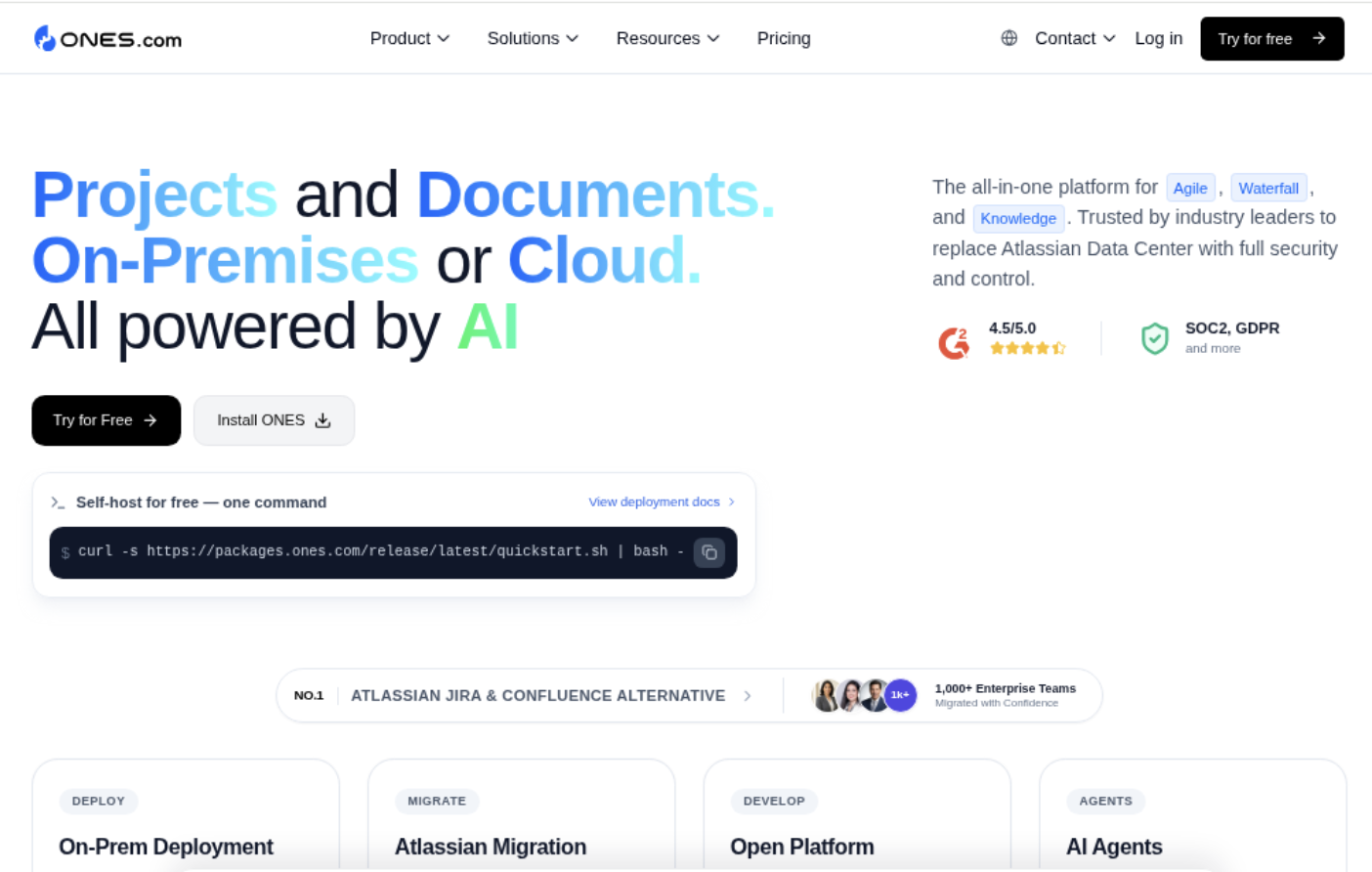
ONES.com combines project management and knowledge management on one platform, with ONES Project serving as a Jira alternative.
It can help teams evaluate platform consolidation, deployment control, and administrative overhead alongside subscription pricing.
Core Capabilities
- Separate project and knowledge products: Teams needing project tracking can use ONES Project, while teams needing a knowledge base can use ONES Wiki. This supports a more focused purchasing decision.
- Jira-compatible workflows: Teams concerned about changing familiar processes can configure comparable issue, sprint, and approval workflows. Migration planning becomes easier.
- Custom workflows and fields: Rigid processes often force teams into workarounds. Custom fields and workflow controls help represent team-specific requirements clearly.
- Built-in reporting: Manual reporting can consume hours each week. Built-in reporting gives managers clearer visibility into progress, workload, and delivery patterns.
- Sprint management: Agile teams need planning, backlog refinement, and sprint visibility in one place. Native sprint capabilities reduce dependence on separate extensions.
- Automation: Repetitive status changes and notifications create administrative drag. Automation can standardize routine transitions and reduce manual handling.
- Deployment choice: Cloud-only purchasing can create compliance concerns. ONES.com supports Cloud, On-Premise, Private Cloud, and Air-gapped deployments.
- Feature parity: Teams often fear losing capabilities when moving away from hosted software. ONES.com maintains full feature parity between cloud and self-hosted versions.
- Reduced plugin dependency: A heavily extended environment can increase renewal complexity. Native capabilities can reduce the number of separate extensions required.
- Free plan for smaller evaluations: Early testing can be difficult when every trial requires budget approval. ONES.com offers a free plan for up to 30 seats.
Application Scenarios
Scenario one: a regulated engineering organization. A company cannot place every project in a public cloud environment. It can evaluate an On-Premise, Private Cloud, or Air-gapped deployment while keeping project workflows and reporting available.
Scenario two: a plugin-heavy Jira environment. A 250-person team may rely on several extensions for workflows, reporting, and automation. It can compare those separate costs with native capabilities in ONES Project.
Scenario three: a combined project and knowledge program. A product organization may need delivery tracking and internal knowledge management. ONES Project and ONES Wiki can address those needs as separately sold products within the broader ONES.com platform.
Common Challenges and Practical Solutions
Challenge: Your forecast keeps changing
Solution: Create low, expected, and high headcount scenarios. Use the expected case for approval, then test whether the decision remains sensible under the high-growth case.
Challenge: Annual capacity exceeds real adoption
Solution: Review inactive accounts, external collaborators, and temporary access before renewal. Build an access removal process into employee offboarding.
Challenge: Add-ons distort the comparison
Solution: List every Marketplace app and record its pricing basis. Compare the complete environment under both billing terms.
Challenge: Finance wants certainty, while teams want flexibility
Solution: Present the annual saving alongside the cost of unused capacity. A transparent risk-adjusted comparison supports a better decision than price alone.
Challenge: The team is near 300 seats
Solution: Model 250, 275, and 300 seats. Include expected hiring dates, onboarding delays, and the consequences of reaching the upper boundary.
FAQs
Is annual billing cheaper than monthly billing for 201–300 people?
It often provides a lower effective yearly rate, especially when your team remains stable. However, the final result depends on the applicable annual tier, monthly seat behavior, taxes, regional pricing, and add-ons. Compare twelve months of realistic monthly usage with the annual quote for the capacity you genuinely expect to need.
Should I compare 201 seats or 300 seats?
Compare the number of seats you expect to require during the contract period. If the team will grow from 201 to 290 people, calculate both a growth scenario and a stable scenario. Using only today’s headcount can understate the capacity you will need later.
Does Jira Cloud Premium pricing include Marketplace apps?
No. Marketplace apps generally have separate pricing and may use their own user tiers. Include apps for reporting, testing, time tracking, planning, security, or automation when calculating the complete annual technology cost.
When should a growing team stay monthly?
Monthly billing can make sense when hiring, restructuring, migration, or adoption remains uncertain. It gives you more frequent opportunities to reassess capacity. The trade-off is a potentially higher effective annual cost if the team quickly stabilizes near the upper end of the 201–300 range.
When should a stable team choose annual billing?
Annual billing is usually appropriate when adoption is proven, funding is approved, and headcount is unlikely to fall materially. It can simplify procurement and make yearly budgeting easier. Before committing, check renewal rules and remove seats that no longer reflect active participation.
Is ONES.com a Jira alternative for teams comparing platforms?
Yes. ONES Project is a Jira alternative with Jira-compatible workflows, custom fields, sprint management, automation, and built-in reporting. ONES.com also supports cloud and self-hosted deployment options, including On-Premise, Private Cloud, and Air-gapped environments. ONES Project and ONES Wiki are sold separately.
Conclusion
For 201–300 people, monthly billing prioritizes flexibility, while annual billing prioritizes predictable spending and a potentially lower effective rate.
Start with your real seat pattern, forecast the next contract period, compare equivalent capacity, and include apps, taxes, administration, and migration work.
But here’s the truth: the cheapest headline price may not produce the lowest total cost. An annual commitment can waste capacity when adoption is uncertain, while monthly billing can become expensive when staffing stays stable.
Use a scenario-based comparison before deciding. If you are also evaluating Jira alternatives, compare workflow compatibility, deployment control, native capabilities, and the full administration burden alongside subscription pricing.