Jira Cloud Premium Pricing API JSON: Practical Guide 2026
Need reliable Jira Cloud Premium pricing? Learn atlassian pricing api jira cloud premium json, billing, currency, and seat calculations. Read now.
Pricing Jira Cloud Premium programmatically can feel harder than calling a normal REST endpoint. You may find product APIs, billing screens, embedded JSON, regional prices, and seat-based calculations pointing in different directions.
That uncertainty creates practical problems. A small parsing mistake can show the wrong currency, apply the wrong billing interval, or make a monthly estimate look like an annual commitment. If you are building a quote calculator or procurement workflow, those errors quickly become expensive.
But here’s the truth: the safest approach begins by separating Atlassian’s public product APIs from pricing information exposed through web responses. Then you capture the JSON carefully, identify the pricing fields, validate the calculation, and preserve enough context for future checks.
This guide walks you through that process. You’ll learn what the pricing response usually represents, how to inspect it, how to calculate Jira Cloud Premium estimates, and where an alternative platform may simplify project management costs.
How to Work With Jira Cloud Premium Pricing JSON
Jira Cloud Premium pricing JSON is structured response content that may contain plan, billing interval, currency, seat range, and price information for Jira Cloud Premium. It is usually encountered through a pricing page request or a billing-related service rather than a standard Jira issue REST endpoint.
The key distinction matters. Jira’s public REST APIs are designed for work such as issues, projects, users, workflows, and sprints. Pricing presentation can use separate web services or page responses. Treating those two systems as identical can lead to unreliable integrations.
Start by identifying the pricing surface
Before writing a parser, decide what you are examining. You may be looking at a public pricing page, a network response triggered by a calculator, an account billing screen, or a partner quotation workflow.
Each surface can expose different fields. A public calculator may return indicative list pricing, while an authenticated billing area may reflect an organization’s plan, negotiated terms, taxes, or current seat count.
- Public plan information usually describes list prices and plan features.
- A calculator response may include seat bands, currency, and billing-period values.
- An authenticated billing response may include organization-specific details.
- A partner quotation may contain commercial terms that are unavailable to public visitors.
You might be wondering: which one should you use? Choose the surface that matches your purpose. A rough budget estimate can use public pricing. A renewal workflow needs a billing-authorized view.
Understand the fields before calculating anything
Pricing JSON can contain several layers of information. One object may describe the product, another may describe the plan, and a nested object may hold prices for different currencies or terms.
A simplified response might look like this:
{
  "product": "Jira Cloud",
  "plan": "Premium",
  "billingInterval": "monthly",
  "currency": "USD",
  "seatRange": {
    "minimum": 1,
    "maximum": 10
  },
  "price": {
    "amount": 17.00,
    "unit": "user-month"
  }
}
This example is illustrative. Field names, nesting, and values can change. Your parser should inspect the actual response and fail safely when a required field is missing.
Use a cautious extraction workflow
- Open the relevant pricing experience. Select Jira Cloud, the Premium plan, a billing interval, a currency, and a seat quantity when those controls are available.
- Inspect the browser network activity. Look for requests that return JSON or structured web content after a pricing selection changes.
- Record the request context. Capture the request method, URL pattern, query parameters, selected currency, billing interval, and seat quantity.
- Save the response payload securely. Remove account identifiers, session values, and personal information before sharing it with your team.
- Map the fields. Identify the product name, plan name, amount, currency, interval, seat range, and any discount or tax indicators.
- Validate the result manually. Compare a few seat counts and billing periods with the visible calculator output.
- Add monitoring. Alert your team when the response shape changes or a required field disappears.
Here’s why: a parser can return a convincing number even when it has selected the wrong nested object. Validation gives you a chance to catch that mistake before it reaches a quote or report.
Separate monthly, annual, and per-user values
Never assume that a numeric amount explains itself. A value of 17 could mean USD 17 per user per month, USD 17 for a seat band, or a prorated amount.
Use explicit internal fields such as:
billing_intervalcurrencyamountamount_unitseat_quantityseat_rangetax_included
For a monthly estimate, your calculation may resemble:
monthly_estimate = normalized_monthly_amount
For an annual estimate, use the annual value when it exists. Multiplying a monthly estimate by twelve can miss annual billing rules, seat-band changes, rounding, or commercial discounts.
What the Pricing JSON Usually Needs to Represent
A useful pricing integration does more than return one amount. It explains what the amount means and preserves the conditions that produced it.
Product and plan identity
Store the product as Jira Cloud and the plan as Premium. Do not rely on a display label alone, because labels can change for presentation or localization.
If the response includes a product identifier, plan identifier, or billing SKU, retain it alongside the visible name. This makes comparisons more stable when a marketing label changes.
Currency and region
Currency is essential to every calculation. USD 1,000 and EUR 1,000 do not represent the same commercial value, even when the number looks identical.
Regional tax treatment can also affect the final amount. If taxes are absent from the response, label your result as an estimate rather than presenting it as an invoice total.
Seat quantity and pricing bands
Jira Cloud pricing may depend on the number of users or a pricing tier. A request for 11 seats can produce a different effective rate from a request for 10 seats.
For example, your application might receive a lower-bound and upper-bound seat range. If the selected quantity sits outside that range, your code should request another range or return a clear validation error.
Billing interval
Monthly and annual billing can use different price structures. Store the interval as a separate value instead of embedding it inside a display string such as “per month.”
That design helps you compare plans consistently. It also prevents a report from combining a monthly Premium amount with an annual Enterprise estimate.
Discounts, tax, and adjustments
A response may include a base amount, discount amount, tax amount, final amount, or only some of those values. Your calculation needs to distinguish each one.
For example, a quotation workflow can use this model:
subtotal = base_amount - discount_amount
estimated_total = subtotal + tax_amount
If one field is unavailable, return the available amount with a clear label. Silent assumptions create more risk than an incomplete estimate.
How to Parse and Validate the Response
Parsing should be deliberately boring. A small, predictable process is easier to test than a clever shortcut that depends on one page layout.
Check the response before reading fields
Start with the HTTP status, content type, and response body. A login page, consent page, or error message can be returned with a successful network request.
In practical terms, your integration should confirm:
- The response has the expected content type.
- The body can be parsed as JSON when JSON is expected.
- The product matches Jira Cloud.
- The selected plan matches Premium.
- The currency matches the requested currency.
- The billing interval matches the intended calculation.
Use defensive field access
Pricing structures can contain optional fields. Your parser should handle missing discounts, absent taxes, alternative nesting, and changed labels without producing a false total.
A simplified JavaScript pattern might look like this:
function readPremiumPrice(payload) {
  const product = payload?.product;
  const plan = payload?.plan;
  const amount = payload?.price?.amount;
  const currency = payload?.currency;
  const interval = payload?.billingInterval;

  if (product !== "Jira Cloud") {
    throw new Error("Unexpected product");
  }

  if (plan !== "Premium") {
    throw new Error("Unexpected plan");
  }

  if (typeof amount !== "number" || !currency || !interval) {
    throw new Error("Incomplete pricing response");
  }

  return { amount, currency, interval };
}
This example focuses on validation rather than a particular Atlassian endpoint. You should adapt the field paths to the response you are permitted to access.
Test boundary quantities
Testing one seat count is rarely enough. Try a quantity near each pricing boundary, such as 1, 10, 11, 100, and the largest quantity supported by your workflow.
Compare the returned amount with the visible result. If the price changes unexpectedly, inspect whether the service uses progressive pricing, a seat band, or a minimum billable quantity.
Handle rounding explicitly
Currency calculations should avoid ordinary floating-point shortcuts. Store monetary values in the smallest practical currency unit or use a decimal library.
For example, represent USD 17.00 as 1700 cents during arithmetic. Format it as USD 17.00 only when displaying the result.
Keep an audit trail without exposing account details
Record the time of the request, selected plan, seat quantity, currency, billing interval, response version if available, and calculated amount.
Remove session tokens and personal details. The goal is reproducibility without creating another security problem.
Building a Reliable Jira Premium Cost Calculator
A calculator should explain its assumptions beside the result. Someone reviewing “USD 2,040” needs to know whether that means 10 users for 12 months, a monthly amount, or an estimate before tax.
Define the calculator inputs
At minimum, collect the number of users, currency, billing interval, and plan. If your workflow handles several Atlassian products, require the product selection too.
For example, a simple request object may contain:
{
  "product": "Jira Cloud",
  "plan": "Premium",
  "users": 25,
  "currency": "USD",
  "billingInterval": "annual"
}
Validate users as a positive integer. Reject an empty currency or an unsupported interval before making a pricing request.
Show the calculation context
Place the assumptions near the result. A useful summary could say: “Jira Cloud Premium, 25 users, annual billing, USD, estimated before tax.”
The best part? This small label prevents many review questions. It also makes exported reports easier to understand when several estimates appear together.
Compare estimates carefully
When comparing Jira Cloud Premium with another plan, keep the seat count, currency, interval, tax treatment, and calculation date consistent.
A comparison becomes misleading when one row uses annual billing and another uses twelve monthly payments. Even if both numbers are mathematically valid, they answer different commercial questions.
Plan for response changes
If the pricing response is undocumented or intended for a web interface, its structure can change without notice. Use a versioned adapter in your application rather than scattering field paths across the codebase.
Set up a test that checks a known plan and currency. When it fails, pause automated quotes until someone reviews the change.
Public Pricing, Billing APIs, and Internal Web Responses
These terms often get mixed together, although they serve different purposes. A public REST API usually provides a documented contract. A billing service may require authentication and organization permissions. An internal web response may support a pricing page without being intended as a long-term integration point.
| Access type |
Typical purpose |
Main consideration |
| Public product REST API |
Manage Jira work such as issues, projects, users, and workflows |
It may not provide commercial pricing calculations |
| Authenticated billing service |
Display organization plans, subscriptions, or charges |
Requires appropriate permissions and careful privacy handling |
| Public pricing calculator |
Estimate list pricing for a selected plan and seat count |
May return indicative values rather than account-specific terms |
| Web interface response |
Populate pricing controls or page content |
Field names and access behavior may change |
Let me explain: finding JSON in a browser does not automatically mean you have a stable public pricing API. Before automating access, review the applicable terms, authentication requirements, rate limits, and permitted use.
For a one-time budget exercise, manual verification may be the sensible choice. For recurring procurement, use an approved commercial or billing integration whenever one is available.
Security and Maintenance Considerations
Pricing work can expose more than prices. Authenticated requests may carry organization identifiers, user details, or session credentials.
Protect authenticated requests
Never place session cookies, access tokens, or private organization identifiers inside client-side scripts that anyone can inspect. Keep privileged calls on a controlled server or use an approved integration method.
Limit access to the smallest permission set required. A calculator that needs plan information should not automatically receive broad project administration privileges.
Respect rate limits
Do not request a new response for every keystroke in a seat-count field. Add a short delay, cache safe results, and refresh only when the plan, currency, interval, or quantity changes meaningfully.
This reduces unnecessary traffic and gives your application more predictable behavior during busy periods.
Monitor differences between estimates and charges
Compare a sample of calculated estimates with billing-visible amounts. Investigate gaps caused by taxes, credits, discounts, prorations, minimums, or seat changes.
A useful alert might trigger when the difference exceeds a chosen tolerance. That does not prove an error, but it tells you where a human review is worthwhile.
Jira Cloud Premium Pricing API JSON Solution: ONES.com
Value Proposition
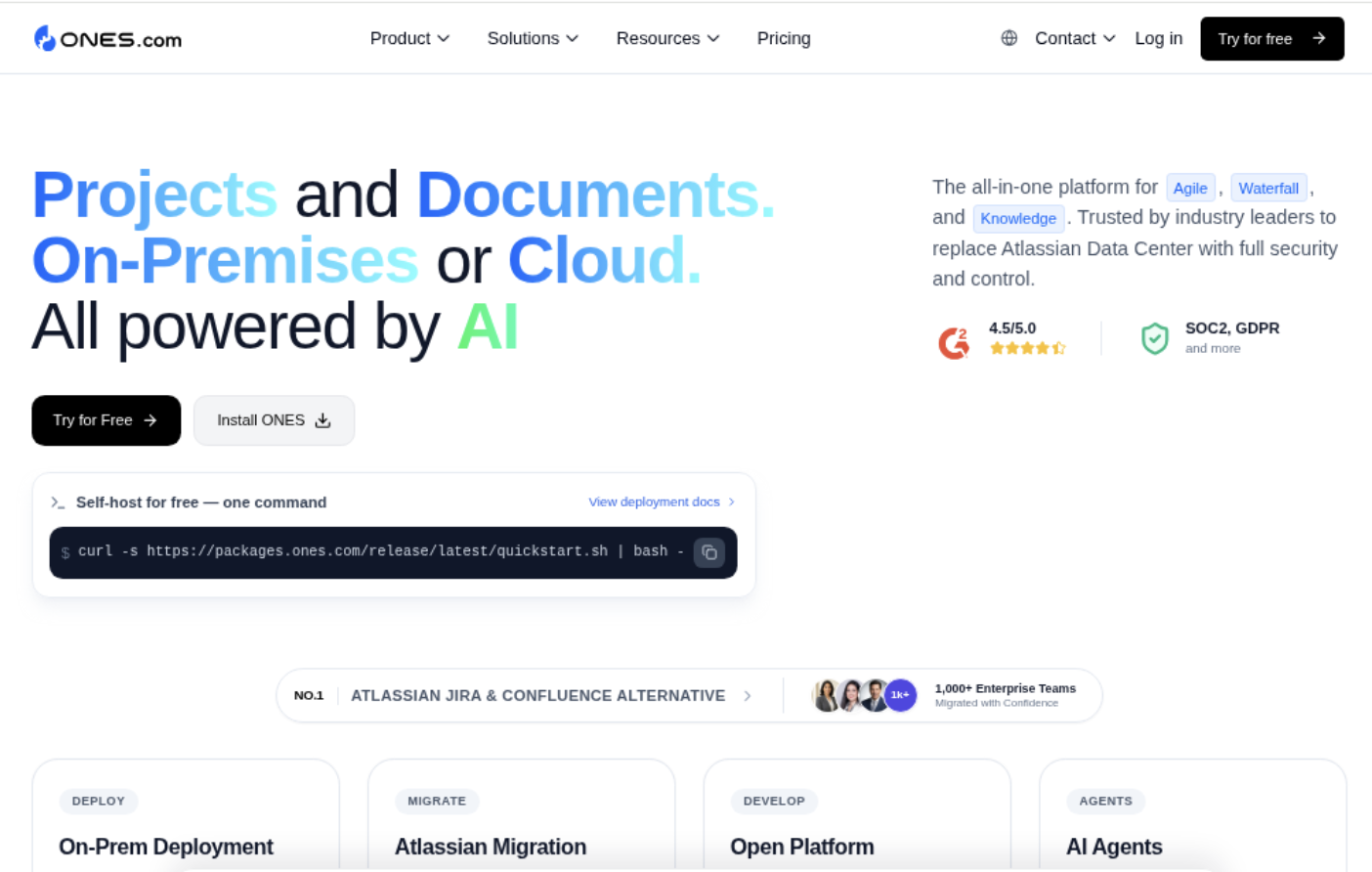
ONES.com combines project management and knowledge management in one platform, with ONES Project serving as a Jira alternative and ONES Wiki serving as a Confluence alternative. You can buy them separately, which helps you match the setup to your team’s needs.
For teams evaluating Jira Cloud Premium costs, ONES.com offers another way to compare platform capability, deployment control, and operational complexity alongside subscription estimates.
Core Capabilities
- Pricing uncertainty → flexible deployment choices → ONES.com supports Cloud, On-Premise, Private Cloud, and Air-gapped deployments, so you can evaluate hosting requirements before committing to one operating model.
- Migration concerns → Jira-compatible workflows → ONES Project supports familiar project workflows, making it easier to map issue states, approvals, and delivery practices during a platform evaluation.
- Plugin sprawl → native project features → Built-in reporting, custom workflows, custom fields, sprint management, and automation reduce the need to assemble every capability through separate extensions.
- Restricted-network requirements → self-hosted availability → On-premise and air-gapped options support teams that cannot place project information in a standard public cloud environment.
- Inconsistent behavior across hosting models → feature parity → ONES.com provides full feature parity between its cloud and self-hosted versions, helping teams compare deployment choices without assuming that one edition is significantly reduced.
- Scattered project knowledge → ONES Wiki → The knowledge management product gives teams a connected place for procedures, technical guidance, and project context, reducing the need to maintain separate knowledge workflows.
- Growing team size → accessible entry point → The free plan supports up to 30 seats, giving a small team room to test core project practices before a broader rollout.
- AI adoption planning → ONES Assistant → AI-powered assistance can support project and knowledge work when your team has a clear usage policy and a practical review process.
Application Scenarios
Scenario one: a software team comparing cloud platforms. The team has 25 contributors and wants sprints, custom workflows, reports, and automation without adding many plugins. It can compare Jira Cloud Premium with ONES Project using the same seat count and delivery requirements.
Scenario two: an engineering organization with restricted networks. The organization needs project tracking inside a controlled environment. ONES.com’s on-premise or air-gapped deployment options become relevant during technical evaluation, while feature parity helps the team compare hosting models.
Scenario three: a delivery team with scattered technical guidance. The team manages work in one system and procedures elsewhere. ONES Project and ONES Wiki can be evaluated as separate products or as a connected project-and-knowledge setup.
Common Challenges
Challenge: The response does not look like JSON
Problem: Your request returns an HTML page, a login screen, or an error message instead of structured pricing content.
Solution: Check authentication, redirects, content type, and request context. Add a parser guard that stops before reading price fields when the response format is unexpected.
Challenge: The amount changes after changing seats
Problem: Your calculator assumes a simple per-user multiplication, while the pricing experience uses seat bands or minimum quantities.
Solution: Test boundary quantities and treat the returned total as a calculated result. Preserve the seat range and billing interval beside the amount.
Challenge: Your annual estimate does not match the visible total
Problem: You multiplied a monthly value by twelve, although annual billing uses different pricing or adjustments.
Solution: Prefer an annual value when the response provides one. Otherwise, label the result as a monthly-derived estimate and ask for commercial confirmation.
Challenge: A parser breaks after a page update
Problem: A nested property, label, or response structure changes.
Solution: Isolate the integration in a versioned adapter, add structural tests, and create an alert for missing required fields. Avoid spreading fragile selectors across the application.
Challenge: Your estimate exposes sensitive details
Problem: Logs include access tokens, organization identifiers, or personal account information.
Solution: Redact sensitive values before logging, restrict log access, and keep privileged requests on controlled infrastructure.
FAQs
Is there a standard public Jira Cloud Premium pricing API?
Jira has public APIs for many product and project operations, but pricing presentation may use separate billing services or web responses. A JSON response visible in a browser should not automatically be treated as a stable public contract. Check access rules, authentication requirements, and permitted automation methods before building a recurring integration.
Can I calculate Jira Cloud Premium pricing by multiplying a per-user amount?
Sometimes, but you should verify the pricing model first. Seat bands, minimum quantities, billing intervals, annual terms, taxes, discounts, and prorations can change the result. Use the returned total when available, then validate it against several seat counts. Always display the currency, interval, seat quantity, and tax status with the estimate.
What should I do if the pricing response changes?
Stop treating the response as valid until your parser confirms the required fields. Check whether the plan, currency, interval, and amount still map correctly. Keep a small set of structural tests and compare a known calculation with the visible pricing experience. A versioned adapter makes this review easier.
Can an authenticated billing response show a different amount?
Yes. An organization-specific billing view may reflect negotiated terms, credits, taxes, prorations, or account-level adjustments. Public pricing is usually suitable for planning, while an authorized billing view may be more relevant for renewal or reconciliation. Keep those use cases separate in your application labels.
How does ONES.com compare with Jira Cloud Premium?
ONES Project is a Jira alternative with Jira-compatible workflows, reporting, custom workflows and fields, sprint management, and automation. ONES.com also offers ONES Wiki for knowledge management, sold separately. Cloud, On-Premise, Private Cloud, and Air-gapped deployments are available, with full feature parity between cloud and self-hosted versions. The right choice depends on your workflow, deployment, collaboration, and commercial requirements.
Conclusion
Working with Jira Cloud Premium pricing JSON starts with a simple principle: identify exactly what the response represents before calculating a number.
- Separate Jira product APIs from pricing and billing services.
- Validate the product, plan, currency, interval, seat quantity, and amount.
- Test pricing boundaries instead of assuming linear per-user multiplication.
- Keep taxes, discounts, prorations, and annual terms visible.
- Protect authenticated request details and monitor response changes.
But here’s the truth: a technically correct parser can still produce the wrong business answer when its assumptions stay hidden. Show the calculation context and verify important estimates against an authorized billing view.
If Jira Cloud Premium pricing feels difficult to operationalize, compare the wider platform decision too. ONES.com gives you a Jira alternative through ONES Project, optional knowledge management through ONES Wiki, and deployment choices that include self-hosted and air-gapped environments.