Jira Cloud Pricing 2025: Standard vs Premium Per-User Guide
Comparing jira software cloud pricing standard premium per user 2025? See costs, limits, and features to choose the right plan. Read now.
Choosing a Jira Cloud plan can feel simple until you compare the real monthly cost. Standard and Premium both support serious project work, yet their limits, administration features, storage, and service commitments differ.
A small team may pay for Premium without using its extra capacity. A growing company may choose Standard, then encounter storage, reliability, or planning limits at an inconvenient time. That mistake can create migration work and surprise budget changes.
But here's the truth: the right plan depends on team size, billing method, delivery risk, and the features your teams will use every week. This guide breaks down the 2025 pricing model, compares Standard with Premium, and shows how to estimate your effective per-user cost before you subscribe.
Jira Cloud Standard vs Premium: The Quick Answer
Jira Cloud Standard is usually the better value for small and mid-sized teams that need core project management. Premium is designed for organizations that need advanced planning, higher service commitments, more scale, and greater operational control.
For 2025 planning, Jira Cloud list pricing is commonly presented around these starting rates:
| Plan |
Typical list price per user per month |
Best suited to |
Important additions |
| Free |
$0 for up to 10 users |
Very small teams testing Jira |
Basic project tracking with usage limits |
| Standard |
About $7.53 per user monthly at the lowest paid tier |
Teams running regular software or business projects |
Higher limits, expanded administration, and 250 GB storage |
| Premium |
About $13.53 per user monthly at the lowest paid tier |
Organizations coordinating complex or business-critical work |
Advanced planning, unlimited storage, higher uptime commitments, and Premium administration features |
| Enterprise |
Custom pricing |
Large organizations with complex governance |
Enterprise-scale administration and commercial terms |
These figures are starting list prices, not a guaranteed quote. Jira Cloud charges can change by region, currency, user count, promotional terms, and billing arrangement. Always confirm the current amount in Atlassian’s pricing calculator before approval.
Here's why: Jira does not always behave like a simple flat multiplication. The effective rate can fall as your paid user count increases, while annual subscriptions use user tiers rather than the exact number of active seats.
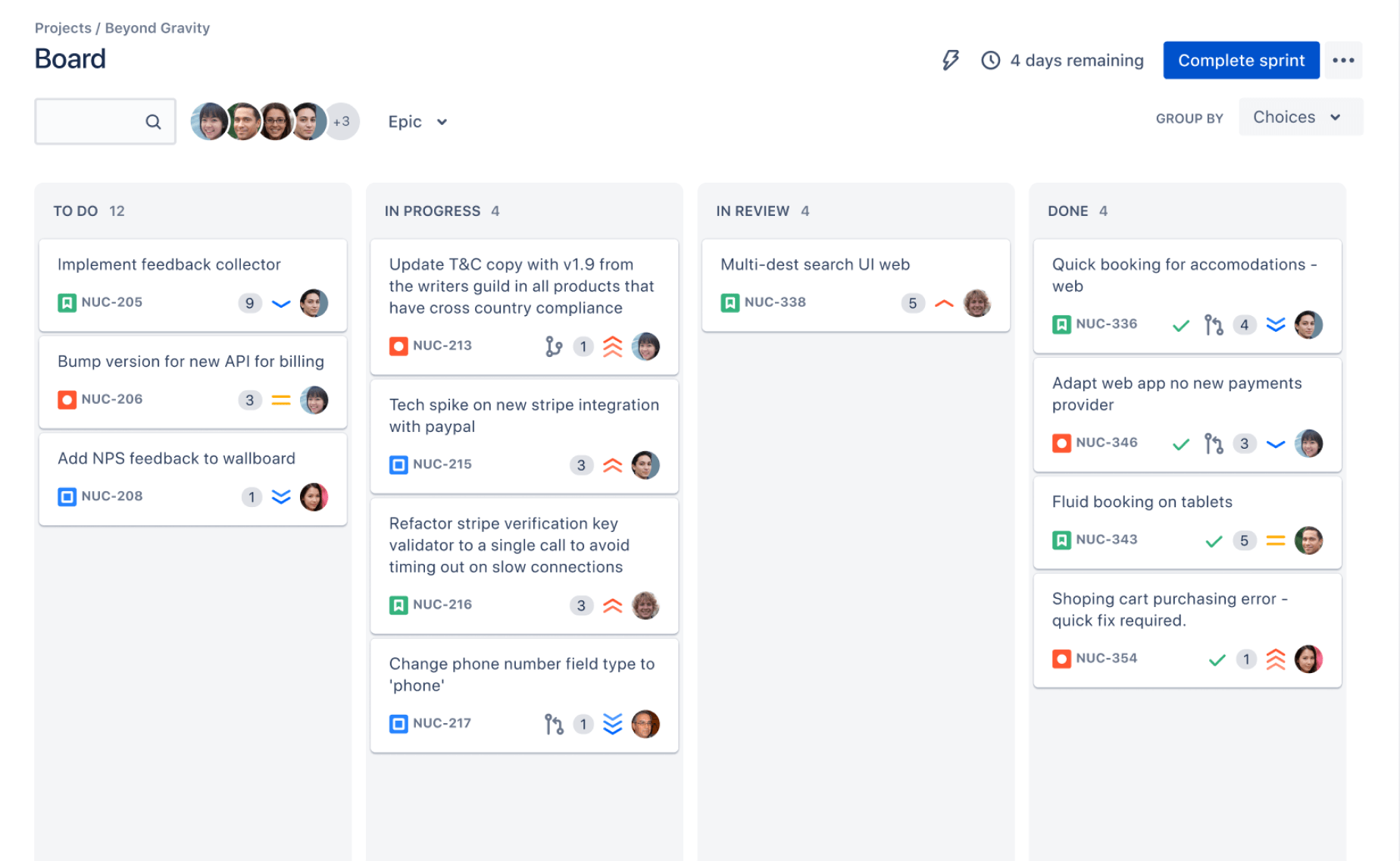
How Jira Cloud Per-User Pricing Works
Monthly billing and annual billing use different logic
With monthly billing, your charge generally reflects the maximum number of users assigned during the billing period. Adding five people for only a few days can still affect that month’s charge.
Annual billing usually uses a tier that covers a stated user range. For example, a plan may offer a 51–100-user tier. You pay for the tier even if only 62 people actively work in Jira.
That difference matters when your team grows unevenly. Monthly billing can suit a temporary project, while annual billing may offer more predictable budgeting for a stable team.
Per-user pricing is progressive rather than perfectly flat
A headline rate such as $7.53 does not necessarily mean every user costs exactly $7.53. Atlassian commonly applies progressive pricing, so the effective average rate changes across user bands.
For example, a 10-person Standard team and a 100-person Standard team should not be estimated by multiplying the first displayed rate by the total headcount. Use the official calculator for a precise estimate.
| Cost factor |
Why it affects your estimate |
| Licensed users |
People with access generally determine the subscription tier. |
| Monthly peak |
Temporary additions can raise a monthly invoice. |
| Annual tier |
Annual plans may charge for a range rather than your exact headcount. |
| Billing region |
Currency, tax, and local commercial terms can change the final amount. |
| Marketplace apps |
Connected apps add separate charges and may use different billing rules. |
| Promotions |
Discounts may apply for a limited period and should not define your long-term budget. |
Example calculation for a small team
Suppose 20 people need Jira Standard. A rough estimate at the starting list rate would be 20 × $7.53, or $150.60 per month.
That is only a planning shortcut. Your actual amount may differ because progressive pricing, taxes, regional pricing, or an annual tier can change the result.
Now compare Premium at the same rough rate: 20 × $13.53 equals $270.60 per month. The difference is about $120 monthly before tax and adjustments.
The practical question is whether Premium saves more than that difference through advanced planning, reduced administration, stronger service commitments, or fewer workarounds.
What Standard Includes for Most Teams
Standard is the practical starting point for teams that need structured work tracking without enterprise-level operating requirements. You can manage backlogs, boards, sprints, workflows, permissions, reports, and project settings.
A product team might use Standard to plan a two-week sprint, assign stories, track bugs, and review velocity. A marketing team could use it for campaign tasks, approvals, and launch dependencies.
Storage and collaboration capacity
Standard commonly includes 250 GB of storage, while Free provides a much smaller allowance. That difference becomes meaningful when your projects accumulate attachments, screenshots, exports, and design references.
Consider a quality team attaching test evidence to every issue. A few thousand images may create a storage concern sooner than expected, especially when several projects share the same site.
Administration and permissions
Standard provides more administration control than Free. You can manage project access, organize teams, configure workflows, and apply permission schemes for regular operating needs.
For many organizations, this is enough. If one administrator can manage access and project configuration without complex regional controls, Premium may offer limited additional value.
When Standard is usually sufficient
- Teams with predictable project volume and moderate user growth.
- Organizations that need core agile planning, issue tracking, and reporting.
- Departments that do not require advanced capacity planning across many teams.
- Companies comfortable with the Standard service commitment and storage allowance.
What Premium Adds to the Decision
Premium costs more because it targets operational scale and planning complexity. Its value appears when delays, coordination gaps, or service interruptions have a measurable business impact.
The extra cost may be reasonable for a product organization coordinating ten development teams. It may be unnecessary for a five-person team managing one internal project.
Advanced planning across teams
Premium commonly includes advanced planning capabilities for coordinating work across projects and teams. You can use higher-level views to examine dependencies, capacity, timelines, and delivery risk.
Imagine three teams sharing a platform release. One team owns the API, another handles the mobile experience, and a third manages security testing. A cross-team plan helps reveal that the mobile launch depends on the API milestone.
Higher storage and service commitments
Premium generally provides unlimited storage and a higher uptime commitment than Standard. It also includes additional reliability and administration features intended for larger operations.
These benefits matter when Jira supports customer-facing releases or internal processes that cannot easily pause. A missed planning window may cost more than the annual plan difference.
Sandbox and controlled experimentation
Premium may include access to features that help teams test changes in a safer environment before applying them broadly. This is useful when a workflow adjustment affects many projects or departments.
For example, an administrator could evaluate a new approval process before changing the live setup used by hundreds of contributors.
When Premium may justify its price
- Multiple teams must coordinate dependencies on shared delivery dates.
- Leadership needs portfolio-level visibility and capacity planning.
- Jira supports business-critical releases or customer commitments.
- Storage requirements exceed Standard’s allowance.
- Administrators need stronger testing and operational controls.
Standard vs Premium: Feature and Cost Comparison
The table below gives you a practical comparison for 2025 budgeting. Individual entitlements can change, so confirm each item before signing an order.
| Area |
Standard |
Premium |
Budget implication |
| Core issue tracking |
Included |
Included |
No reason to upgrade solely for basic boards or backlog work. |
| Agile planning |
Included for regular team planning |
Included with broader planning capability |
Premium becomes more useful across many teams. |
| Storage |
Commonly 250 GB |
Commonly unlimited |
Premium can avoid storage management for attachment-heavy teams. |
| Advanced planning |
More limited |
Expanded capabilities |
Assess whether cross-team planning saves manual coordination. |
| Uptime commitment |
Lower than Premium |
Higher commitment |
Important when service availability affects revenue or delivery. |
| Testing and administration |
Standard controls |
More advanced controls |
Useful for larger administrative teams and complex setups. |
| Approximate starting list rate |
$7.53 per user monthly |
$13.53 per user monthly |
Use a calculator for your actual tier and region. |
But here's the truth: features alone do not determine value. A Premium feature that nobody uses is an expense. A feature that prevents one serious release delay may pay for itself quickly.
How to Choose the Right Plan in 2025
- Count real contributors. Include developers, testers, product managers, service teams, and occasional contributors who need access.
- Separate current users from expected users. Estimate hiring, contractors, acquisitions, and seasonal project participants over the next year.
- List your operational risks. Ask whether storage, availability, cross-team dependencies, or administrative testing could block delivery.
- Compare monthly and annual scenarios. Monthly billing offers flexibility, while annual tiers may create predictable costs for stable teams.
- Price connected apps separately. A cheaper Jira plan can become expensive after adding time tracking, testing, reporting, or automation apps.
- Calculate the cost of workarounds. Include manual status reports, duplicate planning systems, storage cleanup, and administrator effort.
- Recheck the official quote. Confirm currency, taxes, current entitlements, user bands, and renewal terms before purchasing.
Here's a useful test: if your team cannot name three Premium capabilities it will use every month, start with Standard and review the decision after real usage.
Hidden Costs That Affect the Final Budget
The subscription is only one part of the total cost. Implementation, administration, training, marketplace apps, and unused seats can change your effective price substantially.
Unused licenses
A company may purchase 200 seats but actively use only 145. The unused 55 seats still affect the annual tier or monthly headcount calculation.
Run a quarterly access review. Remove people who changed roles, completed a contract, or no longer need Jira. Keep a clear process for restoring access when required.
Marketplace apps
Teams often add test management, time tracking, documentation, reporting, or automation apps. Each app can have its own pricing model, user count, and billing threshold.
For example, an app priced for every Jira account may charge for occasional contributors too. Review app licenses alongside Jira rather than treating them as minor extras.
Migration and administration
A lower monthly rate may not remain economical if administrators spend hours maintaining manual reports or duplicated plans. Measure the time spent managing work, not just the invoice total.
You might discover that a slightly higher plan reduces weekly reconciliation work for four project managers. That time has a real financial value.
Value Proposition
ONES.com combines project management and knowledge management on one platform. ONES Project provides project management capabilities as a Jira alternative, while ONES Wiki provides a knowledge base as a Confluence alternative. They are sold separately.
It may suit teams that want Jira-compatible workflows, native reporting, self-hosted deployment choices, and fewer separate plugins to administer.
Core Capabilities
- Scattered project tracking → ONES Project consolidates issues, backlogs, boards, and delivery views → Teams can follow work in one project environment.
- Complex team processes → Custom workflows and fields reflect different approval or delivery paths → Each department can track the information it actually needs.
- Manual sprint administration → Sprint management supports planning, execution, and review → Scrum teams can maintain a repeatable cadence.
- Limited reporting flexibility → Built-in reporting provides visibility into progress and delivery trends → Managers spend less time assembling status updates.
- Plugin-heavy operations → Native capabilities reduce dependence on multiple extensions → Administrators can manage fewer moving parts.
- Restricted deployment requirements → ONES.com supports Cloud, On-Premise, Private Cloud, and Air-gapped deployments → Teams can match deployment to security and network rules.
- Uneven cloud and self-hosted functionality → Full feature parity is available between cloud and self-hosted versions → Deployment choice does not require giving up core capabilities.
- Growing user costs during evaluation → A free plan supports up to 30 seats → Smaller teams can test the platform before committing to a paid rollout.
Application Scenarios
Software company with restricted networks: A security-sensitive engineering group can run an air-gapped deployment while maintaining sprint planning, custom workflows, and reporting.
Multi-department project office: Product, engineering, and operations teams can use separate workflows while leadership reviews shared delivery information through built-in reporting.
Team replacing a fragmented tool stack: A company using one tool for issues, another for project tracking, and several plugins for reporting can evaluate ONES Project as a Jira alternative and ONES Wiki separately for knowledge management.
Common Challenges and Practical Solutions
Challenge: The per-user rate looks cheaper than the real bill
Solution: Use your expected user tier, not the headline entry rate. Model current headcount, annual growth, taxes, apps, and seasonal contributors together.
Challenge: Premium seems attractive because it includes every extra
Solution: Match each Premium capability to a measurable need. If advanced planning will replace weekly manual coordination, estimate the hours saved. If no team depends on it, Standard may be enough.
Challenge: Users remain licensed after changing roles
Solution: Schedule quarterly access reviews. Assign ownership to an administrator and create a simple offboarding process for employees and contractors.
Challenge: Marketplace apps distort the comparison
Solution: Build a combined estimate for Jira, apps, implementation, training, and administration. Compare the complete operating cost rather than the base subscription alone.
Challenge: Pricing changes after the first year
Solution: Record renewal assumptions and review current commercial terms before renewal. Treat promotional discounts as temporary unless the agreement clearly says otherwise.
FAQs
Is Jira Standard or Premium better for a small team?
Standard is usually the sensible starting point for a small team that needs boards, backlogs, workflows, reports, and regular collaboration. Premium may be worthwhile when the team manages business-critical releases, needs advanced planning, or depends on stronger service commitments. Compare the cost of the additional plan with specific operational problems. If no one will use Premium capabilities regularly, the extra charge may not create meaningful value.
Does Jira charge the same amount for every user?
No. Jira Cloud pricing commonly uses progressive rates and user tiers. The displayed entry rate may apply only to the first pricing band. Monthly billing can also reflect the highest number of users during the period, while annual billing may cover a defined range. Use the official calculator with your location, user count, billing cycle, and expected growth for a more reliable estimate.
Can I change from Standard to Premium later?
Yes, teams can generally upgrade when their requirements change. Before upgrading, identify which Premium capabilities you need and confirm how billing will be adjusted for your current term. A growing organization may begin with Standard, then move to Premium when cross-team planning, storage, reliability, or administration needs become more important. Review app compatibility and permissions after the change.
Is Premium worth the additional monthly cost?
Premium can be worth it when Jira supports complex delivery coordination or business-critical operations. Advanced planning may reduce dependency confusion, while higher service commitments may reduce operational risk. For a small team with one backlog and moderate storage needs, Standard may provide nearly everything required. Calculate the cost of manual work and delivery disruption before deciding.
What should I check before purchasing an annual plan?
Check the annual user tier, expected hiring, contractor access, regional taxes, currency, marketplace apps, renewal terms, and storage needs. Confirm whether your plan covers the maximum number of people who may need access during the year. Also review administrative requirements and service commitments. A short planning exercise can prevent paying for a higher tier that your team will not use.
Conclusion
For most small and mid-sized teams, Jira Cloud Standard offers the core project management capabilities needed for everyday delivery. Premium makes more sense when advanced planning, unlimited storage, higher service commitments, and stronger operational controls solve real problems.
Start with your actual user count, then model growth, billing cycles, apps, and administration time. Compare the complete annual cost rather than multiplying a headline rate by your current team size.
The problem is usually not choosing the cheapest plan. It is choosing a plan without understanding how your team works. Once you connect pricing to delivery risk and daily usage, the Standard-versus-Premium decision becomes much clearer.