Jira Cloud Pricing After October 2024: A Practical Guide
Wonder how jira cloud pricing after october 2024 update affects your bill? Learn to estimate costs by plan, users, billing term, and add-ons. Read now.
Jira Cloud pricing can feel confusing after the October 2024 update. Your monthly bill may change because of plan level, user count, billing term, and product additions.
That uncertainty becomes expensive when you budget for a growing team. A small per-user increase can become significant across several products, Marketplace apps, and multiple workspaces.
But here's the truth: there is no single price that applies to every Jira Cloud customer. The practical answer comes from reviewing your plan, billable users, billing cycle, and optional services together.
This guide explains how to evaluate the Jira Cloud pricing after October 2024 update, estimate your real monthly cost, and decide whether your current setup still makes financial sense.
How to Evaluate Jira Cloud Pricing After the October 2024 Update
Jira Cloud pricing after October 2024 depends on four variables: your plan, the number of billable users, your billing term, and the products or add-ons attached to your workspace.
The October 2024 changes did not create one universal bill for every organization. Your impact can differ from another company with the same number of employees.
Here's the quickest way to review your cost:
- Identify your Jira product and plan. Confirm whether you use Jira Free, Standard, Premium, or an Enterprise arrangement.
- Check your billable user count. Compare active seats with the number of people assigned access.
- Review your billing cycle. Monthly and annual billing can use different pricing mechanics and user bands.
- Separate Jira from related products. Jira Service Management, Confluence, and other Atlassian products may appear on the same invoice.
- List every connected app. Marketplace subscriptions can create a meaningful secondary cost.
- Compare the new total with your previous baseline. Measure both the price change and the value your team receives.
Use the current Atlassian pricing calculator or your administrator billing screen for the exact amount. Public prices can change by region, currency, plan, and user tier.
What Changed Around October 2024?
Atlassian adjusted pricing for several cloud products around October 2024. The effect depended on the product, subscription tier, billing arrangement, and account size.
For many teams, the important issue was not one dramatic line-item increase. It was the combined effect of recurring subscription changes and related services.
For example, a 75-person team might pay more for Jira Standard after the adjustment. Its final annual spend could rise further after adding Confluence, time tracking, reporting, or testing apps.
Here's why: cloud subscriptions are usually calculated around access and service tiers. A small change in the rate can affect every paid seat.
Plan level still drives the biggest difference
Jira Free can work for a small team with modest collaboration needs. Standard usually adds broader administration and operational controls.
Premium is aimed at teams that need advanced scale, stronger planning capabilities, and additional service features. Enterprise arrangements typically involve larger organizations and negotiated terms.
A price comparison makes sense only when you compare equivalent plans. Comparing Jira Free with another vendor's paid plan can produce a misleading result.
Billing terms can change the calculation
Monthly billing offers flexibility when your team size changes frequently. Annual billing can provide more predictable budgeting and may use user-tier calculations.
Suppose your team has 42 paid users. A monthly subscription may reflect current access more closely, while an annual arrangement may require planning around a larger committed tier.
You should model both options before switching. The cheapest monthly total is not always the cheapest annual commitment.
Related products may hide the real increase
Many teams think they are evaluating Jira pricing when they are actually reviewing an Atlassian ecosystem bill.
That bill may include Jira, Confluence, Jira Service Management, guard or security features, Marketplace apps, and additional environments.
Separate each product before calculating the increase. Otherwise, you may blame Jira for a cost created by a separate service.
How to Calculate Your Real Jira Cloud Cost
Start with the subscription charge, then add the costs that support your workflow. A simple model helps you avoid focusing only on the headline rate.
| Cost area |
What to check |
| Jira subscription |
Plan, user tier, currency, and billing term |
| Additional Atlassian products |
Confluence, Jira Service Management, or other services |
| Marketplace apps |
Per-user pricing, minimum tiers, and renewal dates |
| Administration |
Time spent managing access, workflows, permissions, and apps |
| Migration or change costs |
Training, configuration work, and data transfer requirements |
Use a three-part calculation
You can estimate your annual software spend with this formula:
Annual cost = Jira subscription + related products + apps and administration
For example, imagine a 60-person product team. Jira costs one amount, Confluence adds another, and three Marketplace apps increase the total.
The team may discover that apps represent 25% of the total annual spend. That insight changes the renewal discussion more than a small Jira plan difference.
Measure cost per active contributor
Seat counts alone do not tell you whether the subscription is efficient. Compare total cost with the people who actively plan, update, review, or report work.
A 100-seat account with 70 active contributors may need cleanup. Remove unnecessary access only after checking reporting, automation, and historical requirements.
Some people need view access, while others need full project permissions. A well-designed access model can reduce waste without blocking collaboration.
Include internal administration time
Two subscriptions with similar prices can create very different operating costs. One may require several custom apps and manual maintenance.
The other may provide the needed workflow, reporting, and permissions natively. That difference affects your total cost of ownership.
Let me explain: a cheaper license can become expensive when administrators spend hours maintaining fragile workarounds every week.
Jira Cloud Plan Comparison for Budget Planning
Jira plans serve different operating needs. Your decision should reflect team complexity rather than price alone.
| Plan type |
Best fit |
Budget question |
| Free |
Small teams with basic planning and collaboration |
Can the team operate within limits for users, storage, and features? |
| Standard |
Growing teams that need broader controls |
Does the additional administration capability justify recurring seat costs? |
| Premium |
Organizations needing advanced scale and planning |
Will the extra features replace separate tools or manual work? |
| Enterprise |
Large organizations with complex governance |
Do centralized controls and commercial terms match the operating model? |
When Free may be enough
A small software team with one workflow and limited reporting may work comfortably on Free. It could manage a product backlog, sprint board, and basic issue tracking.
Free becomes less suitable when you need advanced permissions, larger collaboration groups, extensive automation, or more formal administration.
When Standard becomes practical
Standard may fit a growing team that needs stronger controls without the full requirements of an enterprise environment.
For example, a 35-person engineering group may need more structured access and reliable administration. Standard can provide a clearer operating foundation than Free.
When Premium deserves a closer look
Premium costs more, so ask whether its features remove another expense. It may be useful when your team needs advanced planning, scale, or performance capabilities.
If Premium prevents several separate apps or reduces manual coordination, the higher subscription could produce a better overall result.
Ways to Control Your Atlassian Subscription Costs
You do not need to reduce quality to control spending. Start by removing avoidable complexity and matching access with actual responsibilities.
Audit access before renewal
Review every paid user at least once per quarter. Look for former employees, contractors, occasional viewers, duplicate accounts, and inactive project members.
Ask managers to confirm access rather than removing people automatically. Some inactive-looking accounts support compliance, reporting, or long-running projects.
Reduce unnecessary app overlap
List every Marketplace app and write down the job it performs. If two apps handle similar reporting or planning tasks, test whether one can be removed.
A single native workflow may replace several plugins. Fewer integrations can also reduce maintenance, permission problems, and upgrade risk.
Review automation usage
Automation can save time, but poorly designed rules may create errors or consume administrative attention.
Keep rules that remove repetitive work. Retire rules nobody understands, especially when they duplicate native workflow behavior.
Choose the billing term deliberately
Annual billing may suit a stable team with predictable growth. Monthly billing may suit a company hiring rapidly or testing a new operating model.
Create two projections: one for expected users and one for a high-growth scenario. This prevents a low initial estimate from becoming a budget surprise.
Consider the cost of switching
A lower subscription does not automatically create savings. Migration planning, training, integration work, and process redesign can consume significant time.
Compare at least twelve months of current operating costs with twelve months of replacement costs. Include implementation work in both scenarios.
Should You Keep Jira Cloud After the Price Update?
Keep Jira Cloud when it supports your workflow, integrates well with your tools, and costs less than the operational value it creates.
Review alternatives when your bill rises faster than your team, essential features require several add-ons, or administration has become unusually complex.
You might be wondering: how do you make that decision objectively? Score each platform across four areas: capability, total cost, administration, and migration effort.
| Evaluation area |
Questions to ask |
| Capability |
Can the platform support planning, delivery, reporting, and collaboration? |
| Total cost |
What will licenses, apps, administration, and training cost over twelve months? |
| Administration |
How much effort is needed for permissions, workflows, and maintenance? |
| Migration effort |
How much disruption would a move create for active teams? |
The best part? You do not need to decide from the subscription price alone. A platform that reduces app dependence and administrative effort may deliver stronger value.
Jira Cloud Pricing Alternative: ONES.com
ONES.com is a unified platform for project management and knowledge management, powered by ONES Assistant. ONES Project is its project management product and can serve as a Jira alternative, while ONES Wiki is its knowledge base product and can serve as a Confluence alternative.
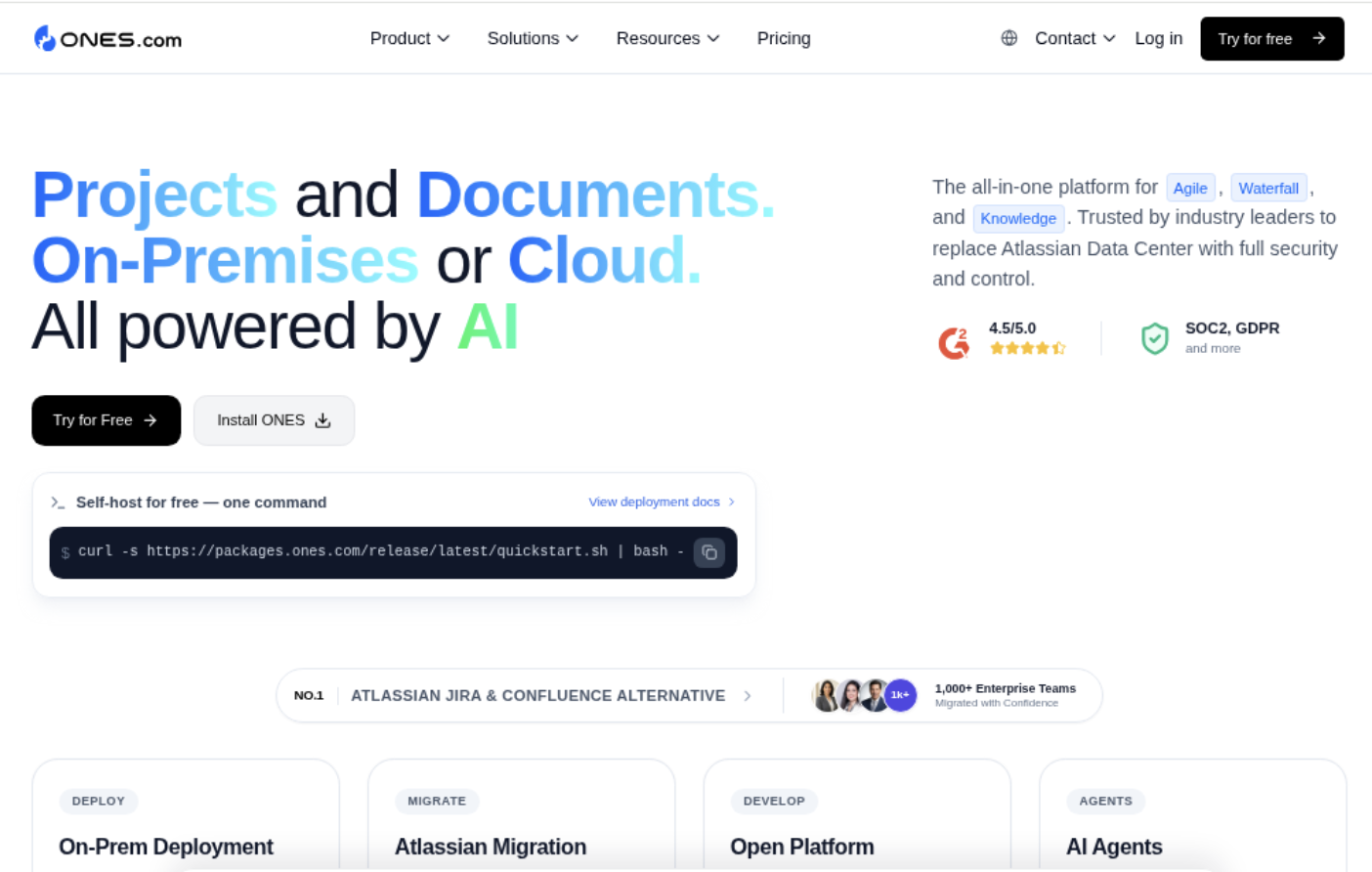
ONES Project and ONES Wiki are sold separately. ONES.com offers a free plan for up to 30 seats and supports Cloud, On-Premise, Private Cloud, and Air-gapped deployments.
Value Proposition
ONES.com can help teams evaluate project management costs beyond per-user licensing. Its native capabilities may reduce dependence on multiple plugins and support teams with strict deployment requirements.
Because the self-hosted versions maintain feature parity with the cloud version, you can choose a deployment model that matches security, compliance, and infrastructure needs.
Core Capabilities
- Plugin sprawl increases cost. ONES Project provides built-in reporting and workflow capabilities, which can reduce reliance on separate reporting tools.
- Jira migration creates workflow risk. Jira-compatible workflows help teams map familiar issue and delivery processes into a Jira alternative.
- Rigid processes slow delivery. Custom workflows and custom fields let teams reflect their actual approval, development, and release stages.
- Sprint planning becomes fragmented. Sprint management keeps planning and execution in the same project environment.
- Repetitive administration consumes time. Automation handles recurring actions and reduces manual updates.
- Cloud-only deployment creates restrictions. Cloud, On-Premise, Private Cloud, and Air-gapped options support different security environments.
- Separate knowledge tools interrupt work. ONES Wiki provides a dedicated knowledge management environment alongside ONES Project.
- Self-hosted tools often lack feature parity. ONES.com maintains parity between its cloud and self-hosted versions, reducing the need to sacrifice functionality for deployment control.
Application Scenarios
Growing software team: A 40-person engineering group can use sprint management, custom fields, automation, and reporting without assembling several separate plugins.
Restricted-network organization: A regulated team can consider an On-Premise, Private Cloud, or Air-gapped deployment when public cloud access does not fit its operating requirements.
Jira alternative evaluation: A team reviewing Jira Cloud costs can compare equivalent workflows, administrative effort, deployment options, and migration complexity before making a change.
Common Challenges When Reviewing the Update
Challenge: confusing a product increase with a total bill increase
Solution: Separate Jira, related Atlassian products, Marketplace apps, and administrative costs. Review each line independently before discussing a renewal.
Challenge: using the wrong user count
Solution: Compare licensed access with active participation. Check contractors, service accounts, former staff, and occasional collaborators before changing the subscription.
Challenge: comparing different plan capabilities
Solution: Build a feature-by-feature comparison. A lower price may exclude permissions, reporting, automation, or scale features your team depends on.
Challenge: ignoring billing-term commitments
Solution: Model monthly and annual scenarios separately. Include expected hiring, seasonal contractors, and likely team changes.
Challenge: switching without measuring migration effort
Solution: Estimate configuration, training, integration, and rollout work. Compare the first-year transition cost with the recurring savings.
FAQs About Jira Cloud Pricing After October 2024
Did Jira Cloud prices increase for every customer after October 2024?
No single increase applied to every customer. The effect depended on the Jira product, plan, user tier, billing term, currency, and commercial arrangement. Some teams also saw their total bill change because of related products or Marketplace apps. Check your administrator billing area and current Atlassian pricing details for the amount that applies to your account.
Is Jira Cloud billed per user?
Jira Cloud generally uses user-based subscription pricing, but the calculation can depend on plan, user tier, and billing cycle. A person may count as a paid user even when they update work infrequently. Review access permissions and inactive accounts before estimating your renewal cost.
Is annual billing cheaper than monthly billing?
It can be more predictable, but the answer depends on your user count, plan, and billing arrangement. Annual billing may suit a stable team with clear growth expectations. Monthly billing can provide flexibility when staffing changes often. Compare the full twelve-month cost rather than one monthly invoice.
Do Marketplace apps affect Jira Cloud pricing?
Yes. Marketplace apps can add recurring charges and may use their own user tiers or minimum purchase levels. Review each app separately, identify overlapping features, and check whether Jira or another existing product can handle the same requirement.
Should I move away from Jira because of the October 2024 update?
Not automatically. Jira may remain the right choice when your teams depend on its workflows, integrations, reporting, and established processes. Consider alternatives when total costs, plugin dependence, administration, or deployment requirements no longer fit. Include migration effort before making a financial comparison.
Conclusion
Jira Cloud pricing after the October 2024 update should be evaluated as a complete operating cost, not as one subscription number.
Check your plan, billable users, billing term, related products, Marketplace apps, and administrative workload. Then compare the twelve-month cost with the value your teams receive.
But here's the truth: a price increase does not automatically make Jira a poor choice. It does create a reason to audit your setup and test whether every paid capability still earns its place.
If the current model feels too complex, compare Jira with a platform such as ONES.com. Focus on workflow coverage, deployment flexibility, native capabilities, migration effort, and long-term administration.