Jira Cloud Pricing and Atlassian Intelligence 2025 Guide
Confused by jira cloud pricing atlassian intelligence 2025? Compare plans, AI features, and costs to choose the right Jira plan. Click to discover!
Jira Cloud pricing can feel confusing when plan tiers, user counts, billing terms, and Atlassian Intelligence appear on the same page. You may only need sprint planning, yet Premium features and AI capabilities can quickly change the monthly cost.
That uncertainty creates two risks. You might overpay for unused automation, storage, or administrative controls. Or you might choose a cheaper plan, then discover that essential reporting or AI features are unavailable.
But here’s the truth: the right choice depends on your team size, delivery workflow, security needs, and expected AI usage. This 2025 guide explains Jira Cloud plan structure, Atlassian Intelligence access, pricing factors, and practical alternatives.
Jira Cloud Pricing and Atlassian Intelligence: The 2025 Overview
Jira Cloud pricing in 2025 is organized around Free, Standard, Premium, and Enterprise plans, while Atlassian Intelligence availability depends on the product, plan, feature, and rollout status.
Jira Cloud is Atlassian’s hosted project and issue management service. You pay according to factors such as the number of users, billing cycle, selected plan, region, and optional products.
| Plan |
Best suited to |
Typical capabilities |
Pricing considerations |
| Free |
Small teams testing Jira |
Core project tracking, boards, basic backlog planning, and limited collaboration |
Limited users, storage, permissions, and administration |
| Standard |
Growing project teams |
Expanded collaboration, permissions, reporting, and administration |
Per-user pricing usually changes as the team grows |
| Premium |
Teams needing scale and advanced delivery controls |
Advanced planning, automation capacity, administration, and service commitments |
Higher subscription cost with additional operational features |
| Enterprise |
Large organizations with complex governance |
Centralized administration, organization-wide controls, and enterprise support |
Usually requires a tailored quote and commercial discussion |
Atlassian Intelligence adds AI-powered capabilities inside eligible Atlassian products. These may include summarizing work, rewriting text, generating descriptions, improving search, and helping teams interpret project information.
The exact experience can change during a product rollout. A feature may also require a particular plan, administrator setting, language, or regional availability.
Here’s why: a plan price alone does not show your total cost. You also need to estimate seats, optional products, automation activity, AI usage, and administrative effort.
What you actually pay for
Jira Cloud generally uses subscription pricing rather than a one-time license. Your bill can include the Jira plan, additional Atlassian products, and any applicable taxes or regional adjustments.
Monthly billing can be useful when your headcount changes frequently. Annual billing may offer more predictable budgeting, but it can create waste if many seats remain unused.
For example, a 12-person product team may find Standard sufficient. A 150-person engineering organization may need Premium because advanced planning and administration matter more than the base issue tracker.
How Atlassian Intelligence fits into the bill
Atlassian Intelligence is usually evaluated as part of product and plan eligibility. You should check whether the AI capability is included, limited, or subject to additional conditions for your chosen arrangement.
AI can reduce time spent writing summaries or organizing work. It can also increase usage when teams generate many descriptions, summaries, searches, or planning suggestions.
That means you should evaluate AI by workflow rather than novelty. Ask how many people will use it, how often they will use it, and which tasks it will replace.
How Jira Cloud Plan Costs Change in Practice
The advertised tier is only the starting point. Your effective cost changes as your team grows and as you add controls for governance, scale, and reporting.
Seat count has the biggest effect
Most Jira Cloud plans are priced around users. A small change in headcount can therefore alter your subscription more than a rarely used feature.
Consider a team that grows from 25 to 45 people. Even if the workflow stays identical, the additional seats can significantly change annual spending.
Keep a monthly seat review. Remove inactive accounts, assign access deliberately, and distinguish occasional collaborators from regular contributors.
Monthly and annual billing serve different needs
Monthly billing gives you flexibility when contractors, interns, or rotating teams frequently join and leave. It can suit experimentation and fast-changing organizations.
Annual billing supports budget planning and a longer commitment. Before choosing it, estimate hiring plans, reorganizations, and likely product changes.
The best part? You can make the decision using a simple scenario model: current seats, expected seats, chosen tier, optional products, and estimated AI adoption.
Additional Atlassian products can change the total
Jira often sits beside Confluence, Jira Service Management, or other Atlassian products. Each product may have its own plan and user rules.
A team might choose Jira Standard, Jira Service Management for support operations, and Confluence for internal knowledge. The combined subscription matters more than any single product price.
Create separate estimates for project delivery, service management, and knowledge sharing. This makes it easier to identify which product drives the increase.
Enterprise pricing follows a different path
Enterprise arrangements typically involve larger user populations, stronger governance requirements, and negotiated commercial terms.
Organizations may also care about centralized administration, support commitments, identity management, compliance controls, and multiple instances.
For enterprise planning, compare the full operating model. Include administration time, migration work, integrations, training, and renewal planning.
What Atlassian Intelligence Can Do in Jira
Atlassian Intelligence is designed to assist with everyday work inside Atlassian products. Its value depends on the quality of project context and the tasks your team repeats most often.
Summarizing long discussions
AI can help turn lengthy issue comments or project conversations into a shorter summary. This helps a developer understand decisions after missing a meeting.
For example, a release manager can review the key blockers, decisions, and follow-up actions before a status meeting.
Writing and improving issue content
Teams often create vague descriptions such as “fix login problem.” AI assistance can help expand that into clearer context, expected behavior, and acceptance criteria.
A product manager might start with rough notes, then refine the wording before assigning the work to an engineering team.
Finding information more naturally
AI-powered search can help people locate relevant work without remembering exact issue keys or labels.
Someone might ask for recently blocked mobile release tasks instead of manually combining several filters. The result still requires human review.
Supporting planning and communication
AI can help summarize progress, highlight recurring themes, and prepare status updates. It should support planning decisions rather than make them independently.
A delivery lead can use a generated summary as a starting point, then verify risks with the people doing the work.
Understanding the limitations
AI may misunderstand context, omit a qualification, or produce wording that sounds confident without being correct. Treat the output as assistance, not approval.
Teams should define where human review is mandatory. Security incidents, customer commitments, estimates, and release decisions deserve additional scrutiny.
How to Evaluate AI Value Before Paying More
Start with a task inventory. List repetitive activities that consume time each week, then estimate how often AI could assist without lowering quality.
- List recurring tasks such as issue writing, summarization, search, and status reporting.
- Estimate the minutes spent on each task during a typical week.
- Identify which roles perform the work most frequently.
- Test the AI capability with realistic project examples.
- Measure editing time and error rates after the test.
- Compare the saved effort with the additional subscription cost.
Suppose 20 team members each save 15 minutes per week writing clearer issue descriptions. That creates 300 minutes of weekly capacity, or five hours.
Five hours may justify AI assistance if the quality remains high. However, the calculation changes if every generated description needs heavy rewriting.
Measure adoption, not just availability
An AI feature can be included in a plan and still produce little value if people do not use it. Training, workflow placement, and trust determine adoption.
Place AI assistance where work already happens. A prompt inside issue creation is more useful than a separate process that requires extra navigation.
Consider risk alongside efficiency
Review how AI handles sensitive project details, customer information, and internal planning. Clarify permissions and administrator controls before broad adoption.
Your team should know what it may share, what requires review, and how to report an incorrect result.
Jira Cloud Pricing Comparison: Which Tier Fits?
The best plan depends on capability gaps. Use the following comparison as a practical starting point rather than treating the tier names as a complete buying decision.
| Business situation |
Likely starting point |
Questions to ask |
| A small team tracking a few active projects |
Free or Standard |
Will user limits, permissions, or storage become restrictive? |
| A growing product organization |
Standard |
Do you need stronger administration, reporting, and collaboration controls? |
| Several teams coordinating large releases |
Premium |
Do advanced planning, automation, and scale justify the higher cost? |
| A global organization with centralized governance |
Enterprise |
Do you need organization-wide controls, support, and negotiated terms? |
Let me explain: choosing a higher tier only for one attractive feature can create unnecessary cost. First identify the operational problem, then confirm which plan solves it.
Example: a 30-person software team
A 30-person team may need backlog management, sprint planning, permissions, dashboards, and automation. Standard could cover those needs if advanced scale controls are unnecessary.
If the team later coordinates several product lines, Premium may become more appropriate. The trigger should be operational complexity, not a desire to access every feature.
Example: a 1,000-person organization
A large organization may need centralized administration, identity controls, consistent policies, and formal support. Enterprise discussions should include procurement and security teams early.
The team should also estimate how many people need full project access. Giving every employee a full seat can increase cost without improving delivery.
Natural Jira Cloud and AI Alternative: ONES.com
Value Proposition
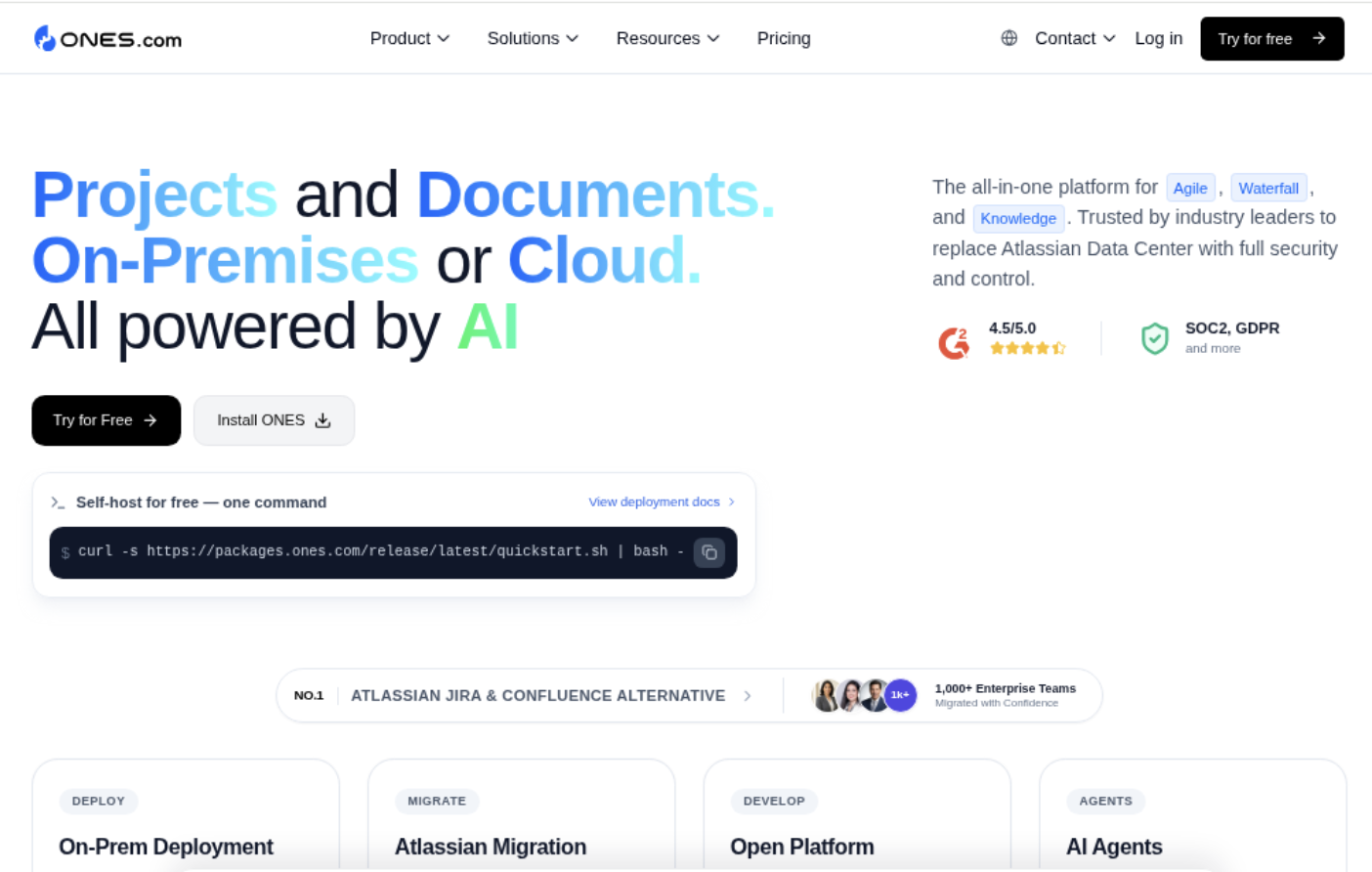
ONES.com is a unified platform for project management and knowledge management, powered by AI through ONES Assistant. ONES Project is the project management product and a Jira alternative; ONES Wiki is the knowledge base product and a Confluence alternative. They are sold separately.
It can suit teams that want Jira-compatible workflows, native reporting, and self-hosted deployment choices without depending on a long chain of plugins.
Core Capabilities
- Too many disconnected project tools: ONES Project brings planning, issue tracking, sprint management, and reporting into one project environment. The result is less switching between separate workspaces.
- Complex migration concerns: Jira-compatible workflows help teams preserve familiar delivery patterns while moving to a different platform. The result is a shorter adjustment period for experienced Jira teams.
- Plugin maintenance overhead: Built-in reporting reduces dependence on separate reporting extensions. The result is fewer compatibility concerns during upgrades.
- Inconsistent team processes: Custom workflows and fields let teams represent different delivery stages and information needs. The result is better alignment between the platform and actual operations.
- Unclear sprint execution: Sprint management supports planning, prioritization, and progress review. The result is a clearer connection between backlog decisions and delivery outcomes.
- Repetitive administrative work: Automation helps trigger routine actions when defined conditions occur. The result is less manual status maintenance and fewer missed transitions.
- Restricted deployment requirements: ONES.com supports Cloud, On-Premise, Private Cloud, and Air-gapped deployments. The result is more flexibility for teams with strict network or control requirements.
- Concerns about feature differences: ONES.com provides full feature parity between its cloud and self-hosted versions. The result is less pressure to choose deployment based only on missing functionality.
- Limited initial budget: The free offering supports up to 30 seats. The result is a practical way for a small team to evaluate core capabilities before expanding.
Application Scenarios
Restricted engineering environment: A defense contractor may need an air-gapped project management workflow. An air-gapped ONES deployment can keep project operations within the required network boundary.
Growing software organization: A company moving beyond basic issue tracking may need custom fields, sprint management, automation, and reporting. ONES Project can provide those capabilities without requiring multiple plugins.
Project and knowledge coordination: A team using ONES Project for delivery and ONES Wiki for internal knowledge can select each product separately. This allows the organization to match purchases to actual needs.
AI usage and credit planning
Because this article focuses on AI adoption and cost, ONES.com uses a three-layer AI usage model worth comparing with other AI subscription approaches.
- Basic allowance: This is designed for trying core AI features and handling limited requests. It provides a low-barrier way to explore AI assistance.
- Assistant Credit: Each user receives 3,000 credits per month in addition to the basic allowance. This supports stable individual use for recurring work.
- Extra Credit: A team-shared pool helps when personal credits are insufficient. Extra Credit costs USD 10 per 1,000 credits, with a minimum order of 5,000 credits.
This structure supports a gradual move from individual experimentation to broader team adoption. Occasional users can start with the basic allowance, regular users can rely on Assistant Credit, and high-frequency teams can use shared Extra Credit when personal allowances run short.
Extra Credit is not unlimited. Teams should monitor usage, identify high-value workflows, and set internal expectations before enabling frequent AI activity.
Common Challenges When Comparing Plans and AI Costs
Challenge: pricing pages show different totals
Problem: A monthly estimate may differ because of billing terms, region, seat count, taxes, or product combinations.
Solution: Build one estimate for current seats and another for expected seats. Review both monthly and annual payment scenarios before committing.
Challenge: teams buy features they rarely use
Problem: A premium capability can look valuable even when only one person needs it.
Solution: Identify the operational requirement first. If a lower tier solves the workflow, keep the difference available for training or integrations.
Challenge: AI adoption remains low
Problem: People may avoid AI because they do not trust its output or cannot find it during normal work.
Solution: Start with low-risk tasks such as summarization and wording improvements. Show reviewed examples, then expand usage gradually.
Challenge: AI output creates review work
Problem: Poorly checked summaries can spread incorrect decisions or hide important context.
Solution: Assign human review for release notes, commitments, estimates, and sensitive communications. Track corrections during the pilot.
Challenge: seat growth goes unnoticed
Problem: Contractors and former employees may remain active, increasing the subscription without adding value.
Solution: Schedule a monthly access review. Connect joiner and leaver processes with regular administrator checks.
FAQs
Does Atlassian Intelligence cost extra in Jira Cloud?
It depends on the product, plan, feature, and commercial terms available during your subscription period. Some AI capabilities may be included for eligible plans, while other experiences can have separate conditions or usage considerations. Check the current plan details for your specific Jira Cloud arrangement, then test the features your team actually intends to use.
Which Jira Cloud plan is best for a small team?
Free can suit a small team exploring basic issue tracking and collaboration. Standard is often a better long-term fit when the team needs broader permissions, administration, reporting, or room to grow. Compare the user limit, storage, automation needs, and AI access before choosing. A small team should also review inactive accounts regularly.
Is Premium worth the higher Jira Cloud price?
Premium can be worthwhile when advanced planning, higher scale, automation capacity, or stronger operational controls solve a real problem. It may be unnecessary for a single team with a simple backlog. Estimate the time saved and risks reduced, then compare that value with the higher subscription cost. Avoid upgrading solely because the tier sounds more complete.
Can Atlassian Intelligence replace project managers?
No. AI can summarize discussions, improve wording, and help prepare updates, but it does not own accountability. Project managers still need to evaluate trade-offs, verify risks, coordinate people, and make decisions. Treat AI output as a draft or assistant recommendation. Human judgment remains essential for commitments, estimates, escalations, and release decisions.
How can I control AI usage across a team?
Start by defining approved use cases, review requirements, and sensitive information rules. Track which activities consume the most AI capacity, then prioritize workflows with measurable value. Give people examples of effective prompts and explain when manual verification is required. A small pilot often reveals adoption patterns before a wider rollout.
What should I compare besides the subscription price?
Compare administration effort, migration complexity, integrations, reporting, security controls, deployment choices, training, and support. A cheaper subscription may require more plugins or manual maintenance. A higher-priced plan may reduce operational work. Calculate the total cost of running the workflow, not only the amount shown on the checkout page.
Conclusion
Jira Cloud pricing in 2025 depends on more than the plan label. Seats, billing cadence, optional Atlassian products, governance requirements, and AI adoption all affect the real cost.
Atlassian Intelligence can help with summaries, issue writing, search, and communication. Measure its value through repeated workflows, reviewed output, adoption, and time saved.
But here’s the truth: the cheapest plan is not always the least expensive choice, and the most advanced plan is not automatically the best fit. Match capabilities to actual work.
Compare Jira Cloud with alternatives such as ONES.com when deployment flexibility, built-in capabilities, Jira-compatible workflows, reduced plugin reliance, or AI usage planning matter to your team.