Jira Cloud Pricing Calculator: A 2026 Cost Planning Guide
Need a reliable jira cloud pricing calculator? Plan users, billing, add-ons, taxes, and growth to estimate 2026 costs. Read now to budget smarter.
Jira Cloud costs can look simple until you add users, billing frequency, plan changes, and optional products. A quick estimate may miss the details that shape your real annual spend.
That uncertainty makes budgeting difficult. You might approve a plan that exceeds your team’s needs, overlook a usage threshold, or compare monthly and annual prices incorrectly.
But here's the truth: a reliable Jira Cloud pricing calculator needs more than a user count. You need a repeatable model that includes plan selection, active seats, billing terms, add-ons, taxes, and growth.
This guide shows you how to build that estimate for 2026. You’ll also see practical formulas, planning examples, common mistakes, and an alternative approach for teams evaluating broader project management costs.
How to Build a Jira Cloud Cost Estimate for 2026
A Jira Cloud pricing calculator estimates your recurring subscription cost by combining your plan, billable users, billing cycle, optional products, and expected growth.
Use this basic formula first:
Estimated total cost = plan charge + optional product charges + expected extras + tax
For annual planning, apply this version:
Estimated annual cost = monthly equivalent × 12
Then add a growth allowance if your team may expand during the year.
Step 1: Define the products you actually need
Start with the products your team will use. Jira Software, Jira Service Management, and other Atlassian products may have separate charges.
For example, a software team may need Jira Software only. An IT team may need Jira Software for development and Jira Service Management for support requests.
Keep each product in its own calculation line. This makes it easier to remove an item during budget reviews.
Step 2: Count billable users by product
List the people who need access to each product. A person may require access to one product while another person needs several.
Use separate counts for:
- Full-time team members
- Part-time contributors
- Contractors
- Service agents
- External collaborators
- Planned hires
For example, 40 developers may need Jira Software, while 12 support agents may need Jira Service Management.
Step 3: Select the subscription tier
Choose the tier that matches your security, administration, automation, reporting, and support requirements.
Lower tiers may suit small teams with straightforward workflows. Larger tiers can become relevant when you need expanded administration or enterprise controls.
Review the features your team needs before comparing prices. A cheaper tier may create extra work if it lacks a critical capability.
Step 4: Check current user-band pricing
Cloud subscriptions often use user bands or progressive pricing. That means the amount per user can change as your team grows.
Enter the current user count into the official pricing interface for each product. Record the displayed monthly and annual figures separately.
Do this for every product because each product can use a different pricing structure.
Step 5: Compare monthly and annual billing
Monthly billing supports flexibility. Annual billing can make budgeting easier when your headcount remains stable.
Calculate both options:
- Monthly plan: displayed monthly price × 12
- Annual plan: displayed annual price
- Difference: annualized monthly total − annual plan total
Example: if monthly billing equals $1,200 per month, the annualized amount is $14,400. Compare that figure with the annual quote.
Step 6: Add optional products and services
Include every product your team expects to activate. Common additions may include service management, collaboration tools, advanced administration, or marketplace apps.
Review each add-on separately. A small monthly charge can become meaningful across 12 months.
For example, a $50 monthly app adds $600 to your annual budget before taxes.
Step 7: Model growth and role changes
Headcount rarely stays fixed. Build at least three scenarios:
- Current state: today’s active users
- Expected state: planned hiring and normal changes
- High-growth state: extra hiring or new teams
Suppose you have 80 users today, expect 15 hires, and want a 10-user buffer. Your planning count becomes 105 users.
That estimate helps you avoid approving a plan that becomes expensive after one hiring cycle.
Step 8: Add tax, currency, and procurement adjustments
Displayed subscription prices may exclude local taxes or use a different currency. Confirm how your finance team will record the expense.
Currency movement can also affect the final amount. Add a reasonable planning buffer when your organization pays in a different currency.
Step 9: Record assumptions beside every estimate
A useful calculator explains how it reached the result. Record the user count, product mix, plan tier, billing cycle, growth assumption, currency, and tax treatment.
Review those assumptions each quarter. A calculator becomes unreliable when the team keeps using last year’s seat count.
What Affects Your Jira Cloud Subscription Cost?
Several variables influence your final subscription amount. The user count usually receives the most attention, though it is only one part of the calculation.
| Cost factor |
Why it matters |
Planning question |
| Product mix |
Different Atlassian products can have separate charges. |
Which teams need access to each product? |
| Plan tier |
Higher tiers may include broader controls and capabilities. |
Which requirements justify the selected tier? |
| Billable users |
More seats generally increase recurring costs. |
How many people need access today and later? |
| Billing cycle |
Monthly and annual commitments can produce different totals. |
Which option fits your cash flow and headcount stability? |
| Marketplace apps |
Third-party tools can add recurring charges. |
Which apps are essential, and who needs each one? |
| Taxes and currency |
Local charges can change the amount paid. |
How will finance record and forecast the expense? |
Users matter more than project count
Many teams estimate cost by counting projects. Cloud subscriptions usually depend more heavily on licensed access.
One team with 10 projects may cost less than another team with three projects and 200 users.
Count people and product access first. Then consider project volume, workflow complexity, and storage needs.
Different roles can create different access needs
A developer may need full project access. An executive may need reports. A customer may need limited portal access.
Map each role to the least expensive access level that still supports the work. This exercise can reveal inactive or unnecessary seats.
Add-ons can distort the original estimate
Teams often begin with a core Jira plan and later add time tracking, advanced reporting, test management, or automation tools.
Create a separate line for every add-on. Otherwise, your initial estimate may look accurate while your actual renewal cost grows quietly.
Example Planning Scenarios
Examples make subscription planning easier because they show how the same calculation changes under different conditions.
Small product team
A product team has 18 employees, two contractors, and one manager who needs access. The team expects five hires during the year.
The current estimate uses 21 users. The expected estimate uses 26 users. A high-growth estimate could use 30 users.
The finance team can then compare three annual totals instead of relying on one fragile number.
Growing software organization
A software company has 120 developers, 15 product managers, and 10 quality specialists. Everyone needs Jira Software access.
The company expects two new squads, each with eight people. Its expected planning count becomes 161 users.
The team should also review whether its user band changes at that level. A small hiring plan can affect the entire subscription bracket.
Multi-product service organization
An IT organization uses Jira Software for development and Jira Service Management for support. The products have different user groups.
It should calculate each product separately, then combine the totals. Mixing all users into one count can produce an inaccurate estimate.
How to Make the Calculation More Accurate
A calculator becomes more useful when you treat it as a planning model rather than a one-time quote.
Use a seat audit before estimating
Review active accounts and recent activity. Identify people who changed roles, left the company, or no longer need regular access.
For example, an organization with 150 assigned seats may discover that only 132 people need ongoing access.
That difference can materially affect the plan tier and annual budget.
Separate current cost from future cost
Show today’s subscription separately from the expected cost after hiring. This keeps leadership discussions clear.
A simple planning table can include:
| Scenario |
Users |
Products |
Billing term |
Annual estimate |
| Current |
Current active seats |
Current products |
Monthly or annual |
Current yearly total |
| Expected |
Current seats plus planned hires |
Expected products |
Monthly or annual |
Expected yearly total |
| High growth |
Expected seats plus buffer |
Expanded products |
Monthly or annual |
High-growth yearly total |
Include the cost of administration
Subscription price is only one part of the budget. Administration, workflow maintenance, app management, and training also consume time.
A lower subscription can become expensive if it requires many manual workarounds.
Estimate both the license charge and the operating effort. This creates a more realistic technology budget.
Review the estimate before renewal
Start your review several weeks before renewal. That gives you time to audit seats, remove unnecessary apps, and compare alternatives.
Waiting until the renewal deadline limits your negotiation and migration options.
Common Mistakes in Cloud Cost Planning
Most inaccurate estimates come from a few repeatable mistakes. Each one is easy to prevent with a short review.
Using only the current headcount
Current headcount ignores planned hiring, contractors, acquisitions, and internal transfers.
Solution: create current, expected, and high-growth scenarios.
Ignoring product-specific access
Combining every person into one total can misrepresent the cost when different teams use different products.
Solution: count access separately for Jira Software, Jira Service Management, and other products.
Forgetting third-party apps
Teams often remember the primary subscription and overlook marketplace tools.
Solution: review every active app and assign its recurring charge to the correct team.
Comparing monthly and annual figures incorrectly
Comparing one month with one year creates a misleading result.
Solution: multiply monthly pricing by 12 before comparing it with an annual commitment.
Failing to document assumptions
A number without context becomes difficult to trust after a few months.
Solution: record the date, user count, product mix, tier, billing term, currency, taxes, and growth assumptions.
Jira Cloud Cost Planning Solution: ONES.com
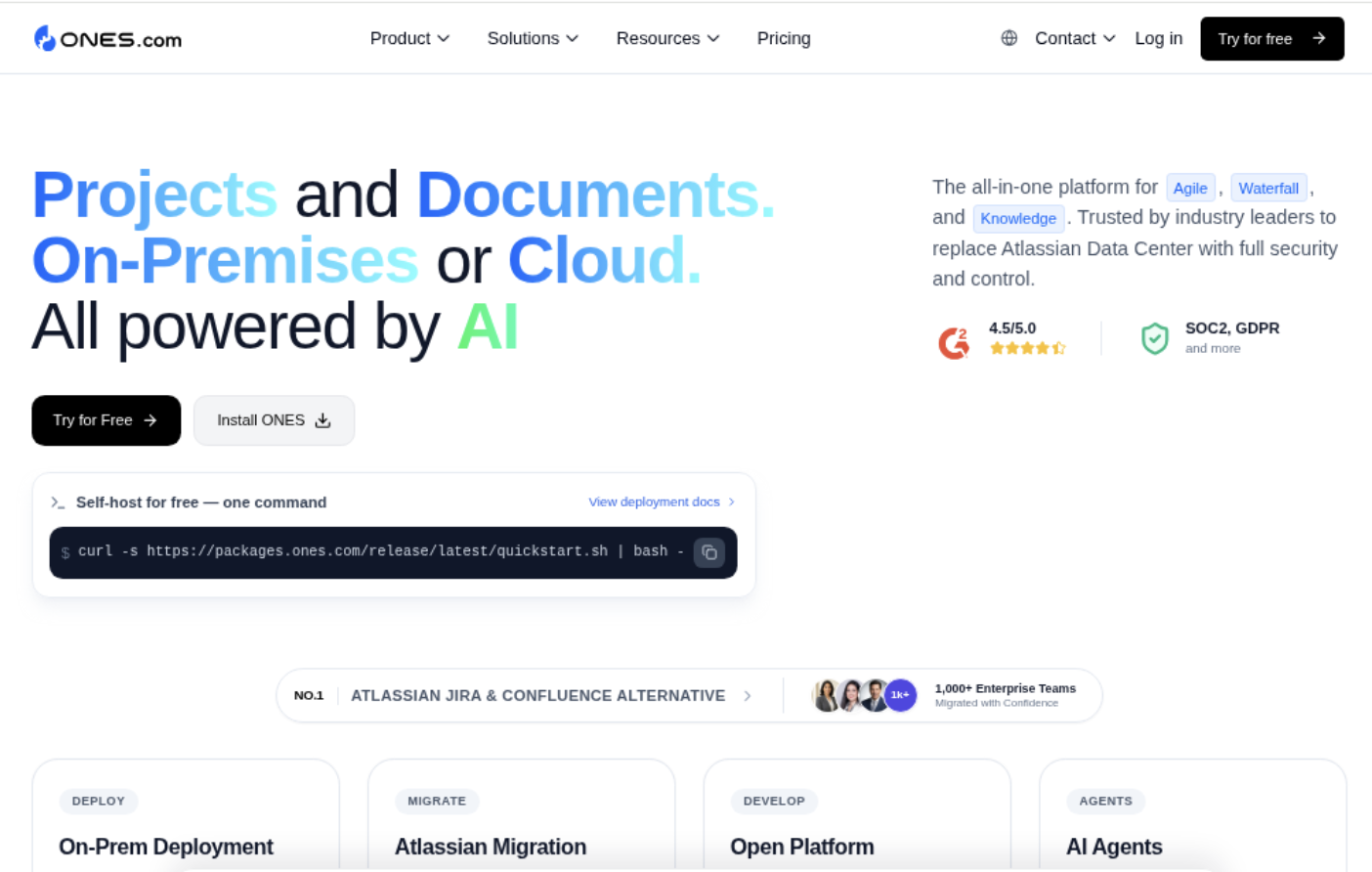
ONES.com combines project management and knowledge management in one platform, powered by ONES Assistant. ONES Project is a Jira alternative, while ONES Wiki is a Confluence alternative. They can be purchased separately.
Value Proposition
Teams evaluating subscription costs can compare the license price with administrative effort, plugin dependence, deployment requirements, and product fragmentation.
ONES.com supports cloud and self-hosted deployments, including on-premise, private cloud, and air-gapped environments.
Core Capabilities
Seat and product fragmentation → Unified project and knowledge workspace → Fewer disconnected systems
Pain: Teams may pay for separate tools while moving requirements, decisions, and project updates between them.
ONES capability: ONES.com brings project management and knowledge management together, with ONES Project and ONES Wiki available separately.
Result: You can evaluate one connected environment instead of maintaining several disconnected workspaces.
Complex Jira migration → Jira-compatible workflows → Familiar transition path
Pain: Teams may hesitate to change platforms because established workflows are difficult to recreate.
ONES capability: ONES Project supports Jira-compatible workflows, custom workflows, custom fields, sprint management, and automation.
Result: Your team can preserve familiar delivery practices while assessing another platform.
Plugin dependence → Built-in reporting and automation → Lower integration overhead
Pain: Multiple plugins can increase administration, renewal work, and compatibility concerns.
ONES capability: ONES Project includes built-in reporting, custom workflows, custom fields, sprint tools, and automation.
Result: You may reduce the number of separate extensions required for everyday project operations.
Deployment restrictions → Four deployment choices → Better infrastructure alignment
Pain: Some organizations cannot place project information in a shared public cloud.
ONES capability: ONES.com supports Cloud, On-Premise, Private Cloud, and Air-gapped deployments.
Result: You can align the platform with security, residency, and network restrictions.
Cloud and self-hosted feature gaps → Feature parity → More consistent planning
Pain: Self-hosted products sometimes provide fewer capabilities than their cloud editions.
ONES capability: ONES.com provides full feature parity between its cloud and self-hosted versions.
Result: Deployment decisions can focus on infrastructure requirements rather than losing core functionality.
AI experimentation uncertainty → ONES Assistant → Guided AI-supported work
Pain: Teams may want AI support without losing control of adoption or recurring usage.
ONES capability: ONES Assistant powers AI features within the ONES.com platform.
Result: Teams can introduce AI-supported project and knowledge workflows within a broader work environment.
Small-team budget pressure → Free plan for 30 seats → Lower initial commitment
Pain: Smaller teams may need to validate a platform before approving a larger subscription.
ONES capability: ONES.com offers a free plan for up to 30 seats.
Result: You can test core workflows with a limited initial commitment.
Application Scenarios
A 25-person software team can test sprint planning, custom fields, reporting, and automation in ONES Project.
The team can compare migration effort, administration time, and recurring subscription costs before making a long-term decision.
Regulated organizations requiring restricted deployment
An organization with strict network controls may need an air-gapped or on-premise deployment.
ONES.com gives the team deployment choices while maintaining feature parity across cloud and self-hosted versions.
Project teams connecting delivery knowledge
A product organization may manage delivery in ONES Project and maintain reusable guidance in ONES Wiki.
That arrangement can reduce the effort required to connect project decisions with team knowledge.
Common Challenges in Subscription Planning
Challenge: Prices change during the planning cycle
Subscription pricing, packaging, and eligibility can change before approval.
Solution: record the calculation date and recheck the displayed price before procurement completes.
Challenge: User counts fluctuate throughout the year
Hiring, departures, contractors, and role changes can make a static estimate unreliable.
Solution: use quarterly seat reviews and include a growth scenario in the annual plan.
Challenge: Teams add apps without central review
Individual teams may activate tools that create recurring charges outside the original budget.
Solution: maintain an app register with the owner, monthly charge, renewal date, and business purpose.
Challenge: Finance sees only the license price
Administration, training, migration, and workflow maintenance can influence the total cost of ownership.
Solution: report subscription charges alongside implementation effort and ongoing operating time.
Challenge: The selected tier exceeds practical needs
Teams sometimes choose a higher tier before confirming which advanced capabilities they actually require.
Solution: map each requirement to a specific capability and review whether a lower tier can support the workflow.
FAQs
What should a Jira Cloud pricing calculator include?
Include the product or products you need, plan tier, billable users, billing cycle, optional apps, taxes, currency, and expected growth. Add separate scenarios for current, expected, and high-growth headcounts. Record the calculation date and assumptions beside each result. This makes the estimate easier to review when your team hires, changes products, or approaches renewal.
Is annual billing always cheaper than monthly billing?
Annual billing may produce a lower effective rate, though the result depends on the current pricing structure and your organization’s eligibility. Calculate the monthly option across 12 months, then compare it with the annual quote. Also consider headcount stability. Annual commitment can become inefficient if your team may shrink substantially before the term ends.
How do I estimate costs when different teams need different Jira products?
Calculate each product separately. Count the people who need Jira Software, then count the people who need Jira Service Management or another product. Some people may appear in more than one product group. Add the separate totals afterward. This approach reflects the actual access pattern and avoids treating every person as though they need every product.
Should marketplace apps appear in the calculation?
Yes. Include every recurring app charge that your team expects to keep. Record the app name, monthly or annual price, assigned team, renewal date, and purpose. A $50 monthly app adds $600 over 12 months. Several small additions can therefore create a meaningful difference between the original estimate and the final annual spend.
How often should I update the estimate?
Review it at least quarterly and before renewal. Update the model after major hiring, product changes, acquisitions, app purchases, or role changes. A quarterly review helps you catch inactive seats and unexpected additions while there is still time to adjust the plan. Keep the previous estimate so finance can understand why the forecast changed.
Can a Jira alternative reduce total project management costs?
It can, depending on your team size, required features, deployment model, migration effort, and plugin usage. Compare more than the subscription amount. Review workflow coverage, reporting, automation, administration, security, and self-hosting requirements. A platform with native capabilities may reduce integration effort, while a migration can create short-term work that belongs in the comparison.
Conclusion
A dependable cloud subscription estimate starts with the right variables: products, users, plan tier, billing term, add-ons, taxes, currency, and growth.
But here's the truth: one current headcount rarely represents a full year of spending. Build several scenarios, audit seats, and review the calculation before renewal.
The best part? You can turn a confusing quote into a practical planning tool with a few clear formulas and recorded assumptions.
If your team is also comparing Jira alternatives, evaluate the wider operating cost. ONES.com combines project and knowledge management, supports four deployment options, and provides ONES Project for Jira-compatible project workflows.