Jira Cloud Pricing Explained: Plans, Costs, and Key Limits
Unsure about pricing Jira Cloud? Compare plans, costs, seats, add-ons, and limits to choose the right option. Click to discover!
Jira Cloud pricing can feel deceptively simple. You see Free, Standard, Premium, and Enterprise, yet the final bill depends on seats, billing frequency, add-ons, automation needs, and service limits.
That uncertainty creates real problems. A small team may choose Premium before needing it, while a growing company can underestimate annual costs after adding more contributors, agents, or apps. The cheapest plan today may also become expensive as your team expands.
But here's the truth: you can understand Jira Cloud costs by checking four things first—plan level, user count, billing cycle, and included limits. This guide explains each tier, shows where extra charges appear, and helps you compare Jira with another project management option.
Jira Cloud Pricing at a Glance
Jira Cloud pricing is based mainly on the plan you choose and the number of users or agents who need access. Jira offers Free, Standard, Premium, and Enterprise options, with monthly and annual billing available for eligible teams.
At a high level, Free suits small teams testing Jira. Standard adds larger capacity and stronger administration. Premium focuses on advanced planning, reliability, and scale. Enterprise is designed for organizations that need centralized governance across multiple sites.
| Plan |
Best for |
Main cost factor |
Important consideration |
| Free |
Small teams and early evaluation |
No subscription charge within the plan limits |
Strict limits on users, storage, support, and automation |
| Standard |
Growing project teams |
Per-user subscription |
More capacity and administration than Free |
| Premium |
Organizations managing complex work |
Higher per-user subscription |
Advanced planning, higher limits, and stronger service commitments |
| Enterprise |
Large organizations with governance requirements |
Custom enterprise pricing |
Usually purchased through a sales agreement |
Atlassian periodically changes prices, plan features, and usage allowances. Treat displayed prices as a planning reference, then confirm the total in the official Jira Cloud calculator before purchasing.
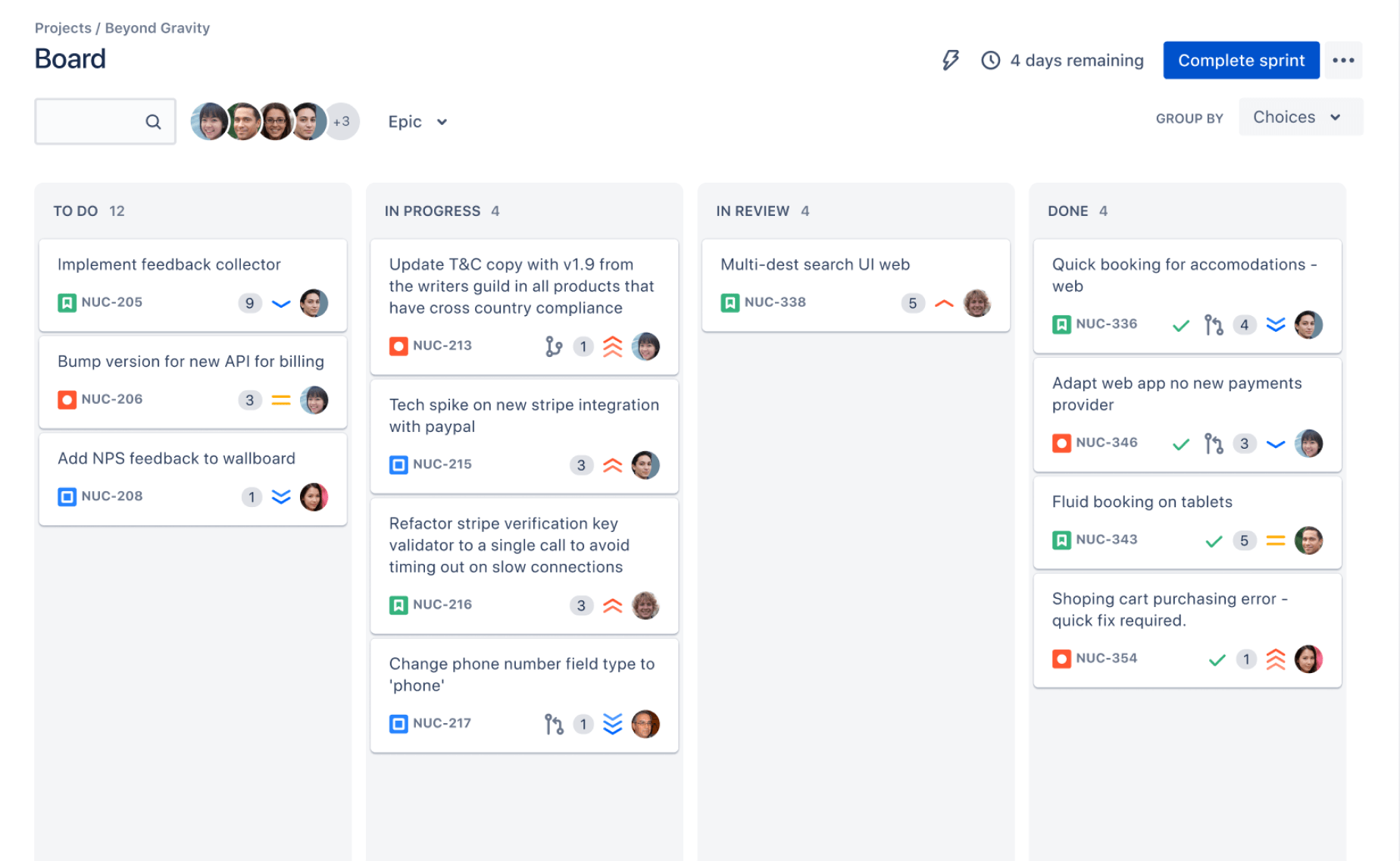
Jira Cloud Plan Costs Explained
The plan price is only the starting point. Your actual subscription depends on the number of paid seats, whether you pay monthly or annually, and which related Atlassian products or Marketplace apps you add.
Free plan
The Free plan is intended for small teams. It typically supports up to 10 users or three agents for Jira Service Management, with limited storage, automation, permissions, and support.
This option works well for a five-person product team managing a simple backlog. It becomes restrictive when you need detailed permission schemes, advanced reporting, wider collaboration, or more automation activity.
You should also consider the cost of the limits themselves. If your team spends several hours working around restricted permissions or automation rules, the subscription may be free while the workflow is expensive.
Standard plan
Standard is the usual starting point for professional teams that have outgrown Free. It supports a much larger user base and provides more practical capacity for everyday project management.
You generally gain expanded storage, broader permissions, additional automation capacity, and standard support. Exact allowances can vary, so check the current plan comparison before committing.
For example, a 35-person software team may choose Standard because every developer, tester, product manager, and designer needs access to the same delivery workflow.
Premium plan
Premium is aimed at teams coordinating complex initiatives or operating at a larger scale. It adds capabilities such as advanced planning, higher service limits, stronger uptime commitments, and features for managing work across teams.
Premium usually costs substantially more than Standard. The upgrade can make sense when cross-team planning, capacity visibility, or operational resilience directly affects delivery.
It may be difficult to justify when your team only needs backlogs, boards, dashboards, and basic automation. Paying for advanced capacity without using it creates avoidable spend.
Enterprise plan
Enterprise pricing is customized rather than displayed as one universal per-user rate. The final agreement may reflect user volume, multiple Jira sites, security requirements, support expectations, and commercial terms.
This tier is more relevant to organizations with centralized administration and formal governance. A company managing separate product, engineering, and service teams may value organization-wide controls more than a lower seat price.
Enterprise evaluation should include procurement, security, legal, and operations teams. The subscription is only one part of the total decision.
How Jira Calculates Your Monthly Bill
Jira Cloud typically uses progressive per-user pricing. That means the price per seat can change as your user count increases, rather than applying one simple rate to every person.
For example, a team with 12 paid users may not pay exactly twice the amount charged to a team with six users. Jira’s calculator applies pricing tiers to the number of seats in your subscription.
Monthly billing
Monthly billing gives you flexibility. You can add or remove users more easily, which helps when your team size changes frequently.
The trade-off is that monthly rates are often higher than the effective annual rate. A consultancy with fluctuating project staffing may accept that premium because it avoids a large upfront commitment.
Annual billing
Annual billing can reduce the effective monthly cost and simplify budgeting. It may also place you into a user tier, so you should estimate realistic usage before selecting a seat quantity.
If you buy an annual subscription for 100 users but actively need only 62, the lower nominal rate may not offset unused capacity. Review hiring plans, contractors, and occasional collaborators before choosing an annual tier.
Licensed users and occasional access
Anyone who needs regular access to Jira may require a paid seat. That can include developers, project managers, testers, designers, executives, and external collaborators.
Do not count only the people who create issues. A tester who updates status every day still contributes to the license count, even if they rarely create new work items.
Jira Service Management agents
Jira Service Management uses a different licensing model for agents. Customers, employees, and people submitting requests may not count in the same way as agents who handle those requests.
This distinction matters for an internal IT team. Two hundred employees might submit requests, while only eight support agents need paid agent access.
What Each Jira Cloud Plan Includes
Price alone does not tell you whether a plan is suitable. Compare each tier across capacity, permissions, automation, reporting, planning, reliability, and support.
Capacity and storage
Free has the tightest capacity limits. Standard provides more room for active teams, while Premium and Enterprise are intended for larger or more demanding environments.
Storage needs can grow through attachments, screenshots, design exports, and imported history. A team that stores large media assets inside issues may reach its allowance sooner than a text-heavy team.
Permissions and administration
Basic teams can work with simple project access. Larger organizations usually need more precise controls, such as separating confidential product work from general engineering activity.
Advanced administration becomes valuable when one Jira site serves multiple departments. Without clear permission design, people may see too much information or spend time requesting access manually.
Automation
Automation can assign issues, update fields, notify teams, and transition work automatically. Each plan includes an allowance, and higher tiers generally support more activity.
Imagine a rule that moves an issue when a pull request merges. One small team may run that rule a few hundred times monthly. A large engineering organization may trigger it thousands of times.
Reporting and planning
Jira’s reporting features help teams track velocity, cycle time, workload, sprint progress, and delivery trends. Advanced planning becomes more important when several teams depend on one another.
A single Scrum team may only need a sprint report. A product organization with six squads may need cross-team plans, dependency tracking, and capacity views.
Reliability and support
Premium and Enterprise plans are more relevant when Jira supports business-critical operations. Service commitments, administrative controls, and higher support expectations can matter during major incidents.
For a small internal project, those benefits may have limited value. For a company coordinating customer-facing releases, downtime can delay revenue and support operations.
Additional Costs Beyond the Jira Subscription
Many teams budget only for Jira seats. The wider cost can include related products, apps, implementation, migration, training, and ongoing administration.
Related Atlassian products
Jira Software, Jira Service Management, and Confluence address different needs. Adding another product can improve collaboration, but it creates a separate subscription to evaluate.
A software team might use Jira for delivery work and Confluence for internal knowledge. An IT department may add Jira Service Management for requests, incidents, and service changes.
Marketplace apps
Marketplace apps can add roadmaps, time tracking, testing, portfolio planning, specialized reports, or stronger integrations. Each app may have its own price and user-count rules.
Five inexpensive apps can create a meaningful recurring bill. Review every app quarterly and remove anything that no longer supports an active workflow.
Implementation and migration
Moving from another project management system can require workflow design, permission planning, issue cleanup, training, and integration work.
A team that pays $500 more each month for Jira but saves 40 hours of manual coordination may still achieve a positive return. Include staff time when comparing platforms.
Administration
Someone must manage users, permissions, workflows, custom fields, automation, dashboards, and app settings. That responsibility may belong to an engineering operations specialist or a part-time administrator.
Complex customization can increase administrative overhead. A cleaner setup with fewer custom fields often costs less to maintain over time.
Jira Cloud Free Versus Paid Plans
The Free plan is useful for validating Jira with a small group. Paid plans become more attractive when limitations affect delivery, governance, or collaboration.
| Evaluation area |
Free may be enough when |
Paid access is more suitable when |
| Team size |
You have a small, stable team |
Your team is growing or includes many collaborators |
| Automation |
You use a few simple rules |
Automated transitions and notifications run frequently |
| Permissions |
Everyone can see most project activity |
You need detailed access controls |
| Reporting |
Basic dashboards answer your questions |
You need cross-team planning and deeper visibility |
| Support |
Your team can troubleshoot independently |
Project interruptions require stronger assistance |
Start with Free when the goal is experimentation. Move to Standard when the limits affect normal work, rather than upgrading simply because a higher tier appears more professional.
How to Choose the Right Jira Cloud Plan
- Count active contributors. Include everyone who needs to create, edit, assign, comment on, or transition work.
- Separate occasional viewers from regular contributors. People who only review dashboards may have different access needs.
- List required capabilities. Mark advanced planning, automation volume, permissions, reporting, uptime commitments, and support as essential or optional.
- Estimate growth. Include expected hires, contractors, acquisitions, and new teams over the next 12 months.
- Compare monthly and annual totals. Check the effective cost, seat commitment, and flexibility of each billing method.
- Add connected products and apps. Include Confluence, Jira Service Management, Marketplace apps, and integration services.
- Calculate administration effort. Estimate time spent managing workflows, fields, permissions, and recurring cleanup.
- Test a realistic project. Use a sample backlog, sprint, dashboard, automation rule, and permission scheme before purchasing widely.
- Review the total in Jira’s calculator. Confirm current pricing, taxes, discounts, seat tiers, and eligibility at checkout.
The best plan is the lowest tier that supports your required workflow without creating costly workarounds. A higher tier should solve a specific operational problem.
Ways to Control Jira Cloud Costs
Audit seats regularly
Remove inactive accounts and review external collaborators. A quarterly access review can prevent paying for people who left the organization months ago.
Limit customization
Every custom field, workflow, and automation rule adds maintenance. Begin with a small operating model, then add complexity when a clear need appears.
Track app value
Ask whether each Marketplace app saves time, improves control, or supports a required process. If nobody uses an app during a full quarter, remove it or pause the subscription.
Measure automation activity
Duplicate rules and unnecessary triggers can consume allowances quickly. Replace several overlapping rules with one clearly scoped rule when possible.
Compare annual commitment carefully
Annual billing can reduce the effective rate, but only if your expected seat count is realistic. A discount does not create savings when you pay for unused capacity.
Jira Cloud Alternative: ONES.com
ONES.com is a unified project management and knowledge management platform powered by AI through ONES Assistant. ONES Project is the project management product and can serve as a Jira alternative, while ONES Wiki is the knowledge management product and can serve as a Confluence alternative. They are sold separately.
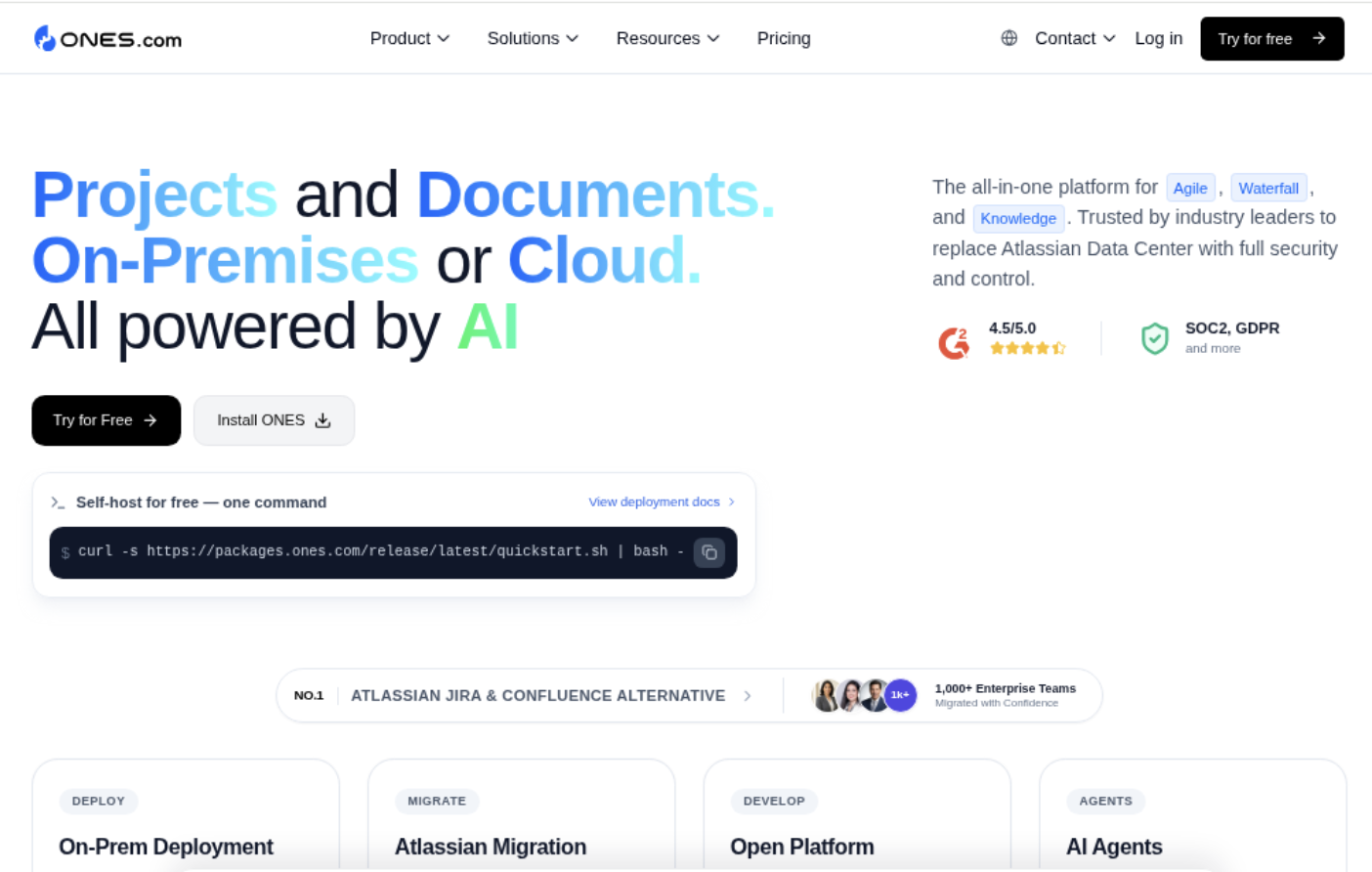
For teams comparing Jira Cloud pricing with another operating model, ONES.com offers Cloud, On-Premise, Private Cloud, and Air-gapped deployments. The free offering supports up to 30 seats, and the self-hosted versions provide feature parity with the cloud version.
Value Proposition
ONES Project brings Jira-compatible workflows, sprint management, reporting, custom fields, and automation into one project management environment. It can reduce dependence on multiple plugins while giving teams a self-hosted deployment option.
Core Capabilities
1. Too many disconnected tools → unified project and knowledge management → less context switching
When delivery work lives in one product and team knowledge lives elsewhere, people repeat questions and lose context. ONES.com connects project management with knowledge management through ONES Project and ONES Wiki.
2. Jira migration concerns → Jira-compatible workflows → a more familiar transition
Teams already using issue types, sprints, boards, and status flows can preserve familiar working patterns. That reduces the training burden during a platform evaluation.
3. Plugin dependence → native reporting and automation → fewer add-on decisions
Many teams add apps to fill reporting or workflow gaps. ONES Project includes built-in reporting, custom workflows, custom fields, and automation, which can reduce the number of separate extensions you need.
4. Complex sprint coordination → sprint management → clearer delivery control
Product and engineering teams can plan iterations, assign work, monitor progress, and review outcomes in one project environment. A sprint review can then focus on delivery results rather than reconstructing activity across tools.
5. Strict hosting requirements → On-Premise, Private Cloud, or Air-gapped deployment → stronger infrastructure alignment
Some organizations cannot place project information in a public cloud environment. ONES.com supports self-hosted deployment models, including air-gapped environments for restricted networks.
6. Uneven feature availability → feature parity across cloud and self-hosted versions → more deployment flexibility
Teams sometimes accept fewer capabilities when choosing self-hosting. ONES.com maintains full feature parity between its cloud and self-hosted versions, helping you choose deployment based on governance needs.
7. Growing user costs → free access for up to 30 seats → a lower-friction evaluation
A small team can test core project workflows without immediately paying for a large commercial rollout. This is useful when you want to validate adoption before planning a wider deployment.
8. Fragmented AI assistance → ONES Assistant → support for knowledge and project work
ONES Assistant brings AI-powered support into the platform. You can evaluate how AI helps with project coordination and knowledge work without treating it as a separate operating environment.
Application Scenarios
Software development team: A 25-person product group can use ONES Project for backlogs, sprints, custom workflows, and delivery reporting. ONES Wiki can hold release practices and engineering knowledge when purchased separately.
Restricted-network organization: A regulated team can deploy ONES.com on-premise or in an air-gapped environment. This approach helps align project operations with internal infrastructure rules.
Growing company: A company moving beyond a small Jira Cloud setup can compare seat costs, plugin requirements, hosting preferences, and administration effort before choosing its next platform.
Common Challenges When Estimating Jira Costs
Challenge: counting only developers
Solution: Count every regular contributor, including testers, product managers, designers, contractors, and support staff. Map each role to the actions it needs to perform.
Challenge: ignoring related subscriptions
Solution: Add Confluence, Jira Service Management, Marketplace apps, and integration services to the same annual budget review.
Challenge: choosing a plan for future features
Solution: Separate current requirements from possible future needs. Upgrade when a real constraint appears, and document the problem the upgrade resolves.
Challenge: underestimating administration
Solution: Include time for access reviews, workflow changes, field cleanup, automation maintenance, and onboarding. Software cost is only one part of ownership.
Challenge: relying on old prices
Solution: Recheck the current Jira calculator before signing an agreement. Prices, limits, regional taxes, and plan features can change.
FAQs About Jira Cloud Costs
Is Jira Cloud free?
Jira Cloud has a Free plan for small teams within specific limits. Those limits can affect users, storage, automation, permissions, support, and available administration features. Free access works well for early evaluation or a small project. Review the current allowance before inviting your full team, because exceeding a limit may require a paid upgrade or a different workflow.
How much does Jira Cloud cost per user?
Paid Jira Cloud plans generally use progressive per-user pricing, so the effective rate depends on your seat tier and billing cycle. Standard and Premium have different rates, while Enterprise uses customized pricing. Monthly billing usually offers more flexibility, whereas annual billing may reduce the effective monthly cost. Use the current Jira pricing calculator for a precise estimate.
What is the difference between Jira Standard and Premium?
Standard is designed for everyday project management with more capacity than Free. Premium adds capabilities for larger or more complex organizations, such as advanced planning, higher service limits, and stronger reliability commitments. The right choice depends on your operating requirements. If your team only needs backlogs, boards, dashboards, and basic automation, Standard may be sufficient.
Does Jira charge for people who only view work?
Access rules depend on the product and permission level. Regular contributors generally need licensed access, while some viewing or customer scenarios may follow different rules. Do not assume that every occasional viewer is free. Review the current licensing terms and identify what each person needs to do before calculating your seat count.
Are Jira Marketplace apps included in the plan price?
Marketplace apps are generally separate subscriptions. They can add time tracking, testing, planning, reporting, integrations, or other capabilities, but each app may use its own pricing and user-count rules. Include app costs in your total estimate. A low Jira subscription can become expensive when several paid extensions are added.
Should I choose monthly or annual Jira billing?
Choose monthly billing when your team size changes often or you are still evaluating Jira. Annual billing can be more economical when your seat count is stable and you expect to use the platform throughout the year. Compare the effective total, unused capacity, renewal terms, and expected hiring plans. The lowest advertised monthly equivalent is not always the lowest practical cost.
Conclusion
Jira Cloud pricing depends on more than the label attached to each plan. Your real cost includes seats, billing frequency, capacity limits, automation, related products, Marketplace apps, implementation, and administration.
But here's the practical solution: count active contributors, match capabilities to actual requirements, estimate growth, compare monthly and annual billing, and confirm the current total before committing.
If Jira’s ecosystem, hosting model, or add-on requirements do not fit your team, compare Jira alternatives such as ONES Project. The right platform is the one that supports your workflow without creating unnecessary cost or operational complexity.