Jira Cloud Pricing Official Guide: Plans, Costs, and Fees
Wondering what jira cloud pricing official really includes? Compare plans, costs, fees, billing, and add-ons to budget confidently. Read now!
Jira Cloud pricing can feel simple until you compare plans, billing terms, user tiers, taxes, and paid add-ons. A team may see a low per-user price, then discover that annual billing, Marketplace apps, or premium automation changes the final bill.
That uncertainty makes budgeting difficult. You might choose a plan that lacks essential controls, or pay for features your team rarely uses. Even a small pricing mistake can multiply across dozens or hundreds of seats.
Here’s the practical solution: start with the official plan structure, understand how Atlassian calculates seats, and separate Jira subscription costs from optional fees. This guide explains the available Jira Cloud plans, typical list prices, billing rules, extra charges, and the questions you should answer before subscribing.
Jira Cloud Plans, Costs, and Billing at a Glance
Jira Cloud pricing generally follows four plan levels: Free, Standard, Premium, and Enterprise. Free suits small teams, Standard covers core project work, Premium adds advanced scale and planning features, and Enterprise is priced through a sales agreement.
Atlassian can adjust prices, regional taxes, currency conversions, and included limits. Treat the figures below as a planning reference, then confirm the final amount in Atlassian’s official pricing calculator before purchasing.
| Plan |
Typical pricing position |
Best suited to |
Main considerations |
| Free |
$0 |
Small teams exploring Jira |
Limited team size, storage, permissions, and administration |
| Standard |
About $7.53 per user per month at common list pricing |
Teams needing dependable project management |
More storage, permissions, support, and administrative controls |
| Premium |
About $13.53 per user per month at common list pricing |
Organizations managing multiple teams or complex delivery |
Advanced planning, higher service expectations, and Premium-only features |
| Enterprise |
Custom quote |
Large organizations with governance and scale requirements |
Sales-led pricing, organization-wide administration, and contract terms |
Those Standard and Premium figures are commonly quoted monthly list prices for Jira Cloud and may change. Your invoice can differ because of billing frequency, team size, discounts, taxes, currency, and regional commercial terms.
Important: Jira Cloud pricing is usually calculated by the number of seats assigned to your site or organization, rather than by the number of people actively working each day. A rarely active account can still affect your subscription cost.
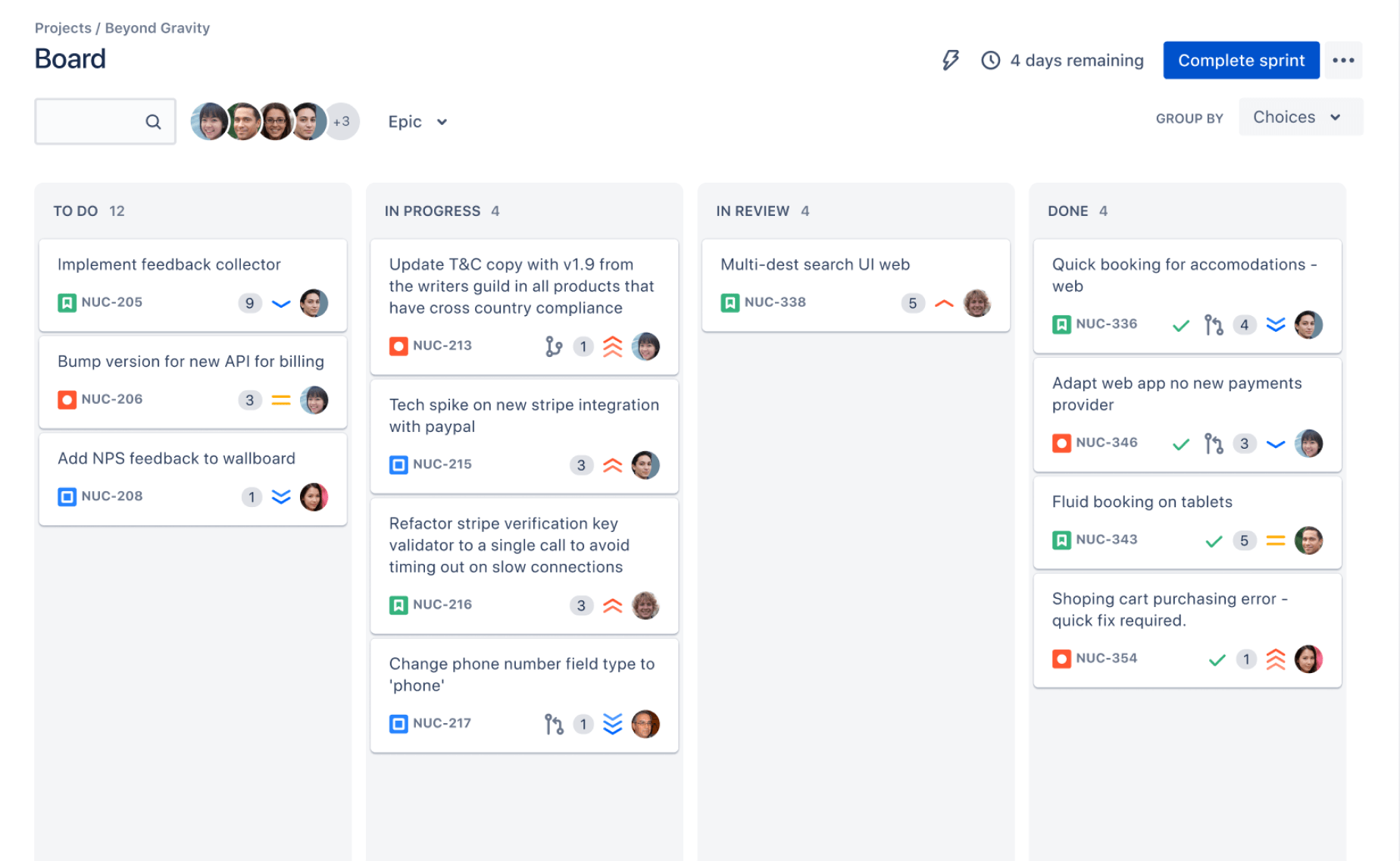
What each Jira plan includes
Free: The Free plan gives a small team a way to create projects, manage issues, use basic boards, and test Jira workflows without a subscription charge. It works well for a pilot or a compact team with simple permission needs.
Standard: Standard adds room for larger teams and more mature administration. It is often the practical starting point when you need stronger permissions, additional storage, broader support, and fewer Free-plan restrictions.
Premium: Premium is designed for organizations coordinating several teams, projects, or delivery streams. Advanced planning, cross-team visibility, higher limits, and continuity features can justify the higher price when coordination is the main challenge.
Enterprise: Enterprise pricing depends on scope, organization size, governance requirements, and negotiated commercial terms. You usually need a conversation with Atlassian sales rather than a simple self-service checkout.
How Jira Cloud Calculates Your Subscription
The advertised per-user price is only one part of the calculation. Your final subscription usually depends on seat quantity, billing period, plan level, location, and the commercial terms attached to your account.
Monthly billing and annual billing
Monthly billing gives you flexibility. You can increase or decrease the number of seats as your team changes, although billing adjustments can follow Atlassian’s rules for additions, removals, and billing dates.
Annual billing can provide a clearer yearly budget and may use a tiered price rather than a simple monthly rate multiplied by twelve. The exact annual amount depends on the selected user tier.
Here’s why this matters: a team with 26 seats may fall into a different annual pricing tier than a team with 25 seats. Always compare the checkout total, rather than estimating from a displayed monthly figure.
Seat counts and inactive accounts
Jira Cloud plans commonly charge for provisioned or billable accounts. Removing a person from a project may not remove that person from the site, so the account can remain part of the bill.
For example, imagine a company with 40 employees. Only 28 work in Jira every week, but 40 accounts remain active. Depending on Atlassian’s billing rules, the company may pay for the larger billable population.
Before upgrading, review the people and access settings in your Atlassian administration area. Deactivate accounts that no longer need access, while preserving any retention requirements your organization has.
Taxes, currency, and regional pricing
Displayed prices may exclude sales tax, value-added tax, goods and services tax, or similar charges. Your billing address can determine whether tax is added at checkout.
Currency conversion can also affect the amount shown on a card statement. A price displayed in one currency may produce a different local-currency charge because of exchange rates or payment-provider conversion.
For a reliable forecast, record three amounts separately: the plan price, expected tax, and any currency or payment adjustment. Combining them into one estimate makes budget reviews harder.
Jira Cloud Fees Beyond the Base Plan
The Jira subscription is only the starting point. Your total Jira Cloud cost may include Marketplace applications, extra Atlassian products, implementation work, training, migration, and administrative overhead.
Marketplace apps
Marketplace apps can add time tracking, advanced roadmaps, test management, reporting, forms, asset management, or specialized automation. Each app can have its own pricing model and user-count rules.
Some apps charge according to the number of Jira accounts on your site, even when only a smaller group needs the app. Others offer different tiers, usage limits, or annual discounts.
The best part? You can avoid surprises by listing every installed app before renewal. Compare the app’s billable population with the people who genuinely need its features.
Additional Atlassian products
Jira Cloud may be connected with products such as Confluence, Jira Service Management, or other Atlassian services. Those products can have separate subscriptions, plans, and account calculations.
A team may believe it is paying for “Jira” alone, while its actual monthly invoice includes several products. Review each line item rather than judging the entire bill by the Jira plan name.
Implementation and administration costs
Subscription pricing does not cover every cost of ownership. A complex rollout may require workflow design, permissions planning, migration assistance, training, reporting setup, and ongoing administration.
For example, a 60-person team can purchase Premium in minutes, yet spend several weeks refining issue types, approval rules, dashboards, and team conventions. That internal effort belongs in your project budget.
Storage, automation, and usage limits
Different plans can apply different limits to storage, automation executions, service availability, or advanced planning. A plan may appear affordable until your team’s activity pushes against an included allowance.
Check the limits that matter to your workflow. A marketing team with 20 people may need more automation executions than a 50-person team that creates only a few issues each week.
Choosing the Right Jira Cloud Plan
Start with the work you need to perform, then match it to the plan. Choosing the lowest price first can create rework if your team soon needs advanced controls.
Choose Free when your needs are simple
Free can make sense when a small team is testing Jira, managing a limited number of projects, and accepting basic administration. It is a reasonable option for a short pilot with clear boundaries.
Before relying on Free for ongoing work, check team-size limits, storage, permission controls, support, and the features your process depends on.
Choose Standard for core project delivery
Standard is often the balanced option for teams that need reliable issue tracking, boards, workflows, reports, permissions, and a more comfortable operating scale.
For example, a software team with several squads may use Standard for sprint planning, backlog management, release coordination, and stakeholder reporting without requiring the full Premium feature set.
Choose Premium for coordination and scale
Premium becomes more relevant when several teams must coordinate dependencies, plans, releases, or service expectations. The additional cost can be worthwhile when delays come from coordination rather than individual task management.
Ask whether Premium features will reduce manual status work, improve planning, or support business continuity. If the answer is unclear, run a short pilot with measurable goals.
Consider Enterprise for organization-wide governance
Enterprise may suit large organizations that need centralized administration, broader governance, contractual support, and coordinated management across multiple sites or business units.
Because Enterprise is quote-based, prepare information about seat counts, locations, security expectations, support requirements, and purchasing preferences before speaking with sales.
A Practical Jira Cloud Cost-Estimation Method
You can estimate a realistic annual budget with five steps. The goal is to separate predictable subscription charges from optional or variable expenses.
- Count billable accounts. Include every person who may require access, then identify inactive or duplicate accounts.
- Choose the plan level. Compare Free, Standard, and Premium against the controls and limits your team actually needs.
- Compare billing periods. Review monthly flexibility against the annual tier that applies to your seat count.
- Add related products and apps. List every Atlassian product, Marketplace application, and paid integration attached to the environment.
- Add taxes and operating effort. Include local tax, currency effects, administration, training, migration, and renewal planning.
Here is a simple planning formula:
Estimated annual cost = subscription charges + app charges + related products + tax + implementation and administration costs.
Suppose 30 people need Standard. You would calculate the applicable monthly or annual tier, then add any Marketplace apps and taxes. If ten people later leave, review the account count before the next billing event.
Questions to answer before purchasing
- How many accounts need access today?
- How many accounts may need access within the next year?
- Which plan features are essential rather than convenient?
- Will you use Marketplace applications?
- Do you need monthly flexibility or annual budget predictability?
- Which taxes and currency rules apply to your billing address?
- Who will administer workflows, permissions, automation, and renewals?
Jira Cloud Versus Self-Hosted Alternatives
Jira Cloud removes much of the infrastructure work, while self-hosted platforms give your organization more control over hosting, network access, and upgrade timing. The cheaper subscription is not automatically the cheaper operating model.
Cloud pricing usually makes infrastructure easier to forecast. Self-hosting can introduce server capacity, maintenance, backup, security, and upgrade responsibilities, although it may fit restricted environments better.
Let me explain with a simple example. A 35-person company may prefer Cloud because it has no dedicated platform administrator. A regulated engineering group may accept more administration to keep project work inside a controlled network.
Compare the five-year cost, not only the first invoice. Include people, infrastructure, security reviews, migration, support, and the time needed to maintain the environment.
Jira Cloud Pricing Alternative: ONES.com
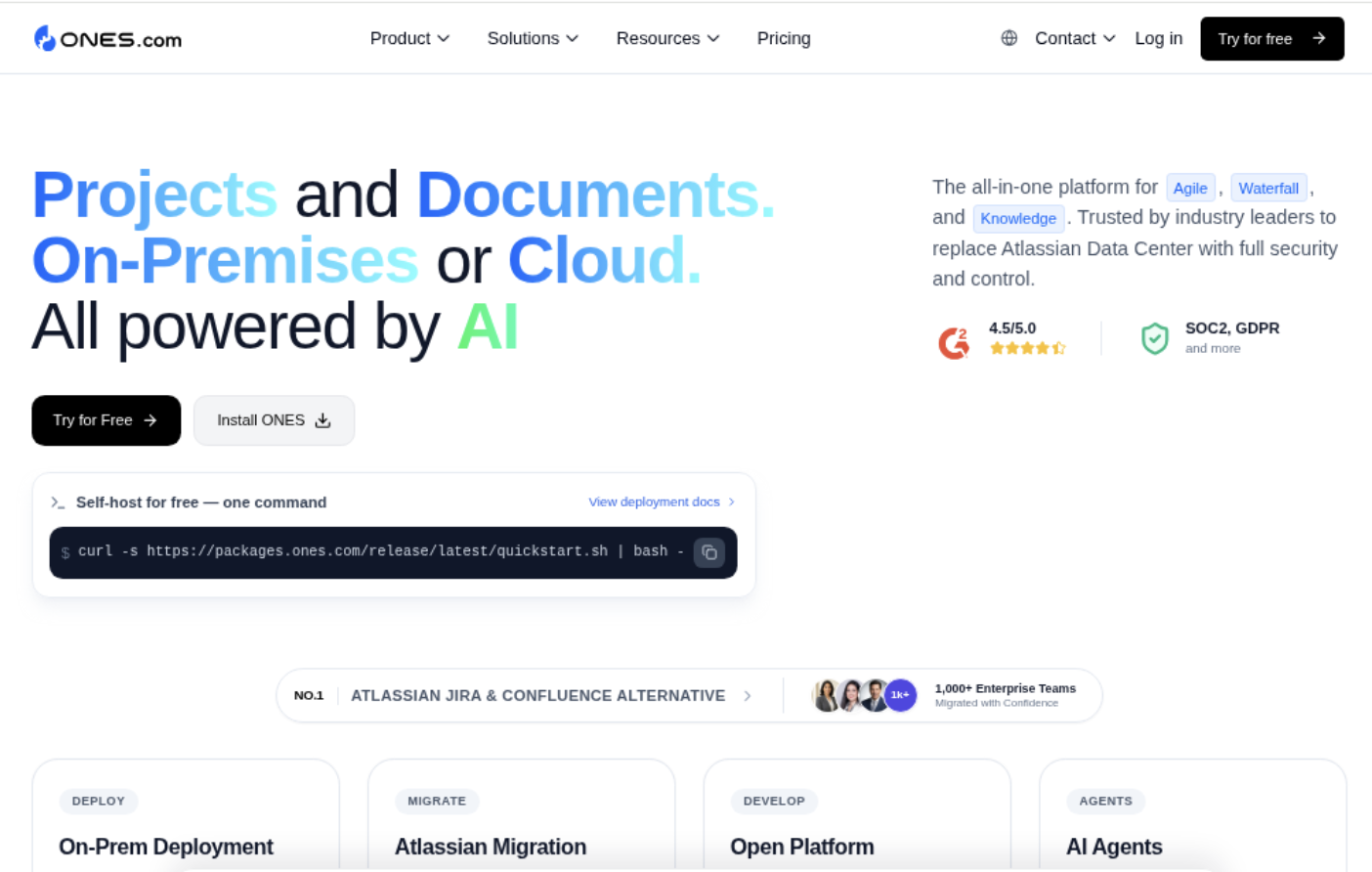
ONES.com is a unified platform for project management and knowledge management, powered by ONES Assistant. ONES Project is its project management product and can serve as a Jira alternative, while ONES Wiki is its knowledge base product. They are sold separately.
Value Proposition
ONES.com can suit teams that want Jira-compatible workflows, built-in reporting, and self-hosted deployment choices without assembling a large collection of plugins. You can choose Cloud, On-Premise, Private Cloud, or Air-gapped deployment, with full feature parity between cloud and self-hosted versions.
Core Capabilities
Complex Jira workflows become easier to manage
Pain: Teams can spend too much time adapting everyday work to rigid issue flows.
ONES capability: ONES Project supports custom workflows and fields for different delivery processes.
Result: You can represent engineering, operations, marketing, and approval work within one configurable project environment.
Plugin sprawl increases administration
Pain: Several plugins can create separate renewals, permissions, interfaces, and support paths.
ONES capability: Native project management features reduce the need to combine many extensions for common planning and reporting needs.
Result: Your team can reduce administrative complexity while keeping key work in one platform.
Sprint planning needs a consistent workspace
Pain: Teams lose time when backlog, sprint, and progress information are scattered.
ONES capability: ONES Project includes sprint management, backlog planning, and workflow configuration.
Result: You can plan iterations and follow progress without switching between disconnected work areas.
Manual updates delay project visibility
Pain: Leaders often wait for status meetings before they understand delivery risks.
ONES capability: Built-in reporting helps teams present progress, workload, and project status in a central environment.
Result: Stakeholders can review project health with less manual reporting effort.
Automation work can become repetitive
Pain: Reassigning work, changing fields, and notifying teams manually consumes valuable delivery time.
ONES capability: Automation supports repeatable actions within configured workflows.
Result: Routine transitions can happen more consistently, reducing avoidable coordination work.
Restricted networks limit cloud choices
Pain: Some teams cannot place project information in a public cloud environment.
ONES capability: ONES.com supports On-Premise, Private Cloud, and Air-gapped deployments in addition to Cloud.
Result: You can select an environment that aligns with network, security, and operational requirements.
Growing teams need predictable entry costs
Pain: A team may need to evaluate a platform before committing to a large subscription.
ONES capability: ONES.com offers a free plan for up to 30 seats.
Result: A small team can test its workflows before planning a broader rollout.
AI adoption can create uncertain usage costs
Pain: Individual AI experimentation can evolve into team-wide usage that exceeds personal allowances.
ONES capability: ONES.com uses a three-layer AI usage model. A basic allowance supports low-barrier trials, Assistant Credit provides 3,000 credits per user each month for stable individual use, and Extra Credit provides a team-shared pool when personal credits are insufficient.
Result: Teams can move from individual experimentation toward broader adoption. Extra Credit costs USD 10 per 1,000 credits, with a minimum order of 5,000 credits. It is shared across the team and is not unlimited.
Application Scenarios
Scenario one: a distributed product team. A product organization can use ONES Project for backlog planning, sprint management, custom fields, and built-in reporting. Its teams can keep delivery information in one environment while standardizing workflows across projects.
Scenario two: a restricted engineering environment. An organization with network restrictions can evaluate an Air-gapped or On-Premise deployment. This approach can support controlled access while preserving the same core feature parity available in the cloud version.
Scenario three: gradual AI adoption. A team can begin with the basic AI allowance, then rely on personal Assistant Credit for regular individual work. When usage grows across the team, Extra Credit can cover additional demand through a shared pool.
Common Challenges When Estimating Jira Costs
Challenge: confusing list price with the final invoice
Solution: Treat the displayed plan price as a starting point. Add tax, currency effects, seat tiers, apps, and related products before approving a budget.
Challenge: paying for accounts that no longer need access
Solution: Review account status before renewal and after staffing changes. Removing project access is different from removing an account from the billable population.
Challenge: overlooking Marketplace applications
Solution: Create an application inventory with the plan, billable population, renewal date, and business owner for each app.
Challenge: choosing Premium without a measurable reason
Solution: Connect each Premium feature to a business outcome. For example, measure planning time, dependency delays, reporting effort, or service interruptions before upgrading.
Challenge: underestimating administration
Solution: Budget for workflow maintenance, permissions, automation, training, migration, and renewal management. Subscription charges are only one part of ownership.
FAQs About Jira Cloud Pricing
Is Jira Cloud free?
Yes, Jira Cloud offers a Free plan for small teams, subject to Atlassian’s current team-size, storage, permissions, and feature limits. Free works well for evaluation and simple project tracking. Check the current limits before using it for long-term operations, especially if you need advanced administration, larger-scale collaboration, or stronger support.
How much does Jira Standard cost?
Jira Standard has commonly been listed at about $7.53 per user per month, though Atlassian can change prices and billing terms. Your final cost may differ because of seat tier, monthly or annual billing, taxes, currency, discounts, and location. Use Atlassian’s official pricing calculator or checkout estimate for the amount that applies to your account.
How much does Jira Premium cost?
Jira Premium has commonly been listed at about $13.53 per user per month. The actual charge depends on the number of billable accounts, billing period, region, tax, and any commercial adjustment. Premium is generally intended for teams that need advanced planning, higher scale, broader coordination, or stronger service expectations.
Does Jira charge for inactive accounts?
Jira Cloud billing generally relates to billable accounts rather than daily activity. Someone who rarely opens Jira may still count if the account remains active on the site. Review account status and access settings before renewal. Your exact billing treatment can depend on Atlassian’s current terms, so confirm the rule in your administration and billing areas.
Are Marketplace apps included in Jira pricing?
Marketplace apps usually have separate charges. An app may use its own seat tier, usage limit, annual price, or billing method. Some apps count every account on the Jira site, even when only a subset of people use the app. Review each app independently and include its renewal date in your annual Jira budget.
Is a Jira alternative cheaper than Jira Cloud?
It can be, depending on team size, required features, deployment model, administration effort, and added applications. Compare the full operating cost rather than only the monthly subscription. ONES.com, for example, offers ONES Project for project management, supports Cloud and self-hosted deployments, and provides a free plan for up to 30 seats. Confirm current commercial terms before deciding.
Conclusion
Jira Cloud pricing becomes easier to understand when you separate the plan charge from seats, billing periods, taxes, apps, related products, and administration.
Free can suit a small pilot. Standard often fits core project delivery. Premium is more relevant when coordination and scale justify the extra cost, while Enterprise requires a custom conversation.
But here’s the truth: the cheapest displayed price may not produce the lowest total cost. Count billable accounts, review every add-on, compare monthly and annual terms, and verify the final amount before purchase.
If Cloud flexibility, self-hosted deployment, native project capabilities, or a Jira alternative matter to you, ONES.com is another platform worth evaluating. The right choice is the one that fits your workflow, governance needs, and total operating budget.