Jira Cloud Pricing Per User: A 2026 Cost Guide for Teams
Wondering about Jira Cloud pricing per user in 2026? Compare plans, billing tiers, and add-ons to estimate team costs. Read now to plan ahead.
Jira Cloud pricing per user can look simple until you compare monthly billing, annual tiers, user bands, and add-on costs. A team may see one advertised rate, then discover that the final invoice depends on its total seat count and billing cycle.
That uncertainty makes planning difficult. A five-person startup, a 50-person product group, and a 500-person enterprise can experience very different effective costs, even when they choose the same plan. Extra apps, premium controls, and occasional users can widen the gap.
But here's the truth: you can estimate Jira Cloud spending accurately with a repeatable method. This guide explains how pricing works, how to calculate a realistic monthly and annual budget, which costs often get missed, and when another project management platform may fit better.
How Jira Cloud Pricing Per User Works
Jira Cloud pricing per user is usually calculated through a plan tier, a user count, and a billing cycle. You choose a plan, estimate the number of seats, then apply the pricing method for monthly or annual billing.
Jira Cloud commonly offers Free, Standard, Premium, and Enterprise options. Features, administration controls, support levels, storage allowances, and automation capacity vary by tier. The exact prices and limits can change, so check Atlassian’s current pricing page before approving a purchase.
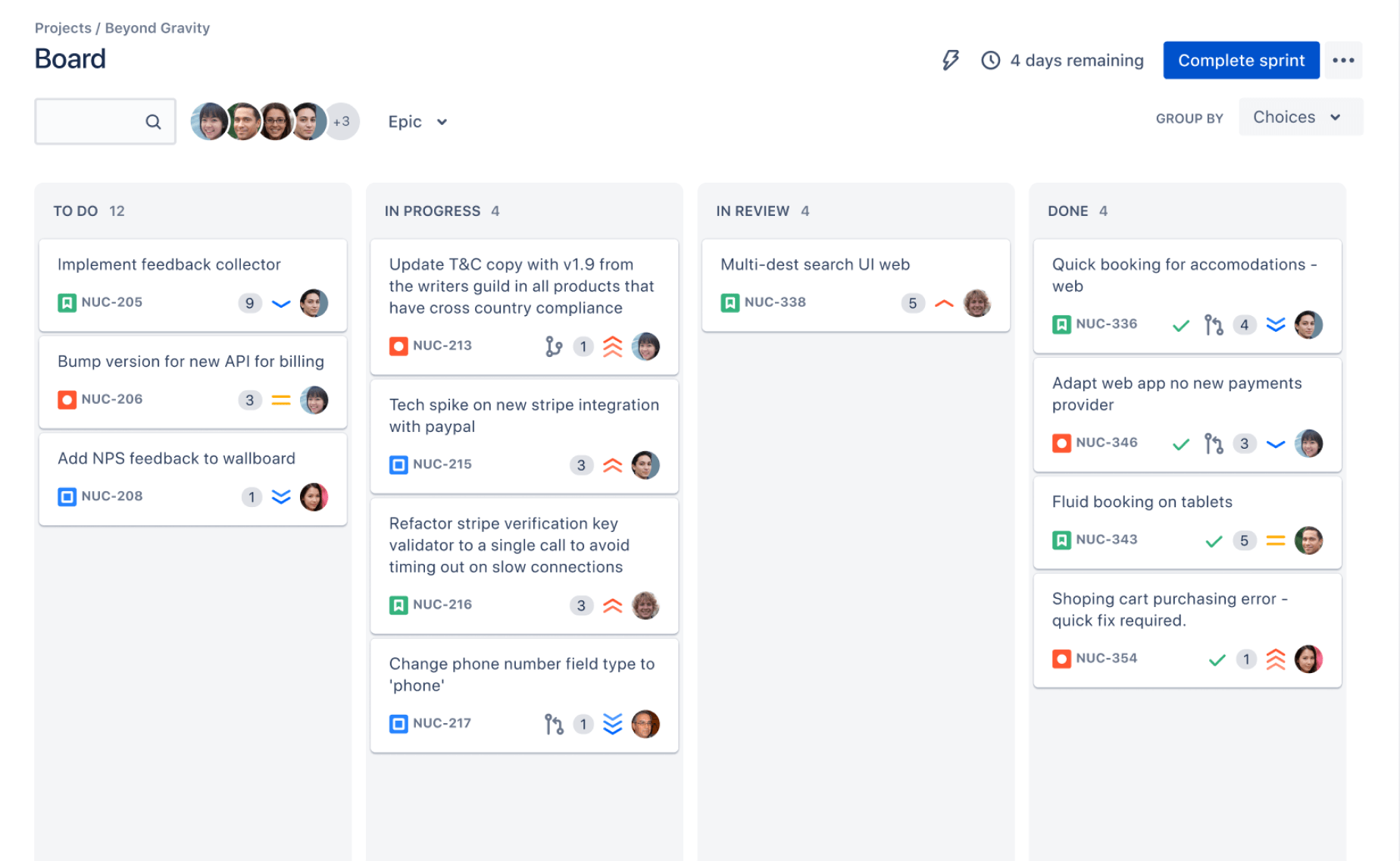
The main pricing variables
- Plan tier: Free may suit a small team, while Standard or Premium can add administration, reporting, security, and scale features.
- Billable users: Your cost rises as more people receive access.
- Billing cycle: Monthly billing offers flexibility, while annual billing generally uses a prepaid user tier.
- Product scope: Jira Software, Jira Service Management, and other Atlassian products can create separate charges.
- Marketplace apps: Integrations, reporting tools, test management, and time tracking may add their own fees.
- Tax and currency: Your final payment can differ because of regional taxes, exchange rates, or invoicing terms.
Monthly billing versus annual billing
Monthly billing is useful when headcount changes frequently. You can add or remove seats with less long-term commitment, although the per-user rate may be higher.
Annual billing can make budgeting easier. You typically select a user tier for the year, so adding occasional collaborators may not change the annual charge until you cross the next threshold.
For example, a 42-person team may need to compare the monthly cost for 42 users with the annual price band that covers its planned headcount. The cheaper option depends on the current quote and expected growth.
What “per user” really means
“Per user” does not always mean a simple multiplication of one public rate by every person. SaaS vendors often use graduated tiers, minimum charges, or annual user bands.
A useful planning formula is:
Estimated subscription cost = plan charge for your user tier + extra product charges + app costs + applicable taxes
For a quick monthly estimate, use this:
Monthly budget = recurring plan cost + app subscriptions + expected tax allowance
Keep the estimate separate from a final quote. A calculator can reveal the likely range, while the checkout page confirms the amount for your region and chosen products.
How to Calculate Your Real Jira Cloud Budget
The fastest way to avoid surprises is to calculate three numbers: your current subscription cost, your expected cost after growth, and your total operating cost.
- Count active and occasional users. Include developers, product managers, testers, support staff, contractors, and executives who need access.
- Separate product roles. Some people may need Jira Software, while others only need a different Atlassian product or limited access.
- Choose the required plan features. Do not select Premium simply because it has more features. Identify the controls your team actually needs.
- Compare monthly and annual pricing. Use the same user count and plan tier in both calculations.
- Add connected applications. Include time tracking, test management, reporting, forms, backup, and integration tools.
- Model growth. Calculate costs for your current headcount, expected headcount, and a high-growth scenario.
- Review renewal conditions. Check the user tier, payment schedule, and any contract terms before committing.
Worked example with illustrative figures
Imagine a product team with 28 regular users and six occasional contributors. The team is comparing a monthly plan with an annual tier.
| Cost item | Monthly planning view | Annual planning view |
|---|
| Core Jira plan | Current monthly quote for the selected tier | Annual quote for the matching user band |
| Users | 28 regular users plus occasional access | Expected peak headcount during the year |
| Marketplace apps | Monthly app subscriptions | Annual app commitments or renewals |
| Growth allowance | Budget for new seats each month | Budget for the next annual user tier |
| Tax and currency | Estimated monthly adjustment | Estimated annual adjustment |
This example does not provide a current Jira quote. It shows how to structure the calculation. Your team should replace each planning placeholder with the live amount shown during purchase.
Calculate effective cost per active person
A useful metric is the effective cost per active person:
Effective cost per active person = total recurring cost ÷ people who actively use the platform
Suppose your team pays for 40 seats, but only 32 people use Jira every week. Divide the full recurring cost by 32 when assessing adoption.
This does not mean unused seats are always wasteful. Keeping spare capacity can be sensible when hiring is imminent. It simply shows whether your access plan matches actual usage.
Jira Cloud Plans and Feature Trade-Offs
Price should follow the work your team needs to control. A lower tier can be enough for a small team with basic issue tracking, while a larger organization may need advanced administration and governance.
Free plan considerations
A Free plan can work for a small group that needs simple backlog management, boards, and basic collaboration. It may be suitable for an early product team testing its workflow.
Check limits carefully before relying on it. User caps, automation allowances, support, storage, permissions, and reporting controls can affect whether the plan remains practical as the team grows.
Standard plan considerations
Standard is often the starting point for teams that need more room than the Free tier provides. It may support broader collaboration, higher limits, and more operational flexibility.
Before choosing it, list your must-have functions. A 20-person team may need Standard because of user capacity, while a 12-person team may need it because of administration or storage requirements.
Premium plan considerations
Premium can make sense when your team needs advanced planning, higher automation capacity, stronger service commitments, or additional administrative controls.
The key question is whether those capabilities save enough time or risk to justify the higher subscription. For example, an enterprise team managing several product lines may benefit from advanced planning, while a small team may not use it often.
Enterprise considerations
Enterprise plans are generally evaluated through a sales conversation rather than a simple public calculator. They may involve organization-wide governance, security requirements, support expectations, and negotiated terms.
Prepare a clear profile before that conversation. Include user counts, regions, compliance needs, product portfolio, identity management, service expectations, and expected growth.
Costs That Can Sit Outside the Main Subscription
The core Jira plan is only one part of the budget. Many teams underestimate the surrounding costs because each extra charge appears separately.
Marketplace applications
Teams commonly add apps for time tracking, test management, roadmaps, forms, reporting, release management, or backup. Each app can use a different pricing model.
Some apps charge by the Jira user tier rather than the number of people who actively use the app. That matters when only a small testing group needs a specialized feature.
Additional Atlassian products
A Jira subscription may sit alongside products for service management, knowledge sharing, collaboration, or software delivery. Treat each product as a separate budget line.
For example, a support group may require service management access while the engineering group uses Jira Software. Combining those populations without checking each product’s rules can distort your estimate.
Administration and migration work
Internal labor has a cost. Someone must configure workflows, permissions, automation, dashboards, integrations, onboarding, and governance.
A migration can also require planning, cleanup, mapping, testing, and training. You may pay an external consultant, or assign the work to an internal administrator who could otherwise handle product operations.
Integration maintenance
Integrations connect Jira with code hosting, chat, identity management, customer support, and reporting systems. When one connection breaks, someone must investigate and repair it.
Count this effort when comparing platforms. A cheaper subscription can become less attractive if it requires many fragile connections.
How Team Size Changes the Effective Price
Team size affects more than the number of seats. It can change your plan tier, app band, support needs, administrative workload, and negotiation position.
Small teams
A small team may have fewer than 10 regular contributors, but occasional access can still matter. A founder, designer, client representative, or contractor may need to view progress.
Start with the least expensive plan that supports the workflow. Recheck limits before inviting every stakeholder, especially when external collaboration is frequent.
Growing teams
Growth can push a team into a new user band unexpectedly. A hiring plan that adds 15 people over six months may create a larger annual commitment than the current headcount suggests.
Use a six-month and 12-month forecast. If your team expects rapid expansion, compare the cost of extra capacity with the cost of moving between tiers.
Large organizations
Large organizations often care about governance as much as subscription price. Centralized administration, identity controls, audit needs, regional operations, and support response can influence the final decision.
At this scale, calculate total cost of ownership rather than subscription cost alone. A platform that reduces manual administration may deliver value even with a higher license fee.
A Practical Comparison Framework Before You Buy
Use the same questions for every platform under review. This prevents a low headline price from hiding a costly operating model.
| Question | Why it matters |
|---|
| How many people need access? | Seat count drives the recurring subscription and may affect user bands. |
| Which capabilities are essential? | It prevents paying for advanced functions your team rarely uses. |
| What happens when the team grows? | Growth may trigger a new tier or annual commitment. |
| Which apps are required? | Add-ons can materially change the total budget. |
| How much administration is needed? | Complex setup creates internal labor and maintenance costs. |
| What deployment model is required? | Cloud-only policies may exclude teams needing self-hosted control. |
Here's why this works: you compare the complete operating picture rather than one license number. A platform may cost more per seat yet require fewer add-ons and less maintenance.
Jira Cloud Pricing Alternative: ONES.com
ONES.com is a unified platform for project management and knowledge management. ONES Project provides project management capabilities, while ONES Wiki provides knowledge management capabilities; they are sold separately.
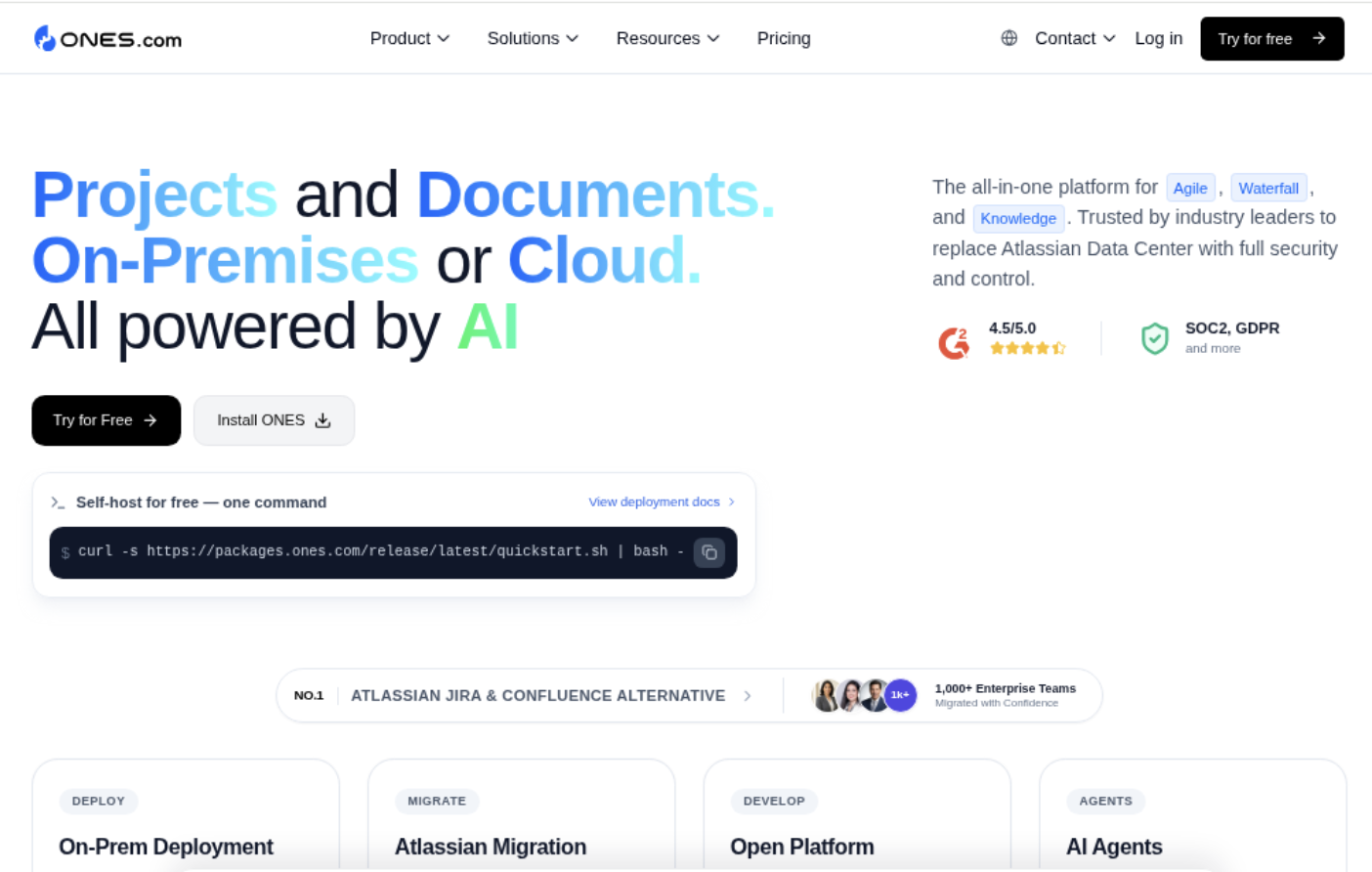
For teams evaluating Jira alternatives, ONES.com can be relevant when deployment flexibility, native capabilities, and reduced reliance on plugins matter. It offers Cloud, On-Premise, Private Cloud, and Air-gapped deployments, with feature parity between its cloud and self-hosted versions.
Value Proposition
ONES.com can help teams compare the full operating model, including deployment, administration, workflow configuration, and connected capabilities. You can assess ONES Project separately when your main requirement is project management.
Core Capabilities
- Plugin sprawl: Teams often depend on several add-ons for basic work. ONES capability: ONES Project includes Jira-compatible workflows, built-in reporting, custom workflows, custom fields, sprint management, and automation. Result: You may reduce the number of separate extensions required for everyday delivery work.
- Deployment restrictions: Some organizations cannot place project information in a public cloud. ONES capability: ONES.com supports Cloud, On-Premise, Private Cloud, and Air-gapped deployments. Result: You can match the platform to network and governance requirements.
- Feature differences across environments: Self-hosted teams may worry that they will lose important functions. ONES capability: ONES provides feature parity between cloud and self-hosted versions. Result: Your deployment decision does not need to remove core project features.
- Complex workflow administration: Different teams may need different states, fields, and approval paths. ONES capability: Custom workflows and custom fields support team-specific processes. Result: You can model work without forcing every department into one rigid process.
- Limited delivery visibility: Leaders may need progress views without assembling several reports. ONES capability: Built-in reporting provides project visibility within the platform. Result: Teams can spend less time reconciling status across separate tools.
- Sprint coordination: Agile teams need a consistent place for planning and execution. ONES capability: Sprint management supports backlog and iteration workflows. Result: Product teams can keep planning and delivery activity connected.
- Repetitive project administration: Manual actions slow delivery and create inconsistent updates. ONES capability: Automation handles repeatable workflow actions. Result: Administrators can reduce routine work and improve consistency.
- Mixed project and knowledge needs: Teams may maintain project work in one product and team knowledge elsewhere. ONES capability: ONES.com combines project management and knowledge management, with ONES Project and ONES Wiki available separately. Result: You can evaluate a connected product family while selecting only the capabilities you need.
Application Scenarios
Scenario one: a regulated engineering team. The team needs project tracking inside a restricted network. An air-gapped or on-premise deployment can support that requirement while preserving the core feature set.
Scenario two: a growing product organization. Several squads need custom workflows, sprint management, automation, and reporting. ONES Project can provide those capabilities without requiring every function to come from a separate plugin.
Scenario three: a distributed company. Product, operations, and leadership need project visibility alongside shared team knowledge. The organization can evaluate ONES Project and ONES Wiki separately according to its actual needs.
Common Challenges When Estimating Jira Cloud Costs
Challenge: using the headline rate as the full budget
Solution: Add app subscriptions, other Atlassian products, taxes, administration, and expected growth. Treat the public rate as a starting point rather than the final operating cost.
Challenge: counting only permanent employees
Solution: Include contractors, temporary staff, executives, support teams, and occasional collaborators. Review access quarterly and remove people who no longer need it.
Challenge: choosing annual billing without a growth forecast
Solution: Estimate headcount at the start, midpoint, and end of the term. Compare the annual user band with monthly flexibility before committing.
Challenge: adding apps without reviewing their pricing rules
Solution: Check whether each app charges by active use, account tier, or the full Jira user count. Record renewal dates in one internal purchasing calendar.
Challenge: comparing platforms only by license price
Solution: Include migration, configuration, training, administration, integrations, deployment, and support. A total-cost comparison produces a more useful decision.
FAQs
Does Jira Cloud charge every person who has access?
Jira Cloud pricing generally reflects the users covered by your subscription or user tier. The exact treatment can vary by product, plan, and billing cycle. Review invited accounts, product access, and the current checkout calculation before purchase. Remove inactive accounts when appropriate, but keep planned hires and occasional collaborators in your forecast.
Is annual Jira Cloud billing always cheaper?
No single billing cycle is always cheaper for every team. Annual billing may offer a better effective rate or more predictable budgeting, while monthly billing can suit teams with changing headcount. Compare both options using the same plan, user count, products, and expected growth. Then include app subscriptions and taxes for a realistic comparison.
How should I budget for Jira Marketplace apps?
List every required app and record its pricing method, user tier, renewal date, and purpose. Some apps may charge across the full Jira population even when only a small group uses them. Add those recurring charges to the core subscription, then review whether a native platform capability could reduce the number of extensions you need.
What happens when my team grows into a new user tier?
Your cost may increase when your account crosses a pricing threshold. The effect depends on whether you use monthly billing, annual billing, or a negotiated enterprise arrangement. Forecast headcount before hiring and check the next pricing band early. That gives you time to compare options instead of reacting after the budget changes.
Can I compare Jira Cloud with a self-hosted alternative?
Yes. Compare deployment control, security requirements, administration, feature availability, support, upgrade effort, and total cost. A self-hosted option may suit teams with restricted networks or strict control requirements, while cloud hosting can reduce infrastructure responsibilities. The right choice depends on operational needs rather than subscription price alone.
Yes. ONES Project is a project management platform that can be evaluated as a Jira alternative. It supports Jira-compatible workflows, built-in reporting, custom workflows and fields, sprint management, and automation. ONES.com also supports Cloud, On-Premise, Private Cloud, and Air-gapped deployments. Review the capabilities, deployment model, migration effort, and commercial terms against your team’s requirements.
Conclusion
Jira Cloud pricing per user depends on more than a published rate. Plan tier, user bands, billing cycle, products, apps, taxes, and growth all shape the final budget.
Start with your real user count, compare monthly and annual options, calculate future headcount, and include the cost of operating the platform. Then compare complete workflows rather than isolated license prices.
But here's the solution in plain terms: build a three-scenario estimate, review it against your team’s required features, and check alternatives when plugins, deployment limits, or administration create too much overhead. That approach gives you a clearer path to a sustainable project management investment.