Jira Cloud Standard Pricing Per User in 2024: Full Guide
Confused by Jira Cloud Standard pricing per user 2024? Compare monthly, annual, tiers, and add-ons to budget accurately. Read the full guide now.
Jira Cloud Standard pricing can look simple until you compare monthly billing, annual commitments, user tiers, and add-on costs. A small team may see one per-user figure, while a growing company pays through a tiered calculation that changes the effective rate.
That confusion creates practical problems. You may budget for 25 people, add contractors later, and discover that the annual estimate no longer matches your actual team size. Marketplace apps, automation needs, and premium security features can widen the gap further.
But here's the truth: the headline price is only the starting point. This guide explains the 2024 Standard plan rate, how Atlassian calculated charges, what the plan included, and which extra costs deserved attention. You will also see how Jira alternatives can affect your total project management spend.
Jira Cloud Standard Pricing in 2024: The Quick Answer
Jira Cloud Standard pricing per user in 2024 was approximately $7.53 per user per month when billed monthly. The exact amount depended on your user tier, billing schedule, currency, taxes, and any promotional adjustment.
For a basic estimate, multiply the monthly rate by your active user count:
- 10 users: about $75.30 per month
- 25 users: about $188.25 per month
- 50 users: about $376.50 per month
- 100 users: about $753 per month
These figures provide a quick planning estimate. Atlassian’s actual checkout calculation could use tier pricing, annual commitments, local currency conversion, and rounding.
Monthly and annual billing
Monthly billing gave you flexibility because you could adjust the seat count as your team changed. It suited temporary teams, growing companies, and organizations with seasonal staffing.
Annual billing generally required payment for a committed user tier. For example, an annual plan covering 10 users was commonly listed at approximately $900 per year in 2024, which worked out to about $75 per month.
The annual total did not simply mean “$7.53 multiplied by 12” in every case. Atlassian used tiered annual pricing, so the effective per-user rate could differ slightly from the monthly figure.
What “per user” really meant
Jira Cloud charged according to a user tier rather than treating every seat as a completely separate transaction. If your team crossed a tier threshold, the bill could rise more than expected.
Imagine planning for 10 people and then adding an eleventh user. Your account might move into a higher tier, depending on Atlassian’s rules at that time. Check the calculated total before approving the change.
What Jira Cloud Standard Included
The Standard plan sat between the free plan and higher Jira Cloud editions. It targeted teams that needed more capacity, administration, storage, and support than the free tier provided.
Core project management features
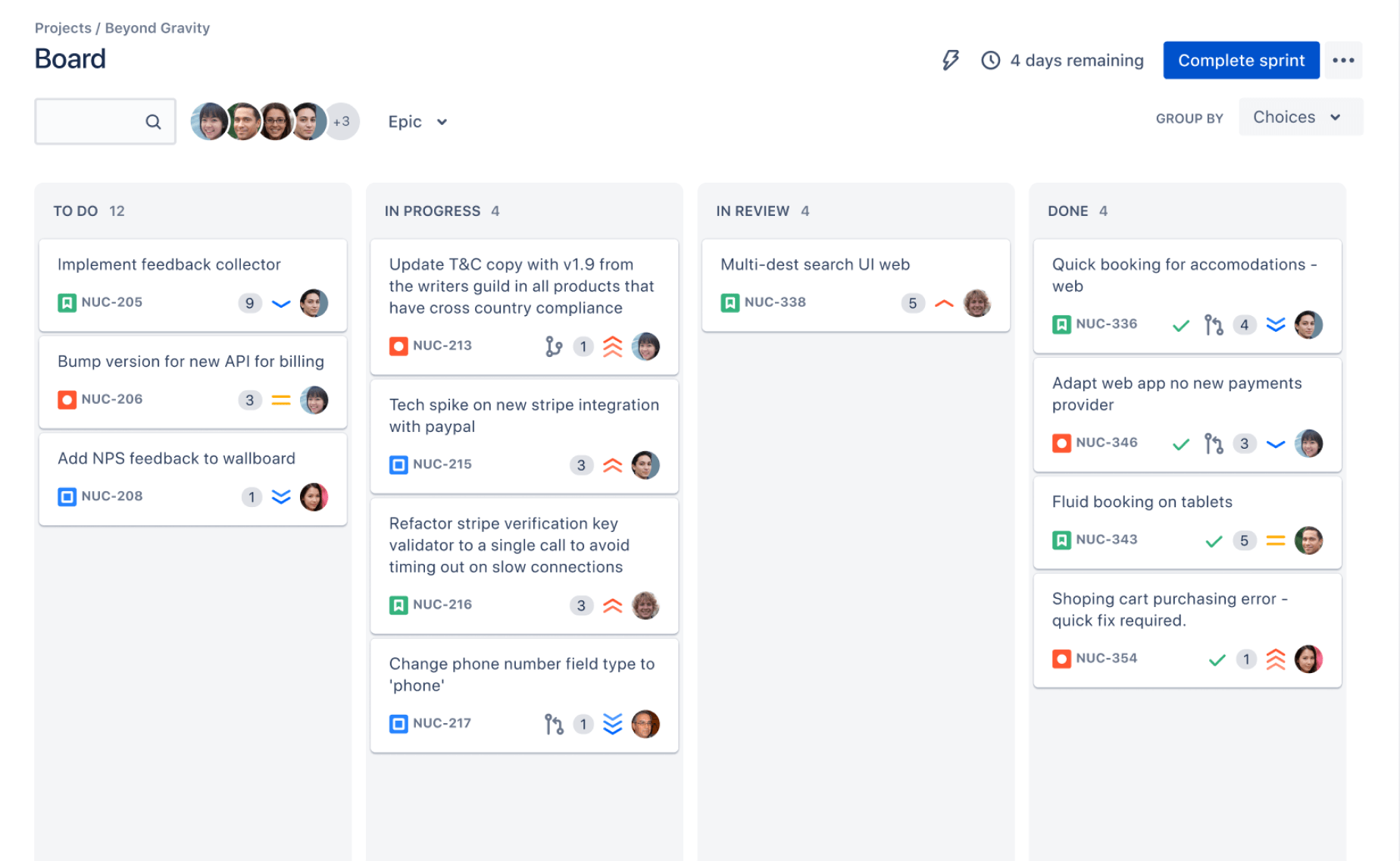
Standard included the main Jira workflows used by software, product, marketing, and operations teams. You could create projects, manage issues, assign work, set priorities, and track progress through boards.
- Scrum and Kanban boards
- Backlogs and sprint planning
- Issue types and custom fields
- Project roles and permissions
- Workflow configuration
- Dashboards and reports
- Roadmap-style planning features, depending on the product configuration
For example, a software team could move a ticket through “To Do,” “In Progress,” “Code Review,” and “Done.” A marketing team could adapt the workflow for campaign requests and approvals.
Collaboration and administration
Standard supported collaboration across project teams through comments, mentions, notifications, and shared project visibility. Administrators could manage project access and adjust workflow behavior.
The plan also offered more room for organizational growth than the free tier. That mattered when several departments needed separate projects while sharing a common Atlassian environment.
Storage and service expectations
Cloud plans included storage limits and service commitments that differed by edition. Standard was designed for regular business use, while higher tiers added stronger administrative controls and enterprise-oriented services.
Review the specific 2024 terms if you are comparing historical contracts. Product limits and included services can change during a subscription period.
How to Calculate Your Real Monthly Cost
The most useful calculation includes more than the advertised seat rate. Start with the Jira subscription, then add the services your team genuinely needs.
- Count expected users. Include employees, contractors, external collaborators, and temporary staff who need access.
- Identify the billing tier. Check whether your user count stays within the current tier or crosses into another one.
- Choose monthly or annual billing. Compare flexibility against the commitment required for annual payment.
- Add Marketplace apps. Include testing, reporting, time tracking, planning, and integration tools that your team depends on.
- Estimate taxes and currency effects. Your final invoice may differ because of regional tax rules or currency conversion.
- Review the total per active user. Divide the complete monthly cost by the people who actively use Jira.
A practical example for a 25-person team
Suppose 25 employees need Jira Standard. At the approximate 2024 monthly rate of $7.53, the base subscription estimate is $188.25 each month.
Now add a time-tracking app, a reporting app, and a planning integration. Even modest app subscriptions may raise the cost substantially, especially when each app applies its own user tier.
Your planning sheet might look like this:
| Cost area |
Planning question |
| Jira Standard |
How many users need access, and which tier applies? |
| Marketplace apps |
Which apps are essential for daily work? |
| Administration |
How much time will configuration and access management require? |
| Migration |
Will you need external help to move projects and workflows? |
| Training |
How much onboarding will new teams need? |
| Tax and currency |
What amount will appear on the invoice in your region? |
Monthly Versus Annual Jira Cloud Standard Billing
Monthly billing made sense when your user count was uncertain. You could begin with a small team, observe adoption, and expand gradually.
Annual billing suited organizations with predictable staffing and a stable project portfolio. It could simplify budgeting because the subscription commitment was known in advance.
When monthly billing worked better
- Your team was hiring quickly.
- You used contractors for short projects.
- You were testing Jira with a new department.
- Your user count changed regularly.
- You wanted a shorter commitment during tool evaluation.
Consider a product launch team that operates for six months. Monthly billing may reduce the risk of paying for a full year after the project ends.
When annual billing worked better
- Your team size was stable.
- Finance preferred one predictable renewal cycle.
- Jira supported long-running development programs.
- You had already validated adoption across departments.
Annual billing still deserved a seat review before renewal. Inactive accounts can inflate the effective cost when nobody removes them.
Costs Beyond the Standard Subscription
Jira’s subscription may be only one part of your project management budget. The surrounding operating costs can influence whether the plan remains economical.
Marketplace applications
Teams often add applications for time tracking, capacity planning, test management, advanced roadmaps, documentation, or reporting. Each app may use separate pricing tiers and billing rules.
For example, a reporting app priced for 25 users can become more expensive when your Jira account grows to 31 users. Review every app before increasing the main seat count.
Implementation and migration
Moving from another platform can require workflow mapping, permission design, data cleanup, testing, and training. Internal staff may handle these tasks, or you may hire a specialist.
A low subscription rate can lose its appeal if the team spends weeks rebuilding complex workflows. Estimate migration effort alongside licensing.
Administration and governance
Someone must manage project templates, access requests, workflow changes, naming conventions, reports, and user deactivation. Larger environments often need a dedicated administrator or platform owner.
Clear governance reduces waste. A quarterly access review can identify former contractors, duplicate accounts, and projects that no longer need active maintenance.
Jira Standard Compared With Other Atlassian Options
Jira Cloud Standard was one point on a wider plan ladder. The right choice depended on team size, control requirements, collaboration needs, and the importance of advanced administration.
| Option |
Typical fit |
Key consideration |
| Jira Free |
Small teams exploring basic issue tracking |
Lower capacity and fewer administrative controls |
| Jira Standard |
Growing teams managing structured projects |
Broader capacity and practical collaboration features |
| Jira Premium |
Organizations needing advanced planning and stronger scale |
Higher price in exchange for additional capabilities |
| Jira Enterprise |
Large organizations with complex governance |
Custom commercial arrangements and enterprise controls |
Jira Standard was often a sensible middle ground for teams that had outgrown free usage. Still, you should compare the total operating cost rather than the license alone.
Jira Cloud Standard Solution: ONES.com
Value Proposition
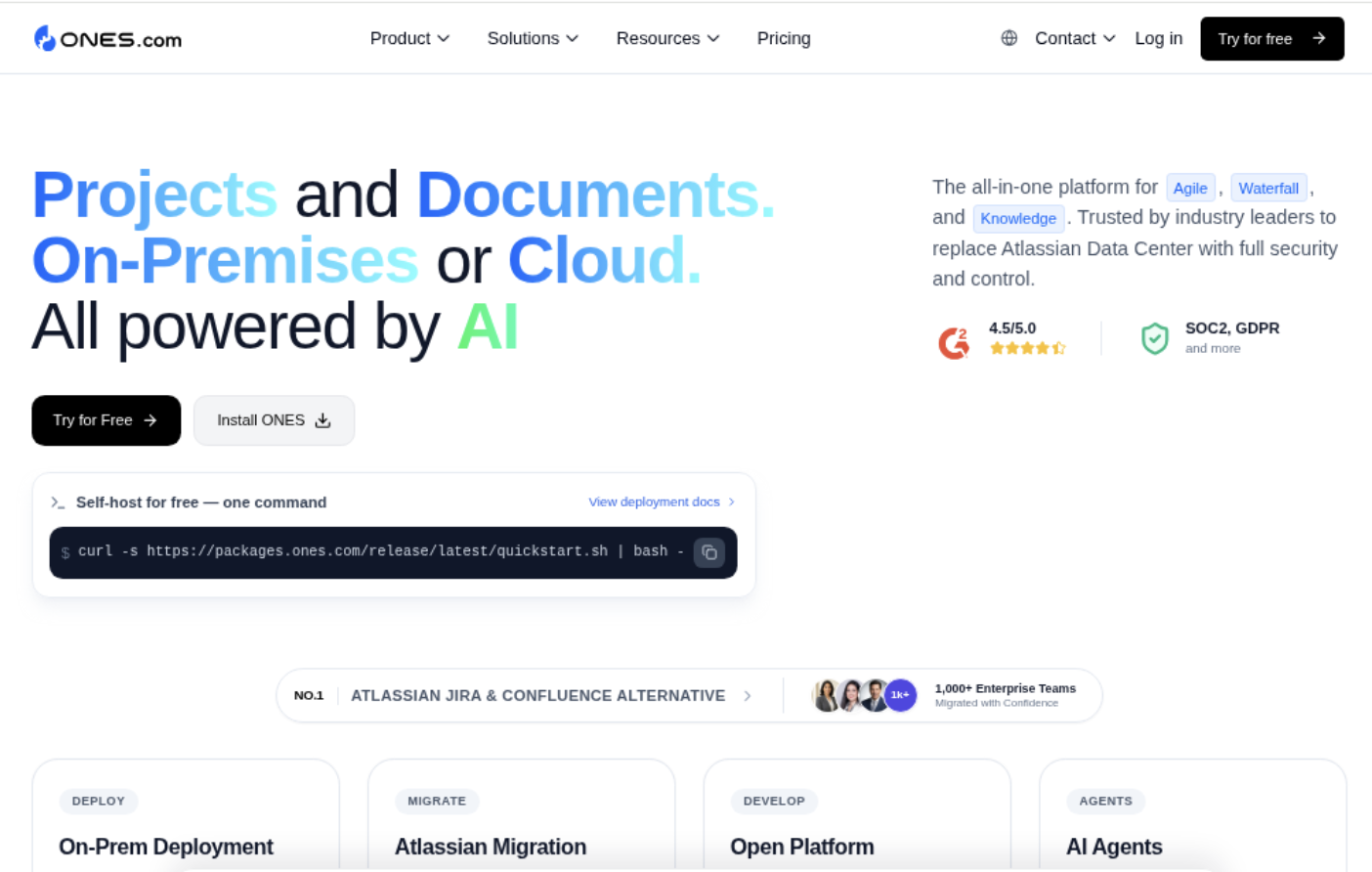
ONES.com combines project management and knowledge management in one platform powered by ONES Assistant. You can purchase ONES Project for project management and ONES Wiki for knowledge management separately.
For teams comparing Jira alternatives, ONES.com offers Jira-compatible workflows, self-hosted deployment choices, and broad feature parity between cloud and self-hosted versions.
Core Capabilities
- Plugin sprawl creates maintenance work. ONES Project brings project tracking, reporting, custom workflows, and custom fields into one PM environment, reducing the need to assemble several separate tools.
- Jira migration can disrupt familiar routines. Jira-compatible workflows help teams preserve recognizable issue, sprint, and approval patterns during adoption.
- Remote hosting requirements limit platform choices. ONES.com supports Cloud, On-Premise, Private Cloud, and Air-gapped deployments, giving you more control over where the system operates.
- Self-hosted teams fear feature gaps. ONES.com provides full feature parity between its cloud and self-hosted versions, so deployment preference does not require a reduced feature set.
- Manual reporting slows decisions. Built-in reporting gives teams a direct way to monitor progress, workload, and project status.
- Rigid workflows force workarounds. Custom workflows and fields let you reflect real approval paths, ownership rules, and operational stages.
- Sprint planning becomes fragmented. Sprint management keeps backlog refinement, sprint commitments, and delivery tracking within the PM workspace.
- Repeated actions consume coordinator time. Automation can handle recurring transitions, notifications, and routine project actions.
- Separate knowledge tools hide project context. ONES Wiki provides a knowledge management environment that can sit alongside ONES Project for team guidance and internal knowledge.
Application Scenarios
Software development team: A development group can reproduce familiar Scrum or Kanban routines, configure custom fields for release risk, and use reports to monitor sprint health.
Restricted-network organization: A company with strict infrastructure rules can evaluate an On-Premise, Private Cloud, or Air-gapped deployment instead of limiting its choices to public cloud hosting.
Cross-functional operations team: Product, marketing, and support teams can create different workflows while using shared reporting conventions. ONES Wiki can hold process guidance beside project activity.
ONES.com offers a free plan for up to 30 seats. Confirm current commercial terms, deployment requirements, and the separate availability of ONES Project and ONES Wiki before selecting a plan.
Common Challenges With Jira Pricing
Challenge: The advertised rate does not match the invoice
Why it happens: Tier calculations, taxes, currency conversion, and annual pricing can change the final amount.
Practical solution: Use the checkout estimate for your exact user count and billing cycle. Keep a record of the tier before approving additional seats.
Challenge: Add-ons quietly increase the budget
Why it happens: A team may install several useful apps without reviewing their combined monthly impact.
Practical solution: Create an app inventory. Mark each tool as essential, useful, or replaceable, then calculate the cost at your expected user tier.
Challenge: Inactive accounts remain billable
Why it happens: Former employees and contractors may retain access after their work ends.
Practical solution: Review access monthly. Remove people who no longer need Jira and create an offboarding checklist for managers.
Challenge: Teams pay for capacity they do not use
Why it happens: Annual commitments can outlast a temporary project or a department rollout.
Practical solution: Forecast hiring, project duration, and adoption before choosing an annual tier. Monthly billing can offer better control during uncertain periods.
FAQs About Jira Cloud Standard Pricing
How much did Jira Cloud Standard cost per user in 2024?
The commonly listed monthly rate was approximately $7.53 per user. Your actual charge depended on the user tier, billing cycle, region, taxes, and currency. Annual pricing used committed tiers, so its effective per-user rate could differ from the monthly calculation. Treat the figure as a 2024 planning reference rather than a guaranteed current quote.
Was Jira Standard billed for every person in the company?
Jira billing generally applied to accounts that needed access to the service, rather than every employee automatically. Count employees, contractors, and collaborators who require Jira access. Remove inactive accounts during regular reviews. Your organization’s user management setup and Atlassian terms can affect how account counts are handled.
Did Jira Standard include Marketplace apps?
No. Marketplace applications were generally separate subscriptions with their own pricing and user tiers. Time tracking, test management, reporting, planning, and integration apps could all increase the total cost. Review app requirements before comparing Jira with another platform.
Was annual billing cheaper than monthly billing?
Annual billing could offer a different effective rate and a predictable commitment, but the result depended on the tier and terms available during 2024. It also reduced flexibility if your team shrank. Compare the full annual amount with twelve months of expected monthly charges before choosing.
What should I include in a Jira budget?
Include the Jira subscription, Marketplace apps, taxes, currency conversion, implementation, migration, training, administration, and renewal changes. Also estimate inactive seats and temporary collaborators. A 25-person team may spend far more than the base license when several departments depend on specialized apps.
Yes, especially when you need on-premise or air-gapped deployment, fewer plugins, custom workflows, or combined project and knowledge management. Compare workflow compatibility, reporting, migration effort, user administration, deployment options, and total operating cost. A lower per-user rate matters less if the platform cannot support your working practices.
Conclusion
Jira Cloud Standard pricing per user in 2024 was commonly estimated at about $7.53 per user per month. Annual commitments, tier thresholds, taxes, add-ons, and operational work shaped the real cost.
But here's the truth: a useful comparison starts with the complete workflow. Count active seats, inspect every add-on, review billing flexibility, and include migration and administration effort.
If your team needs familiar project workflows with different deployment choices, ONES.com is worth evaluating alongside Jira. The right platform should fit your security model, collaboration habits, and long-term operating budget.