Jira Cost Explained: A Practical Budgeting Guide for Teams
Unsure about Jira cost? Learn to budget users, plans, apps, and hidden fees—click now to plan your team’s spend with confidence.
Jira can look inexpensive at first, then become difficult to budget once user tiers, premium features, apps, support, and marketplace subscriptions enter the picture. A small team may pay little today while a growing department faces a much larger annual bill.
That uncertainty creates awkward planning questions. Should you choose monthly or annual billing? Which teammates need paid access? Will automation, reporting, or external collaborators add more cost? A low headline price can hide operational expenses.
Here’s the practical answer: estimate Jira cost by counting billable users, selecting the right plan, adding required apps, and reviewing hidden administration expenses. This guide shows you how to build a realistic budget before committing.
Jira Cost: What You Actually Pay
Jira cost is the total amount your team spends on Jira subscriptions, optional apps, support, administration, and related work. The final amount depends mainly on user count, plan level, billing cycle, and required integrations.
Jira generally offers Free, Standard, Premium, and Enterprise options. The Free plan suits very small teams, while larger organizations usually compare Standard and Premium features.
At a glance, your budget should include these categories:
- Core Jira subscription fees
- Paid access for users who create, update, or manage work
- Marketplace apps for reporting, time tracking, planning, or integrations
- Premium capabilities such as advanced planning, stronger controls, and expanded administration
- Migration, configuration, training, and ongoing administration
Pricing changes over time, so treat the current Atlassian checkout quote as the final figure. Your planning model should remain useful even when the published rates change.
How Jira Pricing Works
Jira pricing becomes easier to understand when you separate the subscription from the surrounding operating costs. Here’s why: the subscription is visible, while the extra work often appears later.
User tiers shape the bill
Most Jira plans use user bands. Your bill can increase when you cross a tier, even if only a few people need access.
For example, imagine a team with 51 paid users. Adding three contractors may move the account into a higher band. That small staffing change can affect the annual budget more than expected.
Review active accounts every month. Remove people who no longer need access, then confirm whether occasional collaborators can use lighter access options.
Free, Standard, Premium, and Enterprise serve different needs
The Free plan can work for a small team with modest collaboration needs. It often becomes restrictive when you need larger capacity, advanced permissions, broader administration, or more sophisticated planning.
Standard usually fits growing teams that need dependable project tracking and everyday administration. Premium becomes more relevant when you need advanced planning, greater scale, or stronger continuity features.
Enterprise planning usually involves organization-wide governance, security requirements, procurement controls, and negotiated commercial terms. It needs a separate evaluation rather than a simple per-user comparison.
Monthly and annual billing change your planning approach
Monthly billing gives you flexibility when team size changes frequently. It can suit a startup, temporary project, or department still testing its workflow.
Annual billing can make forecasting easier and may offer different commercial value. It also creates a larger commitment, so estimate hiring changes before choosing it.
A useful approach is to calculate both scenarios:
| Planning question | Why it matters |
|---|
| How many people need paid access? | User tiers often drive the largest subscription change. |
| Will headcount change this year? | Growth can push the account into a higher pricing band. |
| Do you need flexibility? | Monthly billing may fit changing teams better. |
| Can you commit to a stable team size? | Annual planning may simplify forecasting. |
What Adds to the Subscription Price?
The core plan is only one part of your total spend. A team might begin with standard issue tracking, then add tools for time recording, roadmaps, test management, or portfolio reporting.
Marketplace apps can become a second subscription layer
Jira’s marketplace supports many specialist extensions. Each app may charge separately, often using its own user tiers and billing rules.
For example, a team could pay for Jira, a time-tracking app, a test-management app, and an advanced reporting app. The combined monthly amount may exceed the original Jira subscription.
Before installing an app, ask three questions:
- Does Jira already provide enough functionality for this need?
- How many people require access to the app?
- What happens to the cost when the team grows?
Integrations can create indirect expenses
Integrations with development tools, communication platforms, identity systems, and customer support tools may require extra configuration.
Some integrations are simple. Others need custom automation, security reviews, ongoing maintenance, or troubleshooting when permissions change.
For example, connecting Jira with a communication platform may take one afternoon. Maintaining custom rules across several teams can take hours every month.
Administration takes real time
Someone must manage permissions, workflows, custom fields, screens, boards, automation rules, and project templates. That work has a labor cost, even when no separate invoice appears.
A useful estimate multiplies monthly administration hours by the responsible person’s loaded hourly cost. If administration takes 12 hours each month at $60 per hour, the operating burden is $720 monthly.
How to Build a Realistic Jira Budget
Start with the smallest useful model. Then add known requirements and a sensible buffer. This prevents a low initial estimate from becoming an unpleasant surprise.
Step 1: Count people by access level
Separate full users, occasional collaborators, external partners, and people who only need visibility.
Do not count every employee automatically. Count the people who need meaningful access to the Jira environment.
Step 2: List required capabilities
Write down the workflows your team needs before comparing plans. Include sprint planning, reporting, automation, approvals, permissions, planning views, and compliance controls.
For example, a product team may need sprint management and release reporting. A regulated engineering group may also need stricter permissions and audit controls.
Step 3: Separate essential and optional apps
Mark every app as essential, useful, or replaceable. This simple classification exposes subscriptions that have become part of the habit rather than the workflow.
Test whether native Jira features can cover the requirement. Consolidating several extensions may reduce both spending and administrative effort.
Step 4: Estimate labor around the platform
Include setup, migration, workflow design, training, permissions, maintenance, and troubleshooting. A platform that needs heavy customization may cost more than its subscription suggests.
Step 5: Model three growth scenarios
Create a conservative case, expected case, and growth case. Use different team sizes and app requirements for each scenario.
- Conservative case: current headcount and essential capabilities
- Expected case: planned hiring and normal app usage
- Growth case: new teams, added automation, and higher reporting needs
Step 6: Review the estimate quarterly
Check active accounts, unused apps, automation volume, administrative hours, and upcoming hiring. Quarterly reviews keep small leaks from becoming annual budget problems.
Jira Cost Examples for Different Teams
The right budget depends on how a team works. Two groups with the same headcount can have very different expenses because their workflows and extensions differ.
Small product team
A 10-person product team may use Jira for backlog management, sprints, releases, and basic reporting. Its direct subscription cost may remain modest.
However, the team may still spend time configuring workflows, creating dashboards, and teaching new members. That administrative effort belongs in the total budget.
Growing software organization
A 75-person engineering organization may need several projects, shared workflows, advanced reporting, and integrations with development and communication tools.
At this size, user-tier changes and marketplace subscriptions deserve close attention. A small increase in headcount can affect both Jira and app pricing.
Distributed enterprise group
A large organization may need multiple teams, strict permission models, centralized governance, and continuity planning. Enterprise requirements can influence purchasing decisions more than the base subscription.
For example, a company may accept a higher subscription if it reduces manual administration across dozens of teams. The right comparison measures operating impact, not price alone.
Ways to Control Jira Spending
Cost control works best when it protects useful work instead of restricting access blindly. Here’s the truth: removing every optional feature can create workarounds that cost more later.
Review inactive accounts
Check people who have not signed in or updated work recently. Confirm their role before removing access, since some managers need periodic visibility.
Reduce unnecessary customization
Every custom workflow, field, rule, and screen adds future maintenance. Keep the configuration close to the way teams actually work.
Consolidate overlapping apps
Compare each app’s purpose with native Jira capabilities and other installed tools. Two reporting apps may serve similar audiences with different dashboards.
Set automation guardrails
Automation can remove repetitive work, yet poorly designed rules can create noise and unexpected activity. Use clear owners, naming conventions, and regular reviews.
Standardize project templates
Reusable templates reduce setup time and prevent every team from inventing a separate workflow. They also make administration easier as the organization grows.
ONES.com is a unified platform for project management and knowledge management. ONES Project provides project management capabilities as a Jira alternative, while ONES Wiki provides knowledge management as a Confluence alternative.
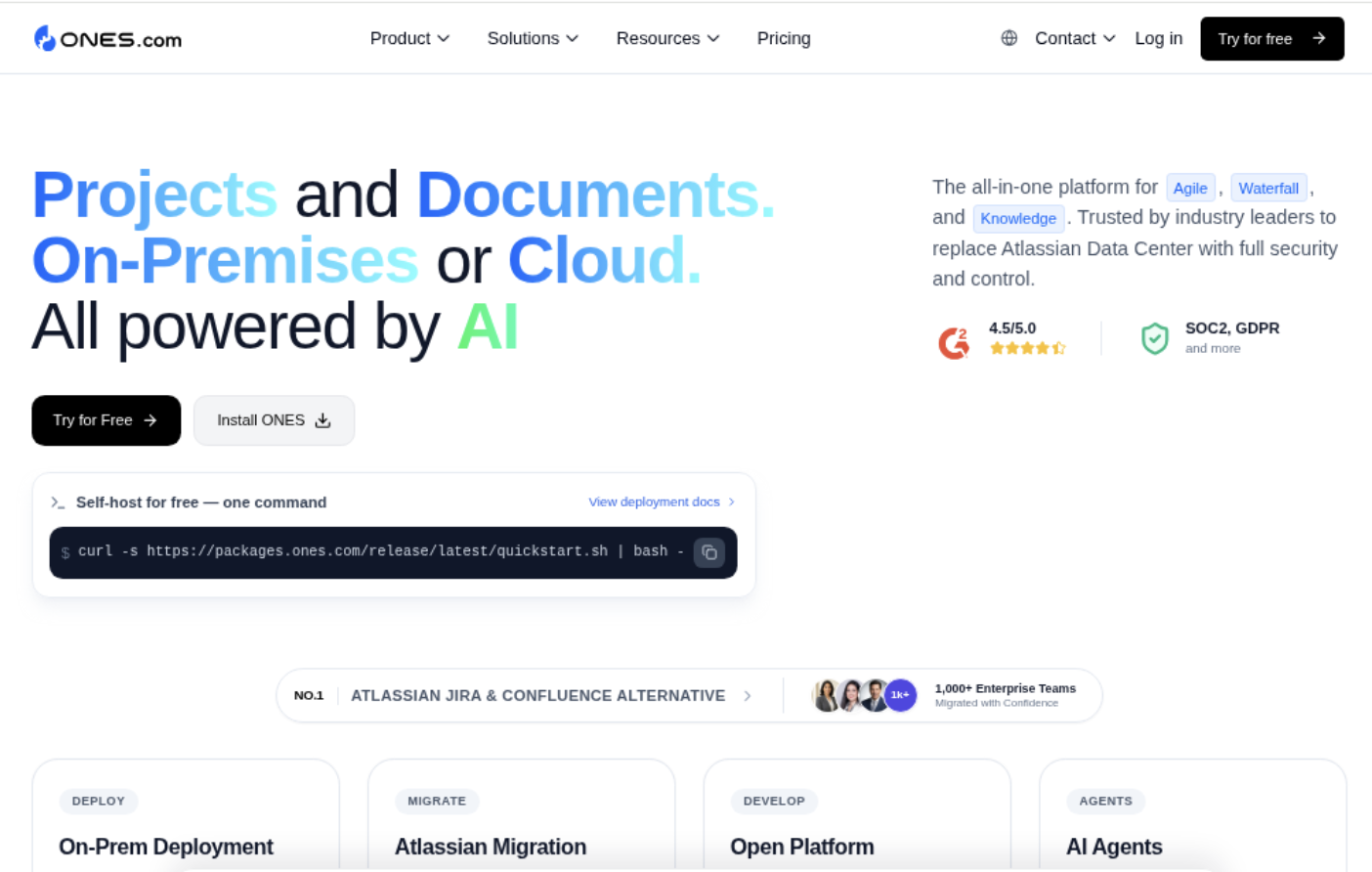
You can purchase ONES Project and ONES Wiki separately. The platform supports Cloud, On-Premise, Private Cloud, and Air-gapped deployments, with feature parity between cloud and self-hosted versions.
Value Proposition
ONES.com can help teams compare platform cost with deployment control, native functionality, and administration effort. It suits organizations that want Jira-compatible workflows while reducing dependence on multiple plugins.
Core Capabilities
1. Fragmented project tracking → ONES Project → One connected workflow
If teams manage requirements, tasks, sprints, and releases across disconnected tools, handoffs become harder to follow. ONES Project brings those activities into one project management environment.
2. Complex migration concerns → Jira-compatible workflows → Familiar adoption
Teams moving away from Jira may worry about retraining and workflow disruption. Jira-compatible workflows help preserve familiar project practices while giving administrators another platform option.
3. Plugin dependency → Built-in reporting and custom workflows → Fewer moving parts
When essential reporting depends on several extensions, maintenance grows with every update. Built-in reporting and custom workflow support can reduce the number of separate tools required.
4. Inconsistent sprint practices → Sprint management → More predictable delivery routines
Different teams often plan and review work in different ways. Sprint management gives teams a shared structure for planning, execution, review, and improvement.
5. Repetitive coordination → Automation → Less manual follow-up
Routine status changes, assignments, and notifications can consume valuable team time. Automation handles repeatable actions and leaves people more time for decisions.
6. Restricted hosting requirements → On-Premise, Private Cloud, or Air-gapped deployment → Greater environment control
Some organizations cannot place project information in a public cloud environment. ONES.com supports deployment choices that align with strict network and infrastructure requirements.
7. Unexpected user growth → Free access for up to 30 seats → Lower entry barrier
Small teams can begin with up to 30 seats at no charge. That gives a team room to test core workflows before planning a larger rollout.
8. Separate project and knowledge systems → ONES Project and ONES Wiki → Clearer team context
Project decisions often lose context when planning and team knowledge live in unrelated systems. ONES.com offers project management and knowledge management within one platform family.
Application Scenarios
A software team can reproduce backlog, sprint, workflow, and reporting practices in ONES Project. It can then review subscription needs, plugin reduction, and hosting preferences together.
Organizations with restricted networks
An engineering group with air-gapped requirements can evaluate a self-hosted deployment. This approach keeps the project environment aligned with internal network controls.
Growing teams seeking simpler administration
A department with several projects can standardize workflows, fields, reports, and automation. That structure can reduce repeated setup work as new teams join.
Common Challenges When Estimating Jira Spending
Challenge: The team counts employees instead of active users
Solution: Categorize people by the access they genuinely need. Review inactive accounts and occasional collaborators before selecting a pricing tier.
Challenge: App subscriptions appear late in the process
Solution: List every required extension during the first estimate. Record its user rules, renewal cycle, and expected growth impact.
Challenge: Administration is treated as free
Solution: Estimate configuration, support, training, and maintenance hours. Include those hours in the platform comparison.
Challenge: The selected plan does not match operational needs
Solution: Map each requirement to a plan capability before purchasing. Separate essential controls from features that can wait.
Challenge: Growth pushes the account into a new tier
Solution: Model expected hiring and contractor changes. Review the budget before crossing each major user threshold.
FAQs About Jira Pricing
Is Jira free for small teams?
Jira offers a Free plan for small teams, subject to its current limits and feature rules. It can work for basic project tracking and collaboration. Check the current plan details before relying on it for advanced permissions, larger teams, or complex administration.
What is usually excluded from the headline Jira price?
The headline subscription may exclude marketplace apps, implementation work, training, administration, migration, and custom integration maintenance. These expenses can matter when several teams share one environment. Add them to your estimate before comparing annual commitments.
Is annual Jira billing cheaper than monthly billing?
Annual and monthly plans can produce different commercial outcomes, depending on current pricing and user tiers. Annual billing may simplify forecasting, while monthly billing offers more flexibility. Compare both options using your expected team size throughout the year.
How can I reduce Jira spending without disrupting teams?
Start with inactive accounts, overlapping apps, unnecessary customization, and unused automation. Keep workflows that support delivery, reporting, and governance. Removing a feature without understanding its purpose can create manual work elsewhere.
When should I consider a Jira alternative?
Consider an alternative when licensing, plugin dependence, hosting restrictions, administration, or workflow fit creates persistent problems. Compare migration effort and operating impact alongside subscription prices. A lower rate alone does not guarantee a better outcome.
Conclusion
Jira cost includes more than the plan shown at checkout. User tiers, billing terms, apps, integrations, administration, training, and growth can all change your real budget.
Build three scenarios, review active access, challenge every extension, and measure the labor required to maintain your setup. That process gives you a clearer financial picture before renewal or expansion.
But here’s the practical takeaway: choose the platform that supports your workflows without creating unnecessary complexity. Whether you stay with Jira or evaluate ONES.com, compare total operating effort as carefully as the subscription amount.