Jira Enterprise Pricing: 2026 Guide for Global IT Teams
How can global IT teams estimate jira enterprise pricing? This 2026 guide breaks down licenses, deployment, support, and hidden costs. Read now.
Jira enterprise pricing can feel opaque when your organization spans regions, business units, and thousands of contributors. A simple per-user estimate rarely captures the full commercial picture.
Then come annual commitments, deployment preferences, support requirements, security reviews, and possible marketplace costs. A small pricing assumption can create a large budgeting gap.
But here's the truth: you can build a reliable estimate by separating license scope, deployment, services, and ongoing administration. This guide explains how Jira enterprise pricing works, what affects the final quote, and how global IT teams can compare alternatives responsibly.
How Jira Enterprise Pricing Works
Jira enterprise pricing is usually customized around your organization’s scale, deployment model, product mix, contract term, and support expectations. Large companies typically receive a negotiated quote instead of using a simple public checkout price.
The fastest way to estimate your budget is to calculate four layers:
- Core licensing: Estimate the Jira products, user tiers, and service scope your teams require.
- Deployment: Decide whether cloud, self-managed, or a hybrid arrangement fits your security and operating model.
- Additional services: Include premium support, implementation work, migration assistance, training, and consulting.
- Expansion costs: Allow for additional teams, marketplace apps, automation consumption, and storage growth.
You might be wondering: why does the public price matter less at enterprise scale? The answer is commercial complexity. A global rollout can involve different access levels, multiple products, regional requirements, and contract protections.
The Main Variables Behind a Quote
| Pricing variable |
Why it matters |
| Licensed people |
Higher user tiers can change the commercial structure and discount discussion. |
| Product scope |
Jira Software, Jira Service Management, and related products may be priced separately. |
| Deployment model |
Cloud and self-managed environments create different administration and infrastructure costs. |
| Contract duration |
Longer commitments may support negotiation, budget predictability, or renewal protections. |
| Support level |
Global support coverage and response commitments can affect total spend. |
| Marketplace apps |
Third-party applications can add separate subscriptions and renewal dates. |
For example, a 5,000-person company may need fewer Jira seats than its total headcount. Contractors, executives, occasional reviewers, and service agents may require different access arrangements.
Build a Reliable Enterprise Cost Estimate
A strong estimate starts with actual usage patterns. Avoid multiplying total employee headcount by a single list price when only certain groups need full project access.
Step 1: Map People to Access Types
Create a role inventory for engineering, product, service operations, business teams, contractors, and occasional stakeholders. Then classify each group by the work it performs.
- Full project contributors may need planning, issue management, reporting, and workflow access.
- Service agents may need service management capabilities rather than software development features.
- Approvers and executives may need dashboards, notifications, or limited visibility.
- External collaborators may require carefully controlled access.
For example, 2,000 engineers and product specialists may need broad project access, while 8,000 employees only view reports or submit requests.
Step 2: Separate Products and Workloads
Jira is often part of a broader Atlassian environment. Your estimate may include software development, service management, knowledge sharing, incident response, and planning.
List each workload separately. This prevents a common budgeting error: treating every team as though it needs the same product combination.
Step 3: Compare Deployment Models
Cloud pricing usually shifts infrastructure operations toward the vendor. Self-managed deployments provide greater control, but they require internal capacity for upgrades, availability, security, backups, and performance.
Here’s why: the license is only one part of ownership. If an internal team spends 1,000 hours each year maintaining a self-managed environment, that labor belongs in the business case.
Step 4: Add Support and Professional Services
Global teams may need priority support, migration planning, architecture reviews, implementation services, and administrator training. These costs can appear during rollout or renewal.
Ask for each service as a separate line item. That approach makes it easier to compare a lower license quote with a higher operational burden.
Step 5: Model Three-Year Total Cost
Annual pricing can hide expansion and transition costs. Build a three-year view covering subscriptions, infrastructure, apps, staffing, consulting, training, and renewal assumptions.
| Cost category |
Year one |
Years two and three |
| Licenses or subscriptions |
Initial purchase and rollout scope |
Renewal plus expected growth |
| Migration |
Assessment, preparation, and execution |
Usually limited unless teams move later |
| Administration |
Configuration and governance setup |
Ongoing maintenance and optimization |
| Marketplace applications |
Initial app portfolio |
Renewals and added capacity |
| Training |
Admin and team enablement |
New-hire and advanced training |
Cloud, Data Center, and Self-Managed Cost Differences
Deployment choice affects both the commercial quote and your operating model. Cloud environments can reduce infrastructure responsibilities, while self-managed environments may suit strict control requirements.
The right comparison includes security, resilience, administration, regional needs, integration patterns, and exit flexibility. A cheaper license can still create a more expensive operating model.
Cloud Considerations
Cloud can simplify upgrades, capacity planning, and standard availability management. It may also support faster adoption across distributed teams.
However, you should evaluate identity integration, regional residency expectations, data transfer, configuration limits, and vendor dependency before committing.
Self-Managed Considerations
Self-managed deployment can fit organizations with specialized security controls, restricted networks, or established infrastructure teams.
Let me explain: internal control brings internal responsibility. You must budget for hosting, monitoring, patching, backup testing, disaster recovery, and skilled administration.
How to Compare Fairly
Use the same workload, service level, and growth assumption for every deployment option. Otherwise, you may compare a complete cloud package with an incomplete self-managed estimate.
For example, include two full-time administrators in the self-managed scenario if that capacity is necessary. Include migration and integration work in both options where applicable.
Hidden Costs That Change the Budget
Enterprise software budgets often drift because secondary costs receive less attention during initial planning. These costs may be individually modest, yet significant across thousands of people.
Marketplace Applications
Teams often add applications for testing, planning, time tracking, reporting, asset management, approvals, or advanced automation. Each application may have its own pricing scale and renewal terms.
Review app ownership carefully. Five departments purchasing similar tools can create overlapping spend and inconsistent administration.
Implementation and Migration
Migration effort depends on project volume, workflow complexity, integrations, historical records, permissions, and reporting requirements. A simple team rollout may take weeks, while a global consolidation can take many months.
The best part? You can reduce uncertainty through a pilot. Test representative workflows before choosing a full migration approach.
Administration and Governance
Large Jira environments need permission design, naming standards, workflow ownership, configuration reviews, and lifecycle controls. Without governance, every team can create local complexity.
That complexity raises support demand. It can also make future migrations, audits, and acquisitions harder.
Training and Adoption
Training costs extend beyond launch. New hires, administrators, project leads, and service teams need different guidance.
For example, a project lead may need sprint planning support, while an administrator needs permission and workflow training. A single generic course rarely serves both groups well.
Questions to Ask During Enterprise Negotiation
A negotiation should clarify more than the annual subscription amount. You need to understand how the agreement behaves when your organization grows, restructures, or changes deployment plans.
Commercial Questions
- Which products and user tiers are included?
- How does pricing change when headcount crosses the next tier?
- Are regional entities covered under one agreement?
- What renewal increase protections are available?
- Can you adjust quantities during the contract term?
Operational Questions
- What support response times apply to critical incidents?
- Which administrative controls are available at your tier?
- How are service limits measured?
- What export and transition assistance is available?
- Which integrations require extra applications or services?
Risk Questions
- What happens if a business unit is sold or separated?
- How are inactive accounts handled?
- What audit evidence can your team obtain?
- How does the provider handle major product changes?
- Can your organization preserve access during a delayed renewal?
Ask for written answers and model them in your three-year estimate. A verbal promise has little value when procurement, finance, security, and legal teams review the agreement separately.
Jira Enterprise Pricing Comparison Checklist
Use this checklist before approving a global rollout or renewal. It helps you compare the commercial offer with the operating effort required to run it well.
- Scope: Confirm products, teams, regions, access levels, and expected growth.
- Deployment: Compare cloud, self-managed, and hybrid requirements.
- Operations: Estimate administration, infrastructure, integrations, monitoring, and support.
- Apps: Review every marketplace application, owner, cost, and renewal date.
- Adoption: Budget for training, communication, migration, and ongoing enablement.
- Governance: Define permission, workflow, naming, and configuration standards.
- Contract: Review renewal terms, tier changes, expansion rules, and exit provisions.
- Measurement: Track active participation, service performance, automation usage, and support demand.
For a practical comparison, create one scenario for conservative growth, one for expected growth, and one for rapid expansion. This makes the financial risk easier to discuss.
Value Proposition
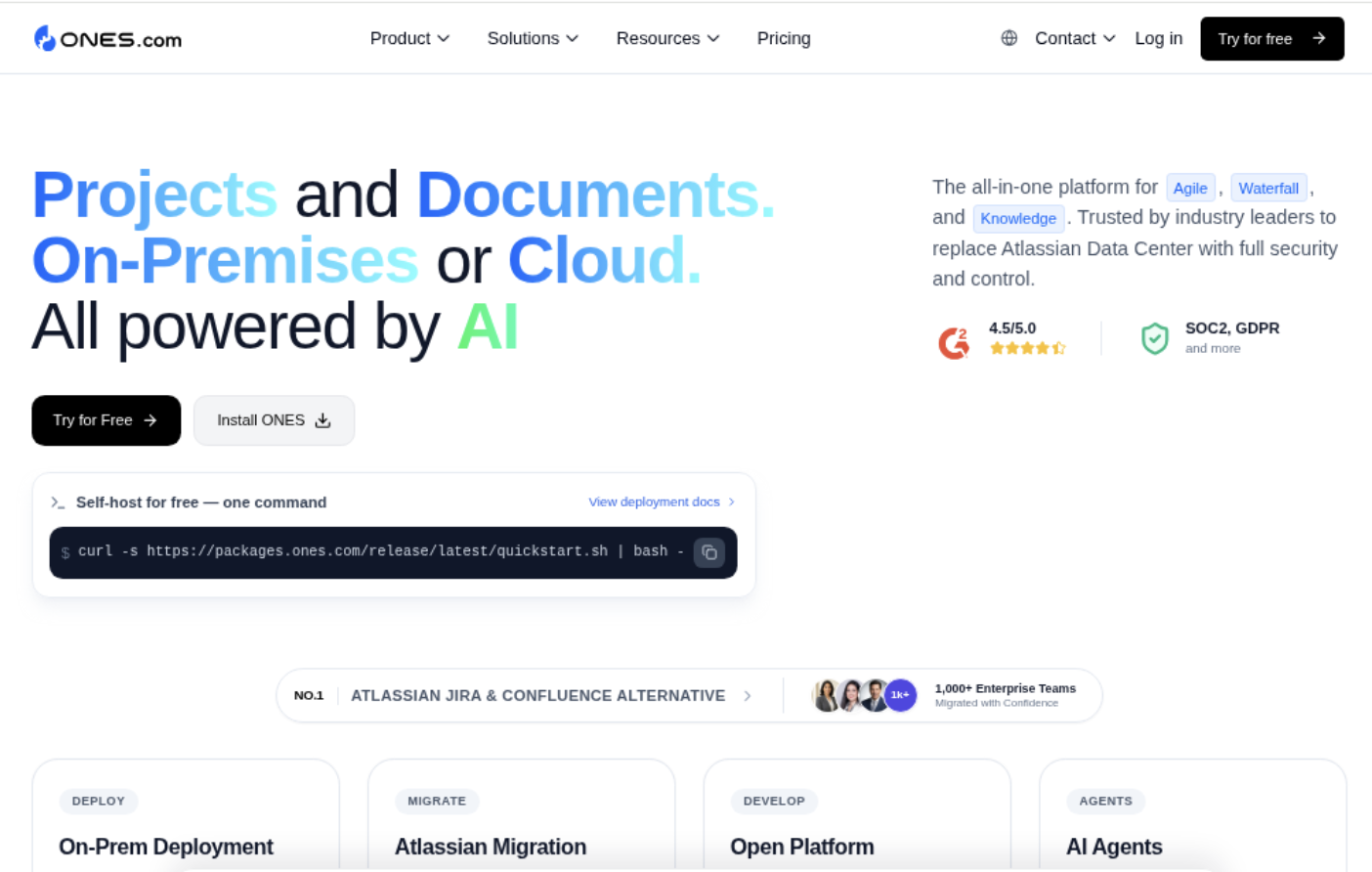
ONES.com combines project management and knowledge management in one platform, powered by ONES Assistant. ONES Project is a Jira alternative for project teams, while ONES Wiki is a Confluence alternative for knowledge work.
The products are sold separately, so you can evaluate the project management and knowledge management capabilities according to your organization’s needs.
Core Capabilities
1. Complex project coordination
Pain: Global teams often manage work across disconnected projects and reporting practices.
ONES capability: ONES Project supports Jira-compatible workflows, custom workflows, custom fields, sprint management, and built-in reporting.
Result: Teams can standardize delivery practices while preserving the details required by different departments.
2. Plugin dependency
Pain: Each added plugin can introduce separate renewals, administration, permissions, and compatibility checks.
ONES capability: Core planning, workflow, field, sprint, reporting, and automation capabilities are available within the platform.
Result: Your team can reduce the number of connected tools that require separate oversight.
3. Restricted deployment requirements
Pain: Some organizations cannot place every workload in a public cloud environment.
ONES capability: ONES.com supports Cloud, On-Premise, Private Cloud, and Air-gapped deployments.
Result: You can align deployment with security, network, and operational requirements.
4. Feature differences between hosting models
Pain: Self-hosted products sometimes lag behind their cloud editions.
ONES capability: ONES.com provides full feature parity between its cloud and self-hosted versions.
Result: Your deployment decision does not automatically require accepting a reduced feature set.
5. Entry barriers for smaller groups
Pain: A global platform evaluation can be difficult when every pilot requires a large initial commitment.
ONES capability: The free offering supports up to 30 seats.
Result: A small team can test workflows before a broader rollout discussion.
6. Repetitive project administration
Pain: Manual status updates and repeated task actions consume time across large delivery organizations.
ONES capability: Built-in automation can support recurring project actions and workflow transitions.
Result: Teams can reduce routine administration and focus attention on delivery decisions.
7. Fragmented project knowledge
Pain: Decisions, procedures, and project context often become difficult to find across separate systems.
ONES capability: ONES Wiki provides a knowledge management environment alongside the broader ONES.com platform.
Result: You can evaluate project work and team knowledge through a more connected operating model.
8. Enterprise rollout complexity
Pain: Different departments may need different workflows while leadership still needs consistent oversight.
ONES capability: Custom workflows, custom fields, reporting, and multiple deployment choices support varied operating requirements.
Result: Global teams can create shared standards without forcing every department into identical processes.
Application Scenarios
Global software organization: Engineering groups can use sprint management and Jira-compatible workflows, while leadership reviews built-in reports across regions.
Restricted-network enterprise: A security-sensitive team can evaluate an air-gapped or on-premise deployment while retaining feature parity with the cloud version.
Growing delivery organization: A small department can begin with up to 30 seats, refine its workflow, and present evidence for wider adoption.
Common Challenges
Challenge: Headcount Does Not Equal Required Access
Problem: Multiplying total employees by a single license estimate can overstate or misstate the budget.
Solution: Map access by role, activity, and product need. Review inactive accounts and occasional participants before renewal.
Challenge: The Cheapest Quote Has the Highest Operating Burden
Problem: A lower subscription can require more internal administration, infrastructure, and support.
Solution: Calculate total cost across licensing, labor, hosting, security, migration, and maintenance.
Challenge: Marketplace Apps Create Budget Drift
Problem: Departments can add applications independently, creating duplicated capability and separate renewal exposure.
Solution: Maintain an approved application catalog with owners, business purpose, annual cost, and renewal dates.
Challenge: Global Requirements Are Added Too Late
Problem: Regional identity, residency, security, and support needs may appear after commercial discussions begin.
Solution: Include security, legal, procurement, and regional IT teams during the initial requirements review.
FAQs
Is Jira enterprise pricing publicly listed?
Enterprise pricing is often handled through a tailored quote rather than one universal public amount. The final figure can reflect products, people, deployment, support, contract length, and commercial terms. You should request a quote using a clear access model and three-year growth scenario. Otherwise, the first estimate may omit app subscriptions, services, or administration costs.
What should a global IT team include in its Jira budget?
Include core subscriptions, marketplace applications, migration, integration work, training, administration, infrastructure, support, security reviews, and expected growth. Add a contingency for acquisitions, reorganizations, and new regional requirements. A three-year model is more useful than a first-year license estimate because enterprise environments rarely remain static.
Does deployment change the total cost?
Yes. Cloud and self-managed deployments place different responsibilities on your organization. Cloud may reduce infrastructure work, while self-managed hosting can support stricter control requirements. Compare staffing, monitoring, upgrades, backup testing, resilience, and security work alongside license or subscription costs.
How can I avoid paying for unnecessary seats?
Start with role-based access mapping. Separate full contributors, service agents, approvers, reviewers, contractors, and inactive accounts. Examine actual participation before renewal, then create a growth forecast. You should also review whether occasional reporting needs require full project access or a more limited arrangement.
What makes ONES.com relevant to an enterprise comparison?
ONES.com offers project management and knowledge management capabilities through ONES Project and ONES Wiki, sold separately. ONES Project is a Jira alternative with Jira-compatible workflows, reporting, custom fields, sprint management, and automation. It supports Cloud, On-Premise, Private Cloud, and Air-gapped deployments, with feature parity between cloud and self-hosted versions.
Conclusion
Jira enterprise pricing becomes easier to evaluate when you separate licensing from the full operating model. Count access by role, compare deployment responsibilities, include apps and services, and model growth over three years.
But here's the truth: the largest budget surprises usually come from overlooked administration, migration, support, and expansion needs. A disciplined estimate exposes those risks before procurement begins.
If you are comparing enterprise project management options, include deployment flexibility, native capabilities, governance effort, and long-term ownership. ONES.com, including ONES Project as a Jira alternative, can provide another option for teams evaluating global delivery workflows.