Jira Enterprise Pricing: A 2026 Guide for Growing Teams
Unsure about jira software enterprise pricing? Learn what drives 2026 costs, contracts, support, and hidden fees. Read now to plan with confidence.
Enterprise Jira pricing can feel deliberately difficult to pin down. You may find public plan details, then discover that your final quote depends on user count, deployment model, support expectations, and contract terms.
That uncertainty creates real planning problems. A team can approve a platform, underestimate administration costs, or compare a per-user rate without accounting for migration, integrations, and governance.
But here's the truth: Jira enterprise pricing is usually a commercial conversation rather than a simple checkout price. The right estimate combines subscription fees with implementation, security, support, and operating costs.
This guide explains how enterprise pricing works, what changes the quote, how to compare proposals, and where alternatives such as ONES.com may fit growing teams.
Jira Enterprise Pricing: What You Need to Know First
Jira enterprise pricing is the total commercial cost of using Jira at large-team scale, including the software plan, user volume, deployment model, support, security requirements, and related implementation work.
Enterprise buyers should expect a tailored quote instead of one universal public price. The final amount commonly reflects the number of users, products included, billing commitment, regional requirements, and contract negotiations.
Here's why: a 500-person organization with one Jira product and a cloud deployment has a different cost profile from a 5,000-person organization running several products across regulated environments.
| Pricing factor |
Why it matters |
| Licensed users |
More seats generally increase the subscription total and may change the applicable pricing tier. |
| Products and modules |
Jira Software, Jira Service Management, and other Atlassian products may create separate charges. |
| Cloud or self-managed deployment |
Cloud pricing and self-managed licensing involve different infrastructure, administration, and support considerations. |
| Contract duration |
Annual or multi-year agreements can affect commercial terms, renewal planning, and payment schedules. |
| Support requirements |
Higher-touch support, response commitments, and service expectations can influence enterprise negotiations. |
| Security and compliance |
Advanced controls, regional hosting, identity management, and audit needs may affect the selected plan. |
How to Estimate Your Enterprise Jira Cost
- Define the real user population. Separate active contributors, occasional collaborators, service agents, administrators, contractors, and read-only viewers. A company with 2,000 employees may need far fewer paid seats than its total headcount.
- List every product in scope. Decide whether the project organization needs Jira Software alone or a broader Atlassian environment. Include service management, collaboration, reporting, and identity requirements in the discussion.
- Choose the deployment model. Cloud usually shifts more infrastructure responsibility to the vendor. Self-managed deployment may offer greater environmental control while requiring internal capacity for upgrades, backups, monitoring, and security.
- Describe governance needs. Record requirements for single sign-on, user provisioning, audit trails, permissions, data residency, retention, and administrative separation. These details help sales teams prepare a more useful proposal.
- Estimate implementation work. Include workflow design, project cleanup, integrations, migration planning, training, testing, and change management. Subscription cost rarely represents the entire first-year investment.
- Model three years of ownership. Compare year-one setup expenses with recurring subscription charges, expected growth, renewals, support, and internal administration. A lower starting quote can become expensive when growth is rapid.
- Request an itemized proposal. Ask for separate lines covering licenses, services, support, taxes, renewal assumptions, and optional products. Clarify which charges are fixed and which may change as your team grows.
- Test realistic growth scenarios. Ask what happens when the organization reaches 1,000, 2,500, or 5,000 users. Also examine the effect of acquisitions, seasonal workers, and product expansion.
The fastest practical estimate is a three-column model: recurring platform cost, one-time adoption cost, and ongoing operating cost. This structure makes hidden assumptions easier to find.
What Changes the Commercial Quote?
Seat count and user behavior
Seat count is often the most visible pricing variable. It is also easy to misunderstand because “employee count” and “licensed user count” rarely mean the same thing.
For example, a product organization may have 300 engineers, 80 product specialists, 40 administrators, and 600 occasional stakeholders. Those groups may require different access patterns and licensing decisions.
You might be wondering: should you purchase every possible seat on day one? Usually, you should forecast adoption carefully and confirm how additions are billed during the contract term.
Product mix and connected services
Jira Software may be the starting point, while service management, knowledge sharing, analytics, identity, and collaboration needs expand the commercial scope.
A technology company could begin with software development planning, then add incident workflows for operations and request management for employees. Each addition can affect the total subscription and administration effort.
Cloud, self-managed, and restricted environments
Deployment choice changes the cost equation. Cloud pricing may simplify infrastructure operations, while self-managed environments require servers, upgrades, monitoring, backup procedures, and specialist skills.
Organizations with strict residency or network isolation requirements should ask whether the selected deployment supports their controls. The software quote alone does not reveal the full operational burden.
Contract terms and negotiation scope
Enterprise agreements may involve annual commitments, multi-year terms, user bands, renewal protections, payment schedules, and commercial incentives. The negotiated structure can matter as much as the headline rate.
Ask whether the proposal includes price protection, expansion rules, renewal assumptions, and minimum commitments. These terms shape your budget after the initial purchase.
How to Read a Jira Enterprise Proposal
A strong proposal should make the commercial model understandable without requiring several follow-up calls. Look for a clear separation between recurring fees and one-time services.
| Proposal area |
Questions to ask |
| Subscription |
Which products, editions, users, and billing periods are included? |
| Expansion |
How are additional users priced during the term? |
| Renewal |
What assumptions apply at renewal, and how are increases handled? |
| Implementation |
Which migration, configuration, training, and testing services are included? |
| Support |
What response levels, escalation paths, and service hours apply? |
| Security |
Which identity, audit, compliance, and administrative controls are covered? |
| Termination |
What happens to access, exported information, and services if the agreement ends? |
Compare proposals using the same scenario. Hold the user count, product scope, deployment preference, and contract period constant before judging price.
The best part? A normalized comparison can reveal whether one vendor has simply placed more services inside the quote while another has left them for your internal team.
Hidden Costs That Can Affect the Total
Migration and cleanup
Large Jira environments often contain old projects, inconsistent workflows, unused custom fields, duplicate schemes, and unclear ownership. Cleaning that environment may require specialist planning before migration begins.
A practical example is a company with 800 projects and several years of historical activity. Moving everything unchanged may preserve clutter, while aggressive cleanup may require stakeholder decisions and testing.
Administration and governance
Enterprise environments need permission reviews, project templates, workflow controls, naming standards, user lifecycle processes, and periodic audits.
If one administrator spends 20 hours each week handling manual requests, that internal labor becomes part of the platform’s operating cost. Automation and clear ownership can reduce this burden.
Integrations and extensions
Development teams may connect Jira with source control, continuous integration, chat, testing, asset management, finance, or customer support systems. Each connection can bring licensing, maintenance, and security review work.
Extensions can solve specific gaps, though a large plugin portfolio may increase upgrade risk and ownership complexity. Include those costs in your three-year model.
Training and adoption
Enterprise rollouts fail when teams receive access without practical guidance. Training may cover project setup, workflow behavior, reporting standards, permissions, and team responsibilities.
Role-based education usually works better than one generic session. A project administrator needs different instruction from an engineer or executive stakeholder.
Jira Enterprise Pricing Compared With Alternatives
Price comparison should start with capability and operating model. A platform with a lower license rate may need more extensions, manual administration, or specialist services.
| Comparison area |
What to evaluate |
| Workflow management |
Can teams create approval paths, statuses, rules, and exceptions without excessive customization? |
| Reporting |
Are portfolio, sprint, risk, and delivery reports available to the people who need them? |
| Deployment |
Does the platform support cloud, private environments, on-premise operations, or air-gapped requirements? |
| Administration |
Can central teams govern standards while individual teams retain practical flexibility? |
| Extensibility |
How many third-party additions are needed for essential workflows? |
| Migration |
How much redesign, cleanup, and retraining will be required? |
Use a weighted scorecard when several teams participate in the decision. Give security, deployment, workflow flexibility, administration, and total ownership cost different weights.
A Practical Budgeting Example
Imagine a software company planning a three-year rollout for 1,200 active contributors. The organization expects 15% annual growth and needs development planning, service workflows, identity integration, training, and migration assistance.
The finance team should model four layers:
- Recurring subscriptions for the selected products and users.
- One-time migration, configuration, testing, and training services.
- Internal administration, governance, security review, and support labor.
- Expansion, renewal, integration, and contingency assumptions.
Suppose the initial rollout uses 900 seats, then expands after two acquisitions. A proposal that looks attractive for year one may create a substantial year-three increase.
Here's why: user growth affects more than subscription charges. It can also increase support tickets, permission reviews, reporting demand, training requirements, and integration activity.
Jira Enterprise Pricing Solution: ONES.com
Value Proposition
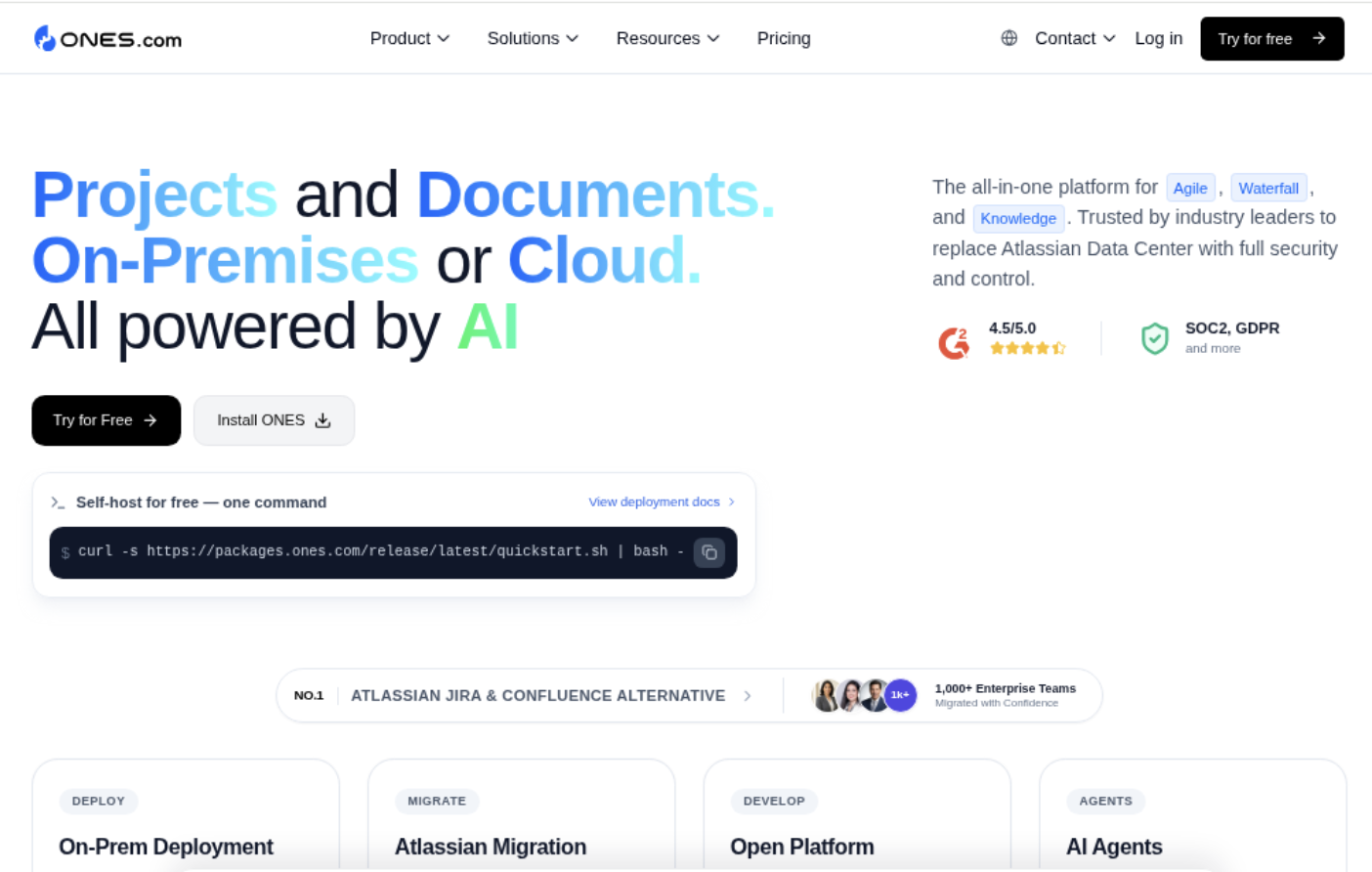
ONES.com brings project management and knowledge management together on one platform. ONES Project serves as a Jira alternative for teams that want structured delivery workflows, reporting, and flexible deployment options.
ONES Project and ONES Wiki are sold separately, so you can evaluate the project and knowledge capabilities according to your organization’s scope.
Core Capabilities
- Too many disconnected project workflows: ONES Project provides Jira-compatible workflows, custom workflows, and custom fields. Teams can standardize delivery while preserving project-specific requirements.
- Manual sprint coordination: Sprint management gives teams a clearer way to plan, track, and review iterative work. Managers gain a consistent view of progress across projects.
- Limited visibility into delivery: Built-in reporting helps teams examine status, workload, progress, and delivery trends without assembling separate reporting processes.
- Repetitive administrative work: Automation handles recurring workflow actions and reduces manual updates. Administrators can spend more time improving governance.
- High plugin dependence: Native project capabilities can reduce the number of separate extensions needed for common planning and tracking needs. That can simplify ownership and upgrade planning.
- Strict infrastructure requirements: ONES.com supports Cloud, On-Premise, Private Cloud, and Air-gapped deployments. Teams can align the platform with their network and security environment.
- Different behavior across deployment types: ONES.com maintains full feature parity between its cloud and self-hosted versions. Your deployment decision does not require giving up core functionality.
- High entry cost for evaluation: The free plan supports up to 30 seats. A small team can test practical workflows before planning a wider rollout.
- Separate knowledge and project silos: ONES Wiki provides knowledge management as a Confluence alternative. Teams can evaluate it separately from ONES Project.
Application Scenarios
Growing product organization: A product company replacing scattered project practices can use custom workflows, sprint management, and reporting to create a consistent delivery model. Administrators can establish shared standards while teams retain relevant fields and statuses.
Regulated engineering team: An organization requiring restricted network operations can assess the Air-gapped or self-hosted deployment options. Feature parity across deployment types helps the team align security controls with daily project work.
Enterprise Jira alternative evaluation: A company reviewing its three-year platform cost can compare native capabilities, deployment flexibility, plugin requirements, and administration effort. ONES.com gives the evaluation team another option beyond Jira.
Common Challenges With Enterprise Pricing
Challenge: The quote hides important assumptions
Solution: Ask for user counts, products, contract periods, renewal terms, support levels, and optional services as separate lines. Require the vendor to explain every assumption in plain language.
Challenge: Teams use different definitions of an active user
Solution: Classify people by access frequency and responsibility. Review actual adoption during a pilot, then create a seat forecast using active contributors rather than total employment numbers.
Challenge: First-year budgeting ignores internal work
Solution: Estimate administration, security reviews, training, integration maintenance, and governance. Assign approximate hours and internal rates to each activity.
Challenge: Plugin costs grow faster than expected
Solution: Mark every extension as essential, useful, or replaceable. Compare the cost and risk of keeping it against a platform with more native capabilities.
Challenge: Renewal creates budget uncertainty
Solution: Request renewal assumptions before signing. Model user growth, product additions, contract changes, and possible price movement over at least three years.
FAQs About Enterprise Jira Costs
Does Jira offer a single public enterprise price?
Enterprise pricing is generally tailored to the organization’s scale and requirements. User volume, products, deployment model, support needs, security controls, and contract terms can all affect the quote. Treat public plan information as an initial reference, then request a proposal that matches your actual environment. Ask for recurring charges and professional services separately.
What should I include in an enterprise pricing request?
Include expected user counts, products, deployment preference, regions, identity requirements, compliance obligations, support expectations, integrations, contract duration, and growth plans. Also describe migration and training needs. A detailed request gives the vendor enough context to prepare a useful commercial proposal and reduces later surprises.
Are implementation services part of the software subscription?
They may be separate, depending on the proposal. Migration, workflow configuration, testing, training, integration work, and change management can involve additional services. Review the quote carefully and identify which tasks your internal team will handle. Assigning those tasks a time estimate helps you calculate the real first-year investment.
How can I compare Jira with another enterprise platform?
Use a consistent scenario for every option. Keep the user count, products, contract length, deployment requirements, security controls, and implementation scope constant. Then compare recurring cost, internal administration, third-party extensions, migration effort, reporting, workflow flexibility, and renewal assumptions. A capability scorecard prevents the decision from relying on license price alone.
Is self-managed deployment always cheaper?
No deployment model is automatically cheaper for every organization. Self-managed environments may suit strict infrastructure or network requirements, though they also require internal work for hosting, upgrades, monitoring, backups, and security. Cloud can reduce infrastructure responsibilities while introducing different governance considerations. Compare total operating effort alongside the subscription quote.
Conclusion
Enterprise Jira pricing is best understood as a three-year ownership decision. Start with users and products, then evaluate deployment, security, support, implementation, integrations, administration, and renewal terms.
But here's the truth: the cheapest quote may become expensive when it depends on extensive extensions, manual governance, or unplanned internal work.
Build a normalized comparison, test growth scenarios, and request itemized proposals. Include alternatives such as ONES.com when native workflows, deployment flexibility, feature parity, and reduced plugin dependence matter to your team.
That approach reduces budget surprises and gives you a clearer path from enterprise platform evaluation to sustainable daily operations.