Jira Explained: A Clear Guide to the Project Tool in 2026
Wondering what is Jira? Learn how projects, issues, and workflows simplify agile work in this clear 2026 guide—read now.
Jira can feel confusing when every team describes it differently. One person calls it a ticketing system, another calls it an agile planning tool, and someone else uses it as a service desk.
That confusion creates real problems. You may create the wrong project type, choose unsuitable workflows, or spend hours searching for work that should be easy to find.
But here's the truth: Jira becomes much easier once you understand its basic structure. You need to know what Jira does, how its work items fit together, and where its limits appear.
This guide explains Jira in plain English. You will learn how projects, issues, boards, workflows, sprints, and reports connect. You will also see when Jira makes sense and when another platform may fit better.
What Is Jira?
Jira is a project management and issue-tracking platform that helps teams plan work, manage tasks, track progress, and resolve problems. Atlassian develops Jira for software teams, business teams, service teams, and other project-based groups.
Teams use Jira to represent work as issues. An issue might be a user story, task, bug, request, improvement, or support ticket.
Each issue can include a description, owner, status, priority, due date, comments, attachments, relationships, and activity history. You can move issues through a workflow as work progresses.
Here's why: Jira connects daily tasks with broader planning. A product team can turn a feature idea into a user story, assign it to a sprint, track its progress, and review the outcome.
What Jira Helps You Manage
- Product features and user stories
- Software bugs and technical improvements
- Project tasks and dependencies
- Sprint planning and delivery
- Service requests and incidents
- Approvals and internal work requests
- Team priorities and workload
- Progress reports and delivery trends
Jira is highly configurable. You can adapt issue types, fields, statuses, permissions, screens, notifications, and automation rules to match a team’s workflow.
That flexibility also creates a learning curve. A simple team may need only a few issue types and statuses, while a large organization may manage several workflows across many teams.
How Jira Works: The Core Building Blocks
Jira becomes easier to understand when you separate its main building blocks. Each one answers a different question about your work.
Projects
A Jira project is a workspace for a particular product, service, team, or business process. A software team might create one project for a mobile application.
An operations team might create another project for internal requests. A project can contain its own issue types, workflows, permissions, boards, and reports.
Project structure affects daily work. If everything goes into one crowded project, filtering and reporting become harder. If you create too many projects, administration becomes more complicated.

Issues
An issue represents one piece of work. Jira uses issues instead of treating every activity as an informal message or separate task list.
For example, “Improve checkout speed” might be an initiative or larger work item. “Add caching to the cart service” could be a task. “Checkout fails on Safari” could be a bug.
Issues can connect to one another. You may link a bug to the feature that caused it or mark one task as dependent on another.
Issue Types
Issue types describe the kind of work being tracked. Common types include:
- Epic: A large body of work containing several related items.
- Story: A user-focused capability or product requirement.
- Task: A specific piece of work that may not be user-facing.
- Bug: A defect or unexpected behavior.
- Sub-task: A smaller activity inside another issue.
- Request: A question, need, or service-related item.
Teams can add custom issue types, although too many types may make reporting difficult. A clear naming system usually works better than a long list.
Fields
Fields hold details about an issue. Standard fields may include the summary, description, assignee, reporter, priority, status, labels, and due date.
Custom fields can capture details such as customer impact, compliance category, release target, risk level, or business value.
Here's a practical example: a security team might add a “severity” field, while a marketing team might add “campaign” and “approval owner.”
Workflows
A workflow defines the stages an issue follows. A simple workflow might use To Do, In Progress, and Done.
A release team may need more stages, such as Ready for Development, In Development, Code Review, Testing, and Released.
Transitions move an issue from one status to another. Conditions, validators, and automatic actions can control what happens during each transition.
Boards
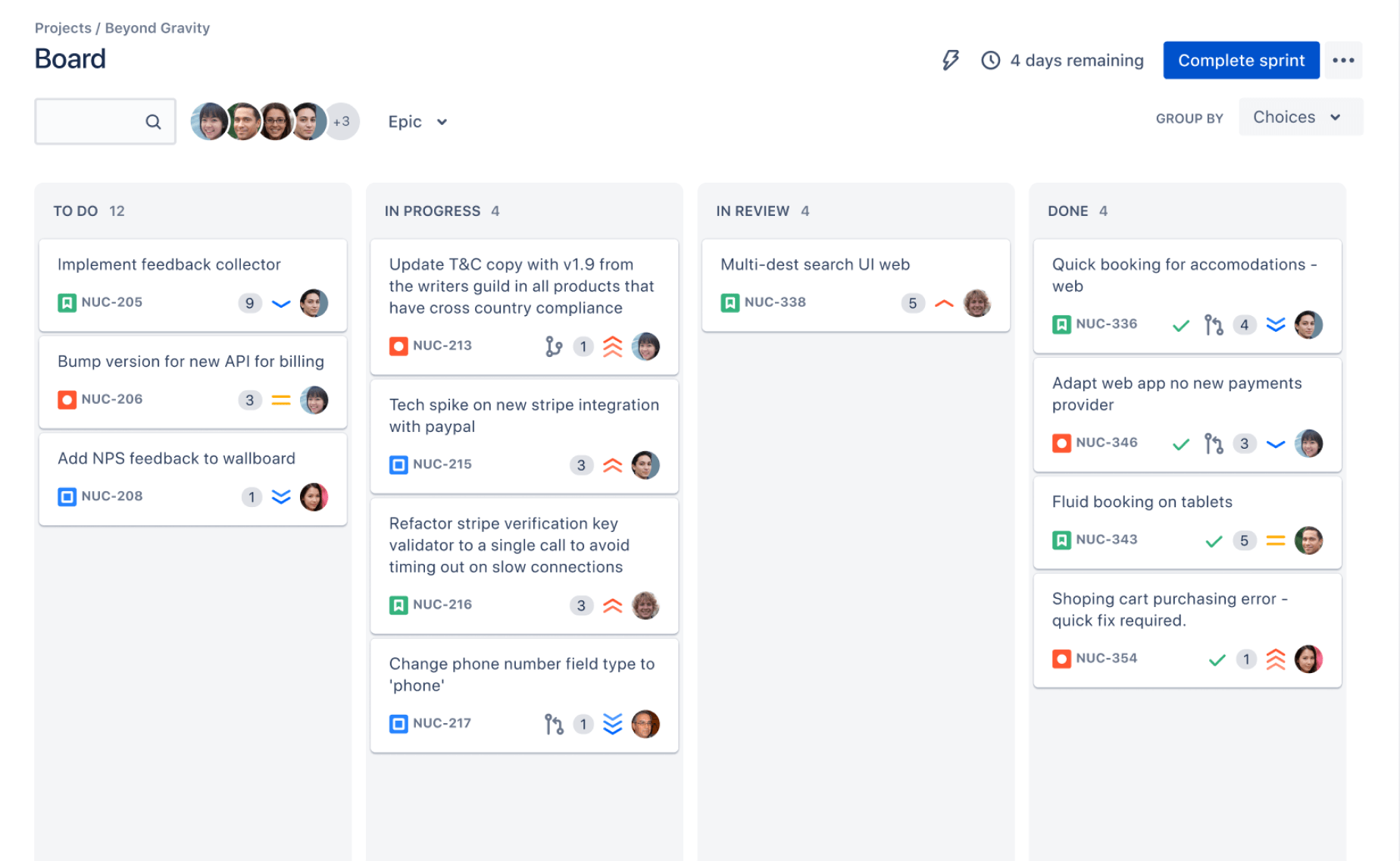
A board displays issues in columns so you can see work visually. Jira supports Scrum boards and Kanban boards.
A Scrum board usually supports sprint planning, sprint execution, and sprint review. A Kanban board focuses on continuous flow and limiting work in progress.
For example, a Kanban board might show Backlog, Selected, Doing, Review, and Done. The columns represent workflow stages rather than individual employees.
Backlogs and Sprints
A backlog is a prioritized list of work that has not entered active delivery. Product teams use it to organize future stories, tasks, bugs, and improvements.
A sprint is a fixed period during which a team plans to complete selected work. Many teams use one- or two-week sprints, although the right duration depends on the work.
During sprint planning, the team chooses work from the backlog. During the sprint, members update issues. At the end, the team reviews results and improves its process.
Reports and Dashboards
Jira reports help you understand delivery patterns. Common examples include sprint reports, burnup charts, burndown charts, velocity reports, cumulative flow diagrams, and control charts.
Dashboards combine charts, filters, issue lists, and activity views. A project manager might track overdue work, open bugs, sprint progress, and blocked items on one dashboard.
Reports are useful only when teams update issues consistently. A beautiful dashboard cannot correct unclear ownership or stale statuses.
Jira Software, Jira Work Management, and Jira Service Management
Jira is an umbrella name connected with several Atlassian products. The right product depends on the type of work you manage.
Jira Software
Jira Software is designed mainly for software development and technical product teams. It includes agile planning features such as Scrum boards, Kanban boards, backlogs, sprints, releases, and development integrations.
A development team might use it to plan a release, prioritize bugs, coordinate engineering tasks, and review sprint performance.
Jira Work Management
Jira Work Management supports business teams that need structured task and project tracking. Marketing, human resources, finance, legal, and operations teams can use it for recurring or project-based work.
A marketing team might track campaign requests through intake, review, approval, production, and publication. Custom fields can capture the campaign owner, audience, launch date, and approval status.
Jira Service Management
Jira Service Management supports service desks and internal support teams. It can manage incidents, service requests, changes, approvals, and knowledge-oriented support processes.
An employee may submit an access request through a portal. The request can then move to review, approval, fulfillment, and closure.
These products overlap in some areas, but their interfaces and workflows serve different purposes. Before choosing a setup, define the work your team handles most often.
How Teams Use Jira in Practice
Jira works best when you connect planning, execution, and review. Each stage should answer a practical question.
1. Capture the Work
Start by creating an issue that clearly describes the need. Use a specific summary, useful context, and an owner when possible.
Instead of writing “Login problem,” write “Users receive an error after resetting a password.” The second summary gives the team a clearer starting point.
2. Prioritize the Work
Teams rank issues according to value, urgency, risk, effort, or dependency. A product manager may place a regulatory requirement above a minor design improvement.
Priority should reflect a decision, not simply the loudest request. A short explanation can help the team understand why an item moved higher.
3. Plan Delivery
Teams select work for a sprint, release, or continuous workflow. Larger initiatives can be divided into smaller issues with clear outcomes.
For example, a mobile payment feature might include interface design, API development, error handling, testing, analytics, and release preparation.
4. Track Progress
Members update statuses, add comments, record decisions, and identify blockers. This activity creates a shared view of current work.
If a task remains in progress for ten days, the team can investigate whether it needs clarification, additional help, or a smaller scope.
5. Review Results
Reports and sprint reviews help teams compare planned work with completed work. Retrospectives then turn observations into process improvements.
A team may discover that testing begins too late. It could respond by adding a testing step earlier in the workflow.
Jira Workflows and Agile Methods
Jira commonly supports Scrum and Kanban, but the platform does not force a team to follow either method perfectly.
Scrum in Jira
Scrum teams work in timeboxed sprints. They maintain a backlog, plan sprint work, hold regular reviews, and discuss process improvements.
Jira can show sprint scope, completed issues, remaining work, and velocity. These views help teams discuss delivery without relying on memory.
For example, if a team repeatedly carries half its sprint work forward, it may need smaller issues, better estimation, or fewer interruptions.
Kanban in Jira
Kanban teams manage a continuous flow of work. They often focus on limiting work in progress and reducing the time required to finish each item.
A support team might limit the number of requests in investigation. This prevents specialists from starting too many tickets while older requests remain unfinished.
Hybrid Approaches
Some teams combine methods. They may use a Kanban board for daily flow while reviewing priorities during a weekly planning session.
Jira can support this arrangement, but the workflow should remain understandable. A board with twelve columns may reflect internal complexity rather than useful visibility.
Let me explain: agile tools work best when they reinforce a team’s habits. They cannot replace prioritization, communication, technical judgment, or clear ownership.
Jira Automation, Integrations, and Customization
Jira can automate repetitive actions and connect with other work systems. For example, a rule may assign an issue when it enters a particular status or notify a reviewer when a deadline approaches.
Teams can also connect Jira with development platforms, communication tools, testing systems, identity services, and reporting applications.
Customization may include workflows, screens, issue layouts, fields, permissions, notifications, project roles, and automation rules.
The best approach is gradual customization. First understand the default workflow. Then change the parts that create measurable friction.
Here's why: every custom field requires maintenance. Every special status can affect reports, training, permissions, and automation.
Jira Benefits and Limitations
Benefits
- Strong support for agile software planning
- Detailed issue tracking and history
- Flexible workflows and custom fields
- Useful sprint and delivery reports
- Broad integration possibilities
- Support for software, business, and service teams
- Visibility into ownership, status, and dependencies
Limitations
- The interface can feel complex for occasional users.
- Administration may require dedicated expertise at larger scale.
- Over-customized workflows can slow everyday work.
- Reporting quality depends on consistent updates.
- Some teams need additional knowledge management capabilities.
- Configuration differences can make projects feel inconsistent.
You might be wondering: is Jira difficult to use? The answer depends on the setup. A small team with three statuses may learn it quickly. A large organization with many project schemes may need formal training.
A useful comparison is a workshop. Jira gives you many tools, but the result depends on how you arrange them. More tools do not automatically create a better process.
How to Set Up Jira for a New Team
- Define the work: Decide whether you are managing software delivery, service requests, business projects, or a combination.
- Choose a project structure: Group work around a product, service, team, or business process.
- Select a workflow: Begin with only the statuses your team genuinely needs.
- Set issue types: Use a small set of types that people can understand quickly.
- Create useful fields: Add only information that supports decisions, reporting, or ownership.
- Set permissions: Decide who can create, edit, assign, transition, and administer issues.
- Build the board: Match columns to meaningful workflow stages.
- Define reporting habits: Agree when team members update status, estimates, priorities, and blockers.
- Test with real work: Run a small pilot before applying the configuration across a large team.
- Review after delivery: Remove unnecessary steps and adjust the workflow using team feedback.
The best part? You do not need to design a perfect Jira environment on the first day. A simple configuration gives you room to learn.
A Jira Alternative for Unified Project and Knowledge Management: ONES.com
Value Proposition
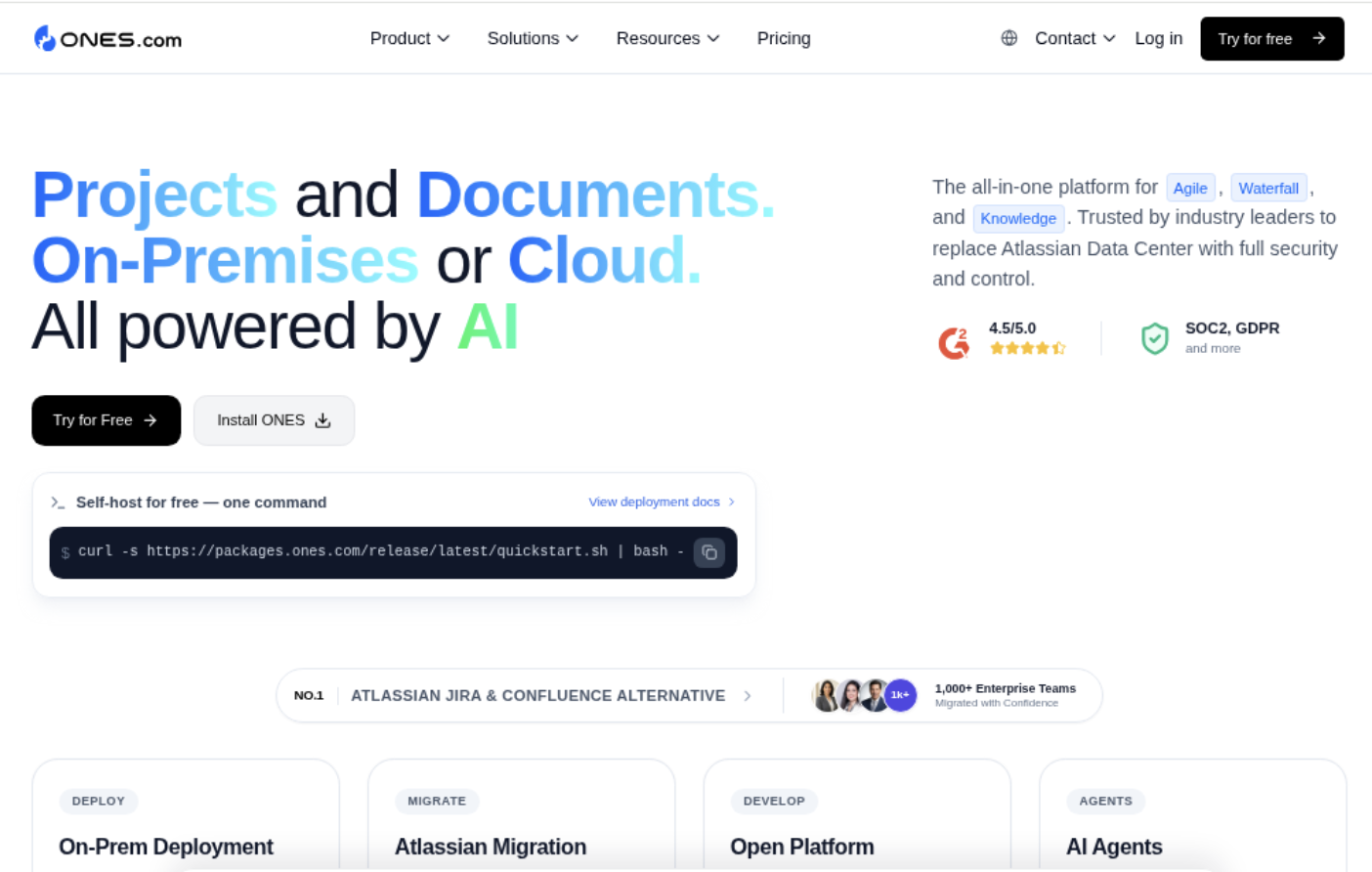
ONES.com combines project management and knowledge management in one platform, powered by the ONES Assistant. It can suit teams that want Jira-compatible project workflows alongside a connected knowledge workspace.
ONES Project is the project management product and a Jira alternative. ONES Wiki is the knowledge management product and a Confluence alternative. They are sold separately.
Core Capabilities
- Scattered project and knowledge work → Connected workspaces: ONES.com brings project execution and knowledge management into a unified platform, helping teams connect plans, decisions, and working guidance.
- Complex agile administration → Jira-compatible workflows: ONES Project supports familiar agile patterns, making it easier for teams to manage stories, tasks, bugs, sprints, and releases.
- Limited visibility into delivery → Built-in reporting: Built-in reports help teams review progress, workload, sprint performance, and delivery trends without assembling every view separately.
- Rigid work tracking → Custom workflows and fields: Teams can adapt statuses, fields, and workflow steps to match product development, operations, or approval-heavy processes.
- Manual recurring actions → Automation: Automation can reduce repetitive assignments, notifications, and transitions, allowing people to focus on decisions and delivery.
- Separate planning environments → Native platform parity: ONES.com provides feature parity between its cloud and self-hosted versions, supporting teams with different hosting requirements.
- Restricted hosting requirements → Flexible deployment: Teams can choose Cloud, On-Premise, Private Cloud, or Air-gapped deployment options.
- Plugin-heavy configurations → More native capabilities: Native project features can reduce dependence on extra plugins for common planning, reporting, workflow, and sprint needs.
- High entry cost for evaluation → Free access for 30 seats: Eligible teams can evaluate the platform with up to 30 seats before deciding whether it fits their operating model.
Application Scenarios
Software product team: A product group can manage epics, stories, bugs, sprints, and releases in ONES Project. Its knowledge workspace can hold architecture guidance, onboarding material, and team decisions.
Air-gapped engineering environment: A team with restricted network requirements can use an air-gapped deployment while preserving core project management capabilities. This supports controlled access without moving work into a public cloud environment.
Cross-functional operations: An operations group can create approval workflows for requests, assign owners, track deadlines, and keep process guidance accessible through ONES Wiki.
ONES.com may be worth evaluating when your team wants a Jira alternative with self-hosted deployment, native reporting, custom workflows, sprint management, and connected knowledge capabilities.
Common Challenges When Using Jira
Challenge: Too Many Statuses
Problem: A team creates separate statuses for every small activity, making boards difficult to read.
Solution: Combine steps that do not change ownership, risk, or decision-making. Keep detailed notes inside the issue when a separate status adds little value.
Challenge: Unclear Issue Descriptions
Problem: Issues contain short summaries but lack context, acceptance criteria, or expected outcomes.
Solution: Add a clear purpose, relevant constraints, completion criteria, and links to related work. A developer should understand the intended result without guessing.
Challenge: Stale Work Items
Problem: Issues remain open after priorities change or work finishes elsewhere.
Solution: Schedule a regular backlog review. Close, combine, reassign, or reprioritize items that no longer represent active work.
Challenge: Reports That Do Not Reflect Reality
Problem: Dashboards show attractive charts, but statuses and estimates are inconsistent.
Solution: Agree on simple update rules. For example, update an issue when work starts, when it becomes blocked, and when it is ready for review.
Challenge: Different Teams Use Jira Differently
Problem: One team treats “Done” as development complete, while another treats it as released to customers.
Solution: Define shared terms and document team-specific differences. Consistent definitions improve reporting across projects.
FAQs About Jira
Is Jira only for software development?
No. Jira is widely used for software development, but business, operations, marketing, human resources, finance, and service teams can also use it. The key question is whether your work benefits from structured issues, ownership, workflows, priorities, and progress tracking. A marketing team, for example, can manage campaign requests and approvals through a customized Jira workflow.
What is the difference between Jira and a task list?
A task list usually records what needs to happen. Jira can also show why the work exists, who owns it, what stage it has reached, which items depend on it, and how it affects a larger plan. For a small personal checklist, Jira may feel excessive. For a team managing shared work, dependencies, reporting, and approvals, its structure can provide valuable visibility.
What is a Jira issue?
A Jira issue is a trackable unit of work. It may represent a bug, task, story, request, improvement, or larger initiative. An issue can include a summary, description, owner, status, priority, comments, relationships, and activity history. Teams move issues through workflows so everyone can see what needs attention and what has already been completed.
What are Scrum and Kanban boards in Jira?
A Scrum board supports planned work in sprints. Teams select items from a backlog, complete them during a fixed period, and review the result. A Kanban board supports continuous flow. Teams pull work through stages and often limit the number of active items. Choose Scrum when sprint planning fits your delivery rhythm. Choose Kanban when work arrives continuously.
Can Jira be customized?
Yes. Jira can support custom workflows, fields, issue types, screens, permissions, notifications, boards, and automation rules. Customization helps when a team has genuine process needs. However, excessive customization can increase administration and confuse occasional contributors. Start with a simple workflow, observe the friction, and change only the parts that improve clarity or control.
Conclusion
Jira is a flexible platform for planning work, tracking issues, managing workflows, and reviewing delivery. Its main building blocks are projects, issues, issue types, fields, workflows, boards, backlogs, sprints, and reports.
But here's the truth: Jira works best when your team keeps the setup understandable. Clear issue descriptions, sensible statuses, consistent updates, and regular backlog reviews matter as much as the platform itself.
If you need agile project management with extensive configuration, Jira may fit well. If you also need connected knowledge management, self-hosted deployment, or a Jira alternative with native project capabilities, ONES.com is worth evaluating.
The solution to Jira confusion is not adding more complexity. It is building a clear path from planned work to completed outcomes.