Jira for Project Management: A 7-Step Guide for Teams [2026]
Struggling with chaotic Jira projects? Learn jira for project management in 7 steps to streamline workflows, track progress, and ship better. Read now!
Jira can help your team plan work, track progress, and manage releases. Yet many teams struggle before they see those benefits. Projects become crowded with vague tickets, inconsistent workflows, overdue tasks, and dashboards nobody checks.
The problem grows when Jira is treated as a task list instead of a working system. A software team may have one process for bugs, another for feature work, and no clear way to connect daily activity with delivery goals.
But here's the truth: Jira becomes much easier when you build it around a repeatable project management process. This seven-step guide shows you how to set up Jira, organize work, run sprints, measure progress, and improve your team’s workflow in 2026.
How to Use Jira for Project Management in 7 Steps
Jira works best when your team defines the operating rules before adding large volumes of work. Start with the project structure, then connect priorities, workflows, schedules, and reporting.
-
Step 1: Choose the Right Jira Project Type
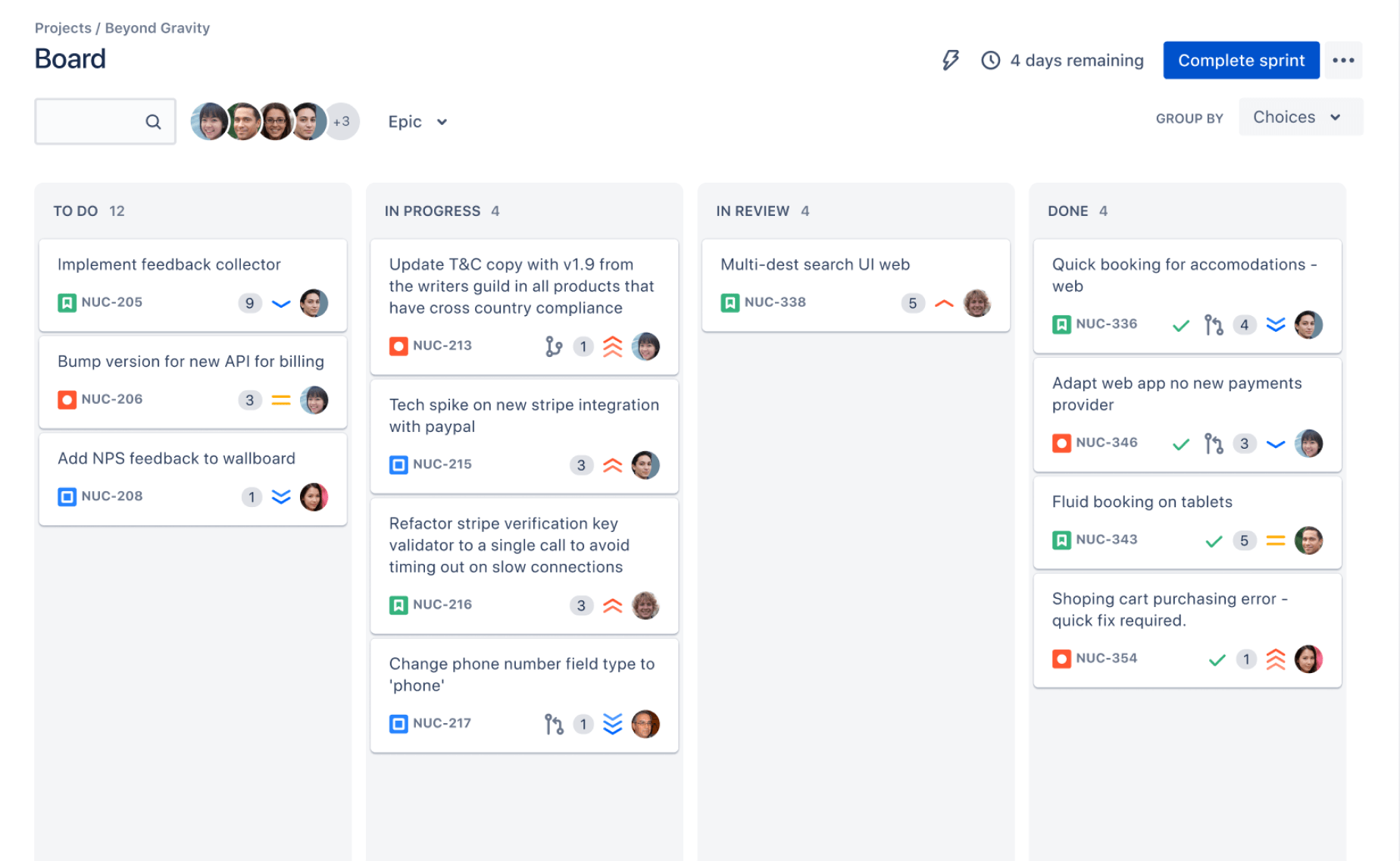
Begin by selecting a project type that matches how your team delivers work. Software teams commonly use Scrum or Kanban, while business teams may prefer a simpler task-management setup.
Choose Scrum when your team plans work in time-boxed sprints. Choose Kanban when work moves continuously through stages such as “To do,” “In progress,” “Review,” and “Done.”
For example, a mobile app team may use Scrum for two-week development cycles. A support engineering team may use Kanban because requests arrive throughout the week.
-
Step 2: Define Projects, Components, and Ownership
Create a clear project boundary before importing or creating work items. A project might represent a product, department, customer program, or long-running service.
Use components or labels to separate meaningful work areas. Examples include authentication, payments, mobile, infrastructure, and customer support.
Assign ownership at two levels. A project lead owns priorities and delivery decisions, while individual team members own specific work items. This prevents responsibility from becoming unclear.
A practical ownership model may look like this:
- Product manager: maintains priorities and acceptance expectations.
- Engineering lead: guides technical decisions and delivery risks.
- Developers: complete implementation work and update progress.
- Quality specialists: manage testing, defects, and release confidence.
-
Step 3: Build a Work Breakdown That People Can Understand
Jira becomes easier to manage when each work item has a clear level of detail. Use larger items for outcomes and smaller items for deliverable actions.
A common structure includes epics, stories, tasks, and subtasks. An epic could be “Improve account security.” A story could be “Allow customers to enable two-factor authentication.” Subtasks might cover interface changes, service updates, and testing.
Write each item around an observable result. “Update login system” is vague. “Allow customers to recover access through a verified email link” gives the team a clearer target.
Keep descriptions short enough to scan. Add acceptance criteria when the team needs a shared definition of completion.
-
Step 4: Configure Workflows and Statuses
A workflow shows how work moves from an idea to completion. Start with the fewest statuses your team can use effectively.
A useful software workflow might include:
- Backlog
- Selected for development
- In progress
- Code review
- Testing
- Done
Each status should answer a practical question. “In progress” means someone is actively working on the item. “Testing” means implementation is complete enough for validation.
Too many statuses create administrative work. If your workflow has twelve stages but team members cannot explain the difference between four of them, simplify it.
-
Step 5: Plan Sprints or Manage Continuous Flow
For Scrum teams, prepare a sprint goal before selecting individual work items. The goal should describe the result the team hopes to achieve, such as “Enable customers to update payment methods securely.”
Estimate work using story points, ideal hours, or another consistent method. The specific technique matters less than using it consistently enough to compare planned work with completed work.
For Kanban teams, set work-in-progress limits. A limit of three items in development can encourage the team to finish existing work before starting more tasks.
Review capacity before committing. A team with planned leave, production support, or technical maintenance needs less feature work in the same period.
-
Step 6: Connect Daily Activity With Releases and Milestones
Project management requires a view beyond individual tickets. Connect work items to versions, releases, milestones, or target dates so stakeholders can understand delivery progress.
For example, an “Account Security” release might include password reset, two-factor authentication, login alerts, and security testing. Each item remains actionable while the release view shows the larger outcome.
Use dependencies carefully. If payment testing cannot begin until a service update is complete, record that relationship. Clear dependencies help the team spot risks before a deadline becomes urgent.
-
Step 7: Review Reports and Improve the System
Use Jira reports to inspect how work actually moves. Useful measures include cycle time, sprint completion, blocked work, reopened defects, and release progress.
A report is valuable when it leads to a decision. If cycle time rises for three weeks, investigate review delays, unclear requirements, or excessive work in progress.
Hold a short process review after each sprint or delivery milestone. Ask what created friction, what helped the team move faster, and which Jira configuration should change.
Improve one process element at a time. Changing workflows, fields, board rules, and reporting together makes it difficult to understand the effect of any single improvement.
What Jira Can Manage Across a Project Lifecycle
Jira can support planning, delivery, quality assurance, release coordination, and post-release improvement. Its strength comes from connecting these activities through shared work items and status changes.
A product manager can create an epic, break it into stories, rank the backlog, and monitor progress through a release view. Engineers can move work across a board, link defects, and record technical decisions within the same workflow.
Quality specialists can connect test-related tasks with feature work. Delivery leads can review sprint trends and identify work that remains blocked.
The result is a connected view of progress. A single ticket may show its owner, priority, status, estimate, related items, target release, and discussion history.
How to Design a Jira Project That Stays Usable
Good Jira administration starts with a small set of shared rules. Decide which fields are required, who can change priorities, and what qualifies as completed work.
For example, require every story to include an owner, priority, acceptance criteria, and target release. Avoid requiring ten fields that add little decision-making value.
Use naming conventions that make work easy to scan. “Checkout: save card for future purchase” is easier to understand than “payment enhancement task 4.”
| Project element |
Practical rule |
| Issue title |
Describe the outcome in plain language. |
| Priority |
Use a small number of meaningful levels. |
| Owner |
Assign one person accountable for the next action. |
| Status |
Use stages that reflect real work movement. |
| Acceptance criteria |
Describe how the team will know the work is complete. |
| Target release |
Connect work with a milestone or delivery objective. |
Review these rules with the team before enforcing them. A process people understand is easier to maintain than one created entirely through administration.
Jira Boards, Backlogs, and Sprints: Choosing the Right View
Each Jira view answers a different project question. The backlog answers “What should we do next?” The board answers “Where is current work?” A sprint report answers “What did we complete during this period?”
Use the backlog for prioritization and refinement. Remove stale items, combine duplicates, and clarify work that may enter an upcoming sprint.
Use the board during daily coordination. A team might notice that five items are waiting for review while only one item is being developed. That pattern suggests a review bottleneck.
Use sprint planning to make a realistic commitment. If a team usually completes 30 points but has a major support obligation, selecting 30 points again may create avoidable pressure.
Kanban teams can focus on aging work and work-in-progress limits. Scrum teams can focus on sprint goals, completed work, and carryover items. Both approaches benefit from clear priorities and visible ownership.
Reporting and Metrics That Support Better Decisions
Metrics should help you find a problem early. They should not turn project management into a competition over activity counts.
Cycle time shows how long work takes after active development begins. Lead time includes the period between a request entering the system and its completion. Comparing both can reveal whether prioritization creates a long waiting period.
Release progress helps stakeholders understand whether a milestone remains realistic. Defect trends can show whether quality problems are increasing after a process change.
Consider a team that completes many small tasks but repeatedly delays a major release. A task-count report may look healthy, while release progress reveals the real issue.
- Use cycle time to identify delivery delays.
- Use sprint completion to compare commitments with results.
- Use cumulative flow to spot queues and bottlenecks.
- Use defect trends to monitor quality after releases.
- Use blocked-item reviews to expose dependencies.
Review metrics with context. A sudden cycle-time increase may result from a complex migration rather than poor team performance.
Common Jira Setup Mistakes to Avoid
Many Jira problems come from configuration decisions made without a clear operating model. Teams add fields, statuses, and automation rules because each request seems useful on its own.
Over time, the project becomes difficult to navigate. New team members need extensive training, and experienced members create personal workarounds.
Another common mistake is treating every request as urgent. When everything has the highest priority, the priority field stops helping people make trade-offs.
Teams also lose value when they stop updating statuses. A board that shows old information damages trust because people cannot use it to coordinate current work.
Set a regular maintenance review. Remove unused fields, simplify transitions, archive inactive work, and confirm that reports still answer real management questions.
ONES.com is a unified platform for project management and knowledge management, powered by AI through ONES Assistant. ONES Project handles project management and serves as a Jira alternative, while ONES Wiki supports knowledge management as a Confluence alternative. They are sold separately.
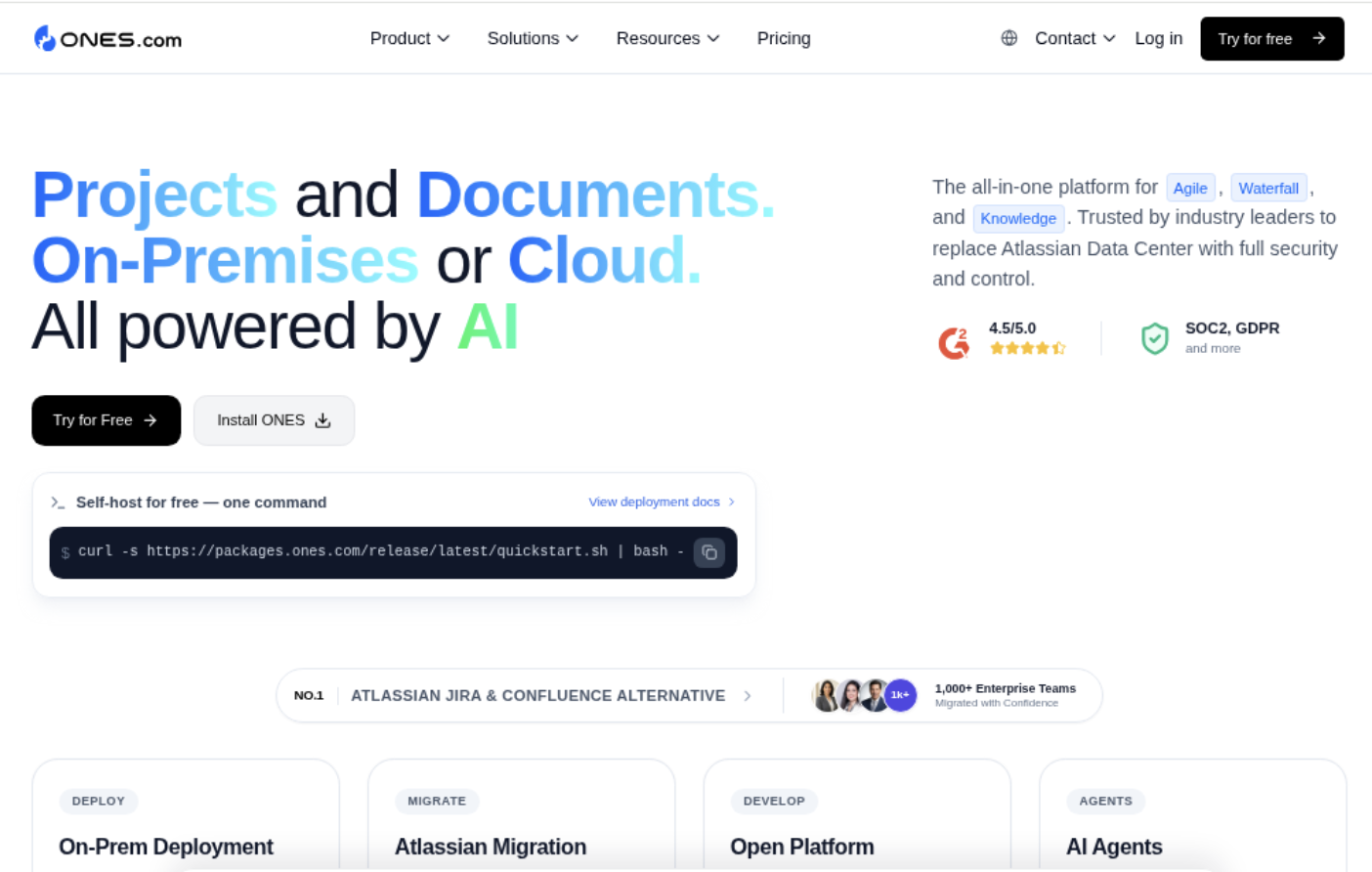
It may suit teams that want Jira-compatible workflows, reporting, automation, and self-hosted deployment options with fewer connected plugins.
Core Capabilities
- Fragmented project planning: ONES Project brings epics, tasks, sprints, releases, and project views into one project management environment. Result: Teams can connect daily work with larger delivery goals.
- Complex workflow administration: Custom workflows let teams reflect stages such as development, review, testing, and approval. Result: The board matches the team’s operating process more closely.
- Inconsistent work details: Custom fields can capture ownership, priority, risk, customer impact, and release information. Result: Teams can standardize the details needed for planning and reporting.
- Limited sprint visibility: Sprint management supports planning, active delivery, and review. Result: Teams can compare commitments with completed work.
- Manual repetitive coordination: Automation can trigger routine actions when work changes status or meets defined conditions. Result: Project leads spend less time repeating administrative updates.
- Scattered performance insights: Built-in reporting provides views into progress, workload, delivery trends, and project health. Result: Managers can identify bottlenecks earlier.
- Plugin-heavy project setups: Native capabilities cover workflows, custom fields, sprint management, and reporting. Result: Teams may reduce the number of separate extensions required for everyday project control.
- Deployment restrictions: ONES.com supports Cloud, On-Premise, Private Cloud, and Air-gapped deployments. Result: Teams can select an environment that matches security and infrastructure requirements.
- Uneven cloud and self-hosted experiences: ONES.com provides full feature parity between its cloud and self-hosted versions. Result: Deployment choice does not require giving up core capabilities.
Application Scenarios
A regulated engineering team may use an air-gapped or on-premise deployment while maintaining sprint planning, custom workflows, and reporting. This can support restricted-network project management without abandoning familiar delivery practices.
A product organization moving away from a plugin-heavy Jira setup may use ONES Project to consolidate workflow controls, release tracking, automation, and reports. The team can then review which extensions remain necessary.
A company managing both projects and internal knowledge may use ONES Project and ONES Wiki separately. Project teams can coordinate delivery while knowledge specialists maintain a dedicated knowledge base environment.
ONES.com offers a free plan for up to 30 seats. Teams can evaluate whether its project structure, deployment choices, and native capabilities fit their operating requirements before expanding usage.
Common Challenges With Jira Project Management
Challenge: Work Items Are Too Vague
Problem: A ticket such as “Improve performance” gives the team no shared completion target.
Solution: Add a measurable outcome, a clear owner, and acceptance criteria. For example, define a page-load target and the customer action that must remain functional.
Challenge: The Backlog Keeps Growing
Problem: New ideas enter faster than the team can evaluate them, creating a long queue of low-value work.
Solution: Review the backlog on a fixed schedule. Archive outdated requests, combine duplicates, and rank work against current goals.
Challenge: Teams Start Too Much Work
Problem: Several items remain partially complete while urgent requests interrupt planned work.
Solution: Set work-in-progress limits and make finishing a visible team goal. A limit of two or three active development items can create healthier flow.
Challenge: Reports Are Ignored
Problem: Dashboards contain many charts, yet meetings still rely on personal updates and guesses.
Solution: Keep only reports that support a decision. If a chart does not change priorities, capacity, risk management, or process improvement, remove it.
Challenge: Stakeholders See Too Much Detail
Problem: Executives may struggle to understand hundreds of tickets, while delivery teams need detailed work views.
Solution: Create separate views for different audiences. Use releases, milestones, and progress summaries for stakeholders, with boards and issue details for delivery teams.
FAQs
Is Jira suitable for project management outside software development?
Yes. Jira can support marketing campaigns, operations work, business initiatives, and service projects when the workflow matches the work. Start with clear stages, owners, priorities, and completion criteria. A Kanban board may suit a continuous request process, while a Scrum setup may help a team delivering planned work in short cycles.
Should every project use sprints?
No. Sprints work well when a team plans and reviews work in regular time periods. Continuous-flow teams may gain more from Kanban limits, queue management, and cycle-time tracking. Choose the method that reflects how work actually arrives and gets completed.
How many Jira statuses should a project have?
Use enough statuses to show meaningful handoffs, while keeping the workflow easy to understand. A small software team may need only backlog, in progress, review, testing, and done. Add another status only when it represents a real decision, responsibility change, or quality checkpoint.
What should a Jira dashboard show?
A useful dashboard may show sprint progress, blocked work, overdue items, release status, cycle time, and unresolved defects. Choose widgets around management questions. For example, if a release is at risk, a release-progress view and blocked-item list may matter more than a general activity feed.
Can teams migrate from Jira to another project management platform?
Yes, but migration needs careful planning. Review workflows, fields, project relationships, permissions, reports, and integrations before moving. Run a small pilot with one team, compare the new process with the old one, and adjust naming rules before expanding the rollout.
Conclusion
Jira for project management works best when it reflects a clear delivery process. Define the project structure, create understandable work items, configure practical workflows, plan capacity, connect tasks to releases, and review metrics that support decisions.
But here's the truth: a crowded board will not fix unclear priorities, and another dashboard will not solve missing ownership. Start with the team’s real workflow, then configure Jira around it.
If your current setup needs fewer plugins, stronger deployment flexibility, or native project controls, ONES.com offers ONES Project as a Jira alternative. The right platform is the one your team can understand, maintain, and use consistently from planning through delivery.