Jira Hosted Pricing Explained: Plans, Costs, and Key Fees
How much is Jira hosted pricing? Compare plans, costs, user tiers, add-ons, and hidden fees to budget confidently. Read now to choose wisely.
Jira hosted pricing can look simple until you compare user tiers, billing terms, add-ons, and service limits. A plan that seems affordable for five people may cost much more after your team grows, adds premium features, or needs stronger administration.
That uncertainty makes budgeting difficult. You may compare the monthly number while overlooking annual commitments, marketplace apps, automation limits, storage, or support differences. The result is often a plan that fits today but creates surprises later.
Here’s the practical solution: separate Jira’s subscription cost from optional services, then estimate the total for your real team size. This guide explains Jira Cloud plans, common fees, billing choices, and the questions to ask before you commit.
Jira Hosted Pricing at a Glance
Jira hosted pricing usually refers to the cost of running Jira through Atlassian’s cloud service instead of hosting Jira on your own infrastructure. Your total cost depends mainly on the number of users, plan level, billing term, marketplace apps, and optional products.
Jira Cloud commonly includes Free, Standard, Premium, and Enterprise tiers. The exact price can change by region, currency, tax treatment, user count, and Atlassian’s current pricing policy.
| Plan |
Best fit |
Typical cost pattern |
Main pricing consideration |
| Free |
Small teams testing Jira |
No subscription fee within the plan limits |
Limited users, storage, permissions, and support |
| Standard |
Growing teams with regular project work |
Per-user subscription with monthly or annual billing |
Team size, storage, and collaboration needs |
| Premium |
Teams needing advanced scale and administration |
Higher per-user subscription |
Advanced capabilities and higher service limits |
| Enterprise |
Large organizations with complex governance |
Custom commercial arrangement |
Organization-wide scale, controls, and negotiated terms |
But here’s the truth: the advertised subscription is only one part of your Jira budget. You should also consider apps, tax, implementation, migration, training, administration, and possible overage or upgrade costs.
How Jira Cloud Plans Work
Free plan
The Free plan is designed for small teams exploring Jira’s core project and issue-tracking features. It can be useful for a prototype, a small internal project, or a team deciding whether Jira fits its workflow.
The trade-off is tighter limits. You may encounter restrictions around user count, storage, permissions, automation, support, and administration. Those limits matter when a team moves from casual testing to structured delivery.
For example, a five-person product team may work comfortably on Free during early planning. A 12-person team with contractors, stakeholders, and multiple projects may quickly need more control.
Standard plan
Standard is usually the starting point for teams that need Jira for everyday work. It typically offers more users, storage, permissions, automation capacity, and support than Free.
The subscription is generally calculated around the number of users assigned to the service. A user who needs access across several projects may still count once at the site level, depending on Atlassian’s licensing rules.
Here’s why: the cheapest plan is not always the lowest-cost option. Standard can reduce the operational friction that appears when Free limits interrupt planning, reporting, or access management.
Premium plan
Premium targets organizations that need more scale, stronger administration, and advanced capabilities. It may suit teams managing several departments, complex release schedules, or higher service expectations.
Premium pricing deserves careful evaluation because the value depends on your workflow. If your team only needs basic issue tracking, the additional cost may provide little benefit.
However, advanced planning, higher limits, improved resilience, and more sophisticated administration can justify the upgrade for larger delivery organizations.
Enterprise plan
Enterprise is aimed at large organizations with broad deployment requirements. Pricing is usually handled through a custom agreement rather than a simple public per-user checkout.
Enterprise discussions may include user volumes, security requirements, governance, service commitments, support arrangements, and commercial terms. The subscription can also span multiple teams or sites.
You might be wondering: when should you discuss Enterprise? Start when administration, compliance, and organization-wide control matter more than a simple team subscription.
Monthly and Annual Billing
Monthly billing
Monthly billing gives you flexibility. You can add or remove users more frequently and avoid a large upfront commitment.
This option often works well when headcount changes quickly, a project has a short lifespan, or you are validating Jira with a new department.
The downside is that monthly pricing can become more expensive over a full year. A team that remains stable may pay more for flexibility it rarely uses.
Annual billing
Annual billing is often more predictable for established teams. You pay for an agreed user tier for the billing period, which can make budgeting easier.
The important detail is the user tier. If you buy an annual subscription for 100 users, adding a small number of people may move you into a higher tier.
The best part? Annual planning encourages you to estimate growth before purchasing. That can prevent repeated short-term changes and reduce approval work.
Choosing the right term
Use monthly billing when flexibility has real value. Choose annual billing when your team size is stable and you can forecast demand with reasonable confidence.
For example, a consulting team with a new six-month engagement may prefer monthly billing. A permanent engineering department with predictable hiring may benefit from annual planning.
What Changes the Total Cost?
User count and billing tiers
User count is usually the largest pricing variable. Jira Cloud commonly uses progressive tiers, meaning the amount per user can change as your organization grows.
Do not estimate cost by multiplying one visible per-user number by every employee. The official calculator may apply tier rules, regional pricing, discounts, and minimum charges.
Make a list of everyone who needs access, including developers, product managers, testers, project leads, service staff, and occasional contributors.
Marketplace apps
Many teams extend Jira with apps for time tracking, advanced roadmaps, test management, portfolio reporting, approvals, documentation, or specialized workflows.
These apps may have their own pricing model. Some charge by user count, while others use separate tiers or service limits.
A practical estimate should include every essential app. A Jira subscription that costs $1,000 per year can become a $3,000 technology budget after several paid extensions.
Taxes and regional pricing
Your checkout amount may differ from the headline price because of local taxes, currency conversion, and regional commercial rules.
Check whether your organization can provide tax details during purchase. Public pricing pages may show a pre-tax amount, while the invoice reflects additional charges.
Support and administration
Lower plans may provide standard support, while higher plans can offer stronger administrative capabilities or more extensive service arrangements.
Support affects cost indirectly. If your team lacks an experienced administrator, troubleshooting and configuration work may require internal time or outside help.
Migration and implementation
Moving from another project management system can require workflow mapping, permissions planning, history transfer, integration work, and user training.
These are not always line items on the Jira invoice. They still belong in your total ownership estimate because they consume time and specialist effort.
A Simple Jira Cost Calculation
Start with this formula:
Estimated annual cost = Jira subscription + marketplace apps + implementation + administration + training + taxes
Then create three scenarios: current team size, expected team size, and high-growth team size.
| Cost element |
Example question |
Why it matters |
| Core subscription |
How many people need access? |
Determines the main plan and user tier |
| Apps |
Which extensions are essential? |
Can add recurring charges outside Jira |
| Tax and currency |
What appears at checkout? |
Changes the payable amount |
| Administration |
Who manages configuration and access? |
Creates ongoing internal labor |
| Migration |
How much existing work must move? |
Creates one-time project effort |
| Training |
How quickly must teams become productive? |
Reduces adoption delays and workflow mistakes |
For example, imagine 40 active Jira users, two paid apps, one administrator, and a planned growth rate of 20 percent. The correct budget is not merely the visible Jira subscription.
Let me explain: compare the three scenarios over 12 months. If a plan upgrade becomes likely within six months, include it now instead of presenting an artificially low estimate.
How to Compare Plans Without Overpaying
Match capabilities to real work
Write down the workflows your team actually runs. Examples include sprint planning, bug triage, release coordination, approvals, service requests, and cross-team reporting.
Then connect each workflow to a required capability. This prevents you from paying for advanced features that sound useful but never enter daily work.
Separate required and optional features
Create two lists. The first contains capabilities required for delivery or governance. The second contains conveniences that would be helpful but are not essential.
If Premium is justified only by one optional feature, test whether a simpler workflow or focused app solves the same problem at a lower total cost.
Review inactive accounts
Inactive accounts can increase subscription costs or create unnecessary access risk. Review external contributors, former employees, contractors, and occasional viewers regularly.
Set a monthly access review for larger teams. A short review can reveal people who no longer need Jira access.
Measure administration time
Price should include the effort required to maintain workflows, permissions, reports, automations, and integrations.
A plan that saves a small subscription amount but requires hours of manual administration each month may cost more in practice.
Common Pricing Mistakes
Comparing only the entry price
An entry-level price attracts attention, but it may not reflect your actual plan. Teams often upgrade after discovering limits around permissions, automation, reporting, or support.
Compare the plan you need today and the plan you are likely to need next year.
Ignoring app subscriptions
Specialized apps can become a significant recurring expense. Review whether each app is actively used and whether its capabilities overlap with another service.
Counting every employee incorrectly
Some employees may need access only to status updates, while others create issues and manage projects daily. Clarify your access model before selecting a tier.
Also check how guests, external collaborators, and multiple products affect licensing under the current commercial rules.
Forgetting growth
A 25-person team can become a 45-person team after hiring, acquisition, or a new business unit. Build growth into your estimate rather than treating it as an unexpected event.
Assuming hosted means maintenance-free
Cloud hosting removes much of the infrastructure work, but it does not eliminate administration. Someone still needs to manage permissions, workflows, integrations, reporting, and adoption.
Jira Hosted Pricing Alternative: ONES.com
Value Proposition
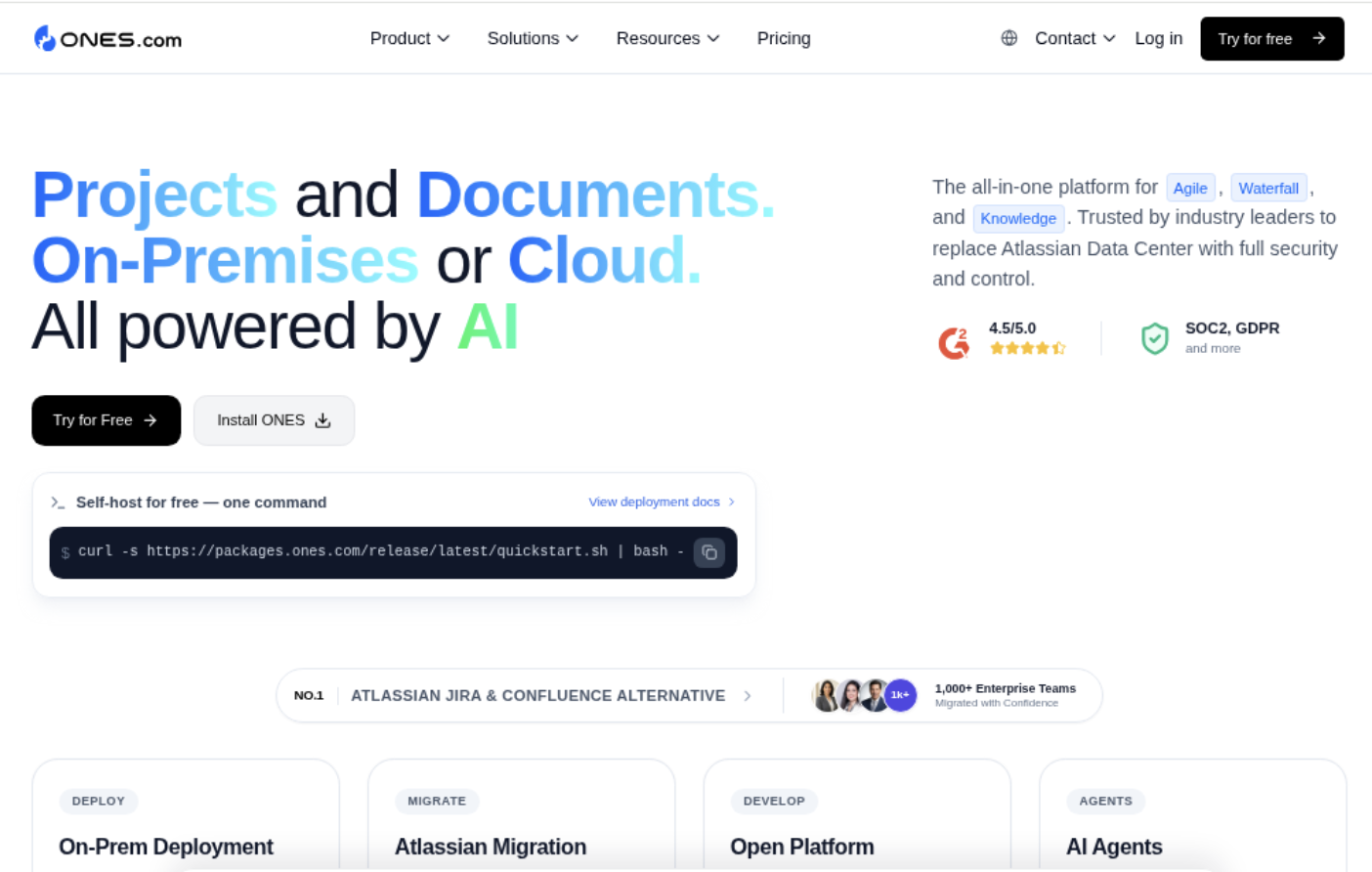
ONES.com combines project management and knowledge management in one platform. ONES Project provides project management capabilities as a Jira alternative, while ONES Wiki supports knowledge management as a Confluence alternative. Each product is sold separately.
This model can help teams compare subscription cost alongside workflow coverage, deployment requirements, and plugin dependence. ONES.com offers a free plan for up to 30 seats and supports Cloud, On-Premise, Private Cloud, and Air-gapped deployments.
Core Capabilities
- Too many disconnected project tools: ONES Project brings planning, issue tracking, sprint management, and reporting into one project environment. The result is less switching between systems.
- Rigid delivery workflows: Custom workflows and custom fields let teams reflect approval stages, engineering states, or department-specific processes. Teams can track work with greater precision.
- Limited sprint visibility: Built-in sprint management supports backlog organization, iteration planning, and progress review. Delivery teams can connect daily work with sprint goals.
- Manual recurring actions: Automation reduces repetitive transitions and routine assignments. Administrators can spend less time handling predictable workflow changes.
- Dependence on external reporting tools: Built-in reporting provides project and delivery visibility within the platform. Teams can review progress without adding another reporting layer for every need.
- Need for restricted deployment: ONES.com supports On-Premise, Private Cloud, and Air-gapped deployments alongside Cloud. Organizations can align deployment with security and network requirements.
- Different behavior between hosted and self-managed editions: ONES.com maintains feature parity between its cloud and self-hosted versions. Teams can compare deployment models without accepting a reduced feature set.
- Separate project and knowledge environments: ONES Project and ONES Wiki cover project work and knowledge management as separate products. Teams can select the product combination that fits their operating model.
Application Scenarios
Software team replacing Jira: A 30-person engineering team can use ONES Project for backlog management, sprint planning, custom workflows, and reporting. The free plan can support an initial evaluation within its seat limit.
Restricted-network organization: A company handling sensitive work can evaluate On-Premise, Private Cloud, or Air-gapped deployment. This gives the team a path that does not require standard public-cloud hosting.
Project and knowledge operations: A product organization can use ONES Project for delivery workflows and ONES Wiki for internal knowledge. The products remain separately sold, allowing a more deliberate purchasing decision.
Common Challenges and Practical Solutions
Challenge: The checkout amount differs from your estimate
Solution: Check user tier rules, taxes, currency, billing term, and optional apps before requesting approval. Save a calculation that shows each component separately.
Challenge: Your team grows soon after purchase
Solution: Model expected hiring and contractor access before selecting annual billing. Ask how adding users affects the current tier and future renewal.
Challenge: Premium features are difficult to justify
Solution: Link every upgrade requirement to a measurable problem. For example, connect advanced planning to reduced coordination time or fewer missed dependencies.
Challenge: App costs grow quietly
Solution: Assign an owner to review marketplace apps quarterly. Remove unused subscriptions and check whether native capabilities now cover the original need.
Challenge: Administration consumes too much time
Solution: Standardize project templates, permission roles, naming conventions, and workflow rules. A repeatable administration model lowers the effort of supporting new teams.
FAQs
What does Jira hosted pricing include?
It generally includes access to Jira Cloud under a selected plan and user tier. Your final amount may also include taxes, marketplace apps, implementation work, training, and administration. Check the current Atlassian checkout or pricing calculator for the amount applicable to your region and team size.
Is Jira Cloud billed per user?
Jira Cloud commonly uses user-based pricing with tier rules. The exact calculation depends on the plan, billing term, user count, region, and current Atlassian commercial policy. Some users may need full access, while others may qualify for different access arrangements. Confirm how contractors and external collaborators are treated before purchasing.
Is annual Jira billing cheaper than monthly billing?
Annual billing can offer better predictability and may reduce the effective cost for a stable team. Monthly billing provides more flexibility when headcount changes frequently. Compare both options using your expected user count, hiring plans, and likely upgrades. Annual billing may be less attractive if your team could shrink substantially during the term.
What extra costs should I include in a Jira budget?
Include marketplace apps, taxes, migration, configuration, training, administration, integrations, and support services. A team may also need consulting help when it has complex workflows or strict governance requirements. Reviewing these expenses together gives you a more realistic total ownership estimate than comparing subscription prices alone.
Can a small team use Jira for free?
A small team may be able to use Jira’s Free plan within its user and feature limits. The plan can work for early evaluation or a compact project. Check current restrictions around users, storage, permissions, automation, and support. A growing team may need Standard once collaboration and administration become more demanding.
What is a practical Jira alternative for restricted deployments?
ONES.com offers ONES Project as a Jira alternative with Cloud, On-Premise, Private Cloud, and Air-gapped deployment options. It provides feature parity between cloud and self-hosted versions, along with custom workflows, fields, sprint management, automation, and built-in reporting. ONES Project and ONES Wiki are sold separately.
Conclusion
Jira hosted pricing is easiest to understand when you separate the core subscription from user growth, billing terms, apps, taxes, and operating effort. The Free, Standard, Premium, and Enterprise tiers serve different team sizes and governance needs.
But here’s the truth: a low headline price can become expensive when limits trigger upgrades or add-ons. Estimate current and future users, identify essential capabilities, and review the complete annual cost.
If Jira Cloud does not fit your deployment model or workflow budget, compare alternatives such as ONES Project. A careful plan comparison helps you choose a platform that supports your team without creating avoidable pricing surprises.