Jira Issue Tracking: A Step-by-Step Guide for Agile Teams
Struggling with Jira issue tracking? Follow this step-by-step guide to clarify work, streamline sprints, and align Agile teams. Read now.
Jira issue tracking can feel simple until a sprint fills with unclear tickets, duplicated bugs, forgotten handoffs, and status updates nobody trusts. A team may create issues quickly, yet still lose hours deciding what matters, who owns the next action, and whether work is truly complete.
That confusion creates more than clutter. It slows delivery, hides risks, frustrates stakeholders, and makes sprint planning feel like detective work. A vague issue can move through several statuses without bringing the team closer to a usable result.
But here's the truth: Jira becomes far more useful when you treat issue tracking as a repeatable workflow. This guide shows you how to create clear issues, prioritize them, move work through each stage, and use reports to improve Agile delivery.
How to Track Issues in Jira: A Step-by-Step Guide
Jira issue tracking is the process of creating, organizing, assigning, updating, and reviewing work items in Jira. Each issue represents a task, bug, story, improvement, or other unit of work.
The goal is simple: every issue should tell your team what needs attention, why it matters, who owns it, what happens next, and when the work is complete.
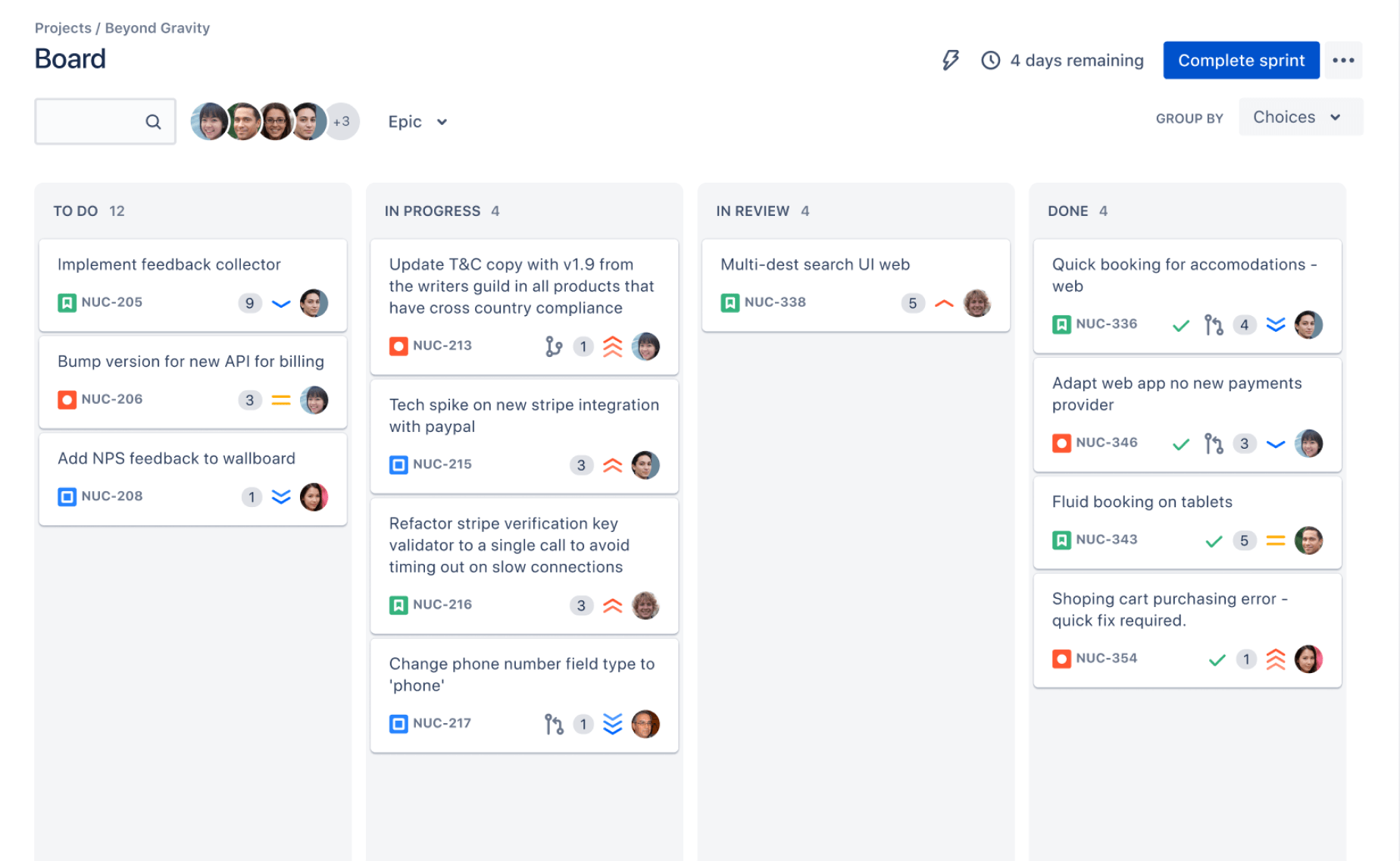
1. Create an issue with a clear purpose
Start by choosing the issue type that matches the work. A story may describe customer value, while a bug records unexpected behavior. A task can represent technical or operational work.
Use a short title that explains the outcome. “Checkout button fails on mobile Safari” gives a team more direction than “Mobile issue.”
Then add enough context for another person to understand the request without scheduling a separate meeting.
- Describe the problem or requested result.
- Explain who is affected.
- Add acceptance criteria or completion conditions.
- Include relevant links, screenshots, or technical details.
- Set the appropriate priority and component.
For a bug, include reproduction steps, expected behavior, actual behavior, environment details, and severity. For a story, describe the user need and the value of solving it.
2. Choose the right issue type and hierarchy
Jira lets you organize work at different levels. A common Agile structure includes initiatives, epics, stories, tasks, and subtasks.
An epic groups related work toward a broader outcome. A story describes a valuable slice of work. A subtask breaks that story into manageable actions.
For example, an epic called “Improve account security” may include stories for two-factor authentication, password reset improvements, and suspicious-login alerts. Each story can contain subtasks for design, development, testing, and release preparation.
Keep the hierarchy practical. If a team creates too many layers, people spend more time maintaining structure than delivering work.
3. Add acceptance criteria before work begins
Acceptance criteria define what must be true before an issue can be considered complete. They help developers, testers, product managers, and stakeholders share the same expectation.
For a password-reset story, criteria might include:
- A valid email address receives a reset message.
- The reset link expires after a defined period.
- An invalid or expired link shows a helpful message.
- The user can create a password that meets security rules.
- The new password works at the next sign-in.
Clear criteria reduce rework because the team can identify missing details before implementation starts.
4. Set priority using agreed rules
Priority should reflect business impact, customer harm, risk, and urgency. It should not simply reflect who asked most recently.
A payment failure affecting every customer deserves faster attention than a cosmetic spacing issue. A security vulnerability may require immediate action even when it affects fewer people.
Define a shared priority policy. For example, your team might classify work as critical, high, medium, or low using customer impact and time sensitivity.
You might be wondering: should every issue be marked urgent? If everything is urgent, the label stops helping. Keep the highest level for work that threatens customers, revenue, security, compliance, or a committed release.
5. Assign ownership and required participants
Every active issue needs a clear owner. The assignee may be a developer, tester, designer, analyst, or another person responsible for moving the work forward.
Ownership does not mean one person completes every activity. A developer may implement a change while a tester verifies it. The assignee remains responsible for coordinating the next step.
Add watchers or relevant reviewers when their involvement matters. Avoid adding an entire department to every issue because excessive notifications make important updates easier to miss.
6. Move the issue through a defined workflow
A workflow describes how an issue moves from creation to completion. A basic flow might include To Do, In Progress, In Review, In Testing, and Done.
Each status should have a clear meaning. “In Progress” should mean active work is happening. “In Review” should mean someone is checking the result. “Done” should require the agreed completion conditions.
Here's why: ambiguous statuses create misleading reports. If half the team uses “In Progress” for waiting work, managers cannot distinguish active delivery from blocked delivery.
7. Link related issues and record dependencies
Some work cannot proceed until another issue reaches a specific state. Record that relationship directly instead of relying on memory or private messages.
Useful relationships include blocks, is blocked by, relates to, duplicates, and is duplicated by. A release task may be blocked by a security review. A bug may duplicate an existing defect.
Dependencies become especially important when several teams contribute to one product. A visible relationship helps people negotiate timing before a dependency becomes a sprint surprise.
8. Update issues during daily work
Issue tracking works only when the information stays current. Update the status when work changes stage, add a comment when a decision is made, and record blockers as soon as they appear.
A useful update answers three questions:
- What changed?
- What happens next?
- What is preventing progress?
For example, “API implementation is complete. Waiting for the identity team to confirm token settings. Testing can start after approval” gives the team a clear view of progress and risk.
9. Review issues before closing them
Closing an issue should confirm that the work meets its acceptance criteria and follows the team’s quality standards. Depending on your workflow, that may include peer review, automated checks, manual testing, product approval, or release verification.
Use a definition of done that matches your product. A software team may require tested code and deployment readiness. A research team may require reviewed findings and an agreed decision.
The best part? A disciplined completion check keeps unfinished work from disappearing into a reassuring green status.
10. Use reports to improve the workflow
Jira reports can help you understand delivery patterns. Useful views include sprint progress, cycle time, velocity, cumulative flow, control charts, and unresolved issue trends.
Do not treat a report as a performance scoreboard. Use it to ask better questions. If cycle time rises, investigate queue size, dependencies, unclear requirements, or review delays.
For example, a cumulative flow view with a growing testing column may show that development is moving faster than verification. The improvement could involve earlier testing, smaller issues, or additional test capacity.
What Makes a Jira Issue Easy to Act On?
A strong issue gives the next person enough information to make progress. It does not need a long essay. It needs a clear purpose, useful context, and an agreed result.
Use a predictable issue format
A consistent format makes scanning easier. You can organize an issue with these sections:
- Summary: the specific outcome or problem.
- Context: why the work matters.
- Details: behavior, constraints, or technical information.
- Acceptance criteria: conditions for completion.
- Priority: the relative urgency and impact.
- Ownership: the person coordinating progress.
- Dependencies: related work that affects timing.
For example, “Improve search” is too broad for sprint planning. “Show an empty-state message when no product matches the search” gives the team a smaller and more testable result.
Keep issues small enough to inspect
A large issue hides uncertainty. A smaller issue makes progress visible and allows the team to adjust sooner.
Suppose a team creates one ticket called “Launch the new checkout.” That item may combine design, payment integration, tax logic, accessibility, analytics, security, and testing. Breaking it into outcome-focused issues reveals the real work.
Small issues also improve forecasting. A team can learn more from completing six similarly sized stories than from carrying one oversized ticket across several sprints.
Separate discussion from decision records
Comments are useful for questions, updates, and decisions. When a decision affects implementation, summarize the conclusion clearly.
Instead of leaving ten comments for teammates to interpret, add a final note such as, “The team will use the existing checkout service because it supports regional tax rules. The alternative requires a separate compliance review.”
This practice helps people understand the reasoning without reading every conversation.
How Agile Teams Should Organize Their Jira Board
Your board should reflect how work actually moves. A Scrum team may organize work by sprint. A Kanban team may focus on continuous flow and work-in-progress limits.
Choose columns that reveal flow
Use enough columns to show meaningful handoffs. A board with only “To Do,” “Doing,” and “Done” may hide review or testing queues.
At the same time, too many columns create administrative overhead. If a status does not change decisions or reveal risk, consider removing it.
A practical workflow might use:
- Backlog
- Ready for development
- In development
- Code review
- Testing
- Ready for release
- Done
Limit work in progress
Work-in-progress limits reduce task switching. If five developers each start three issues, the team may have fifteen active items and very little finished work.
Set a reasonable limit for stages such as development and testing. When a column reaches its limit, the team should help finish existing work before starting another item.
Let me explain: a full testing column is a signal to support testing, improve issue quality, or reduce development intake. It is not a reason to create another status.
Make sprint boundaries meaningful
At sprint planning, select work that fits the team’s capacity and meets the readiness standard. During the sprint, avoid adding unrelated work unless the team agrees on the tradeoff.
At the sprint review, inspect completed outcomes. During the retrospective, examine tracking habits as well as delivery results.
If many issues roll over, look for patterns. Large stories, hidden dependencies, delayed reviews, and unclear acceptance criteria often explain repeated carryover.
Jira Issue Tracking Metrics That Help Teams Improve
Metrics are most useful when they explain a workflow problem. They become harmful when people optimize numbers without improving customer outcomes.
| Metric |
What it helps you understand |
| Cycle time |
How long work takes from active start to completion |
| Lead time |
How long a request waits before completion |
| Throughput |
How many issues the team completes during a period |
| Work in progress |
How much unfinished work is active at once |
| Blocked time |
How long issues wait for decisions, dependencies, or access |
| Defect trends |
Whether quality problems are increasing, decreasing, or recurring |
Use cycle time to find delays
If most issues take two days but a small group takes twelve, examine those outliers. They may involve unclear requirements, complex integrations, approval queues, or unexpected defects.
A trend matters more than one unusual issue. Track cycle time across several iterations before changing the workflow.
Use throughput for planning conversations
Throughput shows how many issues a team completes over time. It can support forecasting when the issues are reasonably comparable.
A sudden increase may reflect smaller work items rather than higher productivity. A decrease may reflect larger issues, holidays, incidents, or a shift toward complex work.
Use blocked time to improve collaboration
Blocked issues deserve visible attention. Add a clear blocker label, record the reason, and identify the person or team needed to unblock progress.
For example, if several tickets wait for legal approval, the improvement may involve earlier review during refinement. The team can then address the cause rather than repeatedly escalating individual tickets.
Jira Issue Tracking Solution: ONES.com
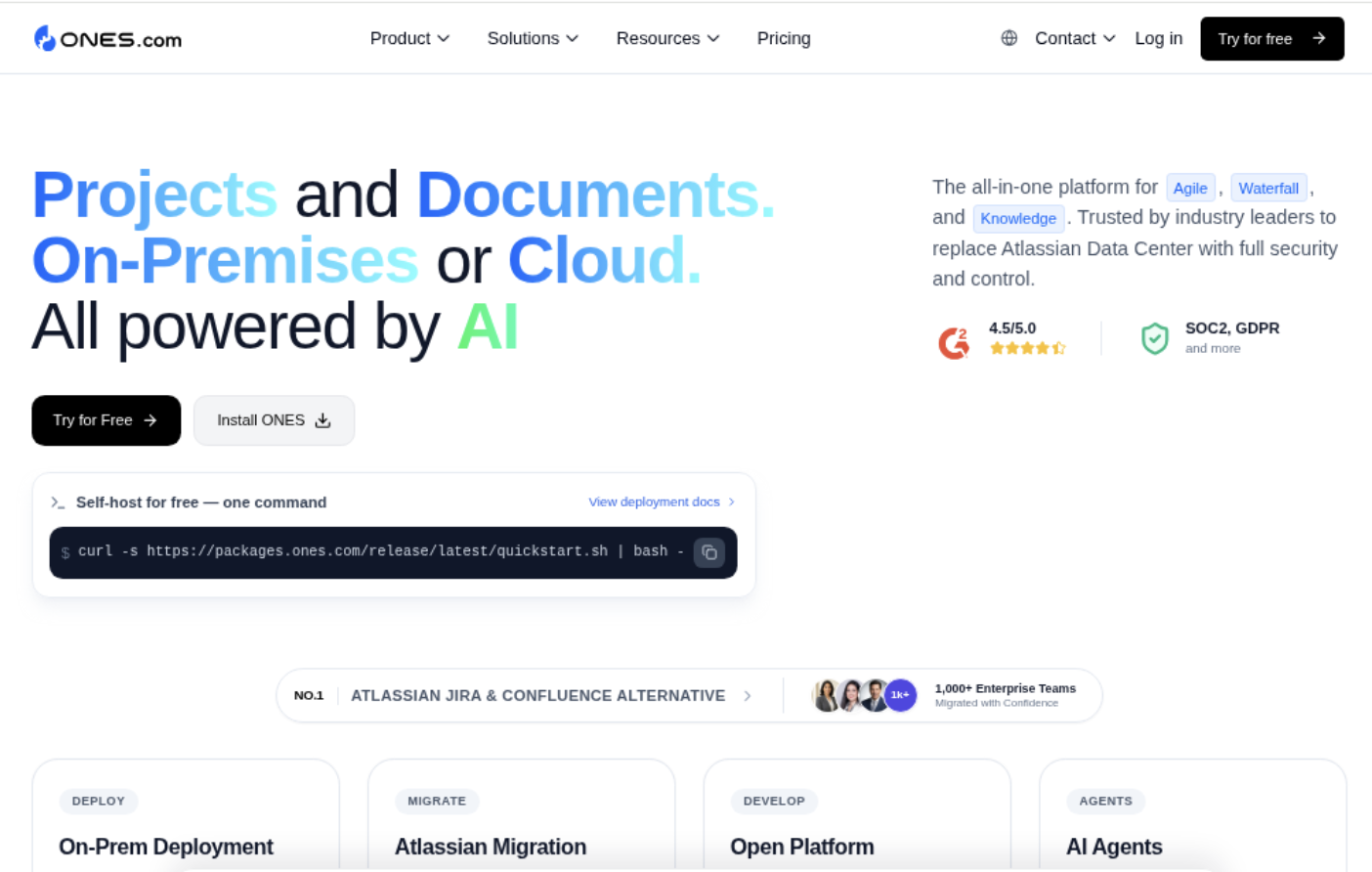
Value Proposition
ONES.com combines project management and knowledge management in one platform, with AI support through ONES Assistant. ONES Project provides project and issue management as a Jira alternative, while ONES Wiki supports knowledge management as a Confluence alternative.
Teams can buy ONES Project and ONES Wiki separately. This separation lets you choose the capabilities that match your current workflow while keeping project work and team knowledge connected when needed.
Core Capabilities
- Scattered work details → ONES Project centralizes issues, priorities, owners, and workflow states → Teams gain a clearer view of active work.
- Unclear delivery stages → Custom workflows and fields reflect your actual process → Each issue carries the context needed for the next handoff.
- Manual sprint coordination → Sprint management supports planning and progress tracking → Agile teams can organize iteration work with fewer disconnected steps.
- Limited visibility → Built-in reporting shows delivery trends and bottlenecks → Teams can investigate cycle time, progress, and workload patterns.
- Repetitive administration → Automation handles routine workflow actions → People spend less time updating predictable transitions.
- Jira migration concerns → Jira-compatible workflows reduce process disruption → Teams can preserve familiar Agile practices while evaluating another platform.
- Plugin-heavy setups → Native capabilities cover common project management needs → Teams may reduce dependence on multiple add-ons.
- Restricted deployment requirements → Cloud, on-premise, private cloud, and air-gapped deployments are available → Organizations can select an environment that fits operational and security constraints.
- Different deployment expectations → Self-hosted versions maintain feature parity with the cloud version → Teams can choose deployment flexibility without giving up core capabilities.
Application Scenarios
Software product team: A product team can create epics for major outcomes, break them into stories, and use custom fields for risk, service area, and release target. Built-in reports can help the team review delivery patterns after each sprint.
Organization with restricted networks: A team operating in an air-gapped environment can use an on-premise or air-gapped deployment. Its issue workflow can still include planning, review, testing, automation, and reporting within the approved environment.
Growing company: A company moving beyond basic task lists can use ONES Project for structured issue tracking and add ONES Wiki when shared knowledge becomes harder to maintain. The platform supports up to 30 seats on its free plan.
Common Jira Issue Tracking Challenges
Challenge: Issues are too vague
Problem: A title such as “Fix reporting” gives no clear outcome or completion condition.
Solution: Describe the affected behavior, intended result, and acceptance criteria. Ask someone outside the original conversation to explain what they think the issue requires.
Challenge: Too many issues remain in progress
Problem: The team starts new work while reviews, tests, and blockers accumulate.
Solution: Add work-in-progress limits and make finishing active work the team’s first priority. Review the oldest active issues during daily coordination.
Challenge: Statuses do not reflect reality
Problem: People leave issues in “In Progress” while waiting for approval or external action.
Solution: Create a waiting or blocked state when it affects decisions. Define entry and exit rules for every workflow status.
Challenge: Reports encourage unhealthy behavior
Problem: People may split issues artificially or close incomplete work to improve a metric.
Solution: Pair metrics with qualitative discussion. Review customer outcomes, quality, blocked time, and team experience alongside throughput.
Challenge: Important decisions disappear in comments
Problem: A key agreement gets buried under routine conversation.
Solution: Summarize the decision, owner, reason, and next action in a concise update. Link related issues when the decision affects other work.
FAQs
What is the difference between a Jira issue and a task?
A Jira issue is a general work item. It can represent a story, bug, task, improvement, question, or other work type. A task is one specific issue type used for work that does not fit a user story or defect. Teams can configure issue types to match their product and workflow.
How often should a Jira issue be updated?
Update an issue whenever its status, owner, priority, blocker, or next action changes. You do not need to add a comment for every small action. A useful update should help another person understand what changed and what needs to happen next.
Should every Jira issue have an assignee?
Every active issue should have clear ownership. Backlog items may remain unassigned until planning, but work selected for a sprint needs a responsible person or role. Ownership improves coordination and makes unresolved blockers easier to escalate.
What should a Jira issue include?
Include a clear summary, useful context, acceptance criteria, priority, relevant links, and dependencies. Bug reports should also include reproduction steps, expected behavior, actual behavior, and environment details. Add only information that helps someone make progress or verify the result.
How can I prevent Jira from becoming cluttered?
Archive obsolete work, merge duplicates, close completed issues promptly, and review stale items regularly. Keep workflows and custom fields limited to meaningful decisions. A short monthly cleanup can prevent the backlog from becoming a second task list that nobody trusts.
Is Jira issue tracking suitable for Kanban teams?
Yes. Kanban teams can use Jira to manage continuous flow, visualize work, set work-in-progress limits, track blocked items, and measure cycle time. The workflow should emphasize movement and capacity rather than sprint commitments when the team delivers continuously.
Conclusion
Effective Jira issue tracking starts with clear issues, sensible priorities, visible ownership, and workflow states that match reality. From there, disciplined updates and useful metrics help your team find delays before they become delivery problems.
But here's the truth: the tool cannot repair an unclear process by itself. Your team needs shared definitions, small enough work items, honest status updates, and regular workflow reviews.
When you apply those habits, Jira becomes easier to trust. If your team needs a Jira alternative with native project management capabilities, flexible deployment options, and built-in reporting, ONES Project is a practical platform to evaluate alongside your current workflow.