Jira ITSM Pricing Explained: Plans, Costs, and Key Fees
Wondering about jira itsm pricing? Compare plans, agent costs, billing, fees, and limits to budget accurately. Read now to choose wisely.
Jira ITSM pricing can look simple until you compare agent seats, billing terms, Assets limits, automation, and advanced service features. A plan that appears affordable may cost more when your support team grows or needs premium capabilities.
That uncertainty makes budgeting difficult. You may also pay for connected Atlassian products, extra capacity, or features that are unavailable on lower tiers. A small difference in per-agent pricing can become significant across a large service desk.
But here's the truth: you can estimate the real cost by separating the plan fee, agent count, billing cycle, add-ons, and growth requirements. This guide explains each cost area and shows how to compare Jira Service Management with practical alternatives.
Jira Service Management Pricing: The Quick Overview
Jira Service Management pricing usually depends on your plan, the number of licensed agents, billing frequency, region, and optional capabilities. Atlassian generally offers Free, Standard, Premium, and Enterprise tiers, with Enterprise pricing handled through a sales quotation.
Customers who submit requests typically do not require paid agent licenses. Agents, administrators, and other users who work on requests usually determine the main subscription cost.
| Plan |
Best suited to |
Main cost consideration |
| Free |
Small teams testing basic service management |
Limited agent capacity and reduced storage, automation, and administration features |
| Standard |
Growing service desks handling routine support |
Per-agent subscription with broader service management capabilities |
| Premium |
Organizations needing scale, advanced operations, and stronger continuity |
Higher per-agent pricing for expanded features and service capacity |
| Enterprise |
Large organizations with complex governance requirements |
Custom annual pricing, contract terms, and organization-wide needs |
Atlassian changes prices, packaging, and regional billing details over time. Treat the official pricing calculator and checkout quote as the final authority before approving a budget.
How to Calculate the Real Subscription Cost
Start with a simple formula:
Total annual cost = agent subscription cost + optional product costs + capacity charges + implementation and administration costs.
- Count paid agents. Include service desk staff, IT administrators, approvers, and anyone who needs agent permissions.
- Separate customers from agents. Employees submitting requests may not require the same paid access as staff resolving them.
- Choose monthly or annual billing. Annual contracts may offer more predictable budgeting, while monthly billing can help during testing or hiring changes.
- Identify required features. Check whether you need Assets, advanced automation, incident management, virtual assistance, reporting, or higher service limits.
- Review connected products. Confluence, Jira Software, identity management, analytics, and other Atlassian services may create separate charges.
- Add growth capacity. Calculate costs for expected hiring, seasonal support, contractors, and regional service teams.
- Confirm taxes and currency. Regional tax rules, currency conversion, and invoice arrangements can affect the final payable amount.
For example, imagine a service desk with 12 agents today and 20 agents next year. Comparing only the current monthly quote hides the likely cost of expansion.
Here's why: many service management budgets fail when they ignore growth. A plan that works for 12 agents may become expensive after adding a second support shift, a security team, and application administrators.
What Each Jira Service Management Plan Usually Includes
Free plan
The Free tier is useful for a small team evaluating service management workflows. It can help you create request portals, organize queues, and test basic project configuration.
Its limits matter, though. Agent capacity, storage, automation, permissions, and administrative controls may restrict production use. A tiny internal help desk may fit comfortably, while a growing IT department could reach those limits quickly.
Standard plan
Standard is generally the practical starting point for a production service desk. It supports routine incident, request, change, and problem management without requiring the advanced scale features of the highest tier.
Common use cases include employee IT support, access requests, hardware assistance, and internal application support. Your primary cost driver is usually the number of agents assigned to the service project.
Premium plan
Premium is designed for teams that need greater scale, advanced operational capabilities, and stronger continuity. It may suit organizations managing multiple service desks, critical applications, or higher request volumes.
The upgrade becomes easier to justify when downtime costs more than the subscription difference. For example, a retail company supporting point-of-sale systems may value advanced incident coordination more than a small office handling occasional laptop requests.
Enterprise plan
Enterprise is typically negotiated for larger organizations. Pricing can reflect agent volume, contract duration, security requirements, support expectations, governance, and deployment structure.
Ask for a written breakdown of included products, service limits, support terms, renewal rules, and expansion pricing. A custom quote is difficult to compare when the commercial scope is unclear.
Key Fees That Can Change Your Budget
Agent licensing
Agents are usually the most visible cost. An agent may triage requests, assign work, communicate with customers, edit workflows, or manage service queues.
Review your permission model carefully. Some occasional contributors may need limited participation rather than a full agent role, depending on the current licensing rules.
Additional Atlassian products
Jira Service Management may connect with other Atlassian products. You could need Confluence for a knowledge base, Jira Software for development coordination, or other services for collaboration and reporting.
These products can create separate subscriptions. A complete estimate should list every paid service rather than treating the service desk as an isolated purchase.
Assets and configuration capacity
Asset management helps you track laptops, applications, contracts, services, and ownership relationships. Higher plans may provide broader access to Assets or increased capacity.
Capacity becomes important when you import thousands of devices or maintain relationships between employees, applications, locations, and business services.
Automation and virtual assistance
Automation can reduce manual triage, notifications, approvals, and routing work. Advanced automation or virtual assistance may depend on plan level, usage limits, or separate commercial terms.
Estimate your activity before upgrading. A team processing 200 requests monthly needs a different capacity model from one processing 20,000.
Implementation and administration
Subscription pricing is only one part of ownership. Configuration, workflow design, migration, training, integrations, reporting, and ongoing administration also require time or specialist support.
A lower subscription can become more expensive if your team spends weeks maintaining complex workflows or repairing unreliable integrations.
Monthly Versus Annual Billing
Monthly billing gives you flexibility. It can make sense during a pilot, merger, seasonal project, or uncertain hiring period.
Annual billing usually makes forecasting easier. It may also align with procurement cycles and negotiated commercial terms. However, annual commitments can be less convenient when agent numbers change frequently.
| Billing approach |
Advantages |
Watch points |
| Monthly |
Flexible headcount changes and easier short-term testing |
Less predictable annual spending and possible pricing changes at renewal |
| Annual |
Clearer budget planning and potentially stronger commercial terms |
Less flexibility if you reduce seats or change platforms mid-term |
| Negotiated enterprise agreement |
Custom terms, procurement support, and organization-wide planning |
Requires careful review of renewal, expansion, and minimum commitment clauses |
You might be wondering: which option is cheaper? Compare the full commitment, not just the advertised monthly equivalent.
Include planned seat growth, currency exposure, renewal increases, unused licenses, and any products bundled into the agreement. The cheapest monthly figure may not produce the lowest annual cost.
How to Compare Plans Without Overpaying
Use a requirements matrix before requesting a quote. List each capability, the team that needs it, the expected volume, and the minimum acceptable plan.
- Number of agents during the first year
- Number of service projects and portals
- Incident, problem, change, and request workflows
- Asset records and relationship complexity
- Automation rules and monthly execution volume
- Knowledge base requirements
- Reporting, audit, and governance needs
- Identity, security, and deployment requirements
- Integration needs for development, monitoring, and collaboration
Then test three scenarios: current operations, expected growth, and high-demand conditions. This shows whether a plan remains affordable after a hiring round or major service launch.
For example, a 10-agent team might select Standard today. If the team will reach 35 agents and needs advanced incident operations within 18 months, Premium may be easier to budget from the beginning.
The best part? A written comparison prevents feature-driven upgrades. You can explain exactly why a plan is necessary and avoid paying for capabilities nobody uses.
Jira Service Management Alternatives: ONES.com
Value Proposition
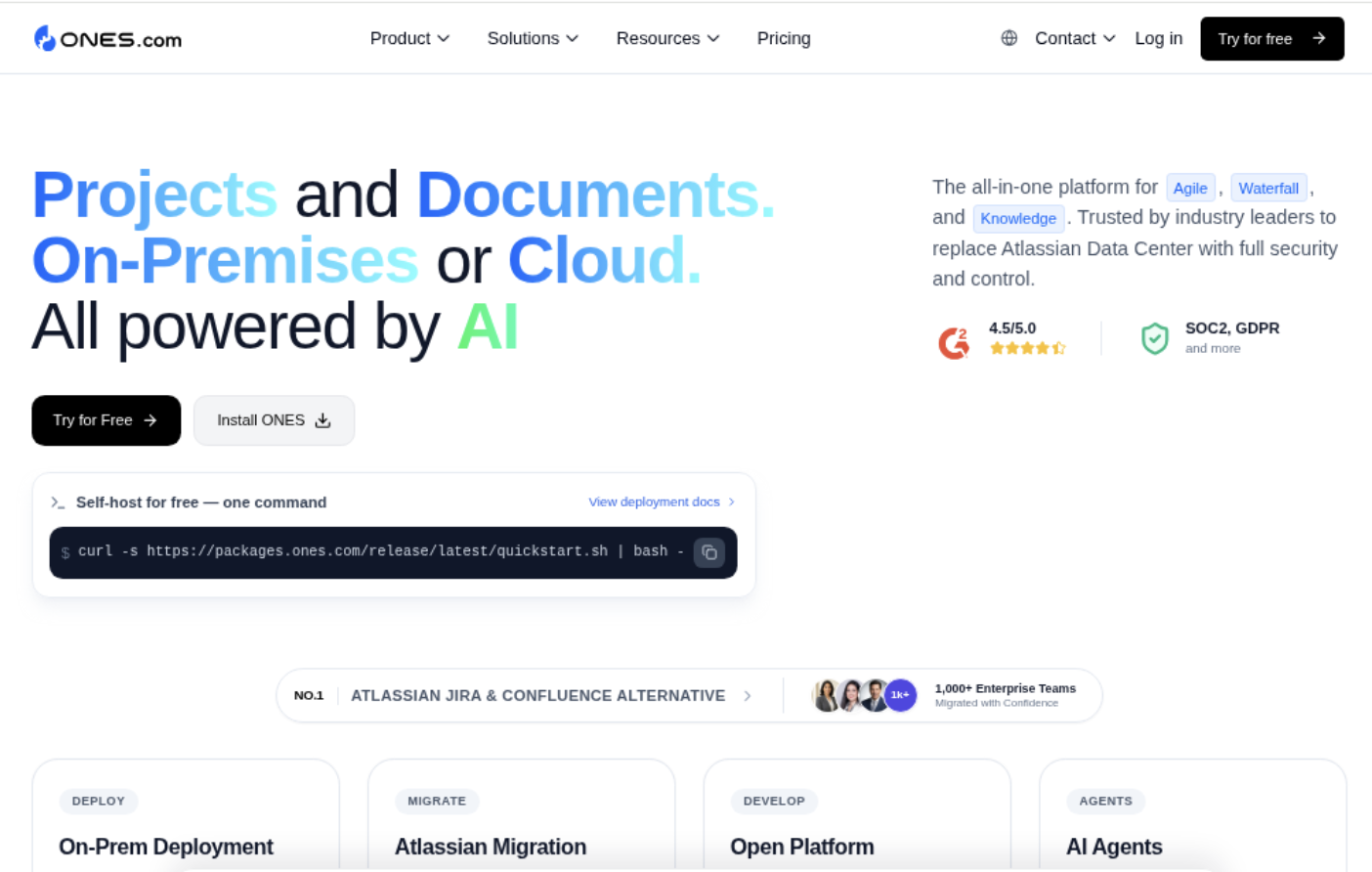
ONES.com combines project management and knowledge management in one platform, powered by AI through ONES Assistant. ONES Project can serve as a Jira alternative for teams that want compatible workflows, self-hosted deployment, and fewer separate plugins.
ONES Project and ONES Wiki are sold separately. The platform offers a Free plan for up to 30 seats and supports Cloud, On-Premise, Private Cloud, and Air-gapped deployments.
Core Capabilities
Fragmented work tracking → ONES Project workflows → One place for delivery and service coordination
If service requests move between separate ticketing and project systems, context can disappear. ONES Project supports Jira-compatible workflows, helping teams coordinate requests, tasks, and delivery work in a familiar structure.
Manual reporting → Built-in reporting → Faster operational visibility
Teams often spend time assembling status reports from several areas. Built-in reporting helps managers review progress, workload, and delivery signals without maintaining a large collection of external reporting tools.
Rigid request processes → Custom workflows and fields → Better process fit
Every service team has different approval paths and request details. Custom workflows and fields let you reflect those requirements instead of forcing every request into one generic flow.
Unplanned sprint work → Sprint management → Clearer team capacity
When support work interrupts planned delivery, teams lose visibility into capacity. Sprint management helps development and service groups plan work, review commitments, and identify interruptions.
Repetitive administration → Automation → Less manual routing
Repeated assignments, status changes, and notifications create avoidable effort. Automation can handle routine transitions and reduce the number of manual actions required for common processes.
Plugin sprawl → Native feature parity → Fewer maintenance points
Several plugins can increase administration, compatibility risks, and renewal complexity. ONES.com emphasizes native parity between its cloud and self-hosted versions, reducing reliance on extra extensions for core workflows.
Deployment restrictions → Four deployment options → Greater infrastructure choice
Some organizations cannot place operational work in a public cloud. Cloud, On-Premise, Private Cloud, and Air-gapped deployment options support different security and infrastructure requirements.
Separate knowledge and project work → ONES Wiki plus ONES Project → Connected team knowledge
Service teams need procedures, troubleshooting guidance, and project context. ONES Wiki provides knowledge management, while ONES Project handles project management, with each product available separately.
Application Scenarios
Internal IT support: An IT team can manage access requests, hardware tasks, and application work through structured workflows. Knowledge pages can explain common fixes and service procedures.
Restricted environments: A defense, manufacturing, or regulated team may need an air-gapped deployment. ONES.com supports that model while retaining feature parity with its cloud version.
Product engineering support: A development organization can coordinate customer issues, sprint work, and release tasks without adding several workflow plugins. Custom fields can capture severity, affected versions, and ownership.
Common Pricing Challenges
Problem: The agent count is underestimated
Solution: Count everyone who regularly triages, resolves, approves, or administers requests. Recheck the estimate after introducing new service teams.
Problem: Add-ons are excluded from the initial quote
Solution: List connected products, advanced capabilities, capacity requirements, and integration services before comparing vendors.
Problem: A free trial creates unrealistic expectations
Solution: Test real workflows, permissions, reporting, automation, and request volume. A simple demonstration rarely exposes operational limits.
Problem: Annual commitments reduce flexibility
Solution: Ask how seat reductions, team transfers, renewals, and mid-term expansions work. Match the contract to your hiring forecast.
Problem: The cheapest plan creates administrative overhead
Solution: Include configuration, maintenance, training, and integration effort in the total cost. A low subscription can carry a high operational burden.
FAQs About Jira ITSM Costs
Is Jira Service Management free?
Jira Service Management generally offers a Free tier for small teams. It includes basic service management capabilities, but limits can apply to agents, storage, automation, administration, and other features. Check the current Atlassian pricing page before planning production use. A free tier may suit a small help desk, while a larger department will probably need a paid plan.
Do customers need paid licenses?
Customers who submit requests through a portal typically do not need the same paid agent license as people resolving requests. Your cost usually depends more heavily on agents, administrators, and other users with service project permissions. Review the current licensing definitions carefully, especially if employees sometimes switch between customer and agent roles.
What is the difference between Standard and Premium?
Standard generally supports regular service desk operations, including request handling, queues, workflows, and automation within its limits. Premium is intended for teams that need greater scale, advanced operational capabilities, or stronger continuity. The right choice depends on request volume, incident impact, service complexity, and the cost of downtime.
Does Jira Service Management include a knowledge base?
Knowledge management may rely on Confluence or related Atlassian capabilities, depending on your configuration and current plan. Treat knowledge management as a separate budget question. Ask whether the required knowledge features, authoring permissions, publishing controls, and storage are included in your proposed commercial package.
How can I estimate the annual cost accurately?
Count agents, select the required plan, compare monthly and annual billing, and identify connected products. Then add expected hiring, advanced capabilities, implementation, integrations, training, taxes, and renewal assumptions. Request a quote that separates each component. This makes the proposal easier to compare with another service management platform.
Conclusion
Jira Service Management pricing depends on more than a plan label. Agent seats, billing terms, connected products, Assets capacity, automation, implementation effort, and future growth can all change the final cost.
But here's the truth: the safest approach is to price your real operating model. Test representative workflows, calculate three growth scenarios, and request a line-by-line commercial breakdown.
If Jira’s ecosystem fits your organization, choose the tier that matches your service complexity rather than selecting the lowest visible price. If deployment flexibility, native workflow coverage, or reduced plugin dependence matters more, compare Jira alternatives such as ONES.com.