Jira On-Premise Pricing: A Practical Cost Planning Guide
Struggling with jira on premise pricing? Build a realistic cost plan covering licenses, infrastructure, support, and growth. Read now to plan wisely.
Planning Jira on-premise pricing can feel harder than planning the implementation itself. License fees are only one part of the bill, while infrastructure, support, upgrades, backups, security, and specialist administration can quietly expand the total.
That uncertainty creates real problems. A quote may look affordable until you add test environments, disaster recovery, user growth, and the staff needed to keep the platform reliable. Then a project that seemed straightforward becomes difficult to defend financially.
But here’s the truth: you can estimate the cost with a practical model. Start with the self-managed edition, count every environment, separate recurring and one-time expenses, and calculate the three-year total. This guide shows you how.
Jira On-Premise Pricing: The Cost Planning Overview
Jira on-premise pricing is the total cost of running a self-managed Jira deployment, including licensing, infrastructure, support, administration, security, upgrades, backup systems, and future growth.
For current Jira planning, “on-premise” usually refers to Jira Data Center or another self-managed enterprise arrangement. Jira Server support ended on February 15, 2024, so new budgets should not treat Server as a current long-term option.
The key point is simple: the license quote is only the starting figure. Your real cost depends on user count, deployment architecture, availability requirements, integrations, and the internal effort needed to operate the platform.
| Cost area |
What it can include |
| Subscription or license |
Jira Data Center entitlement, user tier, and renewal charges |
| Infrastructure |
Servers, virtual machines, storage, networking, load balancing, and hosting |
| Operations |
System administration, monitoring, patching, upgrades, and incident response |
| Security and continuity |
Access controls, vulnerability management, backups, disaster recovery, and testing |
| Customization |
Marketplace apps, integrations, custom workflows, and specialist development |
| Implementation |
Migration, configuration, training, testing, and rollout support |
Use this model before requesting a quote. It helps you compare options on an equal basis instead of comparing one license number with another.
How to Build a Realistic Self-Managed Jira Budget
-
Define the deployment type. Decide whether you need Jira Data Center, a private hosting arrangement, or another self-managed platform. A high-availability environment will cost more than one production instance.
-
Count active users. Use the number of people who need access, then add reasonable growth. For example, 850 current users may become 1,000 users during the planning period.
-
List every environment. Production may be only one environment. Development, testing, staging, training, and disaster recovery can add infrastructure and administration work.
-
Separate one-time and recurring costs. Migration and training may happen once, while subscriptions, hosting, support, backups, and maintenance continue every year.
-
Price the operating model. Estimate the hours needed for administration, patching, monitoring, access management, troubleshooting, and upgrade preparation.
-
Add contingency. A modest reserve helps cover user growth, unexpected consulting, security work, and integration changes.
Here’s why: two organizations with the same number of Jira users can have very different bills. One may run a single virtual machine with limited support. Another may need redundant infrastructure, separate environments, 24-hour monitoring, and formal recovery testing.
A useful planning formula looks like this:
Three-year total cost = licensing or subscription fees + infrastructure + operating labor + apps and integrations + implementation + security and continuity costs.
What Jira Data Center Pricing Usually Depends On
User tier
Self-managed Jira pricing generally depends heavily on the licensed user band. Moving into a higher tier can increase the recurring fee even when only a small number of new people join.
For example, if your team has 1,950 active users, check whether a growth plan would push you into the next tier. Budgeting only for today’s headcount can create a surprise at renewal.
Deployment scale
A small deployment may use a simpler architecture. A large or business-critical environment may require multiple application nodes, a load balancer, separate services, stronger monitoring, and more capacity.
Jira Data Center also brings operational expectations around resilience and scale. If your team needs high availability, include the technology and staff required to maintain it.
Support and commercial terms
Enterprise agreements can involve more than a public list price. Renewal terms, support arrangements, contract length, account structure, and additional Atlassian products may affect the final commercial proposal.
You might be wondering: why avoid planning with one advertised figure? Because the number may exclude your user tier, deployment requirements, apps, and service needs.
Marketplace apps
Jira often becomes more useful through apps for testing, reporting, time tracking, asset management, service workflows, or advanced automation. Each app can introduce another recurring charge.
Review every installed app. An app that costs little for a small team may become significant after your Jira tier grows.
Recurring Costs You Should Include
Recurring expenses determine whether the platform remains affordable after implementation. They deserve more attention than the initial purchase because they continue throughout the system’s life.
| Recurring expense |
Planning question |
| Jira entitlement |
What user tier and renewal arrangement will apply? |
| Infrastructure or hosting |
How much capacity does production need, and how many secondary environments are required? |
| Marketplace apps |
Which apps are essential, and how will their fees change as users increase? |
| Administration |
Who manages workflows, permissions, schemes, upgrades, and support requests? |
| Monitoring and backup |
What tools and staff will protect availability and recover from incidents? |
| Security |
How often will you perform patching, vulnerability reviews, access audits, and recovery tests? |
The best part? You can turn these categories into a monthly operating estimate. If administration takes 70 hours each month and the fully loaded internal rate is $75 per hour, operations represent about $5,250 monthly before infrastructure and licensing.
That calculation does not predict your exact cost. It shows why internal labor belongs in the business case.
One-Time Expenses That Can Change the Total
Implementation expenses often appear before the first team starts work. They may include discovery, architecture, migration planning, workflow design, access setup, integration work, testing, training, and rollout assistance.
A migration from Jira Server or another project platform may require additional cleanup. Old workflows, inactive accounts, unused fields, duplicate projects, and outdated integrations can increase preparation time.
Migration example
Imagine a company with 600 users, 180 projects, and 12 business integrations. A simple license comparison will miss the effort required to review permissions, test integrations, validate history, and train project administrators.
If the team postpones that work, problems can appear after launch. A broken notification, incorrect permission scheme, or missing integration can interrupt project delivery.
Customization and consulting
Specialist help may be valuable when your environment has complex workflows or strict compliance requirements. However, customization can create future maintenance obligations.
Before approving a custom feature, ask who will maintain it after an upgrade. A cheaper implementation can become expensive when only one specialist understands how it works.
Hidden Costs in an On-Premise Deployment
Hidden costs are usually caused by treating self-managed software as a purchase instead of an operating responsibility.
High availability
If Jira supports critical engineering or service operations, one server may not be sufficient. Redundant nodes, traffic management, storage resilience, and tested recovery procedures add cost.
Disaster recovery
Backups are only useful when you can restore them. Include backup storage, recovery environments, recovery exercises, and the time needed to verify that Jira becomes usable after an incident.
Upgrade preparation
Upgrades can require app compatibility checks, testing, maintenance windows, rollback preparation, and stakeholder communication. The larger your customization footprint, the more effort this may require.
Security administration
Self-managed platforms require attention to operating system patches, network controls, identity integration, privileged access, vulnerability findings, and audit requests.
Opportunity cost
Your administrators may spend time maintaining Jira instead of improving delivery workflows. If three specialists each spend 20% of their time on platform operations, that capacity belongs in the financial assessment.
Let me explain: a cloud subscription can look more expensive in one comparison, while the self-managed option can look cheaper in another. The result depends on how much operational responsibility your team can absorb.
Jira Cloud Versus Self-Managed Cost Planning
Cloud and self-managed deployments shift costs in different directions. Cloud usually reduces infrastructure ownership and platform maintenance. Self-managed deployment can provide greater control over hosting, network placement, and operational policies.
| Planning factor |
Cloud tendency |
Self-managed tendency |
| Infrastructure |
Less equipment and hosting administration |
More direct responsibility for capacity and resilience |
| Upgrades |
Less internal upgrade work |
More planning, testing, and scheduling |
| Network control |
May require careful review of connectivity and policy |
More control over network placement |
| Staffing |
Lower platform operations burden in many cases |
Higher need for administrators and infrastructure specialists |
| Customization |
Subject to cloud compatibility and service limits |
May support different deployment and customization choices |
Compare three-year ownership rather than first-year subscription cost. A self-managed option may suit an organization with existing infrastructure and strong operations capability.
A cloud option may suit a team that wants to reduce platform maintenance. Neither choice is automatically cheaper without examining your requirements.
A Practical Three-Year Cost Model
Build three scenarios: lean, expected, and high-growth. This gives decision-makers a range instead of a fragile single estimate.
| Scenario |
Typical assumption |
What to test |
| Lean |
Stable users, limited apps, one main environment |
Whether your team can operate the platform internally |
| Expected |
Moderate growth, normal upgrades, standard resilience |
The likely annual operating cost |
| High-growth |
Rapid adoption, more apps, stronger recovery requirements |
Whether tier changes and staffing create budget pressure |
For each scenario, estimate year one separately from years two and three. Implementation usually affects the first year most, while renewals, staffing, and infrastructure affect every year.
Then calculate the cost per active user. This does not determine value by itself, but it helps compare different deployment strategies and identify unusual cost increases.
Questions to Ask Before Requesting a Quote
- Which self-managed Jira edition is available for your situation? Confirm the current product path instead of relying on older Server pricing pages.
- How many users need access today? Separate active users from occasional viewers and service accounts where the licensing rules allow.
- What growth should you expect? Include planned hiring, acquisitions, contractors, and new business teams.
- How many environments are required? Count production, testing, development, training, and recovery environments.
- Which apps are essential? Review app pricing at your expected user tier.
- What availability target do you need? A critical engineering platform may need stronger resilience than an internal planning tool.
- Who will operate the environment? Assign responsibility for upgrades, security, backups, permissions, and incidents.
- What happens at renewal? Ask how user growth, contract changes, and support terms may affect future spending.
Jira On-Premise Pricing Solution: ONES.com
Value Proposition
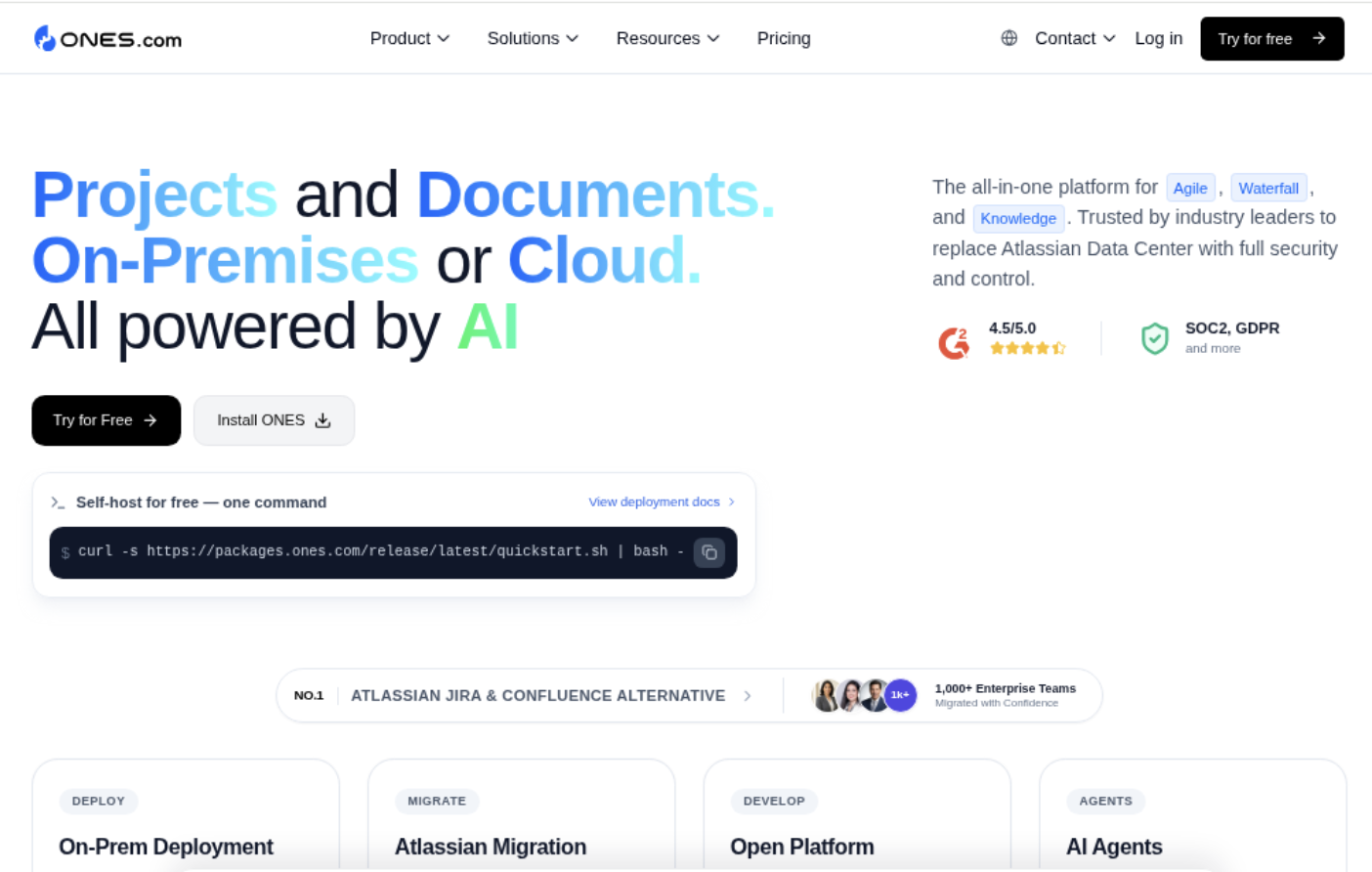
ONES.com combines project management and knowledge management in one platform powered by ONES Assistant. ONES Project is a Jira alternative, while ONES Wiki is a Confluence alternative; they are sold separately.
For organizations evaluating self-managed software, ONES.com offers Cloud, On-Premise, Private Cloud, and Air-gapped deployments. The free plan supports up to 30 seats, and the self-hosted versions provide feature parity with the cloud version.
Core Capabilities
- Fragmented project workflows → ONES Project: Jira-compatible workflows help teams manage planning, execution, and delivery in a familiar structure.
- Limited reporting visibility → Built-in reporting: Teams can review progress and delivery signals without depending on as many separate extensions.
- Rigid process design → Custom workflows and fields: Administrators can shape work tracking around internal processes and approval needs.
- Weak sprint coordination → Sprint management: Agile teams can plan iterations, assign work, and review progress within the same project environment.
- Manual repetitive work → Automation: Rules can reduce routine updates and help standardize recurring project actions.
- Restricted network requirements → Air-gapped deployment: Teams with strict isolation policies can evaluate a deployment designed for disconnected environments.
- Concern about hosting control → On-Premise and Private Cloud options: Organizations can keep more control over infrastructure placement and operational policies.
- Separate knowledge and project context → ONES Wiki: Teams can connect project work with shared knowledge when they license the knowledge management product.
Application Scenarios
Regulated engineering team: An engineering organization with restricted network access can evaluate an air-gapped deployment. Project plans, workflows, and reporting remain within the approved environment.
Growing product organization: A company replacing a plugin-heavy Jira setup can review built-in reporting, custom workflows, automation, and sprint management. Fewer extensions may simplify administration.
Hybrid operating model: A business with separate security requirements can compare Cloud, Private Cloud, and On-Premise deployment choices before selecting the environment that fits its policies.
Common Challenges in Cost Planning
Challenge: Comparing license prices only
Solution: Add infrastructure, apps, labor, security, recovery, and migration. Compare three-year ownership, then review the annual renewal impact.
Challenge: Underestimating user growth
Solution: Create a growth scenario with expected hiring and adoption. Check whether a small increase pushes you into a higher pricing tier.
Challenge: Ignoring secondary environments
Solution: List development, testing, training, and recovery needs before estimating infrastructure. Each environment can require capacity, maintenance, and access controls.
Challenge: Treating administration as free
Solution: Estimate monthly administration hours and apply a realistic labor rate. Include upgrade preparation, incident response, and security work.
Challenge: Keeping too many customizations
Solution: Review every app, workflow, field, and integration. Remove low-value complexity before migration or major platform changes.
FAQs About Self-Managed Jira Costs
Is Jira Server still available for new on-premise deployments?
Jira Server support ended on February 15, 2024. For current self-managed planning, review Jira Data Center and its commercial requirements. If you are maintaining an older Server environment, include migration planning, risk reduction, and support limitations in your budget.
What is included in Jira on-premise pricing?
The commercial entitlement is only one part of the total. Your budget may also need infrastructure, hosting, Marketplace apps, administration, backups, monitoring, security, upgrades, migration, training, and recovery testing. Ask for a quote that clearly separates recurring charges from implementation services.
How can I estimate the total cost of ownership?
Start with your user tier and deployment architecture. Add infrastructure, apps, internal labor, consulting, security, backup, and disaster recovery costs. Then calculate year one, years two and three, and a growth scenario. This approach reveals costs that a license-only estimate misses.
Is self-managed Jira cheaper than Jira Cloud?
It can be cheaper in some environments, especially when an organization already has infrastructure and skilled administrators. It can also cost more when you need high availability, multiple environments, extensive security controls, or significant specialist labor. Compare three-year ownership rather than the subscription alone.
Should I include a contingency budget?
Yes. A contingency reserve can cover user growth, unexpected integration work, security remediation, consulting, or recovery improvements. The right amount depends on the maturity of your environment and the complexity of migration. A high-customization deployment usually deserves a larger reserve.
Conclusion
Planning Jira on-premise pricing requires more than checking a user-tier quote. Count licenses, environments, apps, infrastructure, administration, security, upgrades, recovery, and implementation.
But here’s the truth: the cheapest license can produce the highest ownership cost when your team must compensate with extra labor and complex infrastructure.
Build a three-year model, test lean and growth scenarios, and compare self-managed alternatives using the same requirements. That gives you a clearer business case and fewer renewal surprises.
The solution is practical cost visibility. Once you understand what the platform must support and who will operate it, you can choose a deployment that fits your technical needs and financial reality.