Jira On-Premises Pricing: A Practical Cost Breakdown [2026]
Confused by jira on prem pricing? Get a practical 2026 cost breakdown of licenses, apps, infrastructure, and support. Click to discover.
Jira on-premises pricing can feel confusing because several costs sit behind one license number. You may see a Data Center subscription, marketplace apps, infrastructure, support, and migration work priced separately. That makes a simple user-count estimate unreliable.
The risk grows when an organization compares only the annual Atlassian quote. A lower license tier can still become expensive after adding high-availability infrastructure, backups, monitoring, security controls, and specialist administration. A large team may also pay more when app pricing follows a different user band.
But here's the truth: you can estimate the real cost with a clear model. Start with the Jira edition, then calculate users, apps, infrastructure, operations, and transition work. This guide explains each cost layer, shows practical examples, and compares an on-premises alternative for teams that want greater deployment flexibility.
How to Calculate Jira On-Premises Pricing
For most organizations, Jira on-premises pricing means the annual cost of Jira Data Center plus supporting apps, infrastructure, administration, security, and future growth. Jira Server licenses are no longer available for new purchases, so current planning usually centers on Data Center or a different platform.
Use this formula before requesting quotes:
Total annual ownership cost = Jira subscription + app subscriptions + infrastructure + operations + security and backup + support + contingency
Then estimate one-time transition costs separately:
Transition cost = assessment + configuration + migration + testing + training + rollout support
Follow these steps to create a realistic estimate.
-
Choose the deployment edition. Confirm whether your organization needs Jira Data Center, a cloud deployment, or another self-hosted platform. Jira Server reached end of support in February 2024, so a legacy Server quote should not guide a 2026 budget.
-
Count active users by product. Separate Jira Software, Jira Service Management, and other Atlassian products. A person may need access to one product, while another person needs several.
-
Identify user-tier effects. Atlassian pricing commonly follows user bands. A small increase can move you into a higher tier, especially when contractors, service agents, or occasional users are included.
-
List every marketplace app. Record the app name, purpose, user count, billing tier, renewal date, and business owner. App costs can become a major part of the annual bill.
-
Estimate infrastructure requirements. Include application nodes, load balancing, relational storage, shared storage, backups, test environments, monitoring, network capacity, and disaster recovery.
-
Add operational staffing. Include platform administration, upgrades, incident response, access management, performance tuning, and vendor coordination.
-
Model growth and resilience. Calculate the cost of expected user growth, a second environment, higher availability, recovery testing, and additional security controls.
-
Separate recurring and one-time costs. Migration work, consulting, training, and initial configuration should not disappear inside the annual subscription estimate.
-
Validate the estimate against a current quote. Atlassian pricing, product packaging, app terms, and eligibility rules can change. Treat public figures as planning guidance until your sales quote confirms them.
What Jira Data Center Pricing Usually Includes
Jira Data Center is Atlassian’s self-managed enterprise deployment option. You run the application in your own infrastructure or a supported hosting environment, while Atlassian charges a recurring subscription tied to product access and user capacity.
Here’s why the subscription alone does not equal the full ownership cost: the application needs an operating environment. That environment may include multiple nodes, traffic management, a supported relational system, backup services, monitoring, and operational expertise.
Jira subscription tiers
The primary cost driver is the number of licensed users or agents. Jira Software and Jira Service Management can have separate pricing structures, so combining headcounts too early can distort the estimate.
For example, 1,000 Jira Software users and 300 Jira Service Management agents should be modeled as separate commercial lines. The right total depends on current Atlassian terms, product editions, and any negotiated agreement.
Marketplace applications
Apps for time tracking, advanced roadmaps, test management, reporting, asset management, automation, and portfolio planning can carry separate subscriptions.
A team may pay for 900 Jira users while an app bills against a different tier. Check each vendor’s rules before assuming every add-on follows the main Jira count.
Support and commercial terms
An enterprise agreement may involve renewal terms, support arrangements, purchasing commitments, or negotiated discounts. Those conditions can change the effective annual price.
Ask for a quote that separates Jira products, marketplace apps, support, taxes, and any commercial adjustments. That structure makes renewal comparisons easier.
Cost Breakdown: The Six Layers Beyond the License
A practical budget should show every layer that keeps the platform available and usable. The following categories help you explain the total to finance, procurement, and technical leadership.
1. Core subscription
This is the Atlassian charge for the relevant Data Center products and user capacity. It is usually the easiest figure to find and the easiest one to overemphasize.
Use the current tier, expected growth, and product mix. Include a sensitivity case for users who may join through acquisitions, contractors, or expanded service operations.
2. Marketplace apps
Apps can solve important workflow gaps, yet each one adds renewal work and compatibility testing. A 10-app environment creates more upgrade coordination than a two-app environment.
For example, a reporting app may cost less than a test management suite, while both can affect upgrade planning. Estimate cost and administration together.
3. Infrastructure
Infrastructure may include virtual machines, cloud hosting, operating systems, storage, load balancing, network controls, backup retention, and a recovery environment.
A small internal installation might run with limited capacity. A global engineering organization may require several application nodes across availability zones, plus a separate recovery location.
4. People and operations
Someone must handle upgrades, permissions, workflow changes, performance issues, integrations, and incident response. This work may come from employees, a managed service provider, or a specialist consultancy.
Estimate hours by activity rather than adding a vague administration allowance. Monthly access reviews and quarterly upgrades create a different workload from a heavily customized platform.
5. Security and compliance
Self-managed deployments often require identity integration, privileged access controls, vulnerability management, audit review, encryption, recovery testing, and retention policies.
For a regulated team, security review can affect architecture and staffing. A cheaper hosting arrangement may require more internal controls and oversight.
6. Transition and change management
Moving from Jira Server, another project platform, or a heavily customized workflow can involve analysis, cleanup, testing, training, and staged rollout.
These costs often appear before the first renewal. Keep them visible so the business understands the complete investment.
Illustrative Jira On-Premises Cost Scenarios
The examples below show how to think about cost. They are planning scenarios, not current Atlassian quotes. Confirm every subscription and app price through a live commercial review.
| Scenario |
Typical cost considerations |
Main budget risk |
| Small regulated team |
One production environment, limited apps, identity integration, backups, and administrator time |
Compliance work may exceed infrastructure costs |
| Growing engineering organization |
Several application nodes, multiple apps, staging, monitoring, and frequent workflow changes |
User growth can trigger higher tiers and app renewals |
| Global enterprise |
High availability, recovery environment, regional operations, security reviews, and dedicated platform staff |
Resilience and staffing can outweigh the subscription |
Consider a hypothetical team with 750 Jira users, six marketplace apps, a staging environment, and a recovery environment. Its subscription may be only one part of the annual budget.
The team may also pay for hosting, storage, identity services, monitoring, backup retention, specialist administration, and annual testing. Removing one app could reduce licensing, upgrade work, and support tickets together.
Example of a simple annual model
Build a planning worksheet with these lines:
- Jira Data Center subscription: current quote for the selected products and user tier.
- Marketplace apps: renewal estimate for every active app.
- Hosting: production, staging, recovery, storage, networking, and traffic management.
- Operations: administration, upgrades, monitoring, and incident support.
- Security: access controls, review activities, scanning, and recovery testing.
- Growth reserve: additional users, apps, storage, and infrastructure capacity.
Then create a second model for one-time transition work. This prevents migration labor from being mistaken for recurring licensing.
Why User Counts and Apps Change the Final Price
User counts affect more than the headline Jira subscription. They may change app tiers, support requirements, storage demand, test effort, and the number of teams requesting workflow changes.
Here’s a simple example: a company grows from 900 to 1,050 users. The added 150 users may increase the main subscription, move two apps into higher bands, and require extra capacity for reporting jobs.
You might be wondering: should occasional users count in the estimate? Usually, yes. Anyone who needs licensed access should be reviewed against the product’s current licensing rules.
Questions to ask about user counts
- How many people need Jira Software?
- How many agents need Jira Service Management?
- Which contractors need access during each quarter?
- Do service accounts or integrations require special treatment?
- How many users may join during the next renewal period?
- Do apps use the same user count as the main product?
Use actual access patterns to challenge assumptions. A team may discover that inactive accounts, temporary contractors, or duplicate identities inflate its estimated tier.
On-Premises Costs Compared With Cloud Costs
Cloud pricing usually makes infrastructure and core administration less visible because the provider operates much of the platform. Self-managed pricing exposes those responsibilities more clearly.
That difference does not automatically make one model cheaper. Cloud can simplify operations while increasing recurring subscription spend. Self-managed deployment can provide control while requiring more technical ownership.
| Cost area |
Self-managed deployment |
Cloud deployment |
| Application hosting |
Owned or contracted by your organization |
Primarily handled by the provider |
| Upgrades |
Planned and executed by your team |
Usually handled within the service |
| Customization |
Often offers greater control, subject to support rules |
Uses cloud capabilities and supported integrations |
| Resilience |
Designed and funded by your organization |
Included according to the service plan |
| Administrative workload |
Higher internal responsibility |
Lower platform maintenance burden |
The right comparison uses total ownership cost over several years. Include migration, administration, business disruption, app replacement, security, and growth.
How to Reduce Total Ownership Cost
Cost control works best when you remove unnecessary complexity. Cutting the license tier without reviewing apps and operations may create a small saving while leaving the largest expenses untouched.
Audit access before renewal
Review active accounts, duplicate identities, inactive contractors, and teams that no longer need access. Ask each department owner to confirm continued use.
Retire low-value apps
List every app’s purpose, owner, usage, and renewal date. If a native Jira capability now covers the same need, test whether the app can leave safely.
Reduce customization where possible
Complex workflows, scripts, and integrations increase testing and support effort. Simplify one process at a time, beginning with workflows that create the most incidents.
Plan upgrades deliberately
Unplanned upgrades can create emergency consulting costs. Maintain a test environment, define rollback procedures, and schedule compatibility checks before production changes.
Compare three-year cost
A one-year view may hide transition effort or renewal increases. A three-year model shows whether a deployment choice remains practical as the team grows.
The best part? These improvements can lower operational effort even when the main subscription remains unchanged.
Jira On-Premises Solution: ONES.com
Value Proposition
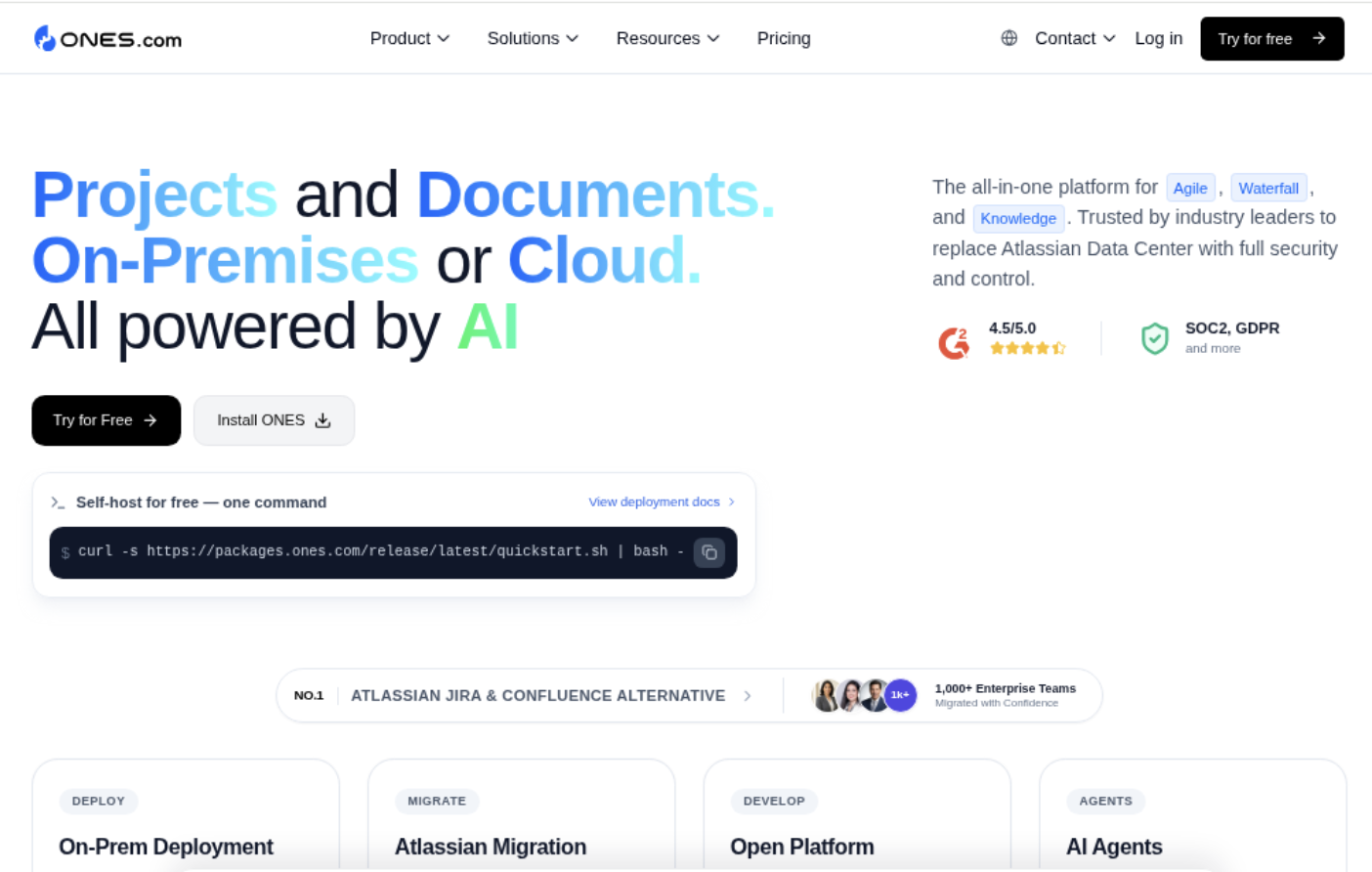
ONES.com is a unified platform for project management and knowledge management, powered by ONES Assistant. ONES Project is a Jira alternative for project teams that want self-hosted deployment options with fewer separate systems.
ONES Project and ONES Wiki are sold separately. The platform supports Cloud, On-Premise, Private Cloud, and Air-gapped deployments, with full feature parity between cloud and self-hosted versions.
Core Capabilities
-
Jira replacement planning: Teams concerned about rising licensing complexity can use ONES Project as a Jira alternative. Jira-compatible workflows help familiar teams reduce process disruption during evaluation.
-
Deployment flexibility: Organizations with residency, security, or network restrictions can choose On-Premise, Private Cloud, or Air-gapped deployment. This supports environments where public cloud access is unsuitable.
-
Reduced plugin dependence: Teams managing many add-ons can use built-in reporting, custom workflows, custom fields, sprint management, and automation. Fewer separate extensions can simplify renewal and compatibility planning.
-
Project planning: Teams struggling with disconnected sprint and delivery views can manage backlogs, sprints, issues, and workflows in one project management environment. This can reduce manual coordination between planning areas.
-
Reporting: Leaders who spend time assembling progress updates can use built-in reporting. Delivery trends, workload views, and project status become easier to review within the same platform.
-
Knowledge management: Teams maintaining project knowledge in a separate system can evaluate ONES Wiki as a knowledge base option. It is sold separately and can support closer alignment between project work and team knowledge.
-
Air-gapped operation: Teams working in restricted networks can deploy the platform in an air-gapped environment. This suits defense, critical infrastructure, and other controlled settings requiring isolated operations.
-
Entry-level adoption: Small teams can start with the free plan for up to 30 seats. Larger teams can evaluate the paid structure against their deployment, support, and growth requirements.
Application Scenarios
Regulated engineering team: A company requiring on-premises control can evaluate ONES Project in its own environment. The team can keep sprint planning, workflow configuration, reporting, and automation within one platform.
Restricted-network program: A program operating without standard internet access can assess the air-gapped option. This may reduce the need to adapt external services to a tightly controlled network.
Growing product organization: A company reviewing several Jira apps can compare native workflow, field, sprint, reporting, and automation features in ONES Project. The goal is to measure whether fewer plugins lower ongoing administration.
Common Challenges When Estimating Self-Managed Pricing
Challenge 1: Treating the subscription as the total cost
Problem: The budget includes Jira and ignores hosting, operations, recovery, and security.
Solution: Use the six-layer model in this guide. Ask infrastructure and security teams to review their portions before approval.
Challenge 2: Missing app renewal costs
Problem: Teams discover separate marketplace renewals after the main contract is approved.
Solution: Create an app register with owners, user tiers, renewal dates, and business purpose. Review it before every commercial cycle.
Challenge 3: Underestimating growth
Problem: A budget fits today’s users but fails after hiring, acquisitions, or service expansion.
Solution: Model current, expected, and high-growth scenarios. Include user tiers, storage, integrations, and administration.
Challenge 4: Ignoring transition effort
Problem: Migration, testing, training, and workflow cleanup appear as unexpected costs.
Solution: Create a separate transition estimate with owners, milestones, test cycles, and rollout support.
Challenge 5: Comparing different deployment assumptions
Problem: One proposal includes high availability and recovery, while another assumes a single environment.
Solution: Normalize every proposal against the same user count, resilience target, recovery objective, app list, and support expectations.
FAQs
Is Jira Server still available in 2026?
Jira Server reached end of support in February 2024, and new planning should focus on supported deployment options. Organizations still operating legacy Server environments should assess migration, support exposure, security requirements, and compatibility. Jira Data Center is the relevant Atlassian self-managed path for many larger organizations, although product suitability depends on scale, architecture, and commercial terms.
Does Jira Data Center pricing include infrastructure?
No. The subscription covers the Atlassian product under the applicable commercial terms. Your organization generally handles hosting, application nodes, storage, traffic management, backups, monitoring, recovery, security controls, and administration. A useful estimate places infrastructure and operational expenses beside the subscription instead of hiding them inside a general technology budget.
How do marketplace apps affect the total cost?
Each marketplace app may have its own pricing model, user bands, renewal terms, and support conditions. Some apps may follow Jira users, while others use agents or another measurement. Review every app separately, then add compatibility testing and administration. Removing an app can reduce licensing expense and lower upgrade coordination.
What should I include in a Jira on-premises budget?
Include the core subscription, marketplace apps, hosting, storage, backups, monitoring, security, identity management, administration, support, recovery testing, growth capacity, and transition work. Separate recurring expenses from one-time migration and rollout costs. This structure gives finance a clearer view of the investment and gives technical teams room to explain operational requirements.
Is self-managed Jira always cheaper than cloud?
No deployment model is automatically cheaper for every organization. Self-managed deployment may suit teams needing infrastructure control, network isolation, or extensive administration authority. Cloud may reduce platform maintenance work while using a different recurring pricing model. Compare several years of subscription, operations, security, resilience, apps, migration, and staffing costs.
Can ONES.com replace Jira for an on-premises team?
ONES Project is positioned as a Jira alternative and supports Cloud, On-Premise, Private Cloud, and Air-gapped deployments. It includes Jira-compatible workflows, reporting, custom fields, sprint management, and automation. Evaluate migration complexity, integrations, user needs, support expectations, and feature fit through a structured trial or technical assessment.
Conclusion
Jira on-premises pricing is more than an annual product subscription. A reliable estimate includes user tiers, marketplace apps, infrastructure, operations, security, resilience, growth, and transition work.
Start with a current quote, then build a three-year ownership model. Review access before renewal, challenge every app, and compare deployment proposals using the same assumptions.
But here's the practical takeaway: the lowest headline price may not create the lowest operating cost. A clear cost model helps you choose between Data Center, cloud, and a Jira alternative such as ONES Project with greater confidence.