Jira Plans Explained: A Practical Guide for Teams in 2026
Not sure which Jira plans fit your team? Compare Free, Standard, Premium, and Enterprise to choose confidently. Click to discover the best option.
Choosing between Jira plans can feel harder than managing the work itself. Free may look sufficient, while Standard, Premium, and Enterprise introduce capabilities your team may not fully understand yet. The wrong choice can create avoidable costs, permission gaps, reporting limitations, or migration pressure later.
That uncertainty becomes more expensive as your team grows. A five-person product group has different needs from a 200-person engineering organization with multiple departments, strict controls, and cross-team dependencies.
Here’s the practical answer: compare each plan by team size, workflow complexity, administration needs, reporting depth, security expectations, and growth plans. This guide explains what each Jira tier is designed to support, where its limits matter, and how to choose confidently in 2026.
Jira Plans Explained: What Each Tier Includes
Jira plans are subscription tiers that determine the users, features, administration controls, security options, automation capacity, and support available to your team. Most teams compare Free, Standard, Premium, and Enterprise.
The right tier depends less on the number of features and more on how your team works. A small team may need only issue tracking and basic boards. A larger organization may need advanced planning, stronger governance, analytics, and centralized administration.
| Plan |
Best suited for |
Main strengths |
Potential limitation |
| Free |
Small teams testing Jira or running simple projects |
Core work tracking, boards, backlog management, and basic collaboration |
User, storage, automation, support, and administration limits |
| Standard |
Growing teams running regular development or service workflows |
Higher capacity, more administration options, and broader collaboration support |
Advanced planning and governance may still require a higher tier |
| Premium |
Multiple teams coordinating complex delivery |
Advanced planning, stronger operational controls, and greater scale |
Higher cost and more configuration responsibility |
| Enterprise |
Large organizations with complex governance requirements |
Centralized administration, enterprise controls, and organization-wide management |
Requires stronger ownership, planning, and budget justification |
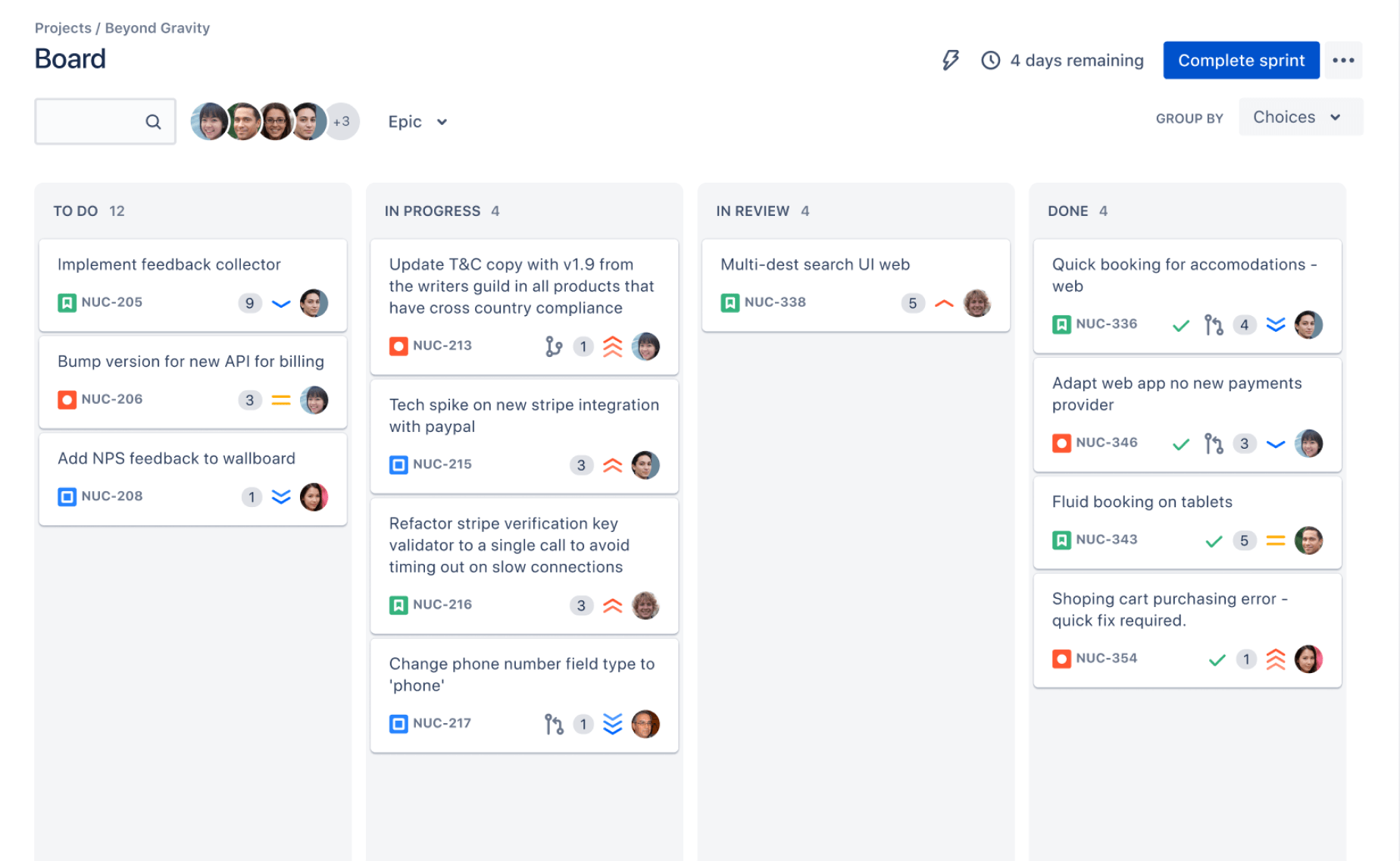
Free: A Practical Starting Point
The Free tier is usually suitable for a small team with a straightforward workflow. For example, a startup with six people might manage product tasks through a backlog, sprint board, and simple reports.
You can use this tier to test whether Jira fits your planning habits. It can also work for a small project that does not require advanced permissions, complex automation, or extensive administration.
But here’s the truth: Free plans often become restrictive when your team adds more people or more process. Limits can affect automation, storage, user access, support, and administrative control.
Standard: The Common Choice for Growing Teams
Standard is often the practical middle tier. It gives growing teams more room for collaboration and administration without immediately moving into enterprise-level complexity.
A product team with developers, testers, designers, and a product manager may prefer Standard when several projects share workflows. The added capacity can make routine delivery more predictable.
Standard can also make sense when you need clearer access control, broader project participation, and more reliable automation than a free workspace provides.
Premium: Advanced Planning and Greater Scale
Premium is designed for organizations managing multiple teams, larger initiatives, or more complicated delivery dependencies. Its value becomes clearer when coordination matters as much as task tracking.
For example, a company launching a mobile application may have separate teams for infrastructure, design, compliance, and customer support. Advanced planning helps leadership see how those workstreams affect one another.
The best part? Premium can reduce the need for disconnected planning habits when teams need a shared view of timelines, capacity, and cross-project dependencies.
Enterprise: Governance Across the Organization
Enterprise is aimed at large organizations that need centralized control across many teams, projects, or business units. It is less about adding one useful feature and more about governing Jira consistently at scale.
An enterprise team may need standardized administration, tighter security oversight, structured access management, and visibility across a large portfolio of work.
Enterprise pricing and availability can vary by agreement. You should confirm current commercial terms, included services, and regional details before making a purchasing decision.
How to Choose the Right Jira Tier
Start with your operating needs rather than the plan names. A simple scoring exercise can reveal which tier fits your team now and which tier protects your next stage of growth.
- Count active users. Include developers, product managers, testers, designers, service staff, contractors, and stakeholders who need access.
- Map your workflows. List the steps for planning, development, review, testing, release, and support.
- Identify coordination pressure. Check whether several teams depend on the same milestones, systems, or approvals.
- Review administration needs. Consider permissions, audit expectations, user management, and workspace governance.
- Estimate automation demand. Count recurring actions such as ticket creation, status updates, notifications, and routing.
- Test reporting requirements. Decide whether basic team reports are enough or whether leadership needs portfolio-level visibility.
- Check growth plans. Think about hiring, new departments, acquired teams, and expected project volume.
- Calculate total cost. Include subscription fees, administration time, integrations, training, configuration, and future upgrades.
Use Team Size as a Signal, Not a Rule
Team size helps you narrow the options, but it should not make the decision alone. Ten people with four complex workflows may need more control than twenty people using one simple board.
A small agency serving regulated clients could need stronger permissions and audit practices. Meanwhile, a larger internal team may operate comfortably with a simpler setup.
You might be wondering: how do you handle that difference? Match the plan to work complexity first, then use user count to validate the cost.
Separate Must-Have Features from Nice-to-Have Features
Create two lists before reviewing pricing. The first list should contain requirements that affect daily delivery. The second should contain improvements that would be helpful but are not essential.
For example, advanced planning may be essential when three teams share a launch date. A more polished dashboard may be useful, but it should not drive the purchase by itself.
Consider the Cost of Staying on a Lower Tier
A cheaper plan may create hidden work. Your team might compensate with manual status updates, extra meeting time, separate planning tools, or custom workarounds.
Suppose four project leads spend two hours each week reconciling disconnected schedules. At an internal cost of $60 per hour, that workaround costs about $480 each month before you count delays.
That calculation does not prove a higher tier is worthwhile. It shows why subscription price should be compared with the operational cost of limitations.
What Changes Between Jira Tiers?
The most meaningful differences usually appear in capacity, planning, automation, administration, analytics, security, and support. These differences affect how smoothly work moves through your organization.
Capacity and User Access
Every tier has practical limits around users, storage, automation, or activity. Those limits may feel invisible during a pilot and become important after adoption spreads.
Track who needs active access and who only needs occasional visibility. A stakeholder who views progress once a month may not need the same access as an engineer working in Jira every day.
Automation and Workflow Control
Automation can remove repetitive work. Examples include assigning issues when they enter a queue, adding labels after a form submission, or notifying a reviewer after a status change.
However, automation capacity is only part of the decision. Poorly designed rules can create duplicate actions, confusing notifications, or unexpected transitions.
Let me explain: a higher plan gives you more room, but it does not replace workflow design. Start with a clear process and automate the stable parts.
Planning Across Projects
Basic boards are useful for team execution. Cross-project planning becomes more valuable when several groups contribute to one outcome.
Imagine a product launch requiring engineering, legal review, marketing preparation, and customer support training. A team board may show individual tasks, while an advanced planning view can reveal timing conflicts between groups.
Reports and Leadership Visibility
Reports answer questions such as:
- Are sprint commitments becoming more reliable?
- Where do issues wait the longest?
- Which work remains unfinished after several cycles?
- Are urgent requests disrupting planned work?
- Do dependencies threaten a release milestone?
Basic reports may be enough for a single team. Leaders overseeing several workstreams usually need consistent views that support prioritization and capacity conversations.
Security, Permissions, and Administration
As more departments join Jira, access control becomes more important. You may need to restrict sensitive projects, separate external collaborators, or standardize how new teams are created.
Administration also includes naming conventions, workflow ownership, permission reviews, integration management, and lifecycle planning. These responsibilities require time even when the platform works well.
Jira Cloud, Self-Managed Options, and Deployment Considerations
Jira planning is not only about feature tiers. You also need to consider where the platform operates and who manages its environment.
Cloud Deployment
Cloud deployment reduces infrastructure work because the vendor operates the platform environment. Your team can usually access updates without managing servers, maintenance windows, or internal hosting capacity.
This model can suit organizations that want quicker adoption and a smaller internal administration burden. It also requires careful attention to access policies, integrations, and vendor governance.
Self-Managed Deployment
Self-managed environments can provide greater control over hosting, network access, and internal operational policies. They may suit organizations with strict technical or regulatory requirements.
The trade-off is management responsibility. Your team must plan upgrades, backups, monitoring, security controls, and support procedures.
Questions to Ask Before Choosing a Deployment Model
- Does your organization require a specific hosting location?
- Can the platform operate inside your network controls?
- Who will manage upgrades and maintenance?
- How will integrations authenticate and exchange information?
- What recovery time and continuity targets must you meet?
- Will contractors or external partners require access?
A team may select a suitable subscription tier and still struggle if the deployment model conflicts with internal requirements. Evaluate both decisions together.
Jira Pricing in 2026: How to Estimate the Real Cost
Jira pricing can change by product, user count, billing term, deployment type, and commercial agreement. Treat any public estimate as a starting point and confirm current pricing through the official purchasing channel.
Subscription Cost Is Only the First Line
Your total cost may include:
- Subscription fees for active users
- Implementation and workflow configuration
- Integration setup and ongoing maintenance
- Administrator and project owner time
- Training for new team members
- Migration and cleanup work
- Consulting or specialist support
- Additional applications from the marketplace
For example, a plan may appear affordable until your team adds several extensions for time tracking, advanced reporting, approvals, or testing management.
Calculate Cost Per Active User
Divide the recurring subscription cost by the number of active users who rely on Jira each month. Then compare that figure with the time saved in planning, coordination, reporting, and administration.
Do not count only developers. Product managers, testers, designers, support staff, and managers may all create value through access to the same workflow.
Review Annual Growth Before Signing
Hiring can move your team into a different pricing bracket. New departments can also create additional administration needs.
Build a simple twelve-month forecast with current users, expected hires, external collaborators, planned projects, and likely integrations. This prevents a short-term decision from creating a rushed upgrade later.
Common Mistakes When Comparing Plans
Choosing the Cheapest Tier Without Testing the Workflow
Price is easy to compare, but workflow fit is harder. A low-cost tier may appear attractive until your team tries to manage approvals, shared milestones, or multiple projects.
Run a realistic trial with actual work. Include one complete cycle, such as planning, execution, review, release, and reporting.
Buying Premium Features Before Defining the Problem
Advanced features can look impressive during a product tour. They create value only when they solve a recurring operational problem.
Before upgrading, write the problem in one sentence. For example: “Three teams cannot see how infrastructure work affects the release date.” Then test whether the proposed capability addresses that issue.
Ignoring Administration Effort
More flexibility can create more configuration choices. Without ownership, teams may create duplicate workflows, inconsistent fields, or conflicting automation.
Assign a platform owner and define lightweight governance. Review changes regularly rather than allowing every team to customize everything independently.
Overlooking Marketplace Dependencies
Extensions can improve Jira, but they add cost, security review, maintenance, and renewal management. They may also create dependencies that complicate future changes.
List every extension your workflow requires. Then ask whether a native capability, a simpler process, or another platform could reduce that dependency.
Jira Plans Alternative: ONES.com
ONES.com combines project management and knowledge management in one platform, with ONES Project for work tracking and ONES Wiki for shared knowledge. ONES Project is positioned as a Jira alternative for teams seeking Jira-compatible workflows, native reporting, and flexible deployment.
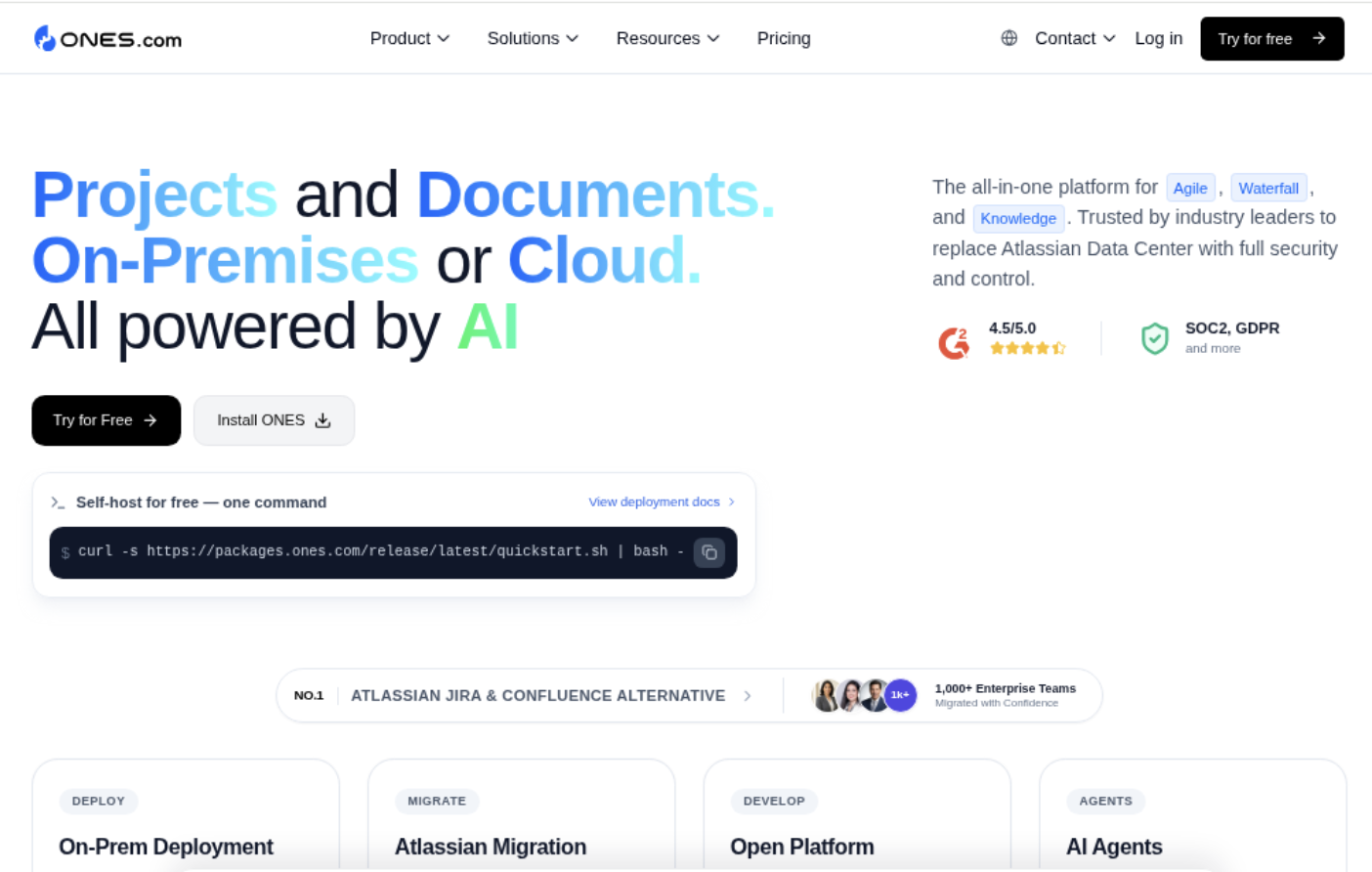
The platform is available separately through ONES Project and ONES Wiki. It supports up to 30 seats on its free offering and provides Cloud, On-Premise, Private Cloud, and Air-gapped deployment options.
Value Proposition
ONES.com can suit teams that want project execution and team knowledge connected in one environment. Its self-hosted options may also appeal to organizations that need stronger control over hosting and network access.
Core Capabilities
1. Disconnected Work Information
Pain: Project tasks and team knowledge often live in separate platforms, forcing people to search across multiple places.
ONES capability: ONES.com combines project management through ONES Project with knowledge management through ONES Wiki.
Result: Teams can connect delivery work with procedures, decisions, and reference material in a more unified workspace.
2. Jira Workflow Familiarity
Pain: Switching platforms can create resistance when teams already understand issue tracking, boards, sprints, and status flows.
ONES capability: ONES Project supports Jira-compatible workflows, helping teams carry familiar working patterns into another platform.
Result: Adoption can require less process reinvention, especially for teams already comfortable with Jira-style delivery.
3. Plugin Dependence
Pain: Teams may rely on several extensions for reporting, custom workflows, fields, automation, and sprint management.
ONES capability: ONES Project includes built-in reporting, custom workflows and fields, sprint management, and automation.
Result: A team may reduce the number of separate plugins it needs to evaluate and maintain.
4. Deployment Restrictions
Pain: Some organizations cannot place project information in a general cloud environment.
ONES capability: ONES.com supports Cloud, On-Premise, Private Cloud, and Air-gapped deployments.
Result: Organizations can evaluate a deployment approach that matches internal network and security requirements.
5. Feature Differences Between Hosting Models
Pain: Self-hosted platforms sometimes provide fewer capabilities than their cloud editions.
ONES capability: ONES.com provides full feature parity between its cloud and self-hosted versions.
Result: A team can prioritize hosting requirements without automatically giving up core platform functionality.
6. Custom Process Requirements
Pain: Standard workflows may not match approval-heavy, research-oriented, or cross-functional projects.
ONES capability: ONES Project supports custom workflows and custom fields.
Result: Teams can model work around their actual process while retaining structured tracking.
7. Sprint Coordination
Pain: Agile teams need a clear view of sprint scope, progress, and unfinished work.
ONES capability: ONES Project includes sprint management for planning and tracking iterative delivery.
Result: Scrum-oriented teams can manage recurring delivery cycles within the same project environment.
8. Repetitive Administrative Work
Pain: Manual updates consume time and create inconsistent status information.
ONES capability: Automation can handle recurring transitions, assignments, notifications, and related workflow actions.
Result: Project owners can spend more time on exceptions and decisions instead of routine maintenance.
Application Scenarios
Growing Product Team
A product group moving beyond basic task tracking may use ONES Project for backlogs, sprints, custom fields, and reports. ONES Wiki can hold product decisions and team guidance.
Restricted-Network Engineering Organization
An engineering organization with air-gapped requirements may evaluate the Air-gapped deployment option. This approach can support controlled environments while preserving access to the platform’s core capabilities.
Company Replacing a Plugin-Heavy Setup
A team using several add-ons for workflows, reports, and automation may compare the native capabilities in ONES Project. The goal is to assess whether fewer separate tools can simplify administration.
Common Challenges When Selecting a Plan
Challenge: Your Team Cannot Agree on Requirements
Solution: Ask each stakeholder to name one recurring problem, one essential capability, and one measurable outcome. Combine overlapping needs before comparing tiers.
Challenge: The Pricing Page Does Not Reflect Your Final Cost
Solution: Create a total-cost estimate that includes users, extensions, administration, training, implementation, and future growth. Request a commercial quote when your needs are complex.
Challenge: Teams Want Different Workflows
Solution: Establish a shared minimum process for statuses, ownership, and reporting. Let teams customize only where the difference supports a genuine business requirement.
Challenge: You Are Unsure Whether to Upgrade
Solution: Track the impact of current limits for two or three delivery cycles. Record manual work, missed visibility, delayed approvals, and recurring workarounds.
Challenge: Adoption Is Slower Than Expected
Solution: Simplify the first workflow. Train people around a real project, define clear ownership, and remove fields or steps that do not support a decision.
FAQs About Jira Tiers
Which Jira plan is best for a small team?
Free can suit a small team with simple workflows, limited administration needs, and a modest number of users. Standard may be a better choice when the team needs more capacity, broader collaboration, or greater control. Test a complete work cycle before deciding. Include planning, execution, review, reporting, and any recurring automation.
When should a team move from Free to Standard?
Consider upgrading when user access, automation, storage, support, or administration limits begin affecting delivery. A team should not wait until work stops completely. If people create manual workarounds every week, compare the cost of those workarounds with the next tier.
Is Premium worth the additional cost?
Premium can be worthwhile when multiple teams share milestones, dependencies, or capacity constraints. Its value is weaker when one small team only needs a backlog and a board. Define the coordination problem first, then test whether advanced planning or scale-related capabilities would change the outcome.
Does Enterprise make sense for every large company?
No. Enterprise is most relevant when a large organization needs centralized governance, stronger administrative control, and consistent management across many teams. A large company with independent departments and simple workflows may not need every enterprise capability. Review security, administration, reporting, and organizational complexity together.
Should I compare Jira with another project management platform?
Yes, especially when your current setup requires many extensions, restricted deployment, or connected knowledge management. Compare workflow compatibility, reporting, administration, hosting choices, migration effort, and total cost. ONES Project is one Jira alternative to evaluate when native capabilities and deployment flexibility matter.
Can I change Jira plans later?
Most teams can change tiers as needs evolve, but the practical impact depends on user counts, configuration, commercial terms, and feature dependencies. Before upgrading or downgrading, review automation, reports, permissions, integrations, and any capabilities that may change. Plan the transition during a low-risk period.
Conclusion
The best Jira plan is the tier that supports your real workflow without creating unnecessary cost or administration. Free may work for a small, simple team. Standard often fits growing groups. Premium supports broader coordination, while Enterprise focuses on organization-wide governance.
But here’s the practical takeaway: compare capacity, automation, planning, permissions, reporting, deployment, and growth together. Then calculate the cost of workarounds, not only the subscription price.
If your team needs Jira-compatible project workflows, built-in reporting, flexible deployment, or connected project and knowledge management, ONES.com is worth evaluating as a Jira alternative.
The problem is uncertainty. The pressure comes from choosing a tier that creates limits later. The solution is a structured comparison using real users, real workflows, and measurable operating needs.