Jira Plugin Pricing: A Practical Guide to Costs in 2026
Wondering what jira plugin pricing really costs? Compare tiers, fees, taxes, and renewals in 2026. Click to budget smarter.
Jira plugin pricing can look simple until you compare marketplace fees, user tiers, cloud and Data Center plans, taxes, support, and renewal changes. A plugin that costs little for a small team may become a major annual expense after your Jira user count grows.
That uncertainty makes budgeting difficult. You might approve one add-on for time tracking, another for reporting, and a third for automation before seeing the combined bill. But here's the truth: the advertised plugin price is only one part of the decision. This guide shows you how to calculate the full cost, compare licensing models, spot hidden expenses, and decide whether a plugin still makes financial sense in 2026.
How Jira Plugin Pricing Works in 2026
Jira plugin pricing is the cost of adding third-party functionality to Jira, usually through a marketplace app or a self-hosted extension. The final amount depends on your deployment type, user tier, billing cycle, app features, support terms, and applicable taxes.
You should evaluate the total annual cost rather than the monthly headline price. A useful calculation is:
Total annual cost = license fee + required Jira plan + support or service fees + tax + migration and administration effort
For example, a team with 25 Jira users may pay a modest amount for a reporting add-on. The same add-on can become much more expensive when the organization reaches 300 users, especially if the app uses Jira’s full licensed-user tier.
1. Identify your Jira deployment
Start by confirming whether your team uses Jira Cloud, Jira Data Center, or another self-managed arrangement. Plugin prices can differ significantly between hosted and self-managed deployments.
Cloud apps commonly use recurring subscriptions. Data Center apps may use annual term licenses, and some extensions have different feature sets across deployment types.
Write down the following details before comparing apps:
- Your Jira deployment type
- The number of licensed Jira users
- The number of people who need the plugin
- Your preferred billing cycle
- Any compliance or hosting requirements
2. Check the billing unit
Some apps charge according to your Jira user tier, while others charge by active users, seats, projects, agents, automation volume, or usage limits.
Suppose only 40 people use a reporting plugin, but your Jira subscription covers 100 users. If the app charges by Jira tier, you may pay for the 100-user bracket.
Look for phrases such as “licensed users,” “maximum users,” “active users,” and “monthly usage.” They describe different pricing rules.
3. Compare monthly and annual billing
Monthly billing gives you flexibility when you are testing an app. Annual billing may reduce the effective monthly cost, but it commits you for a longer period.
For a small pilot, monthly billing can limit risk. For a plugin that supports a long-term workflow, an annual term may be easier to budget.
Do not compare only the displayed monthly equivalent. Calculate the actual payment, renewal date, cancellation rule, and expected user growth.
4. Add implementation and administration costs
A plugin can be affordable while still creating substantial internal work. Someone may need to configure fields, rebuild dashboards, manage permissions, train colleagues, and review automation behavior.
For example, a $1,200 annual app may require 30 hours of administration during rollout. If an administrator costs your organization $60 per hour, the first-year operational cost reaches $3,000.
This does not make the plugin a bad choice. It gives you a more realistic comparison with alternative workflows or a broader project management platform.
5. Test the renewal scenario
Estimate the cost after your team grows. A plugin that fits 50 users may be much less attractive at 500 users.
Use three scenarios:
- Current users
- Expected users in 12 months
- Possible users in 24 months
Then compare the annual total under each scenario. This simple exercise often reveals whether an app is a temporary convenience or a sustainable investment.
What Usually Appears on a Jira Plugin Bill?
A marketplace listing may show a clear subscription price, but the complete commercial picture often contains several layers. Here's why: each layer can affect your actual annual spend.
Base app subscription
This is the recurring amount for the plugin itself. It may be priced by user tier, feature package, usage volume, or deployment type.
Some vendors offer a free plan with limited functionality. Others provide a trial period, after which the paid subscription begins unless you cancel it.
Jira subscription requirement
A plugin does not replace your Jira subscription. You normally need both the Jira plan and the app license.
If your team upgrades Jira to unlock more automation or storage, the plugin may remain unchanged. Your combined technology cost can still rise because the underlying Jira plan costs more.
Premium features and usage limits
Some apps place advanced reporting, automation, integrations, or export functions in a higher tier. Others charge extra after reaching a usage threshold.
Ask whether the plan includes:
- All core modules
- Unlimited projects or workflows
- Required integrations
- Historical reporting
- Automation runs
- Priority support
Taxes and currency conversion
Published prices may exclude regional taxes. Currency conversion can also change the amount charged to your organization.
Finance teams should confirm the final invoice currency, tax treatment, and billing entity before approving a purchase.
Professional services
Some teams need help with setup, migration, custom configuration, or training. These services may be optional, but they can influence the first-year budget.
Ask for a separate estimate rather than assuming implementation is included in the subscription.
| Cost area |
Question to ask |
| App license |
Is pricing tied to Jira users, active users, or usage? |
| Deployment |
Does the Cloud price match the self-managed price? |
| Features |
Are required integrations and advanced functions included? |
| Renewal |
Can the price or tier change when the subscription renews? |
| Services |
Will configuration or training require additional spending? |
Cloud, Data Center, and Self-Managed Pricing Differences
Deployment choice can change how you evaluate a plugin. Cloud apps usually emphasize recurring subscriptions and rapid updates. Self-managed products may involve annual licensing, infrastructure, maintenance, and stricter compatibility checks.
Cloud app economics
Cloud plugins are often easier to activate and test. You may avoid server maintenance, but recurring subscription costs continue for as long as the app remains active.
A cloud app can be a strong fit when your team values quick rollout. It may be less attractive when you need deep control over hosting, network access, or retention policies.
Data Center considerations
Data Center pricing can require closer attention to license terms, supported versions, renewal periods, and deployment architecture.
You should also budget for internal maintenance. An app update may require testing, compatibility checks, and a planned release window.
Self-managed total cost
Self-managed licensing can appear predictable because you may pay an annual term. Yet infrastructure, backups, monitoring, upgrades, and administration still contribute to the total.
For example, a lower annual license may not be cheaper if it requires a dedicated administrator and additional hosting capacity.
Let me explain: the cheapest license is not always the cheapest operating model. Compare the cost of ownership over at least two years, especially for a plugin that supports a core workflow.
How to Compare Plugin Value Before You Buy
Price comparison becomes more useful when you connect cost to a measurable business outcome. A plugin that saves five hours per week may justify a higher subscription than one that only adds a convenient display.
Measure the current problem
Record how much time your team spends on the task today. Include repeated manual work, corrections, status meetings, and delayed decisions.
For instance, if three project leads each spend two hours every week building progress reports, the annual workload can exceed 300 hours. A reporting plugin may create value if it reduces that effort without adding heavy administration.
Estimate the avoided cost
Assign a reasonable internal value to the time saved. Then subtract the annual plugin cost and ongoing administration.
A simple estimate looks like this:
Estimated benefit = annual hours saved × hourly value − annual app cost − administration cost
This is an estimate rather than a guarantee. Use conservative assumptions so the business case remains credible.
Review workflow fit
A plugin may offer impressive features while fitting poorly into your existing process. Check whether it works with your permissions, issue types, custom fields, reports, and approval steps.
For example, a time-tracking app that cannot handle your billing categories may create more reconciliation work than it removes.
Check exit costs
Before purchasing, ask how easily you can remove the app. Can you export configuration? What happens to dashboards? Will your workflow break if the plugin disappears?
Exit planning matters because a low-cost experiment can become expensive when the team relies on proprietary features.
Ways to Reduce Jira Plugin Spending
You can often lower costs without removing useful functionality. The best part? Small governance changes can prevent several unnecessary subscriptions.
Audit installed apps quarterly
Review every active plugin and record its owner, purpose, user count, renewal date, and usage level. Remove apps that no longer support a real workflow.
A quarterly review can reveal duplicate tools. Two apps may provide similar dashboards, approval controls, or notification rules.
Consolidate overlapping functions
Compare plugins that solve adjacent problems. A single platform may cover project tracking, knowledge management, reporting, and workflow automation more efficiently than several disconnected apps.
Consolidation can also reduce training and permission administration.
Limit paid access carefully
If pricing permits separate access levels, give paid seats only to people who need the feature. Keep occasional viewers on included or lower-cost access where the license terms allow it.
Do not reduce access blindly. A cheaper license can create delays if important contributors lose the tools they need.
Use trials as technical tests
A trial should answer practical questions, not merely confirm that the interface looks appealing. Test permissions, performance, reporting, integrations, exports, and removal procedures.
Give the pilot a written success target. For example, the plugin should reduce weekly report preparation from two hours to 30 minutes.
Negotiate for predictable growth
For larger teams, ask vendors about tier thresholds, renewal terms, volume pricing, and multi-year arrangements. Request clarity about what happens when your user count crosses a pricing band.
Predictability can be more valuable than a small initial discount.
Jira Plugin Pricing Solution: ONES.com
Value Proposition
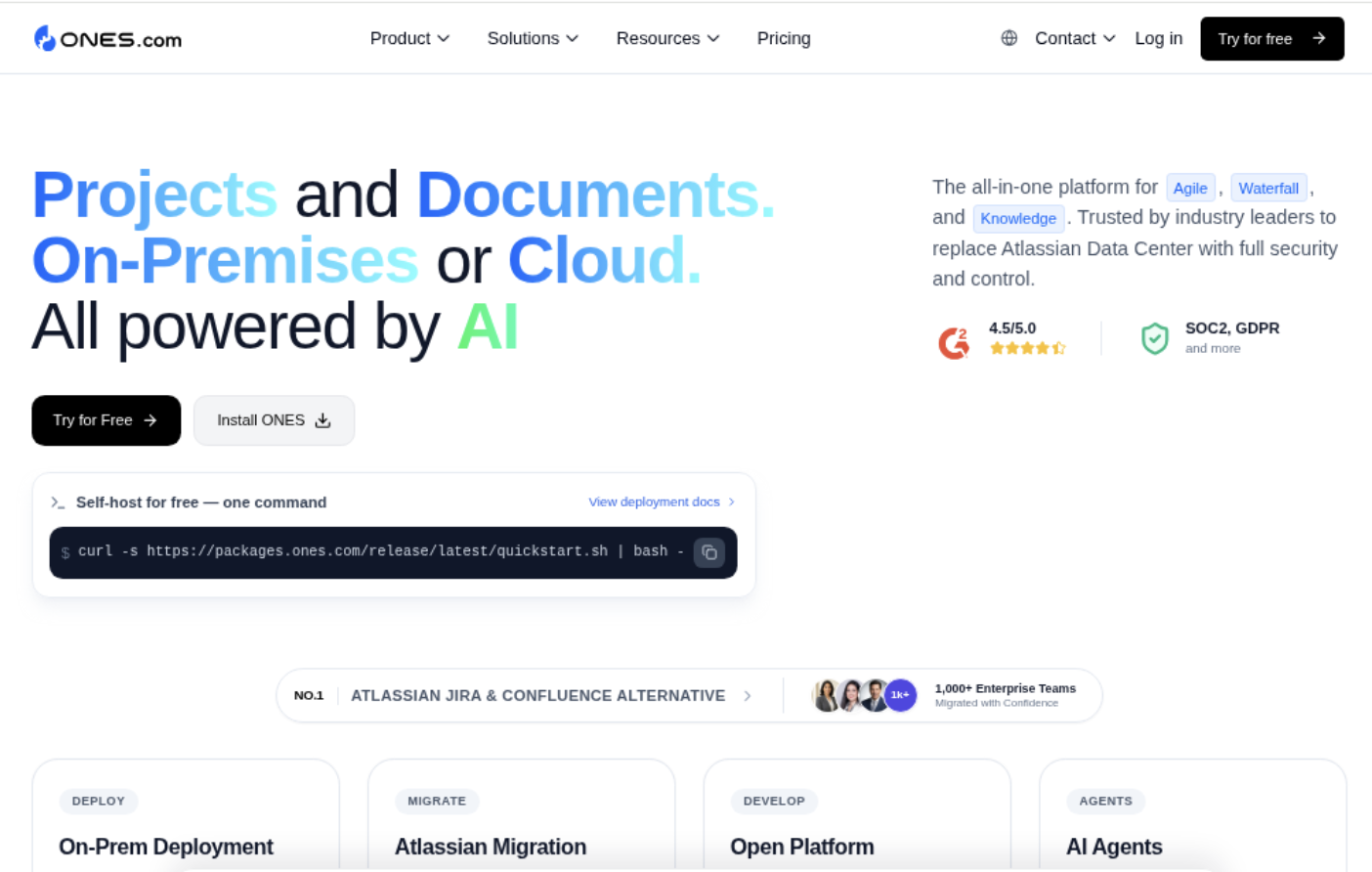
ONES.com combines project management and knowledge management in one platform, powered by ONES Assistant. ONES Project is a Jira alternative for project workflows, while ONES Wiki supports knowledge management as a Confluence alternative. They are sold separately.
For teams reviewing several Jira plugins, ONES.com can provide a broader comparison point. Instead of adding separate apps for project tracking, reporting, workflow control, and team knowledge, you can evaluate whether a more unified setup fits your operating model.
Core Capabilities
- Scattered project tools: ONES Project brings project planning, issue tracking, sprint management, and delivery coordination into one PM environment. Result: teams can reduce context switching across multiple extensions.
- Complex approval steps: Custom workflows support structured transitions and review stages. Result: teams can represent approval-heavy processes without relying on several separate workflow plugins.
- Limited reporting flexibility: Built-in reporting helps teams review progress, workload, and delivery trends. Result: project leads can work with native reporting rather than assembling every view manually.
- Rigid issue configuration: Custom fields allow teams to capture information specific to their products, services, or governance rules. Result: teams can adapt the workflow to the process instead of forcing every project into one template.
- Automation gaps: Automation supports repeatable actions across project workflows. Result: routine transitions and notifications can require less manual coordination.
- Separate knowledge locations: ONES Wiki provides a dedicated knowledge management environment. Result: project decisions, procedures, and team guidance can stay connected to project work.
- Restricted hosting requirements: ONES.com supports Cloud, On-Premise, Private Cloud, and Air-gapped deployments. Result: teams can choose an operating model that matches their network and compliance conditions.
- Feature differences between hosting models: ONES.com maintains full feature parity between its cloud and self-hosted versions. Result: deployment decisions do not require accepting a reduced core feature set.
- Growing team costs: The free plan supports up to 30 seats. Result: smaller teams can evaluate core workflows before committing to a broader commercial plan.
Application Scenarios
Scenario one: a growing product team. A 25-person team uses Jira for sprint work, a reporting add-on for leadership views, and separate pages for operating guidance. The team can compare the combined plugin cost with ONES Project and ONES Wiki as separate products.
Scenario two: a restricted-network organization. A team cannot use a public cloud environment for sensitive project work. It can evaluate ONES Project in an On-Premise, Private Cloud, or Air-gapped deployment while preserving the same core feature set.
Scenario three: an approval-heavy delivery process. A service team needs custom fields, approval transitions, automation, and reporting. It can compare a collection of Jira plugins with a Jira-compatible workflow in ONES Project.
Common Challenges When Budgeting Jira Add-Ons
Challenge: The price changes at a user threshold
Solution: model current, expected, and expansion user tiers before signing. Ask the vendor to explain the next two pricing brackets in writing.
Challenge: Several small subscriptions create a large total
Solution: group apps by business function. Compare the combined annual cost with one broader platform and include migration effort in the calculation.
Challenge: A trial does not reflect real usage
Solution: test with realistic projects, permissions, automation rules, and reporting needs. Include the people who will administer the plugin after launch.
Challenge: The team ignores renewal dates
Solution: assign an owner to every subscription. Review renewal terms at least 60 days before the billing date.
Challenge: Removing a plugin disrupts workflows
Solution: record dependencies before adoption. Confirm how dashboards, fields, automations, and historical views will behave after removal.
FAQs About Jira Plugin Costs
Are Jira plugins included with a Jira subscription?
Usually, no. Jira and third-party apps are commonly billed separately. You may find free apps, limited free plans, or features included with a specific Jira edition, but you should verify each listing’s terms. Add the Jira plan, plugin subscription, taxes, and administration effort together when estimating your annual budget.
Do Jira plugins charge for every Jira user?
It depends on the app. Some plugins use your Jira user tier, even when only a smaller group actively uses the feature. Others charge by active users, project count, agents, or usage volume. Check the licensing definition before buying, especially when many people can view or interact with plugin-created content.
Is annual billing cheaper than monthly billing?
Annual billing may offer a lower effective monthly rate, but the answer depends on the vendor and plan. Monthly billing can be safer for an early pilot because you can stop sooner. Compare the full annual payment, renewal terms, cancellation rules, and expected user growth rather than comparing monthly figures alone.
How should I calculate the total plugin cost?
Add the app license, required Jira subscription, taxes, implementation services, administration time, training, and renewal increases. Then estimate the total for your current team and likely future team size. A plugin that costs $2,000 annually may require another $1,500 in setup and administration during its first year.
Can replacing several Jira plugins reduce costs?
It can, especially when multiple apps cover related functions. However, compare feature depth, migration effort, integrations, hosting requirements, and user adoption. A broader platform may reduce subscription sprawl while introducing transition work. Run a two-year comparison instead of judging only the first invoice.
What should I ask a plugin vendor before purchase?
Ask how pricing is calculated, which users count, what happens at the next tier, and whether key features require an upgrade. Confirm deployment support, renewal terms, data retention, exports, support response times, and removal behavior. Request a realistic quote for your current users and expected growth.
Conclusion
Jira plugin pricing is easiest to understand when you stop treating the marketplace price as the complete answer. Check deployment, user tiers, billing terms, advanced features, taxes, administration, and renewal growth.
But here's the truth: the right choice depends on the workflow you need to improve. A focused plugin may be ideal for one narrow task. Several plugins may become expensive and difficult to govern when their functions overlap.
Start with a clear problem, test the workflow with realistic scenarios, calculate two-year ownership, and compare consolidation options such as ONES.com where appropriate. That approach reduces surprise costs and helps you choose a setup that remains practical as your team grows.