Jira Premium Pricing 2025: Annual Cost Per User Explained
Wondering about jira premium pricing 2025 annual per user? Compare tiers, seat bands, and billing to estimate your true yearly cost. Click to discover.
Jira Premium pricing can look simple until you compare monthly billing with an annual quote. The advertised per-person figure may change when your team crosses a pricing tier, adds seats, or chooses extra products. That makes budgeting difficult, especially when finance needs one annual number.
The confusion grows because annual plans usually use seat bands rather than a perfectly multiplied monthly rate. A team of 201 people may pay differently from a team of 200, even when the additional seat seems minor. Here's the truth: the annual cost depends on your billing method, seat tier, product combination, and current Atlassian quote.
This guide shows you how to interpret Jira Premium pricing in 2025, estimate the yearly amount, avoid common surprises, and compare the result with a Jira alternative when needed.
Jira Premium Annual Pricing Per User: The Short Answer
Jira Premium annual pricing is the yearly cost of Jira Premium, calculated through an Atlassian seat tier rather than a simple monthly price multiplied by every individual seat. Your exact amount depends on the number of seats, billing arrangement, region, currency, taxes, and any bundled Atlassian products.
For a practical estimate, use this process:
- Count the people who need Jira access.
- Identify the annual pricing tier that covers that seat count.
- Check the annual quote or Atlassian pricing calculator.
- Divide the total annual amount by the number of seats to find the effective annual cost per seat.
- Add taxes, Marketplace apps, and related products separately.
For example, if an annual quote is $24,000 for 250 seats, the effective annual cost is $96 per seat. That figure is useful for budgeting, although it may differ from the published rate for a smaller tier.
But here's the truth: there is no single annual per-person price that applies to every Jira Premium customer. Atlassian can revise rates, and annual tiers can create different effective costs for different team sizes.
How Jira Premium Annual Billing Works in 2025
Annual plans use seat bands
Jira Premium annual billing generally follows tiered seat bands. You select a tier that covers your required capacity, then pay for that tier under the annual arrangement.
Imagine two teams with 180 and 201 seats. Their effective annual cost per seat may differ because they fall into separate bands. The larger team could receive a lower effective rate per seat, or it could pay more overall because it moved into a higher tier.
The key figure is the total annual commitment. The per-seat number helps comparison, but it does not always determine the invoice.
Monthly and annual calculations differ
Monthly billing usually responds more closely to the number of active seats during each billing period. Annual billing gives you a longer commitment and may use a defined tier or quoted amount.
That creates two useful calculations:
- Monthly equivalent: annual price divided by 12.
- Effective annual seat cost: annual price divided by the number of seats.
For example, a $18,000 annual plan equals $1,500 per month on average. With 200 seats, the effective annual cost is $90 per seat.
Premium adds more than a higher label
Jira Premium is designed for teams that need capabilities beyond the Standard plan. Depending on the current plan features, Premium may include higher service limits, advanced administration, enhanced support options, and stronger controls for larger or more complex operations.
Before paying for Premium, connect each feature to a real requirement. A development group may value advanced planning and administration. A small team with simple task tracking may gain little from the upgrade.
How to Calculate the 2025 Annual Cost
Step 1: Count required seats
Start with people who need to create, edit, assign, comment on, or report on work. Include contractors and occasional contributors if they need regular access.
For example, a software company might have 120 engineers, 15 product specialists, 8 delivery managers, and 12 occasional stakeholders. That produces 155 potential seats, although the company should confirm whether every stakeholder needs a paid Jira seat.
Step 2: Find the applicable tier
Use Atlassian’s current pricing calculator or request an annual quote for the exact seat count. Avoid estimating from a neighboring tier when your team is close to a threshold.
A team with 199 seats should check the 200-seat boundary carefully. One extra seat can change the applicable tier, while removing unused seats may reduce the required capacity.
Step 3: Separate the base subscription from extras
Your annual Jira Premium estimate may exclude several costs:
- Atlassian Marketplace apps.
- Other Atlassian products.
- Tax or regional charges.
- Implementation and consulting services.
- Additional storage or specialist integrations.
- External identity and security services.
Keeping these amounts separate gives finance a clearer view of the recurring subscription and the surrounding technology cost.
Step 4: Calculate the effective rate
Use this formula:
Effective annual cost per seat = total annual subscription ÷ paid seat capacity
Suppose your annual quote is $30,000 for 300 seats. Your effective rate is $100 per seat per year, or $8.33 per seat per month on an annualized basis.
Step 5: Test realistic growth
Build at least three scenarios: current headcount, expected headcount, and high-growth headcount. This prevents a low initial estimate from becoming an expensive surprise during hiring.
| Scenario |
Seats |
Annual quote |
Effective annual cost |
| Current team |
150 |
$15,000 |
$100 per seat |
| Expected growth |
180 |
$18,000 |
$100 per seat |
| Higher growth |
220 |
$25,300 |
$115 per seat |
The figures above illustrate the calculation only. Your actual 2025 quote may differ by region, currency, contract terms, and current Atlassian pricing.
What Changes the Annual Per-Seat Cost?
Team size and tier boundaries
Seat thresholds have the strongest effect on annual pricing. A team that grows slightly may need to buy a larger capacity tier, raising the total subscription.
Before renewal, review inactive accounts and unused access. A careful license review can prevent paying for people who changed roles or left the organization.
Billing currency and location
Atlassian may display prices in different currencies or apply regional commercial terms. Currency conversion can also affect the amount reported by your finance team.
Use one currency when comparing vendors. Converting one plan to euros and another to dollars can make a small price difference look larger than it really is.
Contract terms and negotiated agreements
Large organizations may receive a quote through a sales agreement rather than a public checkout page. Contract length, purchase volume, renewal timing, and commercial terms can affect the final amount.
You might be wondering: should you use the public price or your negotiated quote? Use the quote for budgeting, then record the public rate as a reference point.
Apps and connected products
A Jira Premium plan rarely operates alone in a mature organization. Teams may add time tracking, test management, reporting, portfolio planning, automation, or security apps.
For example, a $20,000 Jira subscription can become a $28,000 annual work-management stack after adding three paid apps. Compare the complete workflow cost rather than the Jira line alone.
Jira Premium Value: When Does the Upgrade Make Sense?
Premium can make sense when your team needs advanced controls, greater scale, or stronger planning capabilities. The decision should begin with a business problem rather than the plan name.
Consider a product organization coordinating six teams across several releases. Advanced planning and centralized administration may reduce manual coordination enough to justify the higher subscription.
Conversely, a 20-person team handling a small number of straightforward projects may receive enough value from a lower plan. Paying for unused capacity weakens the business case.
Here's why: the right comparison is annual cost against measurable outcomes. Track reduced reporting time, fewer process errors, faster approvals, and lower app dependency.
Jira Premium Versus Other Plan Choices
Premium compared with Standard
Standard typically suits teams that need core issue tracking, project coordination, and routine collaboration. Premium becomes more relevant when administration, scale, planning, or service expectations increase.
Write down the Premium capabilities your team would use each week. If a feature has no named owner or practical use case, remove it from the financial justification.
Premium compared with Enterprise
Enterprise planning usually focuses on broader governance, organization-wide administration, security, and commercial requirements. It may suit large companies with several teams, business units, or complex compliance needs.
Enterprise pricing often requires a tailored conversation. Treat it as a separate procurement exercise rather than a simple extension of the Premium calculator.
Jira Premium compared with a Jira alternative
A competing platform may reduce total cost when it includes capabilities that otherwise require several Jira apps. Compare migration effort, administration, reporting, integrations, training, and long-term maintenance.
The lowest subscription price can still produce a higher total cost if your team needs extensive customization or several add-ons.
Natural Jira Premium Pricing Solution: ONES.com
Value Proposition
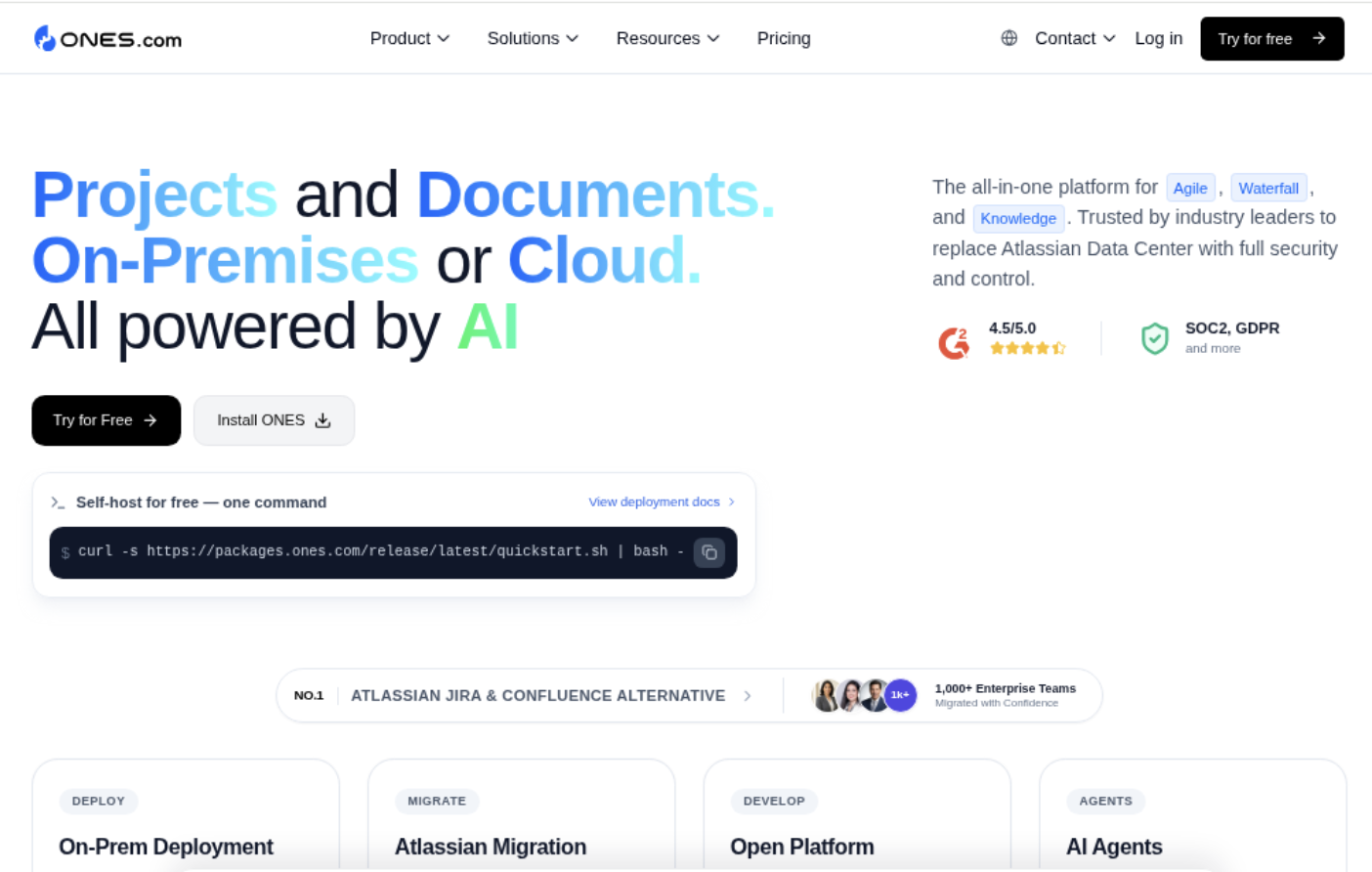
ONES.com combines project management and knowledge management in one platform powered by ONES Assistant. You can evaluate ONES Project as a Jira alternative when you want project workflows, reporting, and knowledge capabilities with fewer separate systems.
ONES Project and ONES Wiki are sold separately, so compare only the products your team actually needs.
Core Capabilities
- Separate project and knowledge products: Teams that need both delivery tracking and a knowledge base can choose ONES Project, ONES Wiki, or both, avoiding an automatic bundle of unwanted capabilities.
- Jira-compatible workflows: Teams concerned about migration disruption can preserve familiar issue-based processes while evaluating a different platform.
- Custom workflows and fields: Teams with unique approval or delivery stages can model those requirements without forcing every project into one rigid process.
- Built-in reporting: Managers who spend time assembling status views can use native reporting to review progress, workload, and delivery information in one environment.
- Sprint management: Agile teams can plan iterations, organize work, and review sprint progress without relying on a separate planning layer.
- Automation: Repetitive transitions and notifications can be handled through workflow automation, reducing manual coordination.
- Deployment flexibility: Organizations with strict hosting requirements can choose Cloud, On-Premise, Private Cloud, or Air-gapped deployment.
- Feature parity: Teams comparing hosting models can expect the self-hosted version to maintain full feature parity with the cloud version.
- Free plan availability: A team of up to 30 seats can evaluate the platform without immediately committing to a larger paid rollout.
Application Scenarios
Growing software company: A 25-person product group can begin with the free allowance, map its sprint process, and review reporting needs before expanding. The team can add custom fields for release risk and approval status.
Restricted-network organization: A regulated engineering team can assess an air-gapped deployment when cloud hosting does not fit its operational requirements. On-Premise and Private Cloud options provide additional control over deployment.
Knowledge-heavy delivery team: A company that manages technical work and internal guidance can evaluate ONES Project alongside ONES Wiki. This can reduce the gap between delivery tasks and team knowledge, while keeping the products separately purchasable.
Common Challenges When Estimating Annual Jira Cost
Challenge: confusing monthly and annual rates
Solution: Record the annual invoice total first. Then calculate the monthly equivalent and effective seat rate as separate metrics.
Challenge: overlooking tier thresholds
Solution: Test seat counts just below and above the next threshold. This shows whether planned hiring creates a material price change.
Challenge: counting every collaborator as a paid seat
Solution: Map access by role. Some people may need full editing rights, while others may only need reports, notifications, or occasional visibility.
Challenge: ignoring connected app costs
Solution: Add every recurring app subscription to the annual estimate. Review whether a native capability or consolidated platform can replace several paid extensions.
Challenge: budgeting from an outdated figure
Solution: Recheck the current calculator or quote before approval and again before renewal. Pricing, currency treatment, and commercial terms can change.
FAQs About Jira Premium Annual Pricing
Is Jira Premium billed per person annually?
Annual Jira Premium billing is generally tied to a seat tier or annual capacity rather than a perfectly individual monthly calculation. Divide the annual total by the paid capacity to calculate the effective annual cost per seat. Your final amount can vary with team size, region, currency, tax, contract terms, and additional Atlassian products.
How do I calculate the annual cost per seat?
Divide the total annual subscription by the number of paid seats. For example, a $24,000 annual quote covering 250 seats produces an effective annual rate of $96 per seat. This rate helps with internal budgeting, although it may change when your team moves into another tier.
Does adding one person increase the annual price?
It can. The result depends on whether the additional seat stays within the current capacity tier or moves your organization into a higher tier. Check the next threshold before approving new access, especially when your team is close to a boundary.
Are Marketplace apps included in Jira Premium?
Marketplace apps are generally separate subscriptions. Include them in your total work-management budget when they support essential processes such as testing, time tracking, reporting, or portfolio planning. A platform with more native capabilities may reduce the number of paid extensions you need.
Can I use an annual plan for a smaller team?
Eligibility and purchase arrangements can depend on the product, seat count, region, and current Atlassian commercial rules. Check the live pricing page or request a quote for your exact team size. Compare the annual commitment with monthly flexibility before choosing a billing cycle.
Conclusion
Jira Premium annual pricing in 2025 depends on seat tiers, contract terms, region, currency, taxes, and related products. The most reliable method is to obtain the current annual quote, divide it by paid capacity, and test future headcount scenarios.
But here's the truth: a subscription price is only one part of the decision. Add apps, administration, migration, reporting effort, and the value of the capabilities your team will actually use.
If the estimate feels difficult to control, compare the complete operating cost with a Jira alternative such as ONES Project. Start with your workflow requirements, test realistic team sizes, and choose the arrangement that gives you predictable value throughout the year.